

Nickfromwales
-
Posts
30335 -
Joined
-
Last visited
-
Days Won
297
Everything posted by Nickfromwales
-
I doubt 10mm latex over an overlay system would not give up eventually. Prob need the thicker alu faced system, I think I said elsewhere its the 400micron panel, and set 6mm cement / hardie boards on to those with tile adhesive. You'd then put feathering compound over those and then the LVT. I'd not use the overlay in there, and instead look to set the UFH pipes into the slab /screed. The issue with the change in floor types and UFH discipliners will be the heat up / cool down times (responsiveness), but not life or death. It would just require wall stats in the different zones / areas to allow each to function independently and run over / under dependant on the time and temps. You'll also need to design it to have a single flow temp, so tbh I'd dig out the 3x1m section and fill that in to match the rest of the area so they 'play nicely'.
-
These as is would not solve the problem, just a beefed up version of what you already have. The first says: Optional Integrated modular water storage tank system This refers to the 'break tanks' I was talking about a bunch of posts back. Basically they're saying scale the system by design, and add a break tank or tanks to match the demand; if the cold mains can't cope with peak demand. Second says: ESYTANK has a 480 Litre maximum working volume per tank So add 480kg plus the weight of the pump set to the static weight-load up there. Honestly, you just need to add a second (300?) litre accumulator and the problem will be solved, personally I'd go to 500L for the little extra money. The pump is going for a crazy long time too, but I guess this was commissioned to not create a negative deficit on the incoming cold mains supply. @texas, do you know if there are any cold taps in the house that come off the cold mains before the pump set and accumulator? Or did they do the job properly and divert the incoming cold mains, in 22mm pipework, straight to the pump set? All hot and cold feeds to the house, bar the kitchen sink for human consumption, should be after the pump and acc'r. Getting to be a bit of a storm in a tea cup here now, tbh.....
-
 @Alan Ambrose Apologies, this thread has been utterly derailed We are bad people.
 -
With a 6000sq/ft (iirc) 2.5 storey metal workshop / barn, that swimming pool would be converted to an iceberg PDQ if you went water source HP . “No bueno”. As for the gen-set providing waste heat for space heating, you’ll just need waaaaay too much, plus it would be relatively low grade heat by the time you go via HEx’s. Would be better if you had that diverted, to flow straight into the UFH loop. I think you’re just sliding the problem around, between these potential solutions, and you’ll just end up chewing through some oil. If you recall, I suggested installing 2-3x the requisite capacity for oil storage so you can bulk purchase when prices drop low during summer. If you run the gen-set then you’d just absorb the waste heat via a low loss header or buffer tank with extra tappings. From that buffer you also feed some hydronic fan heaters (second hand commercial units x2 in opposite corners of the barn) to provide heat on tap. Use the heat as you occupy the building vs heat a slab maybe more sensible? Add UFH if you want to use it when it’s Baltic outside, happy that you choose comfort / warmth vs cost effectiveness. Also, zone the workshop floor to only heat 1/4, or 1/2, or 3/4 as per the area your actually working in to minimise heat energy consumption. At that point, honestly, it would prob be cheaper to use a big ASHP to lift the temp of the concrete slab by 5 or 7°C. May be a candidate for a DIY overlay system, but (again iirc) I suggested getting the slab concrete routered to take the pipes direct. No chance THAT slab is ever coming up lol. Once you solved that, tap off the system to feed the cottage, or with the cheaper oil, just leave the oil combi service the cottage. How much 3ph do you need? You can get 1ph to 3ph adaptors.
-
Please help identify these UFH bits...
Nickfromwales replied to sharpener's topic in Underfloor Heating
Do you know what size UFH pipes? 16mm or other? Not seen those before but the flow controls being on hex keys usually signifies a bit of quality, but with that said it is a dinosaur! I’d like to simply say just replace it, vs set fire to good time and money, but you’d need to get the pipe sized to match a replacement kit around. I’d not take on refurbishing that if I was asked to do it on price, as I think 🤔 be issue will start another, and the TMV and seals are all prob on borrowed time. The minute you start to disassemble this I think you’ll begin to regret it. This looks like it’s on borrowed time tbh. Oh, and no, sorry, not a clue on manufacturer. -
Porcelain works well with UFH as it balances the heat delivery a little better than wood etc, but please check with Wunda as the overlay boards sometimes need an additional layer of backer boards set on top into tile adhesive, prior to installing the tiles. That would add at least another 10mm to the finished height. I think they do a 400micron panel which you can tile directly to, but you'd need to ask them today about what they offer as it was a while since I looked at their system and they may say different. Please explain what the specification for this concrete floor is proposed to be. How much concrete and how much insulation. British Building regs will mandate the insulation so you will definitely be having some. The concrete will not insulate, it will suck the heat out of your UFH and send it to the earth below, so you cannot fit UFH over an uninsulated concrete slab. 👎
-
Hi. Firstly, completely remove any idea of using electricity to heat this home....especially at those temperatures!!! It would bankrupt you to burn electricity to provide space heating. For room temps at or above 22oC you need to stay on gas. Solar panels will have near zero affect on space heating; in winter a 4kWp solar PV system will have an average output of 0.4kWp, just enough to run a few background items. If you have a hot water cylinder and solar PV, ensure you ask the PV company to include a solar PV diversion controller to provide "free" hot water all summer vs exporting your excess generation to 'the grid'. If you want different temps in different rooms you will need 1x thermostat for each room / space, so 1 per bedroom minimum, possibly 1 more for the other area(s). When you zone heating like this it is a problem for the boiler, because when UFH is near to the desired temperature the demand on the boiler is very low, so to deal with that you may need a better boiler which can modulate down to match this. It is also very likely that you would benefit from a small buffer tank to assist the boiler to live a long life, and to stay in the best operating temperature range to promote full condensing effects / efficiencies. Some of the advice given by others above suits a well-insulated, energy efficient house, and I suspect yours does not / will not fall into that category. Please correct me if I am wrong. If I am right, then you CAN install UFH, but you will hear the downsides from us lot, but if you want it it can be done, be comfortable, and do what you ask, it'll just be less energy efficient vs radiators and quite disruptive to install properly. "Can it be done?" = yes. "Should I do it?" = up to you, your budget, and what your energy bills will look like going forwards. Ideal boilers I used to fit for landlords / agents in rental properties btw. If this is a forever home I would fit something far superior for not a huge amount of additional money.
-
If it's a 3 storey home then consider putting the money for the top floor into A2A (AC) for space heating, but more importantly cooling, as even the attic in my sack-o-crap house would be utterly unbearable in the peak of summer without 3kW of cooling power via the portable air con unit. You will need access under the spreader plates to staple the plates up to the underside of the floorboards, as without surface to surface full contact of the heated plates to the sub-floor they'll just be a warm ornament. I've done plenty of these types of installs with great results, and I've been called out to trouble-shoot others where the flow temp is 65-70oC and the rooms are 17oC as the UFH is glowing in the dark but not contacting the sub floor. If getting underneath is a no-go then you will need to install a cheap OSB tray and fill it with rockwool to belly the plates upwards, then the floorboards will compress this when being dropped on and screwed down. Ignore this at your peril!!
-
Do I really need a second layer over routed OSB
Nickfromwales replied to ricardo100671's topic in Underfloor Heating
I’ve done a few where it’s just spreader plates between Posi joists, then 22mm P5, then 6mm plywood, then adhesive and tiles. Worked very well but the caveat is the higher flow temp. Would be ‘ok’ with carpet too I guess, so I disagree that UFH without screed is money down the toilet, just needs to be done properly. I always make sure the plates are in full contact with the deck boards which makes a huge difference, and on the aforementioned one I used an air stapler to tack the plates to the underside of the P5. -
Check valve usually before the control group and PRedV, on the incoming cold mains, but it’s down to how far the whole of house plumbing was picked apart tbh. Cold mains should have been intercepted immediately after the stopcock at ground floor, then that should have been taken uninterrupted up to the pump / etc, then the ‘new’ house cold supply after pump / etc then gets fed back into the house by tee’ing it in upstairs; this how it needs to be done, so the whole house is balanced. People rarely install this type of kit 100% kosher unfortunately. Happy when I’m proven wrong though, of course!
-
Boreholes need to be quite far apart too, so sounds a little too good to be true tbh. @Dreadnaught, can you post the pdf if possible?
-
Would need have the accumulator isolated at the local lever valve too to do this Be good to see some dynamic numbers by doing this, but it will all point back to adding capacity. Not sure if the ST manufacturers installation guidelines call for that PRedV but doubt it can be tweaked up any further. Prob there to mitigate a bit of the hammer from pump stop / start too.
-
Help needed setting timber frame window hole sizes.
Nickfromwales replied to G and J's topic in Windows & Glazing
Is that based on the assumption that airtight tape from frame to fabric will detail the airtightness? I’d personally still go with the 330 foam as it is airtight, purely as a second fail safe layer in case the tape is compromised. If it’s <£5 a can cheaper then I’d just roll with the 330 (tbh if it was more than that I’d still use 330, if it’s an airtight house). -
Decent spray foam guys will propose a very thin layer of closed cell, either before or after the bulk open cell stuff is loaded into the voids, to act as the barrier. Did this in a basement where we needed to insulate under the residence floors (swimming pool hall was its own heated and airtight envelope) and it worked a charm. As with every single thing in life, if it’s done great on paper and executed less than well, it’ll fail. Jobs like this need a clued-up client who can be on site and know what they’re looking at, or a good PM / site agent to do so in their behalf.
-
PM’d you.
-
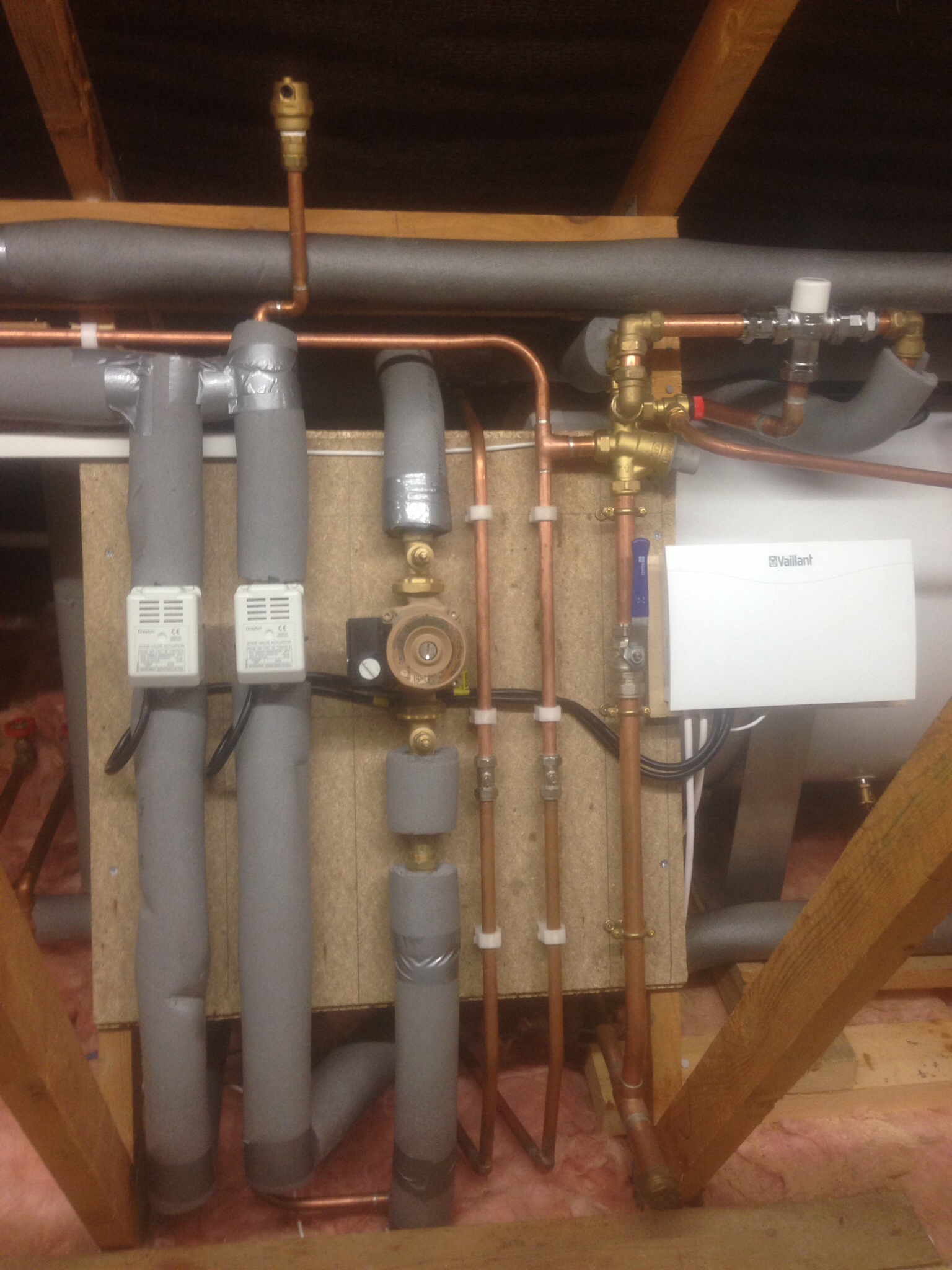
5x 50 gal CWS in the attic, all series linked with 35mm copper x2, all WC’s on gravity, 300L gravity fed open vented HWC and 8x gravity mixer showers with 6x triton T80si pumped electrics (over 3 phases). Just about every other plumber walked away from the job saying it cannot be done. lol. Massive floor standing gas boiler already there (in good nick) so reutilised that for heating and W plan DHW; (large nursing home converted to student HMO). Had to put heat loss on the DHW loop though, big old boiler that threw a lot of flow / heat out, and that was after using a solar cylinder so I could put the 2 coils in series for rapid recovery. Could have tried doing the coils in parallel but I thought that may not ‘be cricket’ in such a tall cylinder. Cold mains went to the F&E (I fitted 2 x float valves set at 4 lpm each, one at the lead CWS and one at the lag) plus the outside taps and kitchen & utility sinks / appliances only. New owners couldn’t / wouldn’t (?) get gas and water upgraded so I went with lots of stored capacity. We put a LOT of supporting timbers in the attic, but thankfully the internal walls were all brick rising from founds through 3 storeys to the attic so I could traverse those. Was a while back, and still makes me cringe with how much work we did there ! As above, design for the task, add 30% redundancy for times of duress, sleep well. 🛌 💤.
-
The quick and simple solution here is to add a second, similarly sized accumulator to boost the stored capacity. After this your issues will be solved. Put the second vessel the opposite end of the attic to put the additional weight away from where the current one is. Ideally these should have had some timbers under them run perpendicular to the attic joists, so maybe do that for the second vessel to be sure to spread the weight. This all needs proper, methodical thought and planning, or, do what I have done previously, use a metal cradle mounted to an external masonry wall to sit the second vessel on. Link the 2 vessels together with MINIMUM 35mm pipe (which every plumber on the planet will tell you is completely overkill / unnecessary) and this solution will allow you to close the door on this. You can’t really improve on this I’m afraid, as it exists, without either a) installing a couple of ‘coffin’ sized break tanks for the pump to suck on, or b) (the best solution and to stay fully potable) fit the second accumulator. I’ve done bucketloads of these types of installs, mostly in HMO properties and massive student accommodation conversions; one example had 14 ensuite shower rooms, 2 full bathrooms with baths, and 2 kitchens + utility running off 1 x 15mm cold mains, and all still in and working after over a decade of service. You can’t squeeze any more juice out of this lemon You need to add capacity. Simples.
-
@texas If you click on someone’s text and highlight it you’ll see a box appear saying “quote selection” To ‘mention’ another user just type the @ symbol and then the first couple of letters of their username and you’ll see a drop box appear below that you can select their name from. Like I’ve done with you at the top of this post. May save you some typing lol 😉👍
-
Hi. If you have a pump connected directly to the cold mains, and you are consuming water faster than the mains flow rate, then you’ll be “sucking” on the mains supply aka applying a negative pressure. A lot of plumbers will speak to a sales rep or some guy behind the counter in the merchant and sell the plumber some kit, the plumber will fit it, and no one ever checks if it’s all ok / compliant as they both just want paying. These systems should be designed after a survey, I say this all the time particularly where an accumulator is the intended solution; this way, when I install expensive equipment and disrupt someone’s lives to do it all, it works afterwards (as intended / promised) and has a great service life. If you have sub 11 lpm flow at the main the 1st advice should be to petition your water authority to see if you can get the local supply uplifted slightly; sometimes there’s just been another 30-40 new homes built and they’ve done nothing to maintain your existing supply, other instances could be that the tapping into the main in the street is furred up (I always ask the neighbours if I can test at their outside taps too to ensure it’s not an isolated issue). If you have a system that fills an A>B break tank then you can’t ‘suck’ on the cold mains supply as the system will be hydraulically separated by an air gap in the break tank. These systems should pump would just be sucking that break tank bone dry faster than the incoming mains can refill it. Some very poorly installed systems will see next doors supply drop to zero whilst the pump is pulling. The water authority do NOT take well to that because of reverse contamination issues.
-
Deepen backboxes in block wall?
Nickfromwales replied to Andeh's topic in General Self Build & DIY Discussion
Collapse the boxes in on themselves, leaving the panel with the cables until last. Remove, chase, fit new box. Will require patience and some understanding that every action has an opposite and equal reaction, eg if you fold the centre of the panel in the edges will contort outwards slightly, firstly, and THEN fold in. If you damage the edges of the plasterboard during these alterations then be sure to inject some 330 foam behind the boards and around the box, as this will give you something solid to fill / sand / paint vs ‘flappy edges’. Wet the block work and plasterboard edges with 50/50 PVA/water mix immediately prior to foaming up. -
Have you tried Gordon, the chap that does a lot of the MBC frames? I know MBC will be keeping him busy, but worth a call as you can do this at any time and shouldn’t really hold you up being in the queue.
-
Help needed setting timber frame window hole sizes.
Nickfromwales replied to G and J's topic in Windows & Glazing
These may come in handy, for injecting the 330 foam into ‘nooks & crannies’ https://amzn.eu/d/736GNiG -
Foam for airtightness - about to do it...
Nickfromwales replied to Garald's topic in Heat Insulation
The black flexi stuff is the one you need, the other is for much more adverse situations. A bit overkill and a total pain in the arse to install. -
+1
-
If I saw air temp that low coming into the house I’d want it heated somehow. I doubt adding any more insulation will help here as the fan is sucking cold air in and that’s being detected by the sensor inside the unit. Consider an inline heater to bolster through the worst of the winter, as the heat recovery doesn’t seem very good either that unit? Maybe for a much better long-term solution you could consider a far better unit. LINK

