

Nickfromwales
-
Posts
31381 -
Joined
-
Last visited
-
Days Won
346
Everything posted by Nickfromwales
-

Comparing Thermals of Laminate Flooring Underlays
Nickfromwales replied to MortarThePoint's topic in Wood & Laminate Flooring
I have had 'orangutans' up-end a full wheelbarrow load of screed on a single pipe, and still just a bit of a dent but nothing more. With Pert-al you have to have a vendetta against the pipe to damage it tbh. Unless they're all concrete laying trannies who have turned up in stilettoes you're pretty safe, as most site boots are flat bottomed and the 100+kg is not delivered in a point load. QQ: are we still allowed to say trannies, or is there a new standard? I'm really struggling to keep up with it all tbh. Bending raduis's (just googled it, hold on.....................) radii, are managed by not reversing by 180 degrees, but instead laying serpentine and only turning 90 degrees until two looser radii bends are required in the middle, to turn at 180's. I've been sinking pipes into screeds etc for north of 25 years, and not ONCE has a pert-al pipe let me down, EVER. I imagine the flexible non al stuff may be more forgiving, but prob easier to strong-arm past it's 'point of no return', so that would then be a possible ticking time bomb that the bendee would be blissfully unaware of.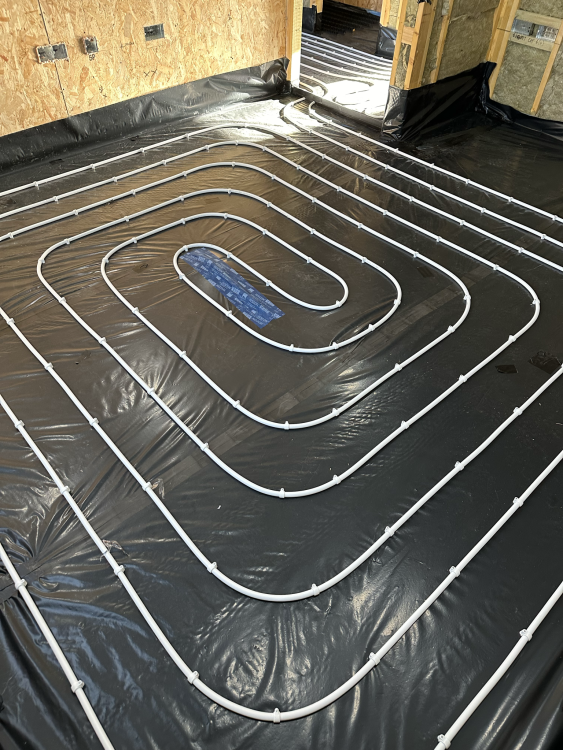
-
Comparing Thermals of Laminate Flooring Underlays
Nickfromwales replied to MortarThePoint's topic in Wood & Laminate Flooring
Thanks for the feedback, good to know. So you just fettled with the flow rates and that was suffice? One stat? -
https://www.ukdrills.com/tct-core-drills-drill-bit?gad_source=1&gad_campaignid=981782100&gbraid=0AAAAAD8ijkek1n6oBt64G-lPT48MKUvMo&gclid=Cj0KCQjwgvnCBhCqARIsADBLZoI0K4MCYSL3UcSclQG1Z-G1Cp8HkHchhEbsZwJ3O_fkmR3HJ0bUwBUaAsOTEALw_wcB One of those Then a 22mm diamond drill arbour to a six-sided chuck adaptor SDS or 'plain' in these kits, but ebay/amazon will sell individual bits I'm sure. https://www.ukdrills.com/diamond-accessory-bits
-
SSSSSHHHHHHHHHHHHHHH...................... He'll ask us to crowd-fund it ffs.
-
Comparing Thermals of Laminate Flooring Underlays
Nickfromwales replied to MortarThePoint's topic in Wood & Laminate Flooring
Do you have the same flooring over the same zones of UFH? -
How many units/flats are you building? ……..
-
It'll be quicker and far less painful to just buy a replacement unit and accept defeat. They're not more than a couple of £10's and they can guilt trip you into fitting it for free.
-
They've simply sent you the wrong document. Ask for the correct one
-
Wet plaster or dot and dab for my self build?
Nickfromwales replied to Berkshire_selfbuild's topic in Plastering & Rendering
That's exactly what I just wrote? -
@all If the Super wall 32 gets immersed, will it dry back out again quickly, and without degradation? There are other threads on here stating folk tested this in buckets of water/other and the product seemed to just shake it off. If the op has this in the walls already, then getting this swapped out may be a complete nightmare.
-
Wet plaster or dot and dab for my self build?
Nickfromwales replied to Berkshire_selfbuild's topic in Plastering & Rendering
Take a completely flat sheet of plasterboard, and then lay the mud on the joint, then apply the tape, then add more mud, and then sand back. That is the process/build-up. Outcome, a high point on each junction; tapered vertical joints can be smoothed well, but tapered board ends are square and the taping and filling process there makes for even higher/prouder joints. They then have to be blended into the vertical......... The only way to reduce that is to feather the filler across a much bigger surface area and blend it out, I know because I have done so myself previously; I therefore have 'hands on' experience vs just an opinion! Upshot was, the huge amount of time, effort, dust, mess (cost) vs a wet skim makes this zero sense whatsoever. Kudos to good guys who have done a good job, but you can't argue that there are no bumps created by the taping and filling, because there are, and you can see these without looking too hard, from my direct experience. -
Wet plaster or dot and dab for my self build?
Nickfromwales replied to Berkshire_selfbuild's topic in Plastering & Rendering
You’d have regretted tape and joint for the rest of your days. Just utter crap and when there’s light on the walls you see every single joint. Plaster every day of the week, unless it’s a school room or an office. -
Wet plaster or dot and dab for my self build?
Nickfromwales replied to Berkshire_selfbuild's topic in Plastering & Rendering
Plaster is a finisher not a filler, so the prep work wasn’t done properly here. The boards make up the reveals, or you batten and bond out, and the beads get set straight/plumb and that’s a done deal. I’m a decent plasterer but too slow (OCD) to make money from it, but I’ll put a stop bead against the window and a regular bead at the reveal, and run the trowel across the two for the first couple of ‘rubs’ and then polish up from there. Laying on plaster thick is a complete pain in the ass, as it’s like moving jelly around a plate. -
The only major consideration should be keeping the vent away from an elevation that has openable windows, or otherwise take the SVP up to gutter height, attached to the building. Not always. If you have a reasonably strong case to not have an SVP to atmosphere, you can ask the BCO for the 1-in-5 or 1-in-10 exclusion; this is where you’re not end of line and have at least 5-10 neighbours who all have visible SVP’s. The requirement of an SVP is to vent the network sewerage system, not to vent your house btw.
-
Done this for 2 other jobs, no issues, no smells, and only AAV (Durgo's) inside the house with zero roof penetrations.
-
How many double check valves are too many?
Nickfromwales replied to Super_Paulie's topic in General Plumbing
Yes, so you can isolate and then service the NRV’s with ease. Fill your boots. Not had many washing machine taps fail, as they’re operated once in a blue moon. Turn on and walk away tbh. Up to you. -
How many double check valves are too many?
Nickfromwales replied to Super_Paulie's topic in General Plumbing
Firstly, you would be using single check valves and defo not double check. The double check is for the water authority approval for connection at the stopcock. The point of these going in at the kitchen sink taps and appliances etc, to prevent reverse contamination, is kosher, but most are fitted with non return (single check) valves by manufacture, and washing machine taps can be bought with an integral NRV LINK which kills two birds with one stone (and satisfies the regs requirement there). For the kitchen sink tap, just use these LINK in the 15mm x 1/2" male union that will be used to connect the 1/2" flexi tails that come supplied. Check first if the tap you've chosen doesn't already come with these in the kit supplied. Tap may also have 3/8" connections so that needs to be confirmed. With your drawing, you'd have an isolator and then a tap for the washing machine, so the isolator on that run is way OTT afaic. Isolators for the hot / cold / appliance make sense, but usually the fridges have a skinny hose that ends in the sink unit with a washing machine sized adaptor to take their flexi feed hose to the water feed, and you'd just install another washing machine tap under the sink for that, therefore no need for the isolator. I've not ever fitted drain off's under sinks as when the water is shut off at the SC you just open the sink taps to drain the house down, and then chuck an old towel down and get a pot or tray in there to catch the remaining couple of pints. You can box clever and mount the washing machine tap for the fridge down low, and use that as your drain off . Pointless having drain off's on the washing (appliance) taps, as they are the drain off points when you remove the hose. IIRC the fridge filters are changed without turning off the water supply anyways. Doesn't need to be elegant, just neat, functional, and not leak lol. -
Comparing Thermals of Laminate Flooring Underlays
Nickfromwales replied to MortarThePoint's topic in Wood & Laminate Flooring
Yup, defo. Putting that thicker 'undulation-absorbing' underlay down is just going to cause you to have to run the UFH flow temp a bit higher, and that would then be quite notable on areas where there are tiles etc, not so problematic if you have one floor covering product throughout. -
Comparing Thermals of Laminate Flooring Underlays
Nickfromwales replied to MortarThePoint's topic in Wood & Laminate Flooring
No. No. And thrice, No. Just NO. You have UFH!! -
Comparing Thermals of Laminate Flooring Underlays
Nickfromwales replied to MortarThePoint's topic in Wood & Laminate Flooring
Expect a punch in the face....followed by 2 - 3 more. He may also go for a swifty to the nut-sack. I'd just shoot you for suggesting it. But yes, go ask him, I am keen to hear his response -
Comparing Thermals of Laminate Flooring Underlays
Nickfromwales replied to MortarThePoint's topic in Wood & Laminate Flooring
Yup, but how is your back? To be honest, grinding can often result in making the floor worse than when you started if you're not proficient with said grinder. -
Comparing Thermals of Laminate Flooring Underlays
Nickfromwales replied to MortarThePoint's topic in Wood & Laminate Flooring
Use a primer and a feathering compound. Shouldn't be a floating floor at all, so look for one that can be bonded. -
You'll need closer to 300mm of EPS to get the same performance of 200mm PIR, so that's the difference (in a nutshell). You'll need a thin membrane on top of the PIR if you have foil-faced stuff, to stop the concrete reacting with the alu face. That bit makes no sense to me sorry? If you need a soil pipe in there then you need the thickness to accommodate it?
-
Stand down brown alert
-
McAlpine is industry standard stuff. Floplast also good.



