
ragg987
-
Posts
872 -
Joined
-
Last visited
-
Days Won
1
Everything posted by ragg987
-
S-Box (and other pop up socket options)
ragg987 replied to Barney12's topic in Electrics - Kitchen & Bathroom
I agree with the safety points of side sockets - in our case these are meant to be "temporary" supplies whilst cooking - e.g. for plugging in the hand mixer whilst using it, then unplug and put away. The more permanent gadgets (radio, chargers etc) are kept away from the island. I also use a couple of the cupboard drawers as homes for some of the appliances - blender, toaster, juicer and the sort. Have wired 13A sockets inside the cupboard and we just pull the drawer out, use the appliance, then shut the drawer. No need to plug and unplug, no trailing leads and the mess is hidden away. -
S-Box (and other pop up socket options)
ragg987 replied to Barney12's topic in Electrics - Kitchen & Bathroom
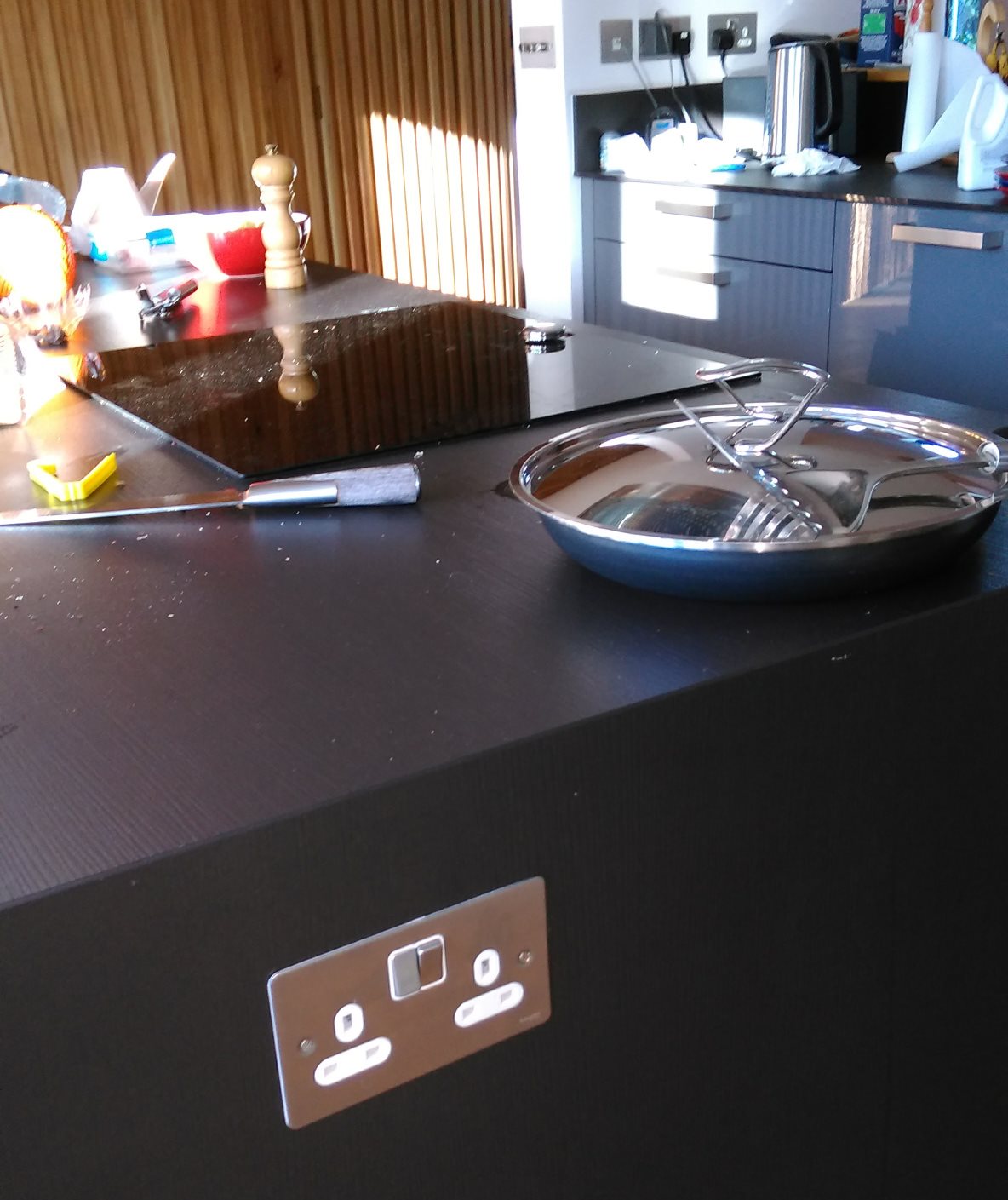
I wanted to avoid pop-ups - felt it was too complicated, requires space underneath and is another moving part that might go wrong. Ended up with this - excuse the mess, this is post a late Saturday lunch. Looks very subtle IMO and this is in an open plan kitchen / lounge / diner.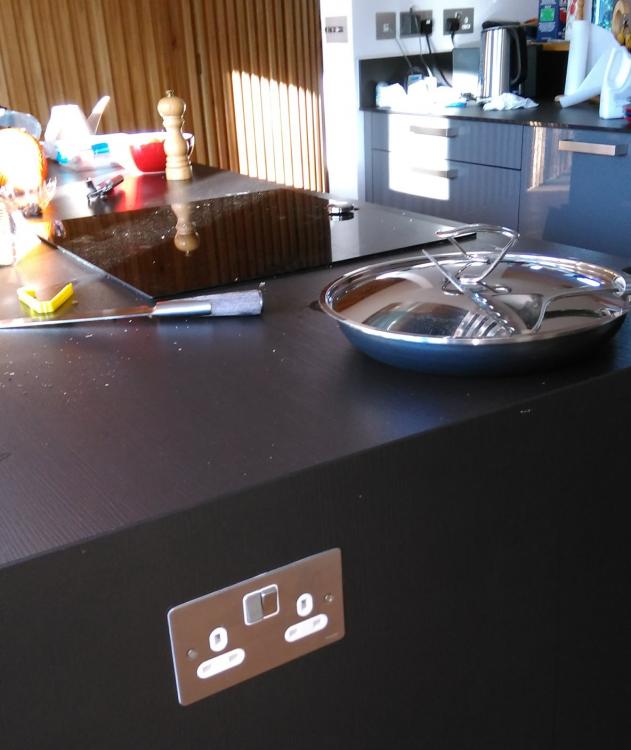
-
I added it to my warranty with Self Build zone, it was a bit over £200 on top of warranty cost. The inspector's visits covered both aspects. Tip from my Architect. A stand-alone quote for BC (private, not council) was about £1,000 (from memory, which is not the greatest at this point).
-
MVHR extract in plant room?
ragg987 replied to jamiehamy's topic in Mechanical Ventilation with Heat Recovery (MVHR)
Our plant room is also an old-fashioned utility room - washing machine and ceiling drying line. So we have an extract. -
Water. I noticed they used large plastic containers filled with water to anchor the temporary stairs and walkway across a railway line at our local railway station. Each plastic containers seemd to be about 1m each side, so probably 1 ton each. You prpbably need a solid platform to support these so may be more complex than a digger or lorry option.
-
I'm not sure we can learn a lot from graph - it shows that internal temperature is only a few degrees higher than external, thus leading to much lower heat losses (which the graph show nicely!). Also, impact of (e.g.) solar gain or internal works (people and tools) is going to be magnified compared to if the inside was a nice toasty 20 deg.
-
We have a large thick persian rug over 20mm engineered oak glued to the (liquid) screed - approx 50% floor area in that room is covered - no issues with heating the room. Slab is generally around 25-27 deg C (estimated).
-
Our old bungalow 92m2 footprint got replaced with a 178m2 footprint house on 0.25 acre plot. LPA did not raise any points about this at all - so I am not convinced that size, alone, is a factor. The application covered some core points that might cause issues or fall foul of published policies - e.g. principle of dwelling, appropriate / fitting to the surrounding, oversight to neighbours, over-bearing, blocking of neighbours amenity, turning / parking space etc. You MUST address these. We then made sure we brought our immediate neighbours along to avoid any objections there. On bat survey, I nearly embarked on one costing about £1k, but happened to speak to our LA environmental officer who agreed to review the site for a nominal fee and gave us the green light. Phew!
-
Thanks - this answers my question. So not an insignificant amount - approx 15% of the annual space heating demand, something I had not factored into my calculations.
-
Done some googling and it seems that the energy to evaporate water is the latent heat - i.e. 2.26MJ / kg. So approx 0.63kWh per kg of water, perhaps 2 or 3kWh per load of washing. Quite small compared to the space heating load on a cold day.
-
I think this is the best and cheapest option so we will continue to use it. Especially given ashp means that this is not direct electrical hearing like a dryer would be. Question really arises as I notice we require more heat than the as designed PHPP shows, so trying to figure out what might be going on. This is one variable. TerryE, are you able to calculate the heat loss in this scenario?
-
Hi, I have installed a ceiling mounted pole dryer in our plant room to dry clothes in the winter months. I am trying to understand how this affects the energy required for space heating - any thoughts? Plant room contains all our M&E stuff, inc ASHP (internal split unit), 300l DHW, 50l buffer, MVHR. So it is generally quite toasty in here. My thinking is that the evaporation of water from clothes to air removes energy from the house, then this moist air goes to the MVHR which must be able to recover some of this energy through condensation. The parallels I can think of are where a non-condensing drier annual energy required is approx 650kWh. In simple terms, this could be the equivalent of the energy required to remove the moisture from the clothes and into the air. (Ignore drum and motor losses for now). A condensing drier uses 550kWh - perhaps the equivalent of the MVHR scenario - so the condensing in the MVHR could recover approx 100kWh? Any thoughts on how this really works? What do the annual energy consumed published by manufacturers really mean - number of loads per year, for instance. Rajive
-
We used a very small 45 deg chamfer on all our skirting, architraves and windows boards. I got samples from a few companies and quality was variable, so ended up with pre-primed HDF (smoother finish than MDF). Good discount and free delivery for the single large order I placed over the phone. http://mdfskirtingworld.co.uk/epages/www_mdfskirtingworld_co_uk.sf/en_GB/?ObjectPath=/Shops/www_mdfskirtingworld_co_uk/Products/edg409/SubProducts/edg409-0001 Skirting 120mm tall by 18mm thick Architraves 70mm x 18mm Window boards 25mm thick Would not hesitate to do the same again.
-
Spoke to Newton and they do not think this is the right application. I suspect this may be a warranty / liability thing as their solution seems to designed for use at the wall end. I might try the potting options - Magic or Wiska. Seems widely available and is designed to work around plastics and electric cabling. Need to find a way to hold the liquid in the pipe before it sets - maybe push a bit of foam in there.
-
Outside the duct is waterproof concrete and that is covered by a warranty, so I am pretty confident about that. Kryton system that contains some kind of crystalline material which will expand if water gets in and close any micro-cracks. http://www.kryton.com/products/application/concrete-waterproofing-joints/
-
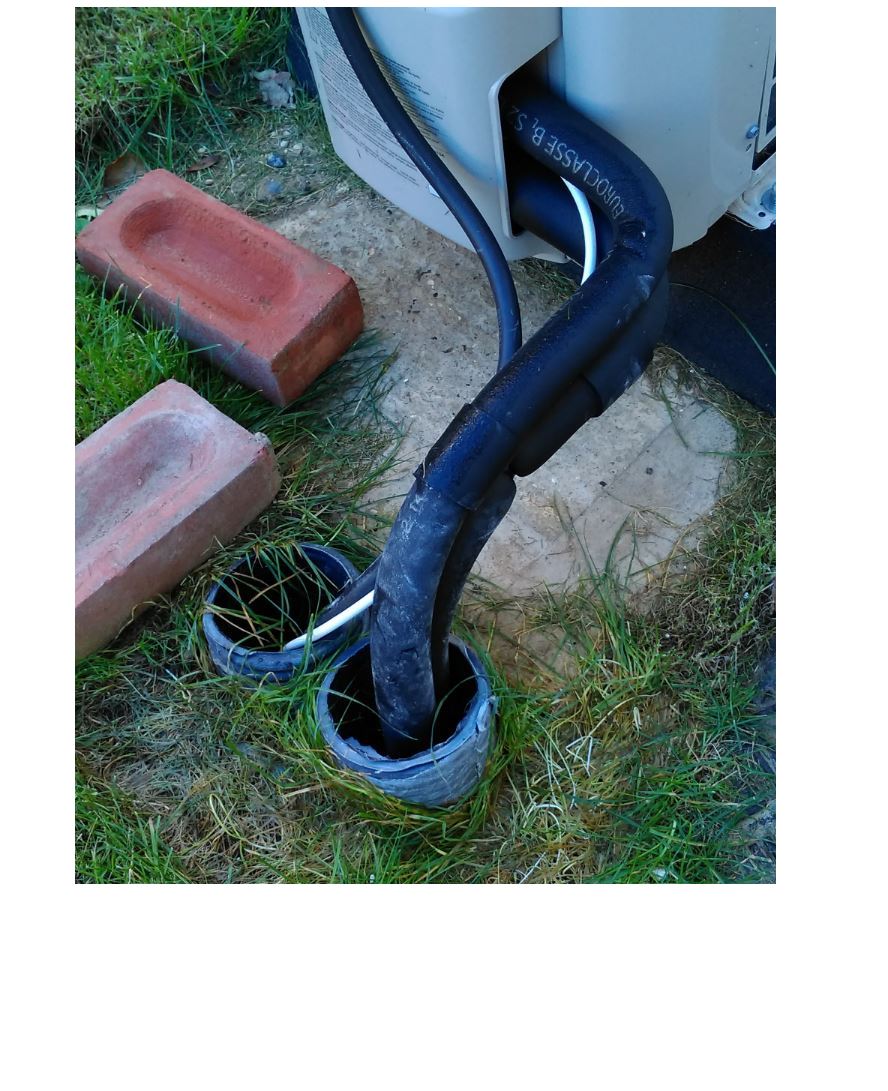
Looks good. The video and guide shows it fitted on internal wall side, any reason I could not apply it to the outside (as per picture)? Trying to avoid opening the basement side as it is already boarded, plastered and painted. I guess the disadvantage of this approach is that any leak in the duct would not get stopped.
-
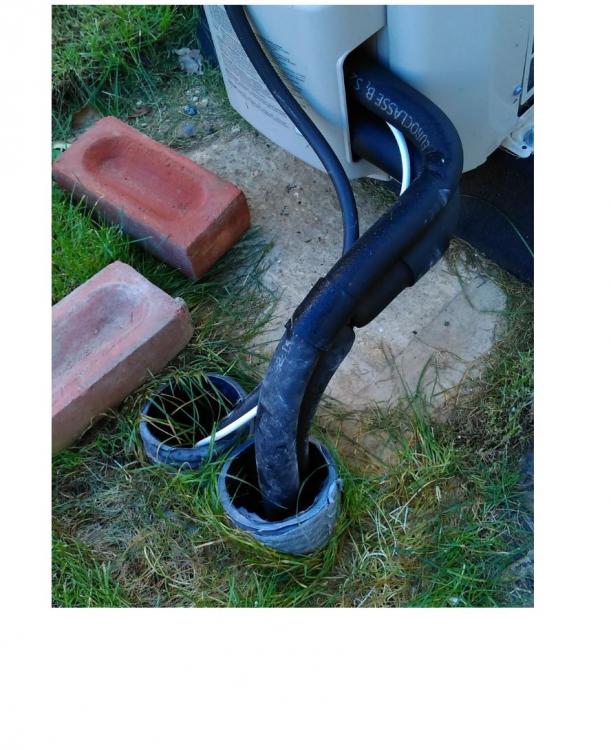
Hi, I have a small detail I would appreciate some input into. We have an ASHP sitting on an external slab and 2 ducts going underground into our basement where they terminate. Electrics into one duct and refrigerant into the other. The services then go up from the basement into the plant room above (but not in the duct). A slight oversight, at the time, now how would I seal these holes so as to prevent ingress of water or other stuff into basement? We have sprayed expanding foam on the basement side but the external (ASHP side)? Am concerned that foam may not be able to last many years outside?
-
We have now had or Haeker kitchen delivered and installed (awaiting worktops). Attention to detail in cabinetry is very good - e.g. rear panels are screwed in with tight spacing between screws and glued around all edges and all joints have been well glued - no movement in the assembled cabinet. Fitter also expressed how solid they are. Here's hoping that this detailing results in a long-lasting kitchen - I have no desire to replace it in my lifetime.
-
Plan printing recommendation
ragg987 replied to Vijay's topic in General Self Build & DIY Discussion
I had used plotgiant. Usually post on same day for next day receipt if you upload the drawing in the morning. Paper is a bit flimsy on large drawings but prices and service are great. Note minimum order quantity - only worth it if you have a lot of drawings. -
Can't tell if you are asking for plumbing or fish-keeping input. From a plumbing perspective of course you can, but for fish-keeping will depend on the purpose of the tanks e.g. one might need to be warmer than the other or used as a "quarantine" tank. For fresh water fish pH seems an unlikely cause of loss. You need to ensure your filter media are properly generated before introducing any fish (this can take a few weeks) and also check for nitrates and nitrites on a regular basis, plus do your 20% water changes every 1-2 weeks. pH can be very difficult to control or change if you are using tap water. It may be possible to buy pH controlled water, but once you start down that route you need to keep doing your water changes with the same stuff.
-
Nearing build completion - key steps?
ragg987 replied to ragg987's topic in General Self Build & DIY Discussion
That is very helpful, thanks. What event signals "completion" of the build (VAT refund)? -
Nearing build completion - key steps?
ragg987 replied to ragg987's topic in General Self Build & DIY Discussion
Thanks - sounds like I ought to speak to my BC officer. How did you handle the build warranty? Does that start from when you move in or from final sign-off? -
We are getting nearer to build completion and the aim is to move in at the end of October. This question is in 2 parts 1. What are the the key steps to getting the build "legal" - e.g. BC sign-off (and what documets they will need to do so), warranty sign-off, local authority notifications, etc. And of course point for VAT refund. 2. We may be moving prior to the whole house being completed - what are the implications, e.g. would BC sign-off? Our house has a basement and an annexe in addition to the main part of the house (all in a single building), annexe has bathroom and kitchen. We only need the main house initially and there is a strong possibility that annexe and basement will not be fully kitted out when we move in. Would appreciate any inputs from someone who had to move in under such circumstances - I am guessing there are critical aspects that must be in place and they will refuse to sign-off without these (e.g. fire alarm in annexe kitchen), but other areas are not?
-
Having just built stud walls with fermacell dry lining and insulation in the cavity, I find that you cannot get away from the hollow sound, though it is much better than plasterboard over stud. We lived in a brick house previously - it is a completely different sound. Having said that, I am happy we have a good compromise. It is only noticeable if you start tapping the partitions. Noise transfer between rooms is fine - just take care to treat gaps.
-
We ended up using a local UK kitchen supplier who provides German kitchens from these guys. Much better than the DIY sheds. https://www.haecker-kuechen.de/en/ There are a number of UK chains and independants that stock them. e.g. Grant and Stone have branded them Kuche. Not yet installed so jury is out, but look good, solid and good pricing - come fully assembled and glued so prices a bit higher than IKEA if you are paying your builder to assemble them.