


MJNewton
-
Posts
1354 -
Joined
-
Last visited
-
Days Won
1
Everything posted by MJNewton
-

Little things put a massive smile on my face sometimes
MJNewton replied to ToughButterCup's topic in Lighting
There are smaller lever Wagos available too - the 221 series: Same rating as the 222's, and I prefer the transparent case for reassurance of correct insertion. Incidentally, re the push connectors they are releasable/reusable - you just twist the wire whilst pulling.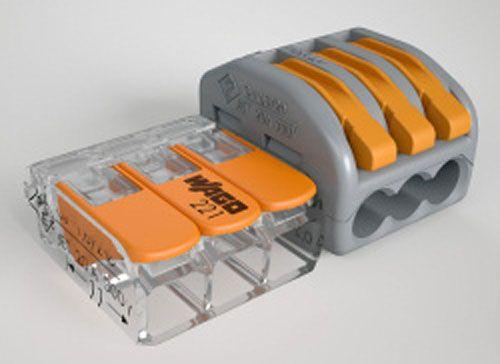
-
Just how bad is CCA network cable?
MJNewton replied to MJNewton's topic in Networks, AV, Security & Automation
Oh I do panic panic Peter... Don't know why. I used to be so easy going - and indeed still consider myself to be - but when it comes to detail like this (particularly when it comes to the house for some reason) I'll keep myself awake at night over this sort of thing! -
In my new family room extension I've included four runs of Cat 5e network cable for TV (and related items) and another for an outdoor IP camera. With the runs coming back to the central wiring cupboard (where the remainder of the house is already connected to) there's about 40m added in total... I bought my cable from a local electrical distributor TLC Direct as I buy a lot of my electrical kit, wiring etc, from there and have always been very pleased. They sell Cat 5e cable either by the metre or on 50m/100m coils as seen here. There's quite a saving to be had buying it by the coil and so I went for a 50m coil for this job... Little did I realise at the time but the by-the-metre cable isn't the same as the by-the-coil; the former is solid copper whereas the latter is copper over 0.5mm aluminium. Grrr. From what I can gather (from a cursory Internet search) CCA network cable is seemingly not compliant with the specs (which calls for 'copper') and is what you get when you buy cheap off eBay. I feel a bit duped to be honest as I didn't spot this detail when I ordered. Just how bad is CCA cable? Each of my runs is <10m and is currently running at 100Mbps but of course I might one day want/need to increase that. It is perhaps more the outdoor IP camera that I am concerned about as I am powering that over PoE, or at least the 'poor mans' method that uses the same pairs is 'proper' PoE but is done using a crude injector/splitter and with a dumb 12v PSU. That said, the camera has worked faultlessly for six months so I know it works but I am concerned about longevity and other potential issues that CCA is seemingly criticised with (e.g. higher resistance). I am tempted to rip it all out but that'd be a bit of a pain for the camera cable give it is run through the external wall, all nicely sealed up etc. I think what I'd rather do is be convinced that I am worrying over nothing (like I do), that there's a million other buildings out there with CCA network cable in working just fine, and I need to get on with 1001 other jobs that still need completing! Don't hold back though - feed my anxieties if that's more appropriate! P.S. The cable sheaf seems to have all the right markings on and doesn't mention CCA.. but then I guess it wouldn't?
-
(smart?) things that should be in every room
MJNewton replied to puntloos's topic in New House & Self Build Design
Yes, I'm keen on experimenting with some sort of miniature programmable board as I would like a smart dimmer that also has local control through a rotary knob (not push buttons). I've been trying to convince Allterco to add rotary encoder inputs to their new Shelly dimmer module and might be making some progress which would be great so I don't have to roll my own! -
(smart?) things that should be in every room
MJNewton replied to puntloos's topic in New House & Self Build Design
That does of course depend on which 'standard' is being followed (convention would be more accurate). All our lighting circuits are looped in at the switches and so have a neutral available. I wouldn't be surprised if this isn't becoming more commonplace as it gives a greater choice of light fixtures (as there's no need for them to accommodate multiple cables) and does of course help with 'smartifying' the switches. -
Why not just screw them on from the inside? Or have I misunderstood the situation?
-
MVHR is Largely Bogus
MJNewton replied to DavidHughes's topic in Mechanical Ventilation with Heat Recovery (MVHR)
I suppose the flip side to that is that the 'attack surface', to coin a security phrase, is reduced with only having that single intake. -
MVHR is Largely Bogus
MJNewton replied to DavidHughes's topic in Mechanical Ventilation with Heat Recovery (MVHR)
I don't just want mechanical ventilation, I want the added benefits of some heat recovery too. Whilst both MVHR and PIV satisfy my primary requirement of mechanical ventilation, only MVHR also satisfies the secondary requirement of providing it with some heat recovery hence it being selected as the preferred solution. (Edit: Reading these two posts I think we're in violent agreement on this particular point.) -
MVHR is Largely Bogus
MJNewton replied to DavidHughes's topic in Mechanical Ventilation with Heat Recovery (MVHR)
Agreed - I wasn't entirely comfortable with the word but couldn't put my finger on anything better! -
MVHR is Largely Bogus
MJNewton replied to DavidHughes's topic in Mechanical Ventilation with Heat Recovery (MVHR)
Its primary function is mechanical ventilation. Heat recovery is secondary - a non-functional requirement if you like (and given your working background where functional vs non-functional requirements will have been bread and butter!). If it was called Heat Recovery with Mechanical Ventilation that'd be different. (Hmm.. gap in the market?! ;-)) -
MVHR is Largely Bogus
MJNewton replied to DavidHughes's topic in Mechanical Ventilation with Heat Recovery (MVHR)
Again Jeremy I think you are viewing this from a perspective that doesn't align with the motivations of why many of us are fitting MVHR systems. We are doing it to provide a high quality comfortable living environment. If the selected mechanism can do this more efficiently than others (e.g. thanks to any amount of heat recovery from MVHR compared to a PIV system) then that's a bonus, particularly if that mechanism adds further to the main goal (e.g. the added comfort from MVHR giving a supply of relatively warm fresh air rather than the cold that PIV or trickle vents would). I do agree with you that, if measured financially or in terms of efficiency, older and less-airtight homes reap fewer benefits but again it is not these benefits we are seeking, particularly in these types of homes. JFDIY's experience is a great example of the true benefit of MVHR for many. In my case we didn't have a problem per se to fix (e.g. condensation) but still have benefitted from it and thus consider it most worthwhile. -
MVHR is Largely Bogus
MJNewton replied to DavidHughes's topic in Mechanical Ventilation with Heat Recovery (MVHR)
...and I think that is good way of looking at it. Like a good mattress I am happy to pay for it for the non-financial benefits it provides. All too often it seems that, like the original poster if I may be so bold, the chosen unit of measurement for assessing the value/benefit of MVHR is '£'. In my view this is wrong, and I can understand the potential for disappointment where it has been done. Sure, it might be the easiest to quantify but that doesn't make it right. -
MVHR is Largely Bogus
MJNewton replied to DavidHughes's topic in Mechanical Ventilation with Heat Recovery (MVHR)
Whilst I am not in a position to dispute the theory I would from personal experience dispute the conclusion. I retrofitted MVHR to our 12yr old house (a Persimmon estate new build so whilst it wasn't 'drafty' I would not expect it to deserve any sort of air tightness label) and the results have been superb. All trickle vents have now been closed and extractors sealed up, and we now enjoy a noticeably fresher and more stable environment, no concerns about drying washing indoors, no cold drafts through the window vents, no noisy extractors etc. Heating costs are hard to compare year on year given the significant variation in winter climate however our annual gas costs look to remain at <£300 (for heating, hot water and hob) and this is a figure that I do not feel compelled to reduce or be concerned about. The only arguable negative has been the cost and effort to install it but, given I don't have concerns about heating costs, it wasn't done for financial reasons (and it was <£1000 given I picked up some bargains along the way) and the effort has been (mostly!) enjoyable and rewarding in my view. Believe me I wouldn't hesitate to label it not worthwhile if I had any doubts as I believe there's no shame in learning through first-hand experience and admitting if/when things haven't turned out quite as expected. -
FD30 doors and MVHR: a contradiction?
MJNewton replied to ToughButterCup's topic in Doors & Door Frames
The emergency light is a neat idea. I'm surprised they're not a mandated requirement, not least given the ease with which they can be provided built in to smoke alarms thanks to the availability of cheap high power white LEDs these days. -
FD30 doors and MVHR: a contradiction?
MJNewton replied to ToughButterCup's topic in Doors & Door Frames
Something important to add - you mentioned about running on 12v so please note the non-intuitive (to me at least) wiring schematic for DC operation that requires + to the 'N' terminal and - to 'L'. -
FD30 doors and MVHR: a contradiction?
MJNewton replied to ToughButterCup's topic in Doors & Door Frames
I hope you're not disappointed! Give me a shout if you run into any issues - there's always the danger that you hear all the positives about the final outcome and not the inevitable niggles and head-scratching that inevitably exist along the way. -
FD30 doors and MVHR: a contradiction?
MJNewton replied to ToughButterCup's topic in Doors & Door Frames
I missed this bit - cheaper to buy direct from the manufacturer in Bulgaria e.g. the Shelly 1PM is ~£12.75 + £4 P&P bought direct compared to the £23.49 via Amazon. I know they've got some delivery issues at the moment though as I think they're still catching up with Black Friday sales and getting caught up in Christmas post issues (I think I read they're shipping a thousand devices a day at the moment). -
FD30 doors and MVHR: a contradiction?
MJNewton replied to ToughButterCup's topic in Doors & Door Frames
We should probably take this to another thread in another sub-forum (is a moderator able to cut this diversion off an dump it in a new thread?) but my knowledge will be largely exhausted in one post anyway... Yes - if you wanted to manually control them without Internet/cloud access you'd just access them on, say, http://192.168.1.231/, http://192.168.1.232 etc and they'd give a basic - but functional - web interface (without the fancy images that are served up from the cloud to the smartphone app / 'full fat' web browser experience). Yes, they act standalone - the app/cloud/web interface just brings them all into one control panel and adds additional functionality that couldn't be done standalone (e.g. schedules based on sunset/sunrise which requires an Internet connection to determine each day) and allows interaction between them e.g. an action on one device can trigger something on another. Yes, very cheap. Made in Europe (by Allterco Robotics in Bulgaria) and some devices are UL certified so gives some confidence about their use despite the cost. They are open platforms too so can be reflashed with 3rd party firmware if desired. I've got a Shelly 1PM controlling power to the MVHR (and smoke alarm interaction), a Shelly 1 running on 12v acting as a 'smart' boost trigger (for a future project) and a Shelly 2.5 controlling a couple of outdoor lighting circuits. They sell a dedicated 'humidity and temperature' device that I haven't tried, and they are currently developing an interface for the smart relays like mine so that you can plug 1-wire sensors into them. They also do a battery-powered flood detector which could be useful. Do it! I bought my first one (the Shelly 2.5 that I've connected to my outside lights) more out of curiosity and because I was after a dusk-to-dawn timer anyway so figured I could try one with 'added features' for giggles. Whilst I thought the novelty would wear off I've actually been very impressed by the responsiveness, reliability and continuous product development that I've now got three and expect to buy a bunch more where needs arise. There is some limited customisation with the GUI in terms of changing names, uploading photos etc: I know others have used 3rd party offerings like Home Assistant, OpenHAB etc to take things to the next level but it's not something I've got any experience of. I've got an extension to finish and a 2.5yr old daughter to fill my time before I get chance to go down that avenue!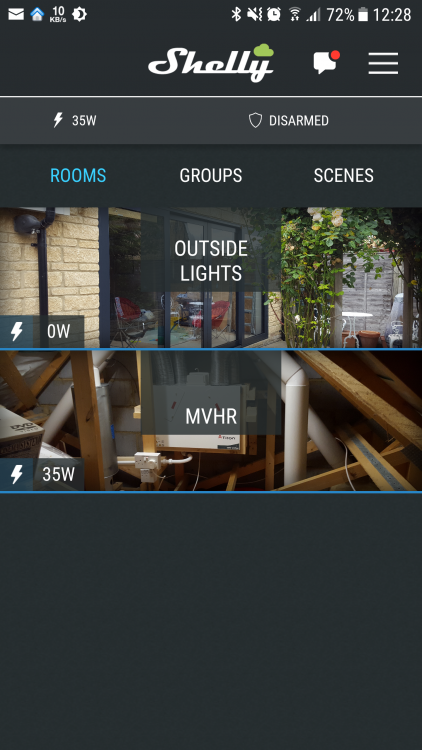
-
FD30 doors and MVHR: a contradiction?
MJNewton replied to ToughButterCup's topic in Doors & Door Frames
The Shelly is dependent on wifi for external access, however the use of the Internet is optional as it has its own built-in web server that can be accessed on the local WLAN (or directly if set up as an access point), and use of the cloud can be disabled entirely. Simple functions like controlling power output based on a physical trigger input, time-based schedules, overtemperature/overcurrent etc are performed locally and don't have any external dependencies (other than to configure them in the first place). For text alerts (and, I think, app alerts) an Internet connection is required. -
FD30 doors and MVHR: a contradiction?
MJNewton replied to ToughButterCup's topic in Doors & Door Frames
Oh yes - same here. If the alarm is indicating that my dinner's ready (hope the wife isn't reading this!) then I can press the hush button on the smoke alarm and the MVHR will turn back on. The functionality is really for when we're not in the house and, to be honest, it's the text alert that I value most rather than the power disabling even thought it was the latter that was the original motivation. -
FD30 doors and MVHR: a contradiction?
MJNewton replied to ToughButterCup's topic in Doors & Door Frames
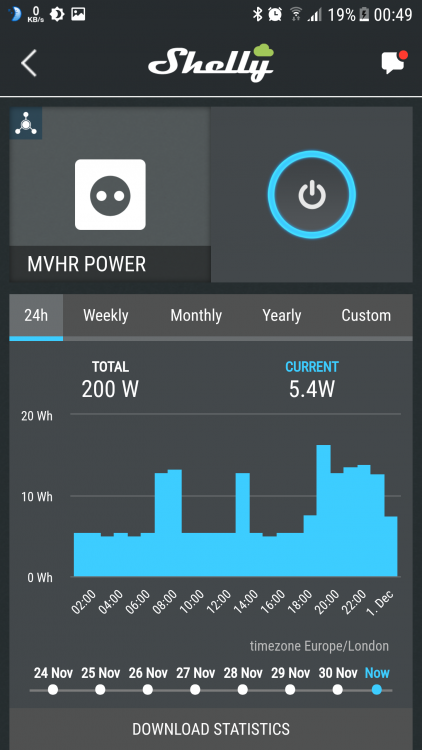
Not wanting to divert the thread, but I've just done exactly this with an Aico smoke alarm relay base and Shelly 1PM smart relay and have been very pleased with the result. Not only does the power to the MVHR get cut in the event of the smoke alarms going off but it also send me an SMS and app alerts within a few seconds to say this has happened. Furthermore, with the smart relay being 'in series' with the power supply it logs power consumption which will be of interest over time (well, to me as I like stats and graphs!): I do wonder how I'll react if I ever get that text!
-
Single Room MVHR
MJNewton replied to Onoff's topic in Mechanical Ventilation with Heat Recovery (MVHR)
Whilst not quite real time (updates every 5 minutes but could be made to be shorter), I log various temperatures with a Raspberry Pi: It's to monitor my MVHR but, as you can probably tell by the figures, the sensors aren't installed yet! The graphing can be configurable on-demand too but at the moment it's a fixed 'past two days' x-scale. Getting realtime figures 'on demand' could also be done. Happy to share my code when I'm back home (freezing my nuts off in Finland at the moment!) -
Mvhr official testing
MJNewton replied to Simon Brooke's topic in Mechanical Ventilation with Heat Recovery (MVHR)
As above I'd ask him to define 'specialist'. Or tell him *you* are a specialist and leave it to him to say in what way he disagrees. Remember often they have to act in a way that demonstrates due diligence, and they may not need much from you to enable him to demonstrate he's done his job in terms of verifying compliance. -
OpenReach and flyover rights.
MJNewton replied to epsilonGreedy's topic in General Self Build & DIY Discussion
I know nothing about this sort of thing but, thinking aloud, if you were to start to raise some sort of temporary structure (scaffold pole for, say, a ham radio aerial?) right along where the crow would fly between the two ends would that stop them? Whilst they might have flyover rights surely that wouldn't be at the detriment to your freedom to do what you want on your land, or am I showing my ignorance? -
No room for pipe!?
MJNewton replied to gc100's topic in Mechanical Ventilation with Heat Recovery (MVHR)
To add: Could you hide the ducting under the kitchen floor cupboards and come up in a boxed-in corner to a vent at the top?




