AliG
-
Posts
3211 -
Joined
-
Last visited
-
Days Won
11
Everything posted by AliG
-
So I couldn't search to find if a cheaper tariff was available as most of the switchers cannot search these tariffs and it seemed to know what kind of meter I have. Is the 16/18p/kWh issue then that the people have allowed their deals to lapse and moved to the standard tariff? Your tariff is a lot cheaper.
-
Open plan conundrum! Real life input required
AliG replied to SuperJohnG's topic in New House & Self Build Design
I have roughly annotated the plans. The area to look at is the sofas as they are much bigger than shown on the plan, when I scaled them up it looked like a chair plus sofa may work better, but it depends on the bulkiness of your chosen furniture. I would also increase the space between the island and wall units to 1.4m as it gives more room to open doors etc. In my design the end of the island and wall units would not line up which I think looks much better. BTW the rest of the design is excellent. Only change I would suggest is turn one of the cupboards on the playroom around to be a wardrobe for the bedroom.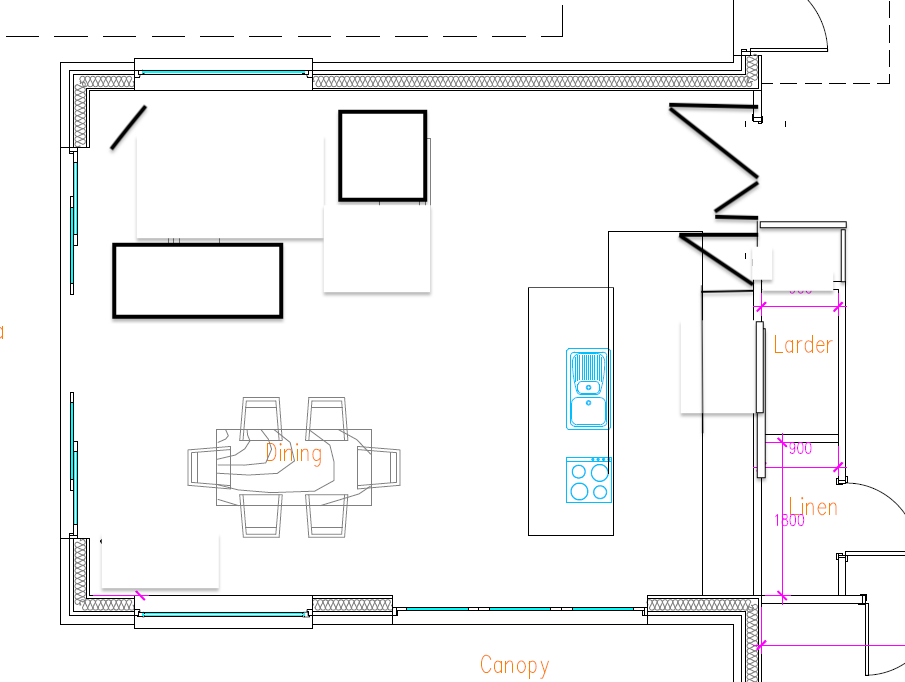
-
Open plan conundrum! Real life input required
AliG replied to SuperJohnG's topic in New House & Self Build Design
@Temp is absolutely right on the drawing sizes. I copied the pic into Acrobat so I could scale from it. the sofas as shown are 1.8m long and 0.6m deep. A three seater sofa is normally around 2.2m long and 1m deep. The sofas would be corner to corner and fill almost the whole area at the top of the room in option one. The dining table size looks more correct at 1.8x0.9m and the island is only 1m wide which is not the full depth of two cupboards. One of my personal design rules is that you shouldn't walk into a tight area at the entrance to a room if possible and that you shouldn't be presented with a poor view of a room when you come through the door. Option 1 fails both of these rules as you come through the door right into the kitchen area which is likely to be busy and have dishes etc. Imagine guests coming in and having to pass you cooking away to get to the table or sitting area. Also the divider is just odd as shown the space between the wall and island is tiny. Option 3 is a non starter, you walk into the room looking at a wall and putting the cabinets under the window means that you cannot use the wall space. I would adjust option 2, which I like as when you come through the door your eye will be naturally drawn across the room to the window and you enter into the clearest part of the room. You can get to the dining, sitting or kitchen areas all easily from there without passing through an area you don't need to be in. There is basically an entrance area in the kitchen. The adjustment I would make is to the double door and larder door. Due to the larder door, you end up with only a 2.4m run of 4 wall units, that is tight. I would change the kitchen door to a door and a half so you can still open it up wider if necessary. Then I would move the larder door along next to it and you can fit a 3.6m run of cabinets, making the larder slightly longer. Currently the larder door is shown as 900mm, it probably only has to be a 700mm door as it is a cupboard basically. If you move the kitchen door to closer to the corner you could still probably fit 2x800mm doors, but as the second door is usually not used in this design, we have two double doors where we only use one of then 99% of the time, then a door and a half might be better as you can have the doors be 900mm and 450mm. With design 2 you have a nice clear run down the middle to the BBQ. I would put the TV between the two sofas (in front of the window or on the wall to the right) as you will be able to see it from the dining table there and also if standing at the sink/hob. Putting the back of the sofa to the kitchen in this design creates a natural break without the bulk of a wall. If you put the other sofa at 90 degrees to this sofa then you cannot see the kitchen from either sofa. and have the option of putting the tv in the corner. Our kitchen is arranged as three distinct areas like this just using the furniture and no walls. The key is not to be looking at the kitchen when sitting on the sofa, we have an l-shaped sofa rather than two sofas. I bbq a lot and had exactly the same thoughts about having a clear line to the bbq area from the kitchen when designing our kitchen. I think the main thing is not the distance but it being a clear shot which it is in option 2. -
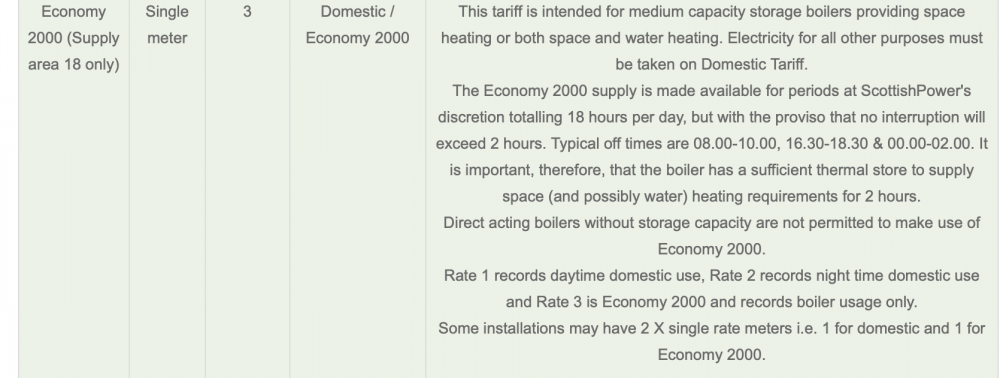
Thanks @TempI had just assumed it was an economy 10 tariff, there are so many tariff names. It is similar but not the same as economy 10 and therefore it seems that ScottishPower are the only people to offer it and there is no way to shop around. I found this explanation at ScottishPower It does indeed seem that when these boilers were installed ScottishPower were offering the off-peak electricity at 5-7p/kWh which tbh is a fantastic price for 18 hours a day. At some point last year they put the price up to 16/18p off peak/peak. This is much higher than normal online electricity prices. I think these customers could probably move to a ScottishPower normal online price at 13p/kWh, a look at Scottishpower's website suggested they could just move to a normal tariff, but it is not clear at all and maybe they will say they cannot do that with their meters. The chances of getting the kind of deal they used to have seem pretty slim. So it seems to be a combination of an inherently expensive electric heating system plus ScottishPower believing they have these people over a barrel and overcharging them. At a guess on the old tariff people probably paid an average of £2000 for electricity, the same amount of electricity would cost £4000 on the current tariff and if they moved to a single rate online tariff they could maybe get that back down to £3000ish.
-
It becomes clearer as I read more. I didn't realise that these houses don't have gas. The boilers are advertised as saving money compared to LPG, oil and storage heaters by using the economy10 wet electric tariff. This could well be true. The website suggests they should cost £1300/year to run, but that is based on a 2 bed house and 11,000kWh per year(2012 tariffs are used). For hot water and heating you are probably looking at 20000kWh. After all that would only be £5-600 a year in gas including the standing charge. People may indeed be using them incorrectly if they are running them all the time and not mainly at night on the economy tariff. Looking at the spec they can hold around 400l of hot water. I guess that the idea is that you heat this up on the economy tariff at night then use it to provide heating and hot water during the day. I am not sure how this would work in practice as once people had a couple of showers the water would need reheated to be hot enough to warm your house. 400l of hot water would store around 30kWh of energy. If you use half of this for hot water, you only have 15kWh left for heating. This is nowhere near enough to heat a poorly insulated house. I think these people are indeed complaining about expecting bills of £3000 because they have always had expensive electric heating and getting bills of £5000. The problem may indeed be that people have not signed up to new lower priced tariffs. I am gobsmacked tbh, it just shows how tough things can be for people if they don't have good technical knowledge. That kind of bill would be crippling to someone on an average income.
-
The more I look at it, the whole thing stinks. I just had a look at what I pay for electricity. I got an awesome deal at 11.41p/kWh just before Christmas (with a high standing charge which is OK as a high user) When I looked on uSwitch I noticed that the ScottishPower standard tariff is 16.77p/kWh. What has probably happened is that people were signed up for a 1 year deal with the new boilers that has now expired. I have been amazed in the past couple of years when I have discussed changing supplier with people and they have no idea that they can change and of how much extra they will pay if they don't sign a new deal. Of course council tenants could have a poor credit score that stops them getting the best deals. Even on a sensible tariff though, you are probably looking at a bill of around £3-4000 a year. Electricity costs around 12-13p/kWh compared to around 2.5p/kWh for gas. An electric boiler will be more efficient but if you had a £800 gas bill in a modest house then you would fully expect to get a £3000+ bill if you changed to electric heating. Surely the council knew this. It seems that a lot of complaints are being directed at ScottishPower. Now they are not helping by moving people onto a standard tariff, but really no matter what these people would have very high bills. For example the local MP is asking ScottishPower to resolve it. Frankly this just reinforces my view that politicians are often very ill informed.
-
This story seems to come up every so often, regarding people with electric boilers and massive electricity bills. https://www.thisismoney.co.uk/money/bills/article-7966625/The-eco-boilers-cost-5K-year-green-energy-deal-gone-wrong.html It allows the Daily Mail to pander to their older readers who believe everything new is bad. Reading this story though, I couldn't help but wonder did Falkirk Council deliberately install boilers that would be very expensive to run as I suspect installing electric boilers was a lot cheaper for them than installing gas boilers and the running costs weren't their problem. It is now exacerbated by people being locked into some very expensive electricity pricing, but anyone who knows the price of electricity versus gas knows that this would create a massive increase in heating costs. The story keeps calling them eco boilers. In no way should an electric combi be called an eco boiler, clearly people have no idea of the difference between these and ASHPs. The DM then have a further story today about banning every new home being connected to the gas grid, that ASHPs will cost £10k to fit and that they won't work in older poorly insulated houses. Assuming that gas boilers are eventually banned, then over time they can be replaced with ASHPs, however, I was thinking is this as simple as it seems? Even relatively modern houses will have heating systems designed to use 75C hot water from a gas boiler. Is the replacement of boilers as simple as it seems?
-
Thanks for replying to people's comments. I wasn't specific on the master bedroom as I knew the windows would be an issue from outside. I have had a good look at it as I feel that you could get more storage and a nicer en suite in the overall available space. Assuming that you want the bed to go with its back against the bathroom wall the options are limited without changing the window at the front and it does indeed look right where it is on the elevation. I would move the window to get a 900mm wide shower, tbh I wouldn't bother putting it to planning, no one will care if a window is moved 100mm. Your comment on the interior garage door is interesting. We have an integral garage and 95/100 times we drive into the garage and then enter the house, the front door is really just for visitors. I am a massive fan of being able to get into the house straight from the car without going outside. I am guessing that a slope to the left of the garage would stop you moving the door. As you have it at the moment the garage will be quite difficult to use if you drive in forwards as the driver's door will be forced close to the wall. However, it would work a lot better if you reverse in as the driver's door will be on the wider side of the garage and the boot will be next to the door into the house. So if you are happy reversing in then it is fine, assuming that your car is less than 4.8m long. Maybe you just don't plan to put the car in the garage. If you do though then you will usually use that interior door, hence the suggestion to make it wider. I would rather not design on the assumption that you have a specific size of car but there may not be anything else you can do. If you could move the door back 250mm towards the stairs then you could maybe out the first step down in the width of the wall so the steps only encroach 500mm into the garage. Then you could drive past them. I also think you would be asked to put a handrail on a three step staircase. The garage door frame is either going to have to be mounted behind the wall or inside the reveal. If you mount it behind the wall you are going to lose another 100-150mm of length and if you mount it in the reveal you will lose maybe 100-150mm in width. I am a bit OCD about being able to get the car in and out of the garage as most people seem to not use their garage, which is a large expensive part of their house, as they find it too awkward to get in and out. As things are already tight this will not help. If you could even find space to move the door 250mm to the left it would help clear the steps. You should try and decide on a door and how it will be mounted as you finalise the plans. I would be looking to have around 2.5m in clear width.
-
Great drawings and some great points already contributed that I will try not to repeat. First a few structural issues which will need an SE I think. 1. I have some questions about the roof, has it been looked at by a SE? The front to back span above bedroom 2 and 3 is almost 8m, can the roof be supported by 200-250mm joists across this size of span? Actually, looking more at the drawings, the joists are shown going in both directions on the sections. 2. There is an outside wall above the master bedroom and then to the right of the stairs. What supports it? 3. The floor joists are also shown going in both directions. It might be a good idea to do a joist plan for the top floor to make sure you have something underneath them for them to be supported. The awkward bit is always around the stairwell where you may also need thicker stud walls to support the wight of the stairs. 4. What supports the outside walls above the study, you have a corner between two walls with little apparent support underneath. 5. The inside blockwork on the entrance hall may need some kind of foundation support? It seems to just rest on the floor screed. 6. Could that continuous full height window in front of the stairs cause problems? Can the frames support the weight of the windows above? Drawing points 1. You have shown the interior stud wall insulation and the roof insulation as the same material, they probably won't be. 2. Once you put a fall on the roof you will need some way to carry the rainwater away. I think the normal solution would be a hopper and downpipe down the outside wall. 3. You have drawn what looks like pieces of wood around the window edges but they will be cavity closers. 4. I don't know if you can combine the bathroom extracts like that, but it would allow sound and smells tp pass between them so they are better separated. Design points 1. Could you move the garage door left to the other side so that you drive in to the left of the stairs? Otherwise the length to the front of the stairs is a very tight 4.9m. 2. I would have a wider interior door into the garage as that is one of your main entry points to the house. 3. Cupboard under the stairs on the entrance level for coats, shoes etc. 4. If you are going to amend your planning I would think about rearranging the windows at the front of the Master Bedroom so that you can put a wardrobe in that area and make the en suite larger.
-
MVHR in large volume New Build
AliG replied to Triassic's topic in Mechanical Ventilation with Heat Recovery (MVHR)
My house is around 900m2 and the volume the MVHR is used in is around 2300m3. We have quite a few double height areas, but we also have a pool room with its own system. I note that the Scottish regs say to not include volume in a room above 3m in height, but if this is open to another floor then it would be included in the area of that floor. The heating engineers specified three MVHR units. We have 2x Dantherm HCH5 and 1x HCV5.These have a max airflow of 375M3/hour each. I do not have the calculations for the sizing of my system, but it seems to me that systems are being oversized due to the regulations. The buildings regs are often on a worst case assumption. They don't know how many people will be in your house, how often you will shower, will you be hanging stuff to dry on radiators etc. As many people on here are building quite spacious houses, the minimum ventilation requirements are likely to be way more than is needed. The amount of CO2 and RH in the house is mainly driven by the activity of the people in the house, not the size. Indeed as the house gets larger, the people will have less effect in it. Thus I suspect that when people feel they have an over specified system it may just be following the regs. When our system was installed it was set to auto which bumped up the speed, when RH got above 45%. I increased this number as I found that it left the system running on speed 2 or 3 a lot of the time. I also noticed that simply it being wet outside was enough to push the RH above the boost trigger point. The average RH in Edinburgh is 80%(I assume it is boosted by the amount of rain). At first I tried increasing the RH boost point to 50%, but again I found that we were sitting at just above 50% a lot of the time. Having monitored the system over a year I decided that I couldn't really tell the difference between 45 and 55% RH so, I decided to switch off the auto boost function. Instead I switched the units to a time of day programme where they run at speed 2 in the morning and just before bed when people are likely to take a shower and speed 1 the rest of the time. I cannot find any ill effects from this and it has materially cut the heating bill. I had changed 2 of the 3 units and one was still running faster. I noticed that rooms connected to it cooled down much more during cold nights as even with heat recovery you are bringing colder outside air into the house. I don't know if anyone else has noticed this effect, where running the MVHR too hard boosts heating costs? -
We have Collingwood downlight which I am quite pleased with and seem reasonably priced. The dimming thing is an issue, most of the LEDs seem to barely change until they suddenly dim when they are almost switched off, but my wife hates lights being dimmed for some reason so it is not an issue for us. Another issue is fittings where the bulbs cannot be changed. I tried to avoid these as much as possible. We have one ceiling light in a room that is like this and sure enough it has already gone after less than two years and will need replaced. Also one of around 22 identical wall lights has failed, luckily I can buy more of the same fitting. But the wall lights are £50 each and the ceiling light was I think around £200. Maybe this is another area where regulations can help, light fittings where you cannot just replace the bulb should be banned as they are enormously wasteful. As to the colour issue, I think you may just have to get used to it. If we started with LEDs and changed to incandescent people would probably complain that they made everything look orange/yellow.
-
What accidents have you had while DIY'ing?!!
AliG replied to mike2016's topic in General Self Build & DIY Discussion
My dad is hopeless when it comes to DIY. About 20 years ago he was helping me put up a curtain rail in my granny’s new flat I put the brackets up then we were at each end of the rail to lift it up. Dad went to kneel on the chair he was going to stand on but knelt right on to a screwdriver. As he fell off the chair in agony it flew the other way gouging the wall. So a half hour job ended with me having to fill and paint the wall which took much longer than actually putting up the curtain rail. -
Rough cost of a 150m2 dormer bungalow in York
AliG replied to Falesh's topic in Costing & Estimating
Thanks @Falesh that puts it into context. I can understand better now why you went for this layout. A lot depends on whether you want to build a house just for your own use or consider that you may have to sell it one day. If it suits you, you are more than entitled to ignore selling it and build just what you would like. You have enough space there in the basic shell to be flexible. Things I would consider - 1. Storage space, maybe under the stairs and in the bedrooms. 2. Somewhere for services such as boiler, hot water tank (maybe not with a combi), MVHR, meters etc. This might be upstairs. 3. Positioning windows to capture light at the best time of the day, so if you sleep late you might prefer a west facing window for example. It also depends on views of the garden etc 4. I would consider having two small entrance halls. a. You could have one in front of the stairs with a door to outside, door to the bedroom and door to the main living area, just move the bathroom to the other side of the bedroom. b. You could make the small hall between the other bedroom and the living area larger and again have a door to outside in there, this way if the bathroom is off a hall and not off the bedroom you will meet the downstairs accessible toilet requirements. This way, each person has their own entrance, but you don't have outside doors in all the large rooms where you will lose a lot of heat when you open them and the rooms are a little separated from the main living room. Also if anyone has visitors they can bring them in their own front door and into their own small hallway. 5. You can still have large windows that are French doors in each bedroom if you want to get straight outside, but not have an actual front door in the bedroom which would seem odd if you ever came to sell the house. Hope this helps, if you really want to do this you will probably have to get an architect or architectural technician involved to try and understand your needs and what might work best for you. How much you spend really depends a lot on what kind of finishes etc you want. If it is nothing too fancy you are probably looking at £1500/m2 but lots of nice fittings and finishes are what can push this higher. Certainly reducing the amount of glass and doors would save a bit of money. -
Rough cost of a 150m2 dormer bungalow in York
AliG replied to Falesh's topic in Costing & Estimating
As said £1500-2000/m2 is a good rule of thumb, depends a lot on the specs. There is an enormous percentage of glass there, it would be very hard to be passive due to this and expensive to build. Is this just a design that you have knocked up yourself. It is somewhat unusual. The stairs next to the window may be problematic depending on what is above them and the shape of the upstairs roof. Where is the front door? It looks like a kitchen/lounge with two bedrooms off it. Is that the front door into the kitchen next to the stairs? Do you then have two bedrooms right off the kitchen without a hall? Why do they also have doors to the outside? I think it would not meet regs for an accessible bathroom as they cannot be off bedrooms, at least in Scotland. There are no cupboards or storage, where would the boiler go, it is easiest to fit on an outside wall. The windows go very close to the corners of the building which will be awkward. Sorry to be negative, but this house would be almost impossible to sell and very strange to live in. -
@peterw are you sure about the steel? I am no structural engineer, but the steel would need somewhere to rest on. It looks like the only place to rest would be the outside walls at each end of the house. This makes it 11-12m long, not only would this be very expensive, but it would be very thick and hard to hide although I think that would be OK due to the small area of roof it could be behind. That small area of roof will need more flashing, guttering etc. Between this and the steel I suspect the lower design would cost more to build whilst being smaller upstairs. Also square metres usually have a value, so you will have reduced the value and spent at least as much. As to the angled sun room, I don't think that would add much to the cost, the roof would be a little more awkward to build and the flooring a little more awkward to install, but I suspect it is minor. Personally I find angled walls a bit jarring, but maybe it is just me. The lower design looks a little better, but for the rear of a house adds little, maybe good for the front of a house, The question re the pitch of the tiles is a good one to check. I would ask about all the bi-folds. Why? Bi-fold are expensive and hard to seal. Would you really be using all those bi-folds. Especially the one at the end of the sunroom, I would assume that any patio is between the back of the house and sunroom, so why open out onto another area of garden. Also a room with only one solid wall will be very difficult to furnish. I would change the end bi-fold to a fixed window at least. I would also try to place your furniture on the plan to see how it might work. If they end up blocked by furniture they don't seem worth the cost.
-
We have triple glazed windows with 39dB noise reduction. 33dB is pretty standard double glazing. As your maximum profile is 25mm, I suspect the supplier meant 6.8/12/6.8 glazing. or 6.4/12/6.4. It tends to be that glass with a whole number thickness is plain glass and with a x.x thickness is laminated. Laminated tends to help noise reduction, also mixing thicknesses, so it might be 6/12/6.8. I am not convinced that the reduction from that glass would be 40dB, but whatever it is, it will be as good as you get with double glazing. What I find is that in fact most of the noise that we hear comes not through the glass but around the edges of the windows, through seals etc. We don't have trickle vents, but they are awful for sound transmission, so certainly have them sound reducing, or eliminate them if you can. Because sash windows are hard to seal, secondary glazing will help the most and make a bigger difference than better glass. Anyway, sealing all the gaps as well as possible will probably be the biggest improvement you can get. Try walking slowly past a window when it is noisy outside, you will hear various points that are much noisier. On our house, applying a bead of mastic around the outside edge of all the window frames made a big difference as noise was getting around the frame. Also making sure all windows are adjusted to shut as tight as possible etc. Even where there is no draught I can sometimes hear noise coming through gaps.
-
Can I make an application to extend an unfinished house
AliG replied to AliG's topic in Planning Permission
I should have said it is a conservation area so no PD rights in Scotland. -
Hi, So while we await planning on my parents' house I am thinking of contingency plans as the existing permission will eventually run out. The site is approx 800m2 and has permission at the moment for a house only covering an area of 88m2. It looks a bit vague on the site plans but basically the owner only applied for half the plot and I think they hoped to build and then try and get planning for another similar house. They had the site marked and then an area of "garden ground owned by current owner" fenced off. If our current application drags on we will do work to start and lock in the existing permission. This will put the wind up the neighbours which I will enjoy. Eventually we have to do something as my parents want to move and aren't getting any younger. As a backup plan looking at the approved plans, I think we could add another 25m2 to the ground floor giving them the downstairs bedroom they desire. My belief is that once we have started building and neighbours see that they cannot stop it, no one will care about adding a ground floor extension, but ideally this would go along with some changes to the existing permitted house, window positions mainly. So can we make a start on foundations etc and then put in an application to extend or would it be considered a totally new application. The alternative is that we build a shell that is not finished on the inside and then apply to extend it. I assume that from a planning perspective if it looks finished outside, this is all that will matter. This is by no means my preferred plan but it is good to plan ahead and think of alternatives.
-
WiFi Speakers Not Wired for Sound
AliG replied to Ferdinand's topic in General Self Build & DIY Discussion
I can see that people would be upset if they have spent a lot of money, I just don't think they are being realistic. The place I would bash Sonos is that some of these devices stayed on sale too long so they appear to have support ending quickly. The Play 5 was announced in 2009 and went on sale in 2010. It is a 10 year old device this year, it is no surprise that support is ending. The Gen 2 came out in November 2015, but I think people still sold the Gen 1 all the way through 2016, so if you bought one then you would rightly be upset. It is extraordinary they hadn't updated it for that long. I suspect they will update devices more often in the future. People won't have been thinking of it as an end of line device in 2016 and it wasn't priced as one. There have been many discussions on here about the merits of installing thousands of pounds worth of smart tech into your house when there is a good chance that it will stop working at some point in the future. As I said, if Sonos was still just used for streaming your own music, I think you could use it indefinitely. This was what it was originally designed for, they were not envisaging Spotify at the time. However, now that they have made it an internet connected application driven product then as technology advances it is going to have a more finite life in this function. I am all for bashing companies with their unreasonable demands etc. I had a Dyson V6 that barely lasted two years before the battery gave out.That is pathetic. The batteries are just not up to the job, I replaced it but it was never the same. I had an expensive HP laptop that was as good as junk after 3 years, the power supply broke after 18 months and they absolutely refused to do anything about it and the screen broke after 3 years, but at that point it was so miserable to use I gave up anyway. I moved over to a MacBook Pro which was a bit more expensive but still works almost like new 6 years later. I think 6 or 7 years is the realistic time for supporting computing devices. So when I spend money on something like that I would calculate the cost over the useable life. -
Not really enjoying this situation. Spoke to the planning consultant today as the 2 month planning determination deadline is up on Monday and thought that he may have heard from the planner to ask for an extension. The planner spoke to him before Christmas and said that he would visit the site in January to get an idea of things. Of course this means that he turned down our previous application just looking at it on paper, but that is par for the course. The question I asked is should we just appeal on non determination straight away as planning will otherwise waste our time. He said that if we do that they will send it back to go to committee first and we will have to wait for that anyway. The issue is the complete lack of feedback. The planner told him that if there was an issue with the application he would come back to him, maybe the fact we haven't heard is good news or maybe he just hasn't started to look at it yet. Now the consultant says the planner has stopped responding to emails or phone calls. The consultant said that he will continue trying and may even pay him a personal visit if he cannot get him on the phone. Without any feedback we have no idea if there is an issue or not. So I said let's give it a week and see if he is leaning towards recommending approval or recommending rejection, but we need to be able to actually contact him to know this. If we had sensible feedback previously we would have quite happily designed something that took this into consideration. We have taken into consideration the feedback that we do have which amounts to three sentences in an email. Meanwhile the existing approval will eventually run out so we are now going to have to do something to lock that in as I frankly don't trust that it will get extended. Luckily for a modest cost we can make a start and lock it in forever. I think this may also put the wind up some of the locals who probably think that they can stop anything happening by dragging out the situation. My parents are at a loss to understand how the system can drag on for so long with no consideration for them, I knew it would be slow, but they struggle with the notion that you can already have planning permission and just want to change it and that you can pay out a lot in design fees and planning fees and then get nowhere. The planners will claim that they are busy and I know that they are, but the planning fee for a single house is around £1000, if I paid out £1000 for any commercial work I would expect something back in return.
-
WiFi Speakers Not Wired for Sound
AliG replied to Ferdinand's topic in General Self Build & DIY Discussion
I think there is a bit of confusion there. If you opt for the 30% off a new device when trading in the old kit then they apparently brick the trade in. This, it has been pointed out, is very environmentally unfriendly as it would be better to sell the old device and keep using it. When they stop support devices will still work. However, at some point to connect to the latest Spotify, Amazon etc update they will need to be updated and will then not work for that service. If you have your own music stored at home they should work pretty much indefinitely. -
WiFi Speakers Not Wired for Sound
AliG replied to Ferdinand's topic in General Self Build & DIY Discussion
We have 2x Play 1s, a Play 5 and 2x Sonos Connects. I think the Play 5 is affected by the announcement, our Connects are post 2015 and so should not be affected (they were still laughably expensive for what they do). The reality is that this affects anything with computing built it. Indeed someone very fairly pointed out in a discussion re this on another site that smart TVs normally lose support after 2 years. If you have something doing more and more in software, for example receiving voice commands, then eventually it will not be powerful enough for the latest features and something will have to give. Factor this is before paying large amounts of money for a fridge/TV/washing machine/phone/car where the core functions will probably keep working but the nifty functions you paid a big premium for will either not work or be antiquated in 5 years time. Thus with this kind of device it is better to separate the computing aspect from the physical aspect if you can. For Smart TVs, much as it is neat to have the functionality built in, I decided that it is better to rely on FireTVs for older TVs. They only cost £25 when there is a sale on so if every 4 or 5 years they are too slow and need replaced then it is pretty cheap. We had a Samsung plasma TV where the Amazon app stopped working after only 2 years as they stopped updating it.The difference between Samsung and Sonos is Sonos have kept updating products for much longer and were honest enough to admit they will eventually have to stop. Samsung and LG just give up supporting devices often very quickly. Despite the sceptics, Apple generally supports phones for 5 years and recent updates do not seem designed to brick your phone. Most Android phones only guarantee support for 2 years. Even then they will work of course, just stop getting updates. You really cannot do much about this when processing power is increasing rapidly, funnily enough as the steps between models get smaller as has happened in PCs, devices should last longer as the older devices won't be at such a performance disadvantage. Anyway despite the initial outrage I don't think Sonos can do much about this and it is really a fact of life with devices including computing power. Where they might be blamed is that they were historically slow to update products so products on sale not that long ago are included in this as they were very old products when they were still being sold. We have connected our Sonos system to Alexas and it works well and easily. Indeed since putting an Alexa in the kitchen it gets a lot of use - Sonos, timers, alarms, weather, calls, football scores etc. I switched from using Deezer to Amazon music as it is somewhat cheaper, however the price increases substantially if you want to use it on more than one device at a time. Ideally I would like a music system like the FireTV plus TV system. This is just more fiddly to do in the music world than the TV world as you need something that outputs the audio, plus an amp plus speakers (or powered speakers). Google used to make the Chromecast Music to do this but stopped. Today the easy option might be to buy an Amazon Echo Dot and use the 3.5mm output to connect to an amp and speakers but I am not sure what quality this would provide. Also the amp and speakers would have to be left on all the time as the Echo ceases to use its own speaker connected in this way. My mate swears by just using his Amazon Echo speaker that he bought. Looking at it today, Echo speakers did not exist when I started buying Sonos stuff, an Amazon Echo 3 costs £90 and £60 in the sales. They can be paired for stereo. Apparently they don't sound quite as good as a Sonos One, but then they are half the price. You can buy an Echo Studio for a similar price and similar quality. At £60 a speaker frankly if they only lasted 5 years I wouldn't care anymore. The music service costs more than the speakers do. It has to be a very tempting if not very environmentally proposition. -
The HH4 is only USB 2.0. I also found some people complaining that the USB is very slow due to a lack of processing power. This review suggests that you can only get a speed of 2.7MB/second from the HH4, the official limit of USB 2.0 is 60MB/s and of USB 3.0 is 640MB/s (bytes not bits here) https://www.trustedreviews.com/reviews/bt-home-hub-4-performance-verdict-page-2 A HDD will probably run at 100-150 MB/Second, a bit above the USB 2.0 speed, USB 3.0 is mainly beneficial on a faster SSD. USB 2.0 would be fine for backups. The other limiting factor will be are you connecting over WiFi or a cable, your in house WiFi speed may not be fast enough to use all the capacity anyway. But again all this is moot if the USB is as slow as suggested.
-
OK if you just want cheap storage on the network, you probably want a USB SSD, not a memory stick. Memory sticks are quite unreliable when used heavily. Something like this is still cheap, £39 for 240GB. https://www.amazon.co.uk/Integral-240GB-Portable-Drive-External/dp/B06XSZYB5R/ref=sr_1_9?adgrpid=53292702855&gclid=CjwKCAiA35rxBRAWEiwADqB372hXhhYFXjb6Z1zQZb_120ojVcM_DNWLdsIRmCqyVw3GnyTCuVGcpBoCxaMQAvD_BwE&hvadid=259065928940&hvdev=c&hvlocphy=1007326&hvnetw=g&hvqmt=e&hvrand=10388665846543852233&hvtargid=aud-857384558340%3Akwd-297346692125&keywords=usb+ssd&qid=1579635859&sr=8-9 You then connect it to your router's USB port. You then should be able to see it using your router's IP address. You can then map this to a network drive. It may be that you need to turn on the functionality in your router's controls. In case this doesn't work you could just use any memory stick you have lying around to try it out before investing in something else. Here is a video of how to do it on a BT Smarthub https://www.youtube.com/watch?v=xHWp9ldR3q4 Internet reports suggest that this function via the router may be slow and unreliable. But it all depends on how much data you need to move and it might work very well for your needs. Again see how you get on with a small USB stick first. The main risk is that doing this if the SSD breaks the data on it will be lost, but this is no different to how most people use their laptops.
-
Office365 comes with 1TB of cloud storage for free if you have it. Can I try and persuade you on the Cloud. We have just moved to the Cloud at work, a couple of people used to say what you said, but it doesn't stand up to scrutiny. Why would stuff in your house be safer than stuff managed by a multi billion dollar corporation. People can get into your network and I think their networks may be safer. Microsoft, Google and Amazon are not going bust. They aren't selling the data you store in the Cloud, that would be corporate suicide. It is not social media. Finally the US Department of Defence uses an Amazon Cloud System now, if it is good enough for them it is good enough for me. I looked into a NAS a while back but they are surprisingly expensive and not simple to manage. If your local storage breaks and you have not invested in a more expensive RAID system them you will lose everything. This is not a problem in the cloud. Connection issues is a fair worry if your internet connection is problematic. I doubt this is an issue for most people. A lot depends on what you want to put on the storage. I used to think I would build a NAS storage system for video and music, but frankly the availability of cheap streaming services makes this a waste of time. Now you might want to store some pictures and files. I really do think the cloud is the best solution for this as you will be able to easily access it from multiple devices. You can also access it whilst not at home. One last thing, do you actually need it. A lazy way of sharing files is just to email them to yourself. I backed up my laptop hard drive onto One Drive by copying all the files there a while back just in case it broke. But files that I regularly need I just email to myself, then I can access them anywhere that I have email.