AliG
-
Posts
3211 -
Joined
-
Last visited
-
Days Won
11
Everything posted by AliG
-
Critique of new new build design, please!
AliG replied to LnP's topic in New House & Self Build Design
A two storey house is a lot easier from a fire perspective. However, you don't pay the VAT and it will be cheaper to do all of the work at once. I would guess that you will be in band G or H anyway. -
Critique of new new build design, please!
AliG replied to LnP's topic in New House & Self Build Design
I too would be looking to combine the boot and utility rooms as you have to walk through the utility room to get to the boot room anyway. -
Critique of new new build design, please!
AliG replied to LnP's topic in New House & Self Build Design
I like it in general, there are just some details points and some things may be personal taste. Construction issues 1. The rear first floor wall will be quite awkward to build and require considerable steel. I would look to one up the top right corner of bed 3 with the kitchen wall, otherwise you are trying to bear the support for that wall above the door between the kitchen and study. Similarly the landing and bed 1 wall is not a straight line which would be easier to rest on a steel beam and will need support in the wall between the study and sitting area. 2 2. The skylights hard against the rear wall would maybe be difficult to weather proof and would be better further out into the roof. I'd probably lose the one in the sitting area, maybe personal preference here, but seems unnecessary. Further skylights under a north facing wall will receive little light and may be a waste of time. 3. That large window in the sitting dining area will be expensive and I personally don't like how it is off centre relative to the room. Layout 1. Windows as mentioned. I would replace the roof lights with an east facing window in the dining area. 2. The WC is too small relative to the house and do you want your guests having to go through the utility room to get there? Also is the plan to not have a door to the utility room? I would probably move the WC to the back of the enormous pantry (personal issue here, but I doubt you'll ever need such a large pantry) 3. The plant room is possibly too small depending what you want in there. If you have an ASHP outside that will help. 4. The boot room is at the side of the house implying that this is where you plan to come into the house, but the garage and parking seem to be in front of the house. Maybe you plan to actually park at the side, but this could be annoying. Also depending on if you come in at the front or the side there could be an issue with lack of storage in the main hall. Could the garage be at the side and attached to the house? 5. It could be a bit dark in the middle of the kitchen without another window at the side. The sink is too far away from the table for clearing up dishes and getting glasses of water. 6. First floor seems good. I would consider making the dressing room smaller and putting a laundry room in part of the space. Then it might be easier to arrange the boot room space downstairs. 7. I'd put another velux on the second floor landing. -
Don't see any particular issues, it will just have to meet building regs. I think the floor will have to be insulated to a minimum of 0.25 U-value which means at least 50mm of PIR. Ideally you would want more, but it doesn't look like there is much of a step down from the house. This will mean that you are going to end up with quite a low ceiling height 2.2m by the looks of it. If you then wanted to board the ceiling it would get lower again. This is allowed within building regs but not ideal. Similarly the wall U-value will have to be improved which will lose you some floorspace. You shouldn't need foundations to block up the door as it would be non load bearing, the door should already have a lintel. You will as you say need a DPC but I would expect it to already have one being part of the house.
-
My parents' house is completed internally as of today, with just some landscaping works to be done. I went along to go over the place with the architect so that he could issue the practical completion. I got there to find that Scottish Water, having verbally agreed a way of us connecting our surface water to the sewer around a month ago, are now trying to renege on this. Literally an email was received at 1422 today. I was furious, the SE wanted to meet on site to discuss yet another solution. We have already spent thousands of pounds trying to meet their ever changing requirements as well as tens of thousands of pounds due to previous delays caused by them. My opinion was absolutely not. We had a verbal agreement. They only offered this after in their words first consulting with someone more senior and the agreement was given with no caveats. Thus as fas as I am concerned legally we can rely on what they said and they cannot just change their mind because some other senior person does not like it. I have asked the SE to put this to them, noting that verbal contracts are binding in Scotland and their actions and words gave us every reason to believe that we could rely on their verbal agreement. I also noted recent guidance on verbal contracts from The Supreme Court in Scotland. I am absolutely dumbfounded. @markharrodo you have any thoughts?
-
As there are no chairs in the kitchen and it is small I assume that it is only used for cooking. Then I do not see the point in spending a lot on heating and especially cooling. If you want cooling I would keep it to rooms that you spend a lot of time in (bedroom/living space). If you want to put in UFH, it can be run as if it is another radiator in this kind of scenario. However, even if you can insulate below the floor, you will likely need to raise the floor as the pipework will probably have to sit on top of the joists and you will then need flooring on top of that. This will create a small step up into the kitchen. I like @Radian's idea of a split A/C unit which could heat and cool the room and not take up any floor or wall space. An even simpler solution is to move the radiator to the space behind the door as this space cannot have any furniture in it anyway. You could use a vertical radiator to keep it narrower, or just a small double radiator would likely suffice. As to the other thread re kitchen floors. We have porcelain tiles on a concrete screed and I have never in the slightest felt it was hurting my feet or knees. That idea is just daft. The only time it hurts your knees is if you kneel on it to clean stuff up. Tile is the hardest wearing kitchen floor. I would not have wood ever in a kitchen.
-
Yes, heat loss from the cylinder over 24h would be roughly the same as having the oven on for an hour.
-
The first cylinder lists the heat loss as 87W for 400l. The second one lists 70W for 300l. I doubt 17W will make much of a difference (presumably that is 0.4kWh a day) The standing losses for a tank are calculated at 65C, so would be reduced by 20-25% if you keep the water at 55C. A lo of the losses come from pipework etc as much as the tank, so it is important that they are all insulated. There may be other things to consider such as was one designed for an ASHP vs a boiler.
-
Can't help myself. Basically that's what I said.
-
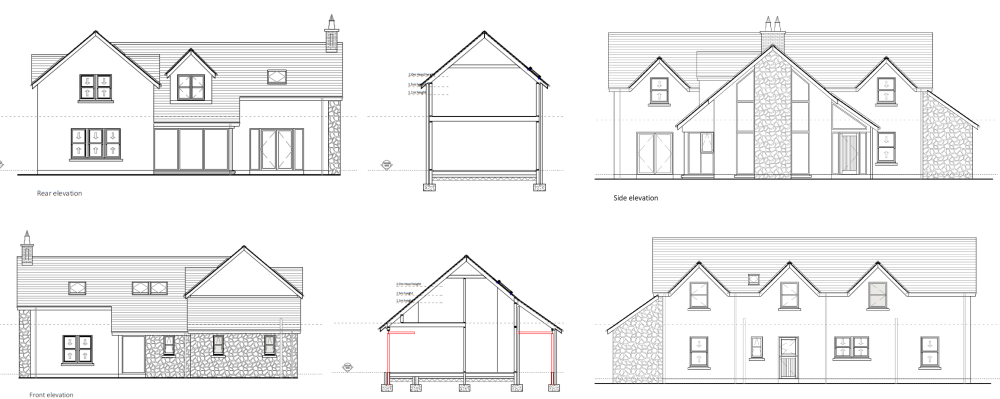
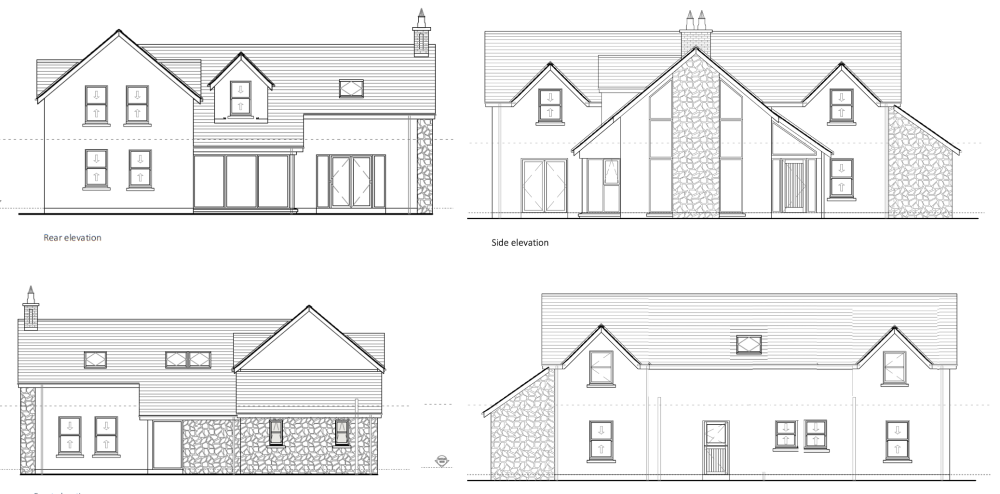
Sorry for the confusion, I was referring to the original drawings by @Lord Greyabbeyand the adjusted ones he posted not the ones that you posted @etc. I should have made that clearer. I did think of copying them in to show which pics I was talking about, I should have done that. Original drawings Improved side elevation, but still a number of issues especially that gable sticking out of the roof and the added on look of the area where the bed 1 ensuite an dressing room are.
-
The first drawings that we got for our house had the first floor around 1.75 storeys high with similar dormers. I hated it and we raised the roof. I think what you have done, making the dormers more symmetrical on the side elevation is a big improvement. I don't know if this involved rejigging the interior. The en suite doesn't need a dormer and that window doesn't line up with a window below so looks very out of place. Why not make bed 4 window a velux., then if you have a velux in bedroom 4 and the ensuite for bed 3 they line up with the window and door below and you don't have the velux being so close to the dormer which looks fussy. Bed 2 ensuite could also be a velux and then you are just left with the bedroom 3 dormer. Now bedroom 3 I have some issues with. I understand the T-shape and it might look better in real life, but that gable sticking out of the roof looks awful on the front elevation. It also looks bad on the side elevation where as noted it looks like you have a little extension jutting out there. Just looking at it was the house designed and then the bed 1 ensuite and dressing room added in later? I think it is spoiling the house actually, probably made worse by highlighting it in stone. It might look better if you remove all the upstairs dormers in bed 2 and the gable and give it a sloped ceiling all the way round. I'd tell you to rejig downstairs to lose the sticking out bit, but the foundations are in.
-
Heat Pump vs Gas Boiler: Relative Climate Impact
AliG replied to Green Power's topic in Air Source Heat Pumps (ASHP)
There is an argument for face to face meetings, but private jet use is laughable in terms of CO2, roughly 2000kg per hour, so 27x a commercial jet. I am not actually against flying. The only way to travel long distances efficiently is to fly.There is no alternative. ASHPs on the other hand are a readily available alternative to gas boilers, albeit more expensive. I would focus on fixing what is easily fixed first. Note this does mean that I would probably restrict flights under 500 miles where you could probably take the train instead. In the long run once most electricity is zero carbon then what should happen is we use this to produce synhetic fuels and run aircraft using these to eliminate the carbon. This is the kind of thing we will need to do to eliminate the last of the CO2 output after we all have EVs and ASHPs etc. -
Heat Pump vs Gas Boiler: Relative Climate Impact
AliG replied to Green Power's topic in Air Source Heat Pumps (ASHP)
I don't see a lot of room for argument here. ASHPs are way more efficient than gas boilers 3-400% (lower if you include grid losses) vs 75-90% and a large proportion of electricity is generated by renewables, nuclear and hydro so there is not even a shadow of a doubt that they reduce carbon emissions. The assumption is actually that a kWh of gas and electricity have around the same carbon output, with electricity falling. Fair arguments regard costs. At current gas prices running costs are similar. Installation costs for ASHPs are higher, although most numbers I see quoted for ASHPs seems crazy high and I think include all the initial work putting in pipes, tanks etc in a new house. Still they cost a few thousand more than boilers and I would not expect people to be considering installing one unless they needed to install a boiler anyway either in a new build or replacement. By far the worst thing you can do for the environment actually is fly. Electricity produces around 0.2kg of carbon per kWh. Flying produces around 75kg per hour. The price cap is based on 12000kWh of gas and 2900kWh of electricity. That is around 2800kg a year of CO2. So 37 hours of flying is equal to one house, taking the whole family to Disneyworld would produce more CO2 than their house does in a year. I do wish people would ask climate protestors if they ever go on holiday. It seems to me that they love to protest cars, especially large expensive ones (including large EVs with low carbon output) suggesting it is nothing to do with climate. UK emissions have already fallen dramatically and with almost all new electricity production being renewable this should continue. This will also have the happy consequence of reducing our reliance on imported energy. McKinsey have put out a few useful pieces on this. There is some summary info here. Global oil demand is expected to peak around 2025 and natural gas around 2035. There is a very clear path to lower emissions, however, at the moment the world is not meeting the targets to limit warming to 1.5C. https://www.mckinsey.com/industries/oil-and-gas/our-insights/global-energy-perspective-2022 A few people have also mentioned population growth. UN population growth forecasts have been too high for some time and are being consistently revised down. I am extremely suspicious that the creators of these forecasts need them to look alarming. They are full of assumptions that are already wrong. The US for example has had considerably less growth than expected in the last five years. Developed countries in general are heading towards 1-1.5 children per woman and seeing populations begin to fall. China will start to fall soon. Extrapolating this out, the world population will probably peak around 2065 then start to decline. Elon use has been banging on about this for some time now. https://www.theguardian.com/world/2020/jul/15/world-population-in-2100-could-be-2-billion-below-un-forecasts-study-suggests -
Hi @markharro I had to do this for my house but not for my parents' house. It seems somewhat random and a total waste of money. For my house though the architect asked for it as he said the council would probably want it. You have been living in a house right there on the site, you didn't have a report covering it. I made the same argument for our house though and it fell on death ears. A more cogent argument may be that the raft foundation will have a radon barrier in it anyway, so why the need for a report. Your house is listed as being in a radon potential area (you can see it under constraints on the planning website) so I think this is the issue. The area is also highlighted own the map here https://www.ukradon.org You could argue that as you have a radon barrier the survey is moot, but they might insist on it. I don't have any arguments for other contaminants other than it was garden previously. This is where dealing with councils etc is a pain. The can simply waste your money with no come back.
-
As @ProDave says, cold air might be getting into the small space between the blockwork and the dot and dab plasterboard. Where you put in the fused spur, you need to seal where the cable goes through the blockwork, so cold air is not getting ing in behind the plasterboard. If you go up into the loft and check at the outside wall, you will be able to see if the small cavity between the blockwork and plasterboard is open to the loft which will let cold air in. If it is I would use expanding foam to seal the top edge. There won't be much difference between blown in insulation and mineral wool. At least it means that it is unlikely the builders missed putting pieces in.
-
Is the temperature dropping as much in the lounge overnight as the bedrooms? Has the lounge had the heating on for longer than half an hour to heat up the fabric of the room more? As you say the lounge and kitchen will have a lot of heat input from ovens, TVs etc over the day. I am guessing that your house has 100mm of mineral wool in the cavity which is the bare minimum required to pass building regs. This gives a U-value of around 0.28 which is very poor today. The maximum roof U-value in England is 0.18 and the maximum window U-value is 1.4 Assuming these numbers the room will lose around 75W an hour through the walls, 35W through the window and 30W through the ceiling with an outside temp of 3C. If for example the bathroom or hall are not heated then further heat would be lost to these areas. I assumed a room size of 3.5x2.5x2.4m and 1.5sq metres for the window. These will give a rough idea. You can probably double the heat loss including ventilation losses, but this would be a guesstimate. Thus the room will likely need around 2-300W of energy to keep a constant temperature during the night. I am assuming a 21C internal room temperature and 18C differential to calculate heat loss. The heat loss is directly proportional to the differential, so if the outside temperature is 12C as it has been during the day recently, then the heat loss halves versus 3C night time temperature in the last couple of days. The day also benefits from solar radiation and heat generated by activity in the house thus requires a lot less heat input. Assuming that the room has a volume of 20m3, that is roughly 24kg of air. The energy required to increase the temperature of 24kg of air by 1C is roughly 24Kj. So to heat the room air by 3C requires 72Kj or only 20Wh of energy. However, assuming 120mm of blockwork/plaster. The outside walls of the room weigh around 1500kg. The specific heating capacity of this would be around 1Kj per kg. Thus to heat the walls up by 3C would require around 4500Kj or 1260Wh. I don't know what size of radiator you have in there but say it has a 3-400W output. It could easily warm the air by 3C in half an hour (20Wh required versus 150-200Wh of output), but you would need to run it for 3-4 hours for the walls to be up to the same temperature as the air. Once the walls are up to that temperature then you will only have to overcome the 200-300W heat loss, but initially you have a large deficit to make up. Net net at 3C outside during the night, if the heating was on for 12 hours, I would expect it to be actually running for around 75% of the time. (Very dependant on the radiator size assumption). The size assumption just affects the time the radiator runs for, the amount of energy required to heat the room is the same it can just be provided faster by a lager radiator/higher flow temperature. Basically you cannot run the heating for half an hour and expect the temperature not to drop quickly on a cold night. If you ran the heating for 4-5 hours in the evening I would expect to see much less temperature drop as the walls would be up to temperature. Their relatively high heat capacity would lead to a more constant air temperature. Basically set the thermostat at 21C at 5pm and leave the heating on until 9 or 10. It would not run constantly, but it would run a lot of the time whilst the walls warm up. Then I would expect a much steadier temperature during the night. However, the poor insulation levels of the house mean that even then I would expect it to be somewhat colder by the morning as you have quite a lot of heat loss at 3C outside. If the walls have not heated up and are materially colder than the air in the room, due to their dramatically larger heat capacity they will take energy from the air and cool the room down during the night.
-
Thanks for the info posted. As @JohnMo said normally you would not draught proof internal doors so that air can circulate. Also is the hall actually that much colder than the bedrooms? Without an IR camera it is hard to tell if there is an issue in the walls. If there was an issue, once it is quite cold (like last night) the walls in the problem room would probably feel colder to the touch than in the other bedroom. I would have though that the most likely place to lose heat is via cold air in the floor but this would probably impact both bedrooms equally. TBH the temperature drop you mentioned last night is less concerning than what you mentioned at first. If you turned the heating off at 630pm and it got down to 3C outside then it would indeed cool down quite a bit in the bedroom. A well insulated self build might drop 1-2C over that period. Really in an average house I don't think you can expect to turn the heating off at 630pm and it still to be warm 12 hours later when it is 3C outside. Your bedroom would have been warmer in the morning as you and your partner generate a lot more body heat than a baby. Also you need to consider the construction of your house in how you run the heating. I assume that you have solid wet plastered walls if they are blockwork. When you turn on the heating, it will heat the air quickly as air holds a lot less heat than concrete. If you only had the heating on for half an hour the air would have likely heated up but not the walls. Then once you turn the heating off the walls will actually suck heat out of the air as their temperature equalises with the air. This would not happen so much in a timber frame house where the walls have less mass. If we were properly into winter and the heating had been on for a long period then the heat stored in the walls would actually help to keep the air temperature steadier, but when it first starts to get cold your house will take more heating to warm up the walls.
-
Hi @Littlebig I just found this thread. Can you provide more info so people can maybe help more. In general a north facing room will be colder than a south facing one. In my nouse the south facing rooms don't need any heating and the north facing ones do. However, a properly insulated room should lose maybe 1-2C overnight. There are a lot of things that could impact this, but losing 5C over 2 hours as you described in your first post would definitely indicate something wrong. That is such a high rate of heat loss that it is likely coming from a draught somewhere. As was mentioned a draught under the floorboards could be to blame, but it could be missing insulation, badly fitted windows etc. It hasn't really been that cold yet where I am, so it may not have been cold enough for problems to show up yet. So a few things - 1. Do you have a floorplan you can post? Assuming the house was bought from a major developer a link to the house style on line would be useful. 2. What kind of wall construction do you have? Full fill insulation suggests two layers of brick/blockwork with a cavity. 3. What kind of windows do you have? Standard would be UPVC double glazed. Standard would also be having weep vents in the frames. 4. When you say that you have draught proofed bedrooms what do you mean? In a new house the windows should not be draughty and you should not have to draught proof internal doors in a properly insulated house. However, if draughts are coming from unexpected places then this would have an impact. 5. When you say the loft insulation looks OK, how much is there? it should be almost a foot thick to meet current regs. I had a couple of spots in my house with issues behind the wall re insulation and an IR camera spotted them immediately if you can get your hands on one.
-
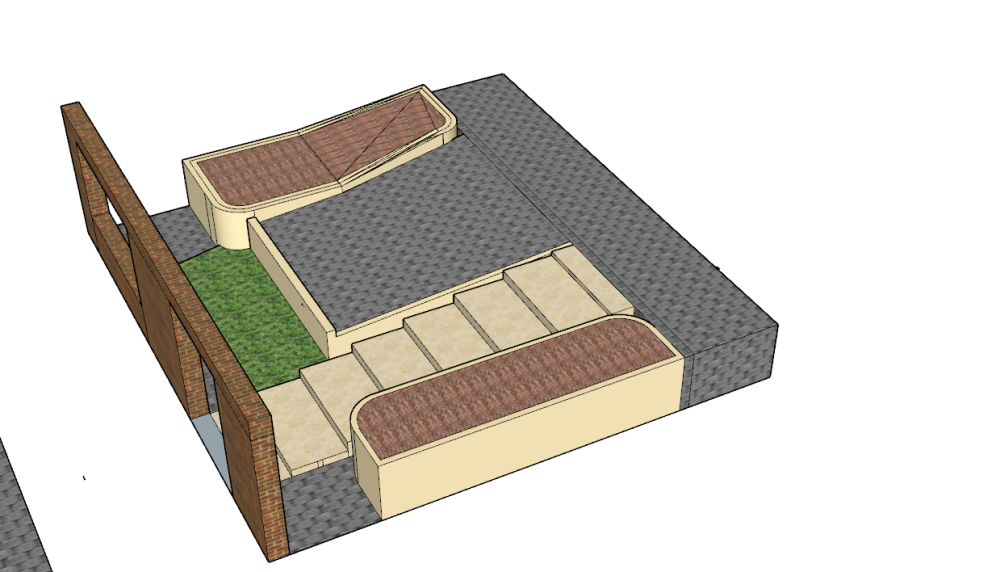
You cannot go higher than 600mm without a barrier to stop people falling over the edge, so that it the most the slope could be reduced by still keeping a gap to the front of the house. I would go for something like this option, except no grass so that you can still access the bike store and bins and the end of the driveway can probably be closer to the house. You just have to take the bins up and down the steps. I would give it a go before starting, but I don't think bumping a bin up the steps will be a big issue. You should be able to move the lights up the wall and it won't require moving the shed and so on. Although removing the wax from the setts will help at the moment, this problem will only get worse over time. As the setts get older they will get smoother and they will get covered in dead leaves, moss etc making them even more slippery. Edinburgh is full of setts and most people consider them a safety hazard in wintery weather. They aren't used on slopes, people would consider that crazy. Marshalls are talking nonsense saying they are fine up to 15 degrees.
-
They are being an idiot. That has been in building regs since 2010. It just means that fittings that limit water use have to be used. No one actually checks the water consumption.
- 20 replies
-
- 1
-

-
- building regs
- water consumption
- (and 1 more)
-
Neighbour selling without Planning Permission
AliG replied to Becks1974's topic in Planning Permission
Like others I am a bit confused as to whether the guy just annoys you or there is an actual issue with the work done impacting you. If if doesn't;t actually affect you then forget about it. In the next street, someone bought a listed house and started renovating it. I saw wood paneling from inside in a skip and checked, but no listed building application had been made. I simply filled out a form informing the council. They sent someone along to check if work was being done without required permissions. I got an email back saying nothing yet had been done which needed permission, but it would and they would be applying for it. I didn't believe they would have applied for permission, but the issue was dealt with. I just wanted to make sure that no work was done on a listed house without the correct permission as it would be a shame to ruin it. It is also a criminal offence, according to my architect (I haven't checked). If you think work needs permission just inform the council, simple as that. If it is all within the rules he will get permission if there is an issue he will have to change it back. I would not consider this a neighbour dispute, anyone can notify the council of work without planning permission. When we sold out last house we needed every single drawing from building control and planning for every piece of work we had ever had done. I doubt he will be able to easily sell it with obvious recent work and no permissions. -
New build design & floorplan - Comments please!
AliG replied to jimmyharris80's topic in New House & Self Build Design
We have a sink and hob on the island, but we have another sink on the wall for dishwashing as I didn’t want stuff stacked in the island. Island sink for food prep and glasses of water, main sink for dishes. Makes life a lot easier as you can just brush stuff into the sink. Both sinks have a waste disposal. I don’t know why everyone doesn’t have one. Cheap and massively reduces waste that has to be dealt with. -
New build design & floorplan - Comments please!
AliG replied to jimmyharris80's topic in New House & Self Build Design
I agree with almost every word already said. A very noice house with just a few details to refine. 1. Moving the front door 1m towards the front of the house will make moving around in the hall a lot easier. You have the entrance to the stairs, and three doors all in a small space. 2. Either have an understair cupboard or have a deeper cupboard that utilises one of the cupboards in the playroom. 3. Sliders are considerably more expensive than windows, lose a set of sliders in the kitchen. Even if you make one a full height fixed window it would be around half the price. 4. I would put the hob on the island so that you can face the room as you cook. 5. You could probably make the utility room smaller and the pocket door to the plant room will be an unnecessary expense. 6. I don't think the central doors in the dressing room/en suite are a good idea. They are probably better put to one side. It will be quite difficult to furnish the dressing room with the door in the middle. 7. I am fine with the size of the landing, I like them to have a window, but I doubt anyone is ever going to sit there. A second en suite would be nice and you could possibly free up some space if you made the landing a little narrower, but that won't be easy as it requires moving the stairs. -
Hi @Bungalow Bill Are you building a new house from scratch or upgrading an existing property? Funnily enough I just saw Scottish Water today on site. The people I have met/spoken to have been quite helpful, but back at head office their strict adherence to rules and bureaucracy has made them a real pain to deal with, causing a lot of delays and a lot of expense. If you are building a new property they will want you to try to build a soakaway rather than connect your rainwater to the drainage system. We had to pay a structural engineer to draw up drainage plans. It was £1250+VAT which I thought was expensive, but he said was due to how much time he would waste talking to Scottish Water. With what I know now he was right and we were probably undercharged. I recommend you get as much stuff as possible signed off by them before you start as it can have major implications for a build. They also insist on you using a Watersafe plumber and filling in forms re this. If not they may have to inspect your interior pipework also. https://www.watersafe.org.uk/?gclid=CjwKCAjwm8WZBhBUEiwA178UnOZNdqj4oyoFl_GWePGT_NEjUnsMxxL-bFzskb6PHd1hKHfO67COwBoCiAYQAvD_BwE
-
Copyright dispute with timber frame company. Help.
AliG replied to Paulp1's topic in General Self Build & DIY Discussion
Can you clarify - Did she already pay the timber frame company for the drawings? If so then you should own them, if not then they need to be paid for their work. Considering what they are saying I suspect not. I am appalled at comments suggesting that it's hard luck on the timber frame company and just ignore them. I hope other people don't do work and then not get paid for it and get told that it's just hard luck.