


AliG
-
Posts
3211 -
Joined
-
Last visited
-
Days Won
11
Everything posted by AliG
-
Where is the kWh price heading in 2022?
AliG replied to epsilonGreedy's topic in General Self Build & DIY Discussion
To state the obvious this is a very difficult problem. Russia was almost 40% of European gas supply. As they have cut supply by 80%, then we are short around 30% of previous supply. Note that as the price has risen around 10x then they will be making twice as much money at current levels of supply as before. This might actually suggest that even if the war ended they could just restrict supply indefinitely, although it is hard to say how much of the current price includes an certainty factor due to Ukraine and the unpredictability of Russia. The SNP plan had me looking at how gas sufficient the UK is. It appears as if the UK produces around 66% of the gas it uses (quick Google so may be wrong). So nationalising our energy companies would be entirely pointless as we would still have to import lots of gas. This kind of nonsense would even more destroy the gas markets and drive prices further up. The £6000 number being bandied about just does what I mentioned the other day, which is take the latest spot price and project it out forever. As the spot price can move dramatic amounts in a few days this has almost zero value as a prediction. So what to do? Basically Europe needs to get the market as close to back in balance as possible. i.e. they need a combination of supply increases and usage reduction that offset the 30% reduction in supply. It looks as if the increase in LNG imports is equivalent to between 10 and 15% of EU demand. Of course this also requires increased gas supply outside the EU and has driven up prices in the US. But assume that other countries can cover this extra supply. Then this would suggest that Europe needs to increase supply/reduce demand by around 20%. At this point the loss of Russian gas will be irrelevant. Prices would still no doubt be higher, but not anywhere near as high. It takes a long time to bring on gas supply, we can probably only increase it by a few percent a year. This suggests that the 15% reduction in demand being bandied about is maybe correct. As someone said though, how much gas is wasted? I think you do need prices to go up quite a lot to encourage people to reduce consumption, but £3000 is probably the price where there is enough pain to do that. The problem is though that as a very high percentage of gas is used for space and water heating as well as electricity production, people cannot alter consumption of these that quickly. We cannot insulate every house in the country in a few months. Reading Facebook utility user groups suggests that a lot of people, unlike on here, just don't understand enough about the workings of their heating system and use of energy to maximise efficiency (e.g. people who worry about phone chargers being plugged in, which uses a laughably negligible amount of electricity) Still it does give me hope that over a couple of years we could pretty much wean Europe off Russian gas through a combination of LNG imports, supply increases and demand reduction including more renewables to make electricity. It will be painful until we get there. One of the best policies might be to educate people about energy use and how to save it (frankly I sometimes think we need to send someone door to door to explain to people how to reduce energy use) Now all we need is a plan to do this and a politician willing to actually give people a straightforward explanation of what is happening. If the gas markets were convinced this was going to happen, gas prices would also start to fall. They don't want to buy up gas futures to find no buyers n a couple of years. Out the other side of this, it will have accelerated energy efficiency and the move to renewables but it is hard to see those benefits sitting on the precipice as we are now. This is the danger of allowing a massive short term increase in prices. People will find a way around using your product. -
I just see a lot of people saying in passing that they have had devices burn out. I don't have any stats unfortunately. If you look at the immersion timers on Amazon there are quite a lot of one star reviews where they have broken after a year or less. The other problem on Amazon is that loads of people review things after a few days which doesn't tell you anything about their longevity. For me considering the small saving for export use and a 5-10 year payback period on an Eddi, it just doesn't seem worth it.
-
Having looked at this I think I am just going to install an immersion timer. I have looked at my export of electricity and I won't even make 1000kWh in a year. If I assume I can get an export payment of around 5p versus gas cost of 5-10p long term (more in the next year I know) then I can only save maybe £50 a year. Also it seems that these devices often burn out due to having 3kW going through them for hours on end. But I can save a few hundred in the next 12 months using Octopus to heat my water overnight with a £50 immersion timer. Any recommendations for an immersion timer that is robust and won't burn out after a few months?
-
Where is the kWh price heading in 2022?
AliG replied to epsilonGreedy's topic in General Self Build & DIY Discussion
Are you on Go or Intelligent? They won't let you have Outgoing Agile if you are on one of these. -
I have coined a phrase recently - I am not a structural engineer but... it looks alright to me. What kind of rails are you planning? It might affect the outside edges. Please feel free to use "I am not a structural engineer but" in any situation where you give an opinion even though you don't actually know what you are talking about.
-
Water pipe and electricity cable in duct to carport/garage
AliG replied to AliG's topic in General Plumbing
All we have at the moment is a duct under the foundation. It was intended initially for electricity, but the outside tap has not been put in yet and the best place for it is actually the carport. -
Hi, We have put a duct under our foundations to carry electricity cables under the house and then across to the carport. Can we push 15mm pipe through this to have an outside tap there also. I know you cannot mix them on the supply side but am not sure what the rules are once the are into the house. If they cannot be in the same duct once into the garden, could they be in the same duct then split once it is out from under the foundations? Thanks
-
Where is the kWh price heading in 2022?
AliG replied to epsilonGreedy's topic in General Self Build & DIY Discussion
Fair point as I know the spot price of gas has been low on some days recently due to short term supply chain issues. -
Where is the kWh price heading in 2022?
AliG replied to epsilonGreedy's topic in General Self Build & DIY Discussion
Oil is mainly a global commodity. It’s price is falling as people worry about slower economic growth impacting demand. Gas is a more localised commodity as there is not enough capacity to move it between continents. You have to convert it to LNG to ship it which is expensive and has limited capacity. Most of it is piped. As Russia constitutes around 40% of European gas supply there is no way of getting alternative supplies to cover the shortfall from Russia. The price has risen in the US but is now considerably lower than in Europe, it has mainly risen as they can export LNG to Europe which has increased demand. As gas is mainly used to produce electricity and for heating there is little demand elasticity and it is less affected by an economic slowdown. Thus the price can and has risen considerably. The current wholesale price of gas in the U.K. is almost £5 per therm, or 17p per kWh. The US price is around $9 per MMBtu or 3c per kWh. It has still risen considerably over the last year. -
Where is the kWh price heading in 2022?
AliG replied to epsilonGreedy's topic in General Self Build & DIY Discussion
Filling up gas storage at this point would be moronic. It would increase demand sending prices higher. Supply is already severely restricted. You stockpile things when they are cheaper than usual, not 10x the normal price. -
Where is the kWh price heading in 2022?
AliG replied to epsilonGreedy's topic in General Self Build & DIY Discussion
I am just reading the suggestion that the energy price be capped at the current price. At a cost of £29bn! Whilst I totally recognise the need to help people, I think politicians are once again messing up. It seems to me that politicians across most of Europe are using taxpayer money/borrowing to subsidise rising energy prices. The problem with this is that producers see that demand never falls as the price rises so the price will just keep rising. Basically it is an economically dangerous policy that would could just see prices spiralling out of control. -
Air Source Heat Pump in Stone House
AliG replied to Bemak's topic in Ground Source Heat Pumps (GSHP)
I meant to ask this. Rather than the spreadsheet, the actual energy consumption in past winters would give you a good idea of how much you are going to need. -
Air Source Heat Pump in Stone House
AliG replied to Bemak's topic in Ground Source Heat Pumps (GSHP)
3600kWh is the amount of energy you would need in January if the average temperature was 0.6C. It is calculated from the instantaneous consumption multiplied by the number of hours in the month. The ventilation heat loss looks wrong, it should probably be around 1/3 of the fabric heat loss. Even a very airtight house with MVHR would struggle to get to the figure you have. The number you have to look at is "Total daily heat loss power for minimum OAT (W). This is the instantaneous heat input your house will require at the minimum temp of 0.6C. The heating system has to be sized to keep your house warm at the minimum temp. So basically 5kW at just above 0C. I would change the minimum temp to -5C and see what the number is then, as well as fixing the ventilation heat loss, as you want the heating system to cope on a cold day. -
Air Source Heat Pump in Stone House
AliG replied to Bemak's topic in Ground Source Heat Pumps (GSHP)
The system has to be sized for the maximum heat input, not the average. If you look at the January column, you will see a heat required at the minimum temperature in watts. Depending on the weather where you are I would suggest changing the minimum temperature to around -5C and seeing what heat input is required at this point. I would guess it is 4-5000W. I guess your floor area is quite small at around 100sq metres then. You can divide this by your floor area to calculate the output per square metre required. You would thus probably need at least a 5kW output heat pump for heating, but you also need to be able to heat hot water whilst heating the house so I would suggest 8-10kW (depends on that minimum figure) Personally I always allow a decent amount over the spreadsheet number just in case real life is worse. -
Air Source Heat Pump in Stone House
AliG replied to Bemak's topic in Ground Source Heat Pumps (GSHP)
Yes, I actually just brought it up and changed the wall u-value from the 0.11 I had in for my parent's house to 1, it roughly doubled the heat energy required. I then removed MVHR and it added another 50%. You have to size the system to keep the house warm at a reasonably lively low temperature, say -5C. At a guess you are looking at around 50W/sq metre of heat input which is 3-4x what a new well insulated house needs. This is doable with UFH or low temperature radiators, but I looked very quickly and don't have all the data on your insulation levels. -
Air Source Heat Pump in Stone House
AliG replied to Bemak's topic in Ground Source Heat Pumps (GSHP)
The numbers @saveasteadinghas listed are the numbers I have seen for the u-value of a solid stone wall i.e. roughly equivalent to a double glazed window. Imagine your whole house was a sun room, it would require a a similar amount of heating without upgraded insulation. You can do the heat loss calculations and see how much heat output you need. The key to using an ASHP is keeping the heat output to a level where you can run the flow temperature as low as possible. This is where ASHP in badly insulated houses goes wrong, as flow temps rise, the COP of the ASHP falls and some houses designed for a gas boiler will need the ASHP to run at its max 55C output where the COP would be awful at low temperatures and costs would be high. Indeed radiator systems are often designed for 70C flow temps and just won't work with an ASHP that cannot provide this high a water temperature. So if the calculation suggest you can run a flow temp of 45C or ideally less then an ASHP is OK. If not then I would stick to a boiler. This would require digging up the floors and putting in insulation and UFH. Then you could have a low flow temperature with closely spaced pipework. It would not work with radiators. Also in passing you said that you hoped to use ASHP and PV. PV provides as good as no output in the winter when you need heating. 80-90% of our output comes during the summer when the heating is off. It can help with hot water at that time of year. -
For heating your COP should stay above 3 most of the time for heating as long as your flow temperature is below 40C. That is why people have been asking about the flow temperature. This is also why less well insulated houses become a problem as the heat loss is too high to be offset by a low flow temp and the COP starts to drop off as the flow temp increases. For hot water at say 50C, then the COP will be above 3 for most of the year, unlike heating you need hot water at all outside temperatures, but fall into the low 2s when it is coldest in winter. For that small part of your demand, a gas boiler would probably be cheaper, but this is why they quote a seasonal COP that tries to average this out over the year. If your house is high up and exposed with a lower than average outside temperature then you will have a modestly worse COP than some other people.
-
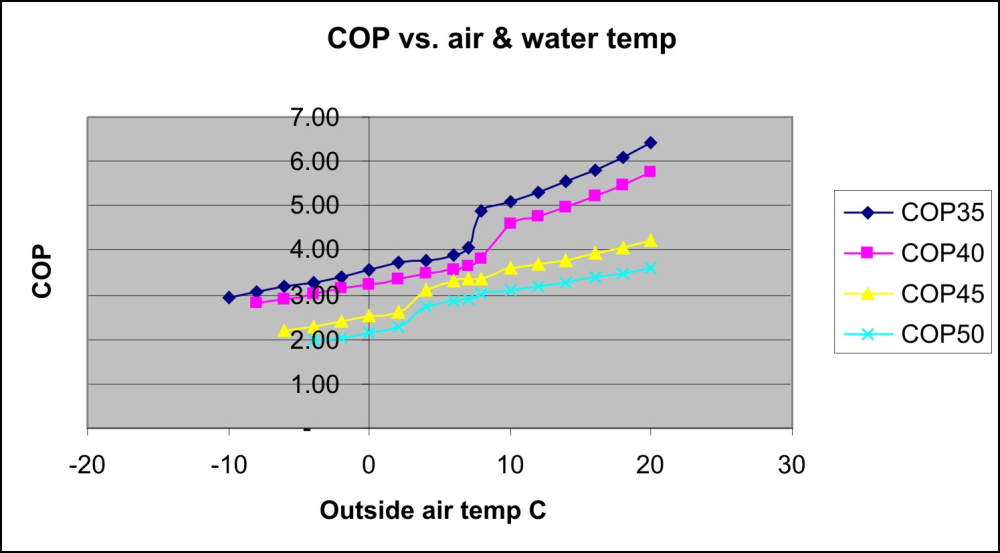
It uses roughly 5kWh of energy to heat 100 litres of water up from 3C to 45C With a COP of 3, that is going to be 1.7kWh to your heat pump. You are probably going to use roughly 1.7kWh per person per day, depending on how many baths, showers etc people have. The COP will drop to around 2.5 if the temperature falls below 5C, so it also depends on the outside temperature. This chart gives you an idea of COPs for different outside temperatures and water temperatures, it is not your specific ASHP, but they are normal quite similar. The big improvement in COP is between 45 and 40, this is why running your UFH flow at a lower temperature helps. Realistically 40C would be too cold for your hot water.
-
I have an MCS system but it was installed after FiTs. Because it is 3-phase I couldn't get a smart meter to see my exported electricity, so couldn't sign up for export payments. Now that I have a smart meter I still cannot get export payments as Octopus want the DNO letter which I don't have. I suspect the way around it is to apply again to the DNO, ut it is quite a faff.
-
Where is the kWh price heading in 2022?
AliG replied to epsilonGreedy's topic in General Self Build & DIY Discussion
Time and again when serious problems like this come along the government appears to be seriously lacking in imagination. -
Where is the kWh price heading in 2022?
AliG replied to epsilonGreedy's topic in General Self Build & DIY Discussion
All the various predictions at the moment are entirely based by taking the current wholesale price of gas and electricity and extrapolating it forwards. Whilst this is fine in the short term, it has little predictive power in the longer term. The price of gas has doubled since early June, hence the massive recent increase in predictions for the next energy cap and the one in January which would see the full effect of recent increases. Predictions from just three or four months ago were wildly wrong. Forecasts of a similar price next winter are worthless, considering the price of gas has doubled in two months it could as easily double again or fall by 50%. I am getting somewhat annoyed that politicians are not being honest about what is going on. This is almost 100% due to the war in Ukraine and sanctions against Russia. Russia has retaliated by massively reducing the gas supply. Astonishingly the price of gas has gone up so much that Europe is giving more money to Russia than ever. Indeed the correct way to hurt the producer of a commodity is to increase supply and reduce use so that the price of the commodity falls. We have managed to achieve the opposite effect. We are basically having an economic war with Russia. There were some articles in the papers about it last week. The Russians think that we will give up before they run out of the ability to fight Ukraine. I think people are hardier than they realise, but telling them honestly what is happening would help a lot. I find it quite bizarre that the Daily Mail etc blame this on renewables which actually are helping the situation. That electricity from the new Hinkley station will also be looking a lot better value than originally. Gas is a more regional commodity than oil and because so much of it is used for domestic heating in Europe, it also has less elastic demand. Thus the producers are in a much more powerful position than they are with oil, where substitution and buying it from elsewhere are easier. Basically it is a lot easier not to drive than it is not to turn on your heating and gas boilers don't have any alternative in the short run. Anyway we have got ourselves in a very difficult situation I am in the fortunate position that I have an efficient house and I can afford the increases. Some people are going to be wiped out by this. It is not easy for the government to do anything about it. They would basically have to borrow money to pay people's energy bills. With almost 28m UK households, it would cost over £30bn a year to stop bills going up more. They were supposed to be looking at the pricing of electricity as fixed cost producers are coining in at the moment. I guess the windfall tax is an easy way to capture this. The price of gas, however, is simply driven by the rising price of gas. The long term solution is more renewables and more insulation. The short term solution is the end of the war, something that I wouldn't begin to try and predict. -
Yes, I have run into this. I have an MCS install, but I have the letter they sent the DNO, but I do not have the DNO's response letter. I emailed the DNO asking for it and got no response.
-
I have started to look into getting the Eddi. In my case we have 3 phase and it seems like the only system that can measure export on three phases, using the Harvi add on. I also have Octopus Intelligent, currently fixed at 7.5p during the night, so this water I can save money by using night time electricity rather than gas to heat my hot water. I had the opposite thought, which is that I can put the cost of the timer towards a PV diverter. If I didn't need the three phase capability I would get a Solic which is a lot cheaper at just over £200. I have not had a smart meter for a full 12 months yet, but it looks like I will export maybe 900-1000kWh over a year. I guess the sum you need to do is - Export kWh x Offset cost of gas for water heating Minus Export kWh x possible export payments. and then look attached this relative to the cost of the diverter. @ProDaveI think you are maybe on the FiT scheme, otherwise you ned to subtract export payments from the benefit. I think Octopus Agile Outgoing has actually been paying higher export payments can the price of gas recently, so you could sign up for that instead of a diverter (I cannot as you cannot get these higher payments if you are on an Octopus Go type plan) So if you are set on exporting around 1000kWh a year, then you are going to have a net saving of around £100 at the next price cap. However, if gas prices settle back to longer term averages in a few years the saving could be quite marginal. 18 months ago gas cost less than the payment I could have got for exported electricity. My case is a little different as I reckon we use around 15000kWh a year of gas to heat hot water. By heating my hot water overnight using Octopus from October, before my fix is up, I could save £375. Annoyingly the Solic does not have a timer. So I would have around £500 for an Eddi and a Harvi covered by year 1 savings.
-
Thanks, this helps. It seems that you are often using large amounts of electricity in the middle of the day when your PV should be generating. It may be that it was a cloudy day of course. It could be that the ovens are on or that the the heat pump is heating your water. The other useful thing to know, but you would have to gather this on a go forward basis, would be how much you generate on a given day versus how much you export. Then you can tell if you are always using a lot of electricity but it is covered by PV, or if your PV is covering a small amount of your electricity. If it is the former then you would expect your electricity usage to go up considerably in the winter. I suspect that is what is happening. It takes a lot of fiddling around to maximise the use of PV and heat pumps. This doesn't work for everyone, my wife doesn't like being told to use the washing machine at night when we have cheap electricity for example. If you are running UFH flow and hot water at 45C then you should have a decent COP and decent performance from the system. In fact I would expect a COP of 3.5-4 at this time of year. To maximise your use of PV you should try to not use the ovens and PV at the same time. The ovens use 1-1.5kWh per hour, but the elements come off and on, so at any one time they could be using 3kW each. Your heat pump has an input of around 3.5kW. Thus if they all fired up together you would be using around 10kW in the house and start to use a large amount of imported electricity. If there is a time during the day when your wife tends to cook, say 12-2. Then I would set the hot water heating on your heat pump to be 9-12 and 2-5. Thus it is much more likely that your PV covers your ovens and hot water use. If you cannot stick to a specific time for cooking then there is nothing you can do about this except buy an expensive battery. During the summer there is an argument that you should in fact heat the hot water to 50 or 55C during the day when you have PV and turn it off during the evening and night. Again ideally, everyone has showers in the morning and then the PV reheats the water during the day. A lot depends on the size of your hot water tank and the amount of hot water you sue though. During the winter though I would use 45C for the better COP and lack of PV. Ultimately there are many trade offs between cost and convenience. Looking at your usage charts you have quite spiky energy usage. You can try to smooth this out to use more PV which will help in the summer, hence my comment you could maybe save around 1000kWh but that won't help in winter. In winter the only thing that can help is reduced energy use through insulation, draught proofing etc.
-
That’s right. But you could probably use over 1000kWh of exported electricity over the summer months. From October that’s a £400 a year saving for free.


