AliG
-
Posts
3211 -
Joined
-
Last visited
-
Days Won
11
Everything posted by AliG
-
Telephone/broadband strategy for new build
AliG replied to kandgmitchell's topic in Networks, AV, Security & Automation
It is amazing how much it varies. I just switched us over to Vodafone from Three and from contract to PAYG. The main reason was that we have lots of holidays planned this year and now that Three have ended free roaming, Vodafone PAYG was going to save me hundreds of pounds (We are going to some odd places like Japan, Israel and Egypt). PAYG global roaming plan is £25 each for 15 days for three phones. We are about to go to Japan for 11 days and then the USA for 11 days. USA is £5 a day in contract on Three, but free on PAYG which is bizarre. Japan is £3/MB on Three! Took me ages to figure out which network was best for upcoming trips. The other reason for switching is that Three constantly slowed down to being unusable in central London. For example I often could not do anything with my phone in Kings Cross Station, it had 4 bars, but the internet speed was basically zero. On the other hand Vodafone has more capacity in London but is considerably slower than Three in Edinburgh. Annoyingly they limit 5G to PAYG over £40 a month or contracts. I moved to PAYG for the cheaper roaming benefits and the reduced risk that someone accidentally racks up a £1000 bill on our travels. -
Telephone/broadband strategy for new build
AliG replied to kandgmitchell's topic in Networks, AV, Security & Automation
You can get unlimited data for £16 a month in the UK. -
Telephone/broadband strategy for new build
AliG replied to kandgmitchell's topic in Networks, AV, Security & Automation
Assuming you know the address of the nearby house served by the same pole you would be connected to, put this into the broadband checker on the BT website and see which services and speeds you can get. I would note that you should look at both broadband only and broadband + phone as I get offered faster services for broadband and phone versus broadband only for some reason. Assuming there is just a copper wire to a distant cabinet, it is likely you can only get a speed less than 40Mbps. Maybe considerably less depending on the distance. Ideally you want a speed around 100Mbps which makes most things easily doable over broadband, although even 40Mbps is fast enough for one 4k video stream. The alternative to this would be a mobile connection. I recently went through the exercise of trying to see what was the best connection at my house. I ordered a PAYG sim that worked on every network (not necessarily from the underlying network e.g. it was cheaper to use buy an Asda mobile sim to test Vodafone) and put them in a phone and then did a speedtest. In my case I wanted to see which signal best penetrated the walls of our house. Mobile speeds can vary wildly between networks in any given area. You can look online to see which network is liable to have the best signal. You may find that one of the networks is faster than the landline service. This will give you an idea of where best to get service from. Even then I would probably put a duct into the ground so that cable can be connected up if a better service comes available (I would note that we put cable into the ground on my parents' house and then Openreach found a pole that they could connect to and were insistent they had to bring the cable through the air and attach it to the side of the house, so we went with Virgin instead). I would assume that the pole is so far aways that you would put a pole on the edge of your site and then duct from this to the house if required. Openreach are very slow and a pain to deal with. You can contact them and have the site added to their database so that service can be connected up whether that is to the caravan or the house in the future. I think you will need to apply to the council for a street address first, or this will at least make it easier. If you do need mobile service you will need the router to be able to get a signal from outside as modern insulation/triple glazing destroy the signal inside the house. If neither mobile nor landline gives an acceptable speed then you can use Starling, it is just a bit more expensive. -
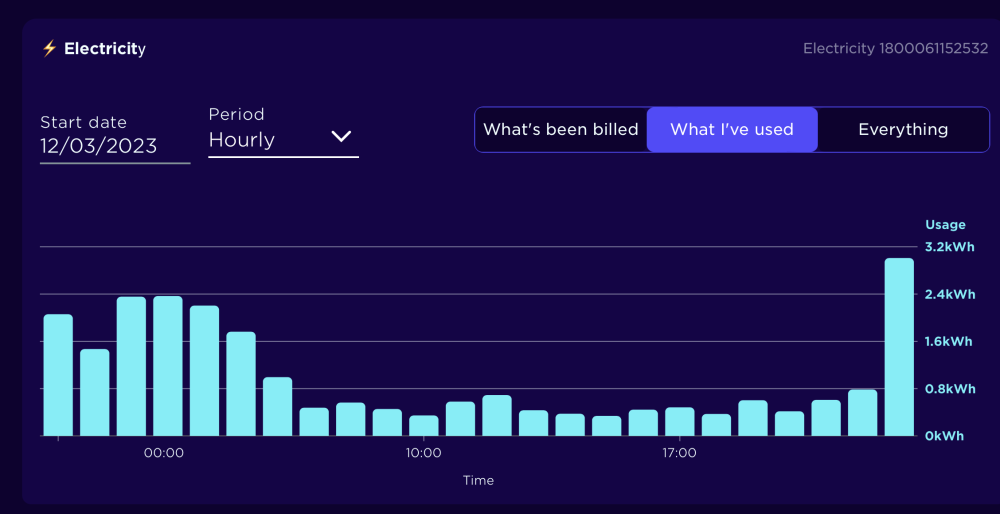
Solar would reduce consumption, the problem is that overnight electricity is so cheap that the ROI on solar becomes poor depending on your usage. Their consumption looks like the chart below since they moved to IO in March. They use around 0.5kWh per hour outside IO hours. They have room for a 2.7kW array which judging by my solar production would generate around 1500kWh a year. Slightly less than optimal as they have a flat roof. Considering weather, spikes in usage, the fact that power is concentrated between 9 and 4pm looking at my system and so on, they wouldn't be able to self consume much more than 50% of the production, maybe even less. I get a reasonably good idea from the data on my system. So say they utilise 750kWh of PV that is £225 a year at the July price cap. I have consistently argued that people should not make PV investment decisions based on recent inflated electricity prices. Wholesale prices continue to fall and if and when the Ukraine war ends they will likely fall considerably. Using say 20p per kWh, still well above pre war levels you get £150 a year of self consumption, maybe £200-250 including SEG payments. As they were quoted £5k for the array, it wasn't really worth the bother (Installers massively bumped up prices when electricity prices went up).
-
The best way to save money then is probably to move to a low priced overnight tariff. I have moved my parents to Intelligent Octopus(they just got an EV). I then reprogrammed their DHW to heat overnight and set the UFH to slightly overheat the house at night (I set the thermostats to 23C at the end of the cheap period then turn them down to 21-22 during the day). Thus the vast amount of ASHP running is on cheap rate. Depending on the rate you can get you will likely have more than half your electricity use on the lower rate. They use so much electricity overnight it’s not worth installing solar.
-
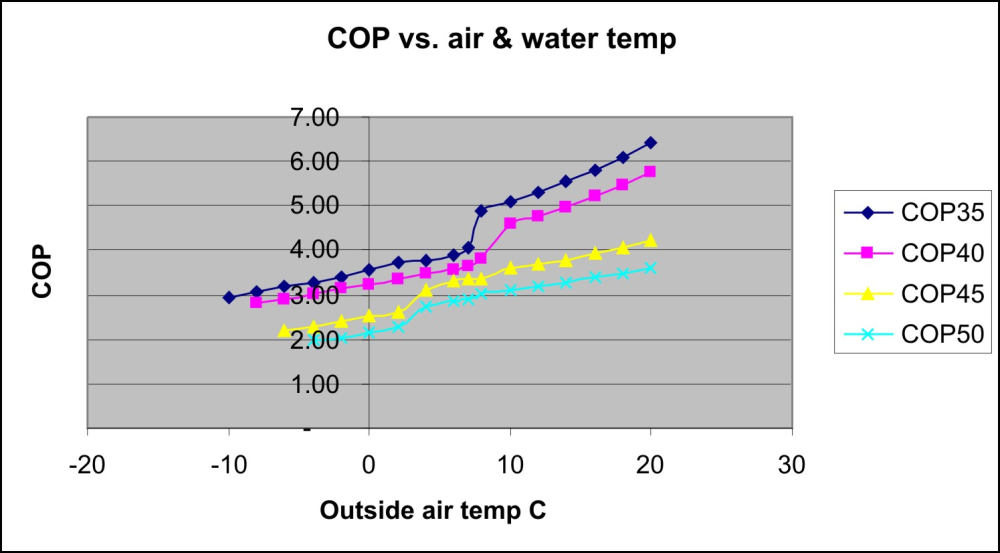
If you take this as a typical COP chart then you will get a better COP running the ASHP when it is warmer. We have had days recently when it was 5C during the night and 15C during the day so, heating DHW to 50C, you would get a COP of 2.8 at night and 3.2 during the day. The big difference would come if the night time temp was between 0 and 5 and the daytime temp was 10Cish as you might get in the spring or early winter. Then the COP might be 2.2 vs 3. So it could be 15-30% cheaper to heat DHW during the day. But the real issue is what do you pay for electricity. If you have free PV or cheap overnight electricity then that will make a way bigger difference than the small change in COP at different times of the day. As an aside when I monitor our energy usage we use quite a bit more during winter because the water coming into the house to be heated is sitting closer to 0C whereas in the summer it is close to 10C. So you need roughly 1/3 more energy to heat it, increasing the temperature by 40C in winter and 30C in summer.
-
New build design - thoughts welcome!
AliG replied to AppleDown's topic in New House & Self Build Design
@AppleDown it would really help people if you came back with some info on who will be living in the house, where you spend tme and how long you plan to live there, understanding that plans change. If you are a retired couple looking for a house with a couple of spare rooms, versus having young children and working from home, this really should impact the internal layout. Also do you plan to live there forever or sell it at some point? It looks to me like your architect has worked from the outside in. You wanted a certain look and then rooms were fitted into the house that was designed. This has resulted in a compromised internal layout. @ETCsuggested layout looks much better. When we designed our house, I gave the architect a list of the rooms we wanted with rough sizes. I then let him design a house around them. Our thinking was that we live in the house, but he is an expert on design. Consistently we have found that we have had to push him on practical aspects e.g the size we wanted bathrooms to be, whilst he is vastly better than us when it comes to aesthetics. This reflects the fact that we will live in the house not the architect and are better placed to decide what kind of space we will need, not withstanding he will also have useful input. -
Unauthorised deviation from extension plans
AliG replied to Jimbo123's topic in House Extensions & Conservatories
Is it a fixed price job and they have done this to save the cost of the drainage changes? These were clearly in the work quoted for and if so they are just at it. It would look really odd to save a couple of grand moving the inspection chamber. -
New build design - thoughts welcome!
AliG replied to AppleDown's topic in New House & Self Build Design
Style wise, it is a bit fussy for me and as others say the roof will likely be very expensive. A couple of small ways to simplify it without losing what you are going for would be to make the study and utility room the same length and to lift the porch roof to meet the bedroom roof at the apex. I would also consider making the upstairs bedroom window a simpler dormer. Finally the apex of the roof is a slightly different height on one side to the other. This could look strange and give the impression that the house has been extended rather than built as one. Layout wise there are a few basic rules I would use that the house breaks, I have seen a lot worse. 1. Bedrooms should have fitted wardrobes if possible. It may be that the bedrooms are a bit small to achieve this. TBF other than this there is a good amount of storage. 2. If you put a table on the kitchen plan you will have to walk past the table every time you want to go to the kitchen and an enormous distance to get to the study and utility room. You should consider routes through the house and if they make sense. Imagine taking a large laundry basket to the utility room or the distance from the study to the bathroom. I would fully plan out the kitchen now. 3. How will the house be heated. The plant room has no outside walls. Will there be a hot water tank in there and boiler or an ASHP. Where will the ASHP go? If it is a boiler how will you get the flue out through the wall. Will you have MVHR? Ideally you want all the grilles, flues etc hidden at the side of the house. The south/north aspects of the kitchen and lounge and the separation of the rooms depend quite a bit on your usage patterns. If you are normally only in the lounge in the evening and in the kitchen during the day, a north facing lounge may not be an issue for example. Do you have a budget and what has the architect suggested as build cost? Building what is effectively a one story house with large complicated roof will be quite expensive. Architects are often overly optimistic on build costs. -
Timberframe cladding - Cost of cavity barriers and insect mesh
AliG replied to AliG's topic in Timber Frame
8mm -
Timberframe cladding - Cost of cavity barriers and insect mesh
AliG replied to AliG's topic in Timber Frame
We used Tenmat I think as they are red. Eventually after a lot of arguing about it, the architects drew up every elevation of the house with exactly where mesh, Tenmat etc went. It was too difficult to tell just from a description. None of our cladding is full height, there is a band of render 500mm tall around the middle of the house, so the Tenmat was behind this. I don't think it would be noticeable behind the cladding however. Re your point though, I don't think the space behind open cladding is a "cavity" as it is not sealed and thus I don't think the regs apply here. Would probably need to check with BC. We used solid battens at the corners of the building as you don't need air to circulate around corners. The Tenmat is on areas where you need vertical air circulation. Originally the architect wanted it all around every window opening. MBC said that people normally battened around openings. The architects didn't like this as it would prevent air circulating behind the render board above the windows. Thus we agreed to solid battens at the sides of the windows and Tenmat above. There is no insect mesh at the bottom of the cladding as it is open. But if there is cladding next to renderboard, we treated the cladding area like a window and so had battens at the sides and mesh and Tenmat at the vertical junctions. -
Ah good on the diverter. The issue you have is that you need to set it up so it is more likely to heat from the diverter than the boiler. If your boiler is set to provide hot water in the morning for example, then the tank will already be hot by the time the sun comes out. There are two things. As discussed you want to set the immersion thermostat higher than the boiler thermostat. This way there should be some room to heat the water even if the boiler has been on. If you are going to get consistent hot water from the immersion during summer, you might set the boiler thermostat to only 48C as a back up if there has been no sun. The other thing you probably want to do is to set your boiler hot water to not be on during the day. It will depend a bit on when you have showers/baths. Assuming showers in the morning, you want to give the PV a chance to heat the cooled down water before the boiler kicks in. It might be a bit difficult to manage due to the small tank. Say for example you have the tank heated to 48C overnight by the boiler. Then two people have showers in the morning and the boiler is turned off. The water will be cool before you finish your showers. Basically due to the size of the tank, the boiler has to be on at any point two people might have a shower. But if you heat up the water with the boiler then you won't be able to use your PV. It only takes 2.8kWh to heat 200L from 48C to 60C. You cannot really set your boiler much lower as you won't have enough hot water. It is one of those, "I wouldn't start here" problems. Unfortunately if this was the plan you should have had a bigger tank.
-
Thinking about what you actually want to do. You want to divert PV electricity to the immersion. I bought an Eddi which does this automatically. Other similar PV diverters are available. Doing this manually will not work well. The immersion draws 3kW. Depending on the size of your solar array and other use of electricity in the house it is unlikely you have enough excess PV to fully run the immersion constantly. It varies a lot with clouds etc. As electricity costs 3.4x as much as gas if you end up purchasing electricity when the PV fluctuates it will offset the savings. Including higher efficiency electricity is roughly 3x the cost of gas for heating water. Also if you simply forget about it and leave it on it would be quite expensive. PV diverters vary the electricity sent to the immersion to only the excess so this does not happen. But they cost a few hundred quid.
-
Instructions for your newer model- https://irp-cdn.multiscreensite.com/7d2b88c7/files/uploaded/megaflo he manual.pdf The red arrow is the main thermostat and the black one is the immersion. I would set the immersion to maximum and the red arrow to 55. Was the red arrow really set to the position in the pic you posted? That would be less than 40C.
-
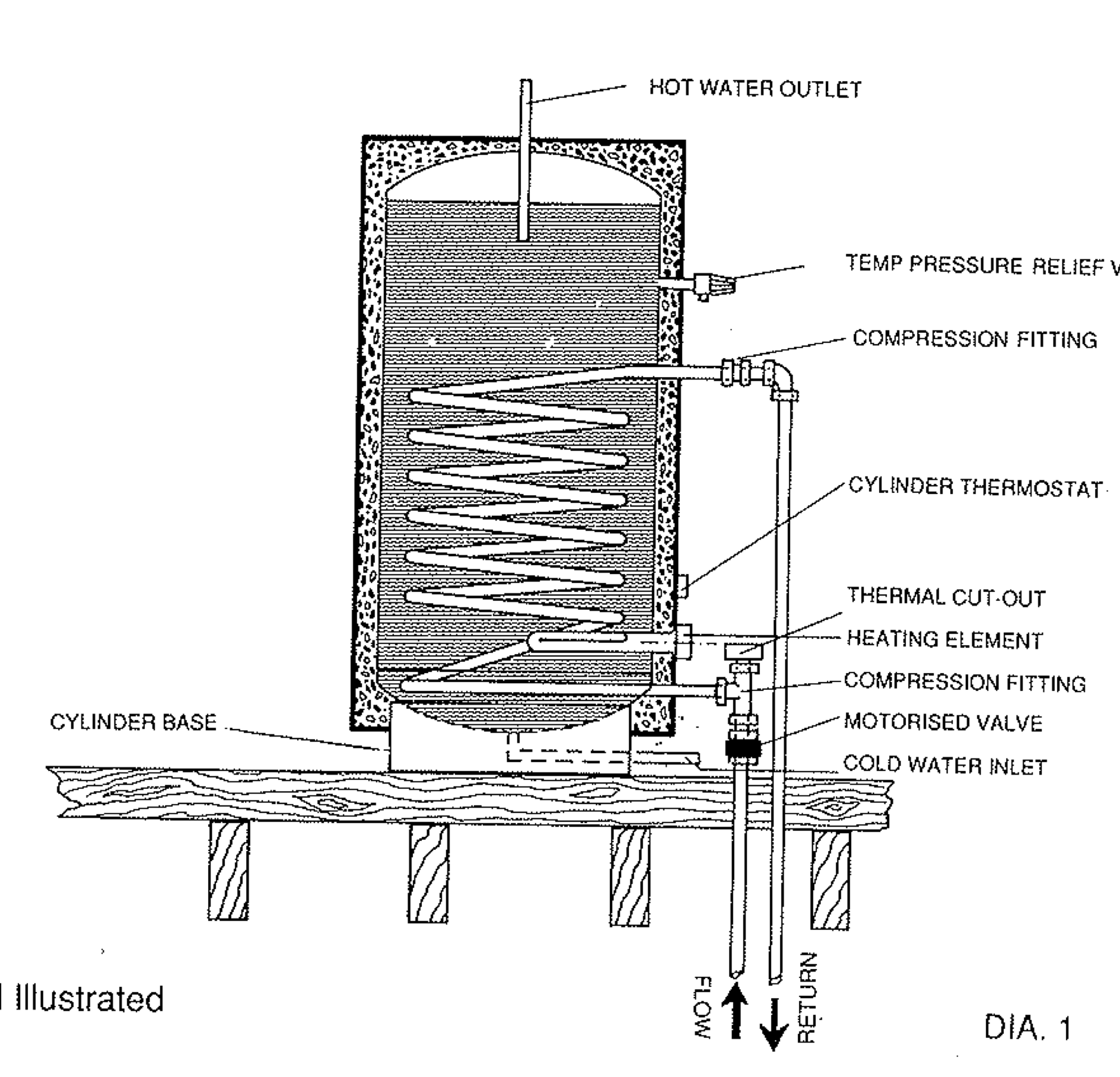
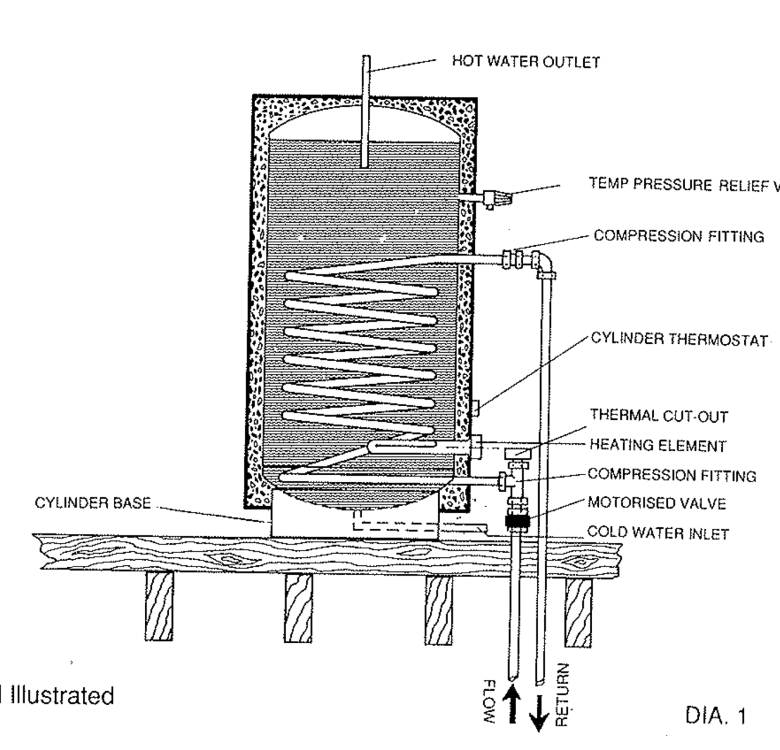
This is an indirect tank. The boiler does not send hot water into it. It sends it into a coil that heats up the water in the tank. However, the coil is around half the height of the tank so will heat up most of the tank. The warmer water will take a while to rise inside the tank so the immersion will cut out when only some of the tank is hot. A 210L tank is not very large. It could conceivably be cooled considerably by two showers. 2 showers could be 150ish litres of hot water and the tank would be filling up with cold water and cooling down. What you may be noticing is that the immersion can only heat up 50l of water an hour, but the boiler can heat up 400l. If you spent 10 minutes in the shower and used 75l of hot water, the boiler could almost heat the water as fast as you were using it. Thus the water will not cool down anywhere near as much when two people have a shower and the boiler is on versus the immersion.
-
Manual here - https://mediacdn.heatraesadia.com/-/media/themes/heatrae/literature/discontinued-literature/megaflo-cl-installation-manual.pdf?v=1&d=20170629T112101Z The heating element is at the bottom behind the cover.
-
As @Radianpointed out - A Megaflow cl210 has a 24.3kW heating coil connected to the boiler versus a 3kW electrical heating element. A 3kW element would take 2 hours to heat just 100L of water from 8C to 60C. So 1 hour on the boiler would put roughly the same amount of heat into it as 8 hours from the immersion. On top of that the heating coil will be much larger than the heating element. Thus the heating element will tend to heat a more localised area within the tank before cutting off when thermostat is tripped. I have a Eddi PV diverter and the same thing happens. It cuts off before the full tank is heated up as the water around the immersion has hit the thermostat temp. One thing you could check is the immersion itself has its own thermostat. This is a little arrow on e Megaflow element. If this is not at the maximum level it will cut out early. The maximum it can be set to is 60C which may be another reason it cuts out earlier than you expect. I would set the main tank thermostat lower than this so that it tries to heat from the immersion first.
-
Ask them to give you the floor specification so you can check if it meets the requirements of the building regs and if it has been built to spec. It’s not an enormous job to fix this. You could simply double board it (put another layer or plasterboard on top of the existing board). However, I suspect insulation next to the pipes would be more helpful in reducing the sound of water. If you were going to double board it you could cut holes and push insulation up inside around the pipes as these would be covered up by the new boards. It’s not going to be cheap. Putting boards up isn’t expensive but then they will need taped, filled and painted. Also you would have to refit the lights.
-
Worktop overhanging on flush handless kitchen
AliG replied to revelation's topic in Kitchen Units & Worktops
I just checked ours, it overhangs by 2-3mm. If a large amount of liquid is spilled 90% of it goes down the front/onto the floor. 20mm is surely going to result in scraped knuckles. Putting handles on a handleless kitchen is a non starter. I would be asking for a new worktop. I guess the argument comes in to whether you were told/asked about the overhang, was it shown on drawings you signed off etc? I think that is a laminate worktop, so presumably they cannot cut it down. -
My parents had issues in their previous flat in Scotland with sound traveling between the floors. The builder just said that they met the specification. Again though It seemed like they didn't have to actually test individual homes. I think I posted a link before to the British Gypsum Whitebook which gives the specifications for all kinds of partitions. https://www.gyproc.ie/sites/default/files/Gyproc White Book Feb 2021.pdf Timber joist ceiling inför starts on p427. This is also useful - see p8. https://www.rockwool.com/syssiteassets/rw-uk/downloads/regulations/technical-guidebook-domestic-section-5---noise---scotland.pdf I suspect that you have timber i-joist floors. This is what our old cala house had.To achieve 43dB reduction you need 12.5mm acoustic plasterboard plus 100mm of rock wool. Alternatively you could double board the ceiling. Thus I would check that your ceiling is to this spec. When I Googled this I saw a thing fromEgger suggesting that you could achieve 44dB with their flooring, no insulation and 15mm acoustic plasterboard to save money. It may be that you have something like this. The problem with no insulation will be, in particular, that you will hear water in any pipes in the floors and walls. The other way that sound travels is even when the specification is correct, builders just drill and knock holes all over the place to get pipes and cables through. You may find that by taping or foaming up any holes like this you will considerably reduce noise transmission. This is usually the main way that noise travels.
-
It was an aesthetic choice, although it did in places make routing the MVHR easier. We have the stepped ceiling in three rooms. I had just seen it and thought it was a cool feature. Ceilings are similar height to yours, usually around 2.75 with a small void above. We have concrete plank upper floors and did not realise that these are not flat, so had to drop the ceilings down from them more than expected to create flat ceilings. Intended ceiling height was 2.8m.
-
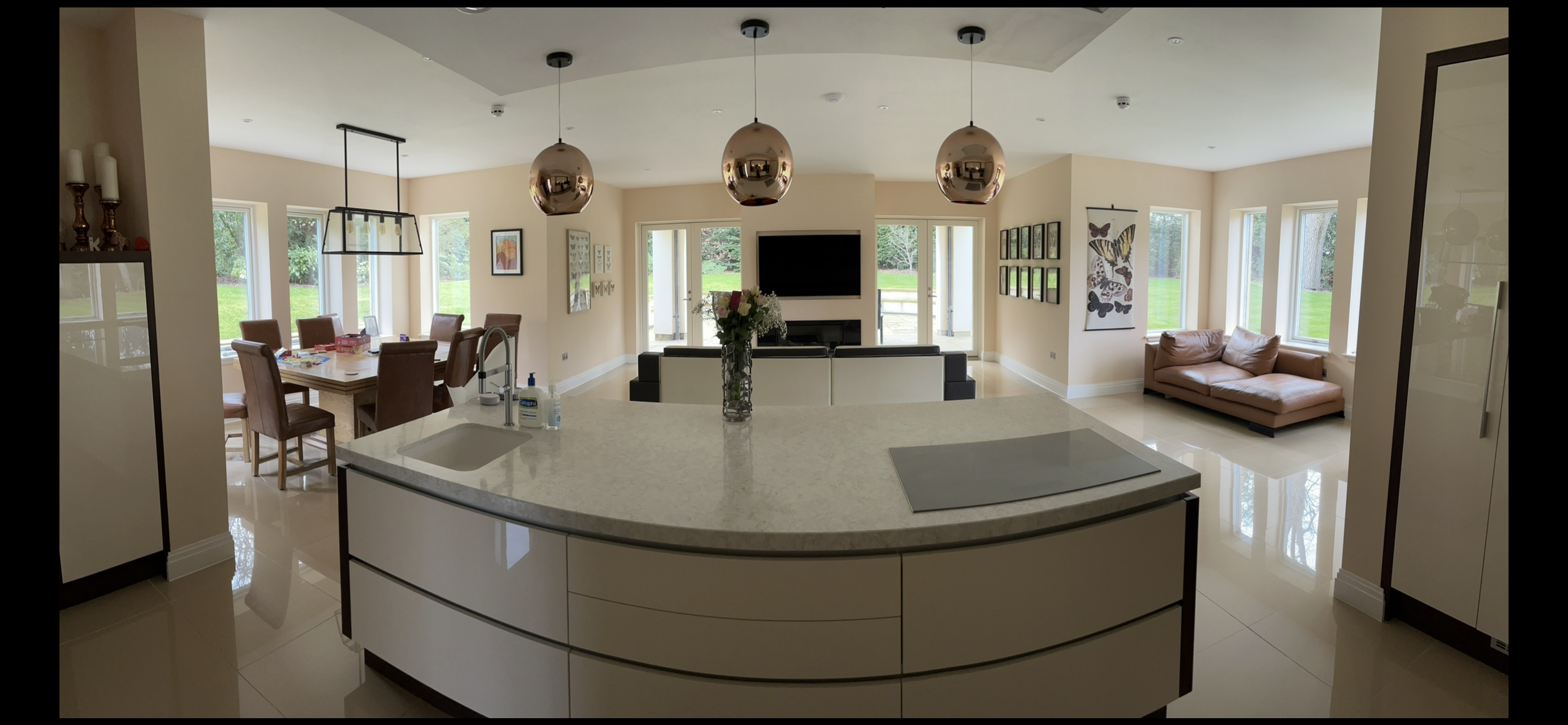
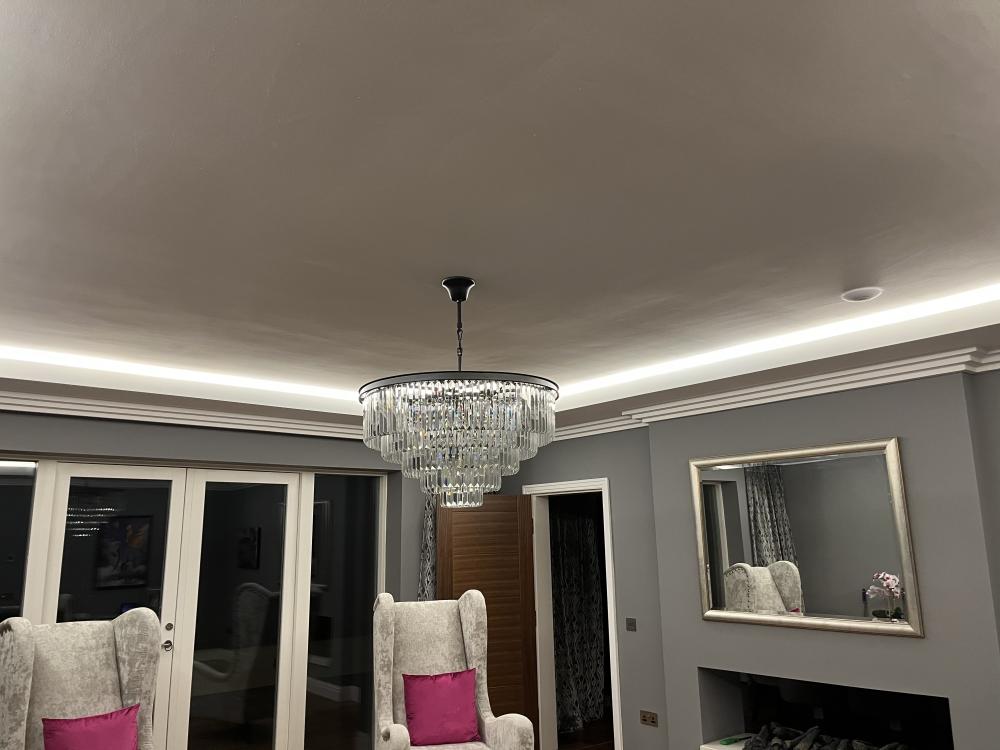
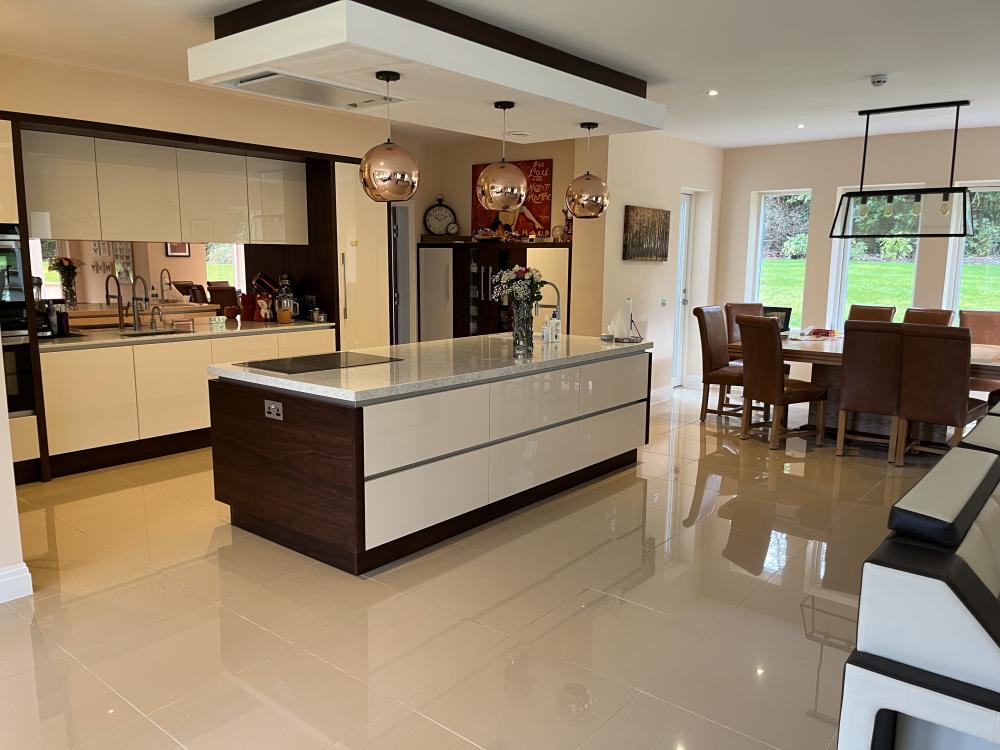
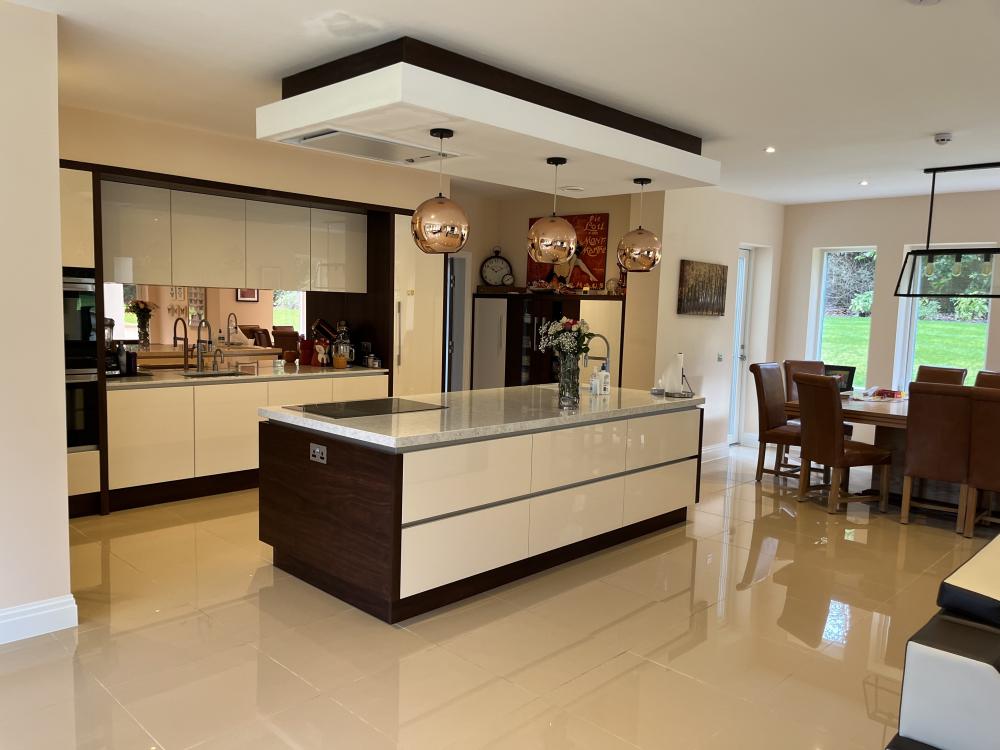
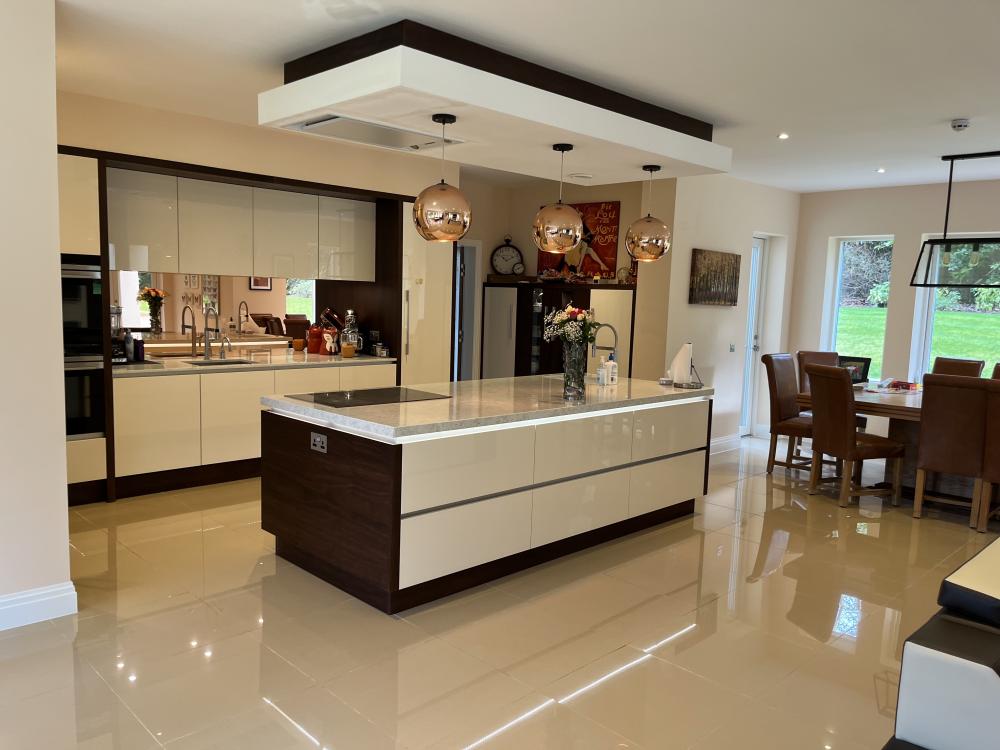
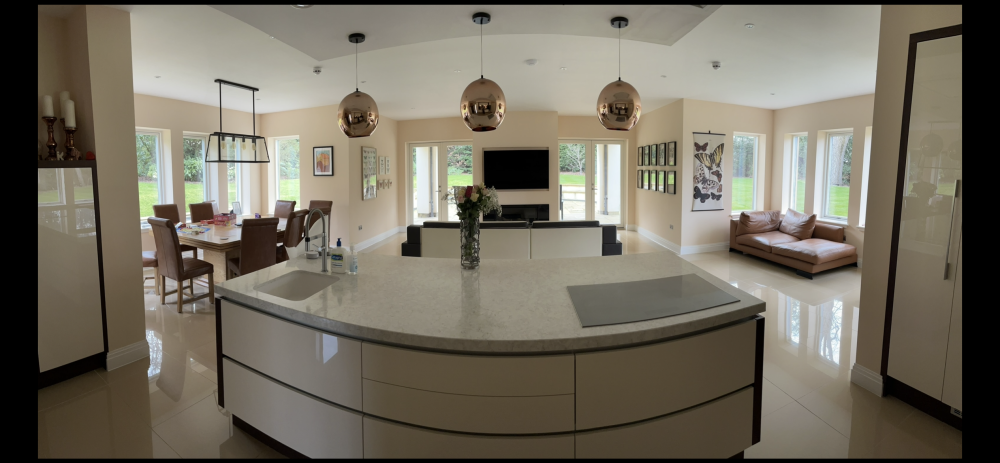
The wings of the kitchen are 2m deep. It is 10m across so the centre of the island is over 5m from the nearest window. But the inside edge of the table is only 2m away and even at that point it is already considerably darker. The ceilings have a step with the sides 150mm below the centre and LED strips inside them bouncing off the ceiling.
-
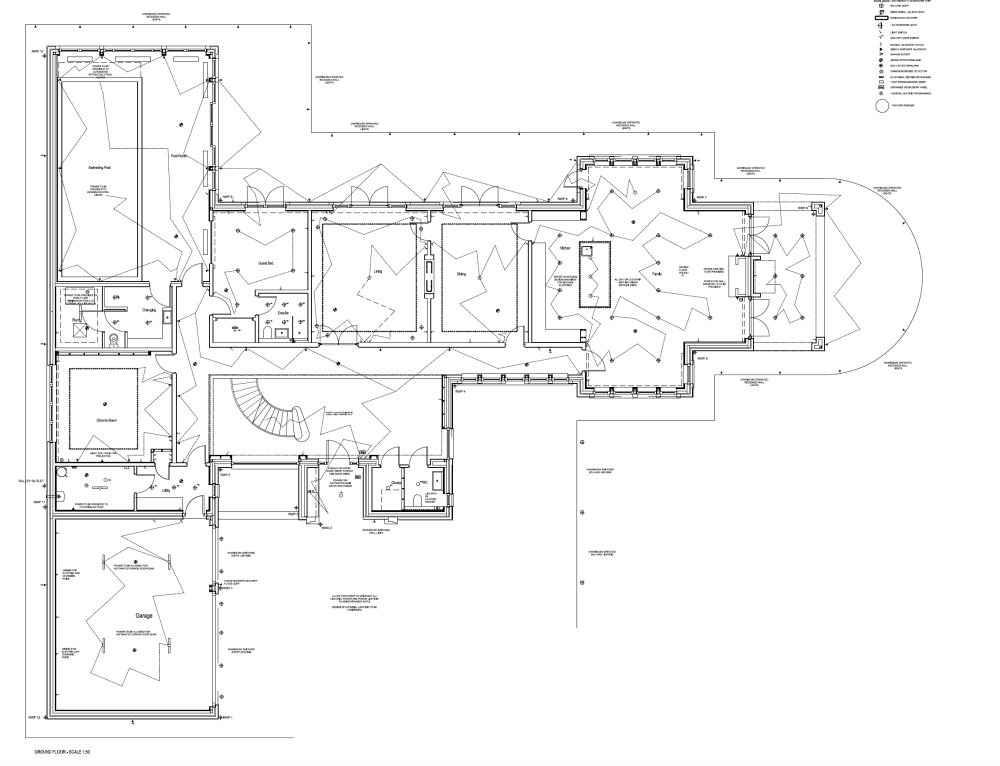
Long time since I posted these, i found one with the lighting plan n it. I did all the lighting plans myself, it took a long time - The kitchen lighting plan is correct here, there were some changes to other rooms after this. It is very dull and raining today. Yesterday was a bit brighter. 1. Lights off - Table close to windows - 170 lux. The lux level varied between 190 at the window edge of the table and around 90 at the other side, showing how quickly it drops off as you go into the room. Island - 30 lux 2. Lights on behind island and table - Table - 220 lux Island - 160 lux 3. All ceiling lights on - Everywhere in the room was between 190 and 220 lux.
-
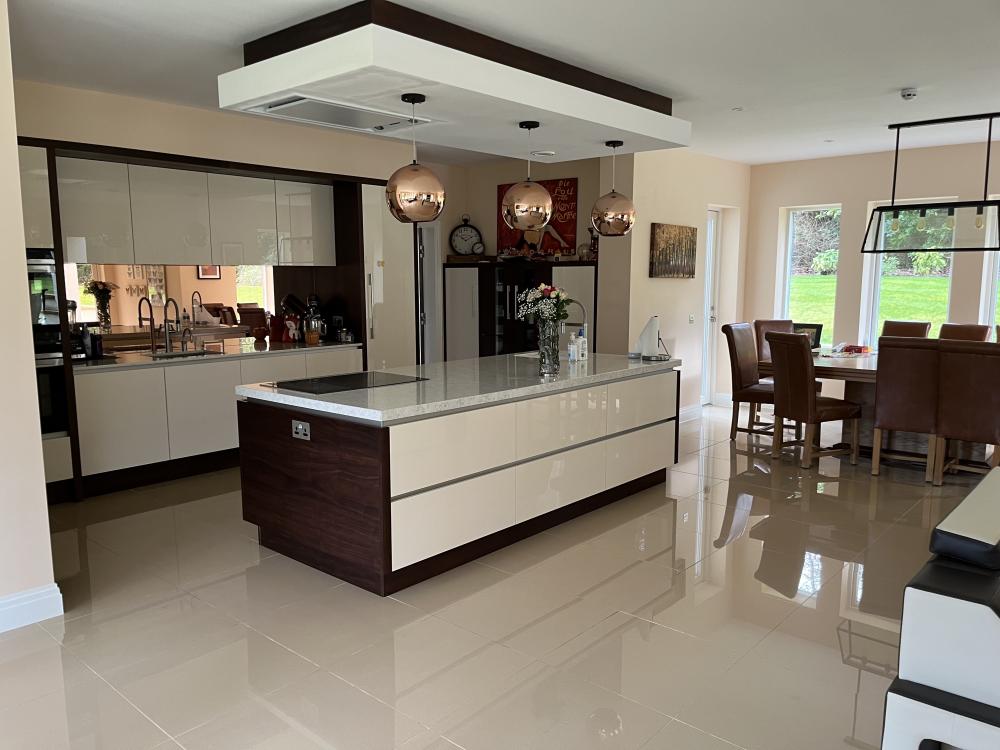
I just took these. 3pm and cloudy. The widows you see face south east, the sun is currently southwest. All three side of the kitchen have windows except where the kitchen is In order these are 1. No lights 2. Lights between the island and worktop and in the wings to the kitchen. 10x 5w GU10 3. All ceiling lights, adding in lights in the sitting area. 16x 5W GU10 4. Ceiling lights plus under cabinet and above island lights. We use number 2 nearly all the time. If it is sunny outside, you can sit at the table without the lights on, but it is never quite light enough on the kitchen area to work. If it is very sunny and in the middle of the day, I notice that there is no difference at the table between lights on and lights off, but by that point someone has nearly always turned them on. We basically never use the under cabinet lights or above island lights, we do almost all prep work on the island. I split the lights into two circuits, kitchen/entrance/table area and sitting area. I never turn on the sitting area lights, my family always turn on all of the lights. By my calculation, the kitchen lights use more electricity than all the other lights in the house put together. This reflects spending a lot of time in the kitchen plus GU10s being a less efficient way to light an area so the kitchen have more bulbs to get a similar spread of light than other rooms. I added a picture of the whole room with no lights on. I think it quite clearly shows that light doesn't penetrate much more than 2-3m into the room from the windows. If I was redoing things I would also have put a couple of GU10s directly above the island, although it is well enough lit by the ones around the island. I would say it is much brighter above the island with just one set of lights on which I don't think the picture captures well.
-
Our kitchen has lots of windows, but none near the actual kitchen area. i find that we always need the lights on when working at the island and I think you would be the same here. The pictures look like quite an accurate representation of how it would look when I think about mine. You really need overhead light in the kitchen area and the angle from the window and sky lights would prevent that happening. Part of it is personal as i like it to be bright. I would probably have a grid of 12 LEDs above the kitchen area.