
Dreadnaught
-
Posts
1806 -
Joined
-
Last visited
-
Days Won
5
Everything posted by Dreadnaught
-
Yes, quite right, we will be removing two small trees that are within the footprint of the dwelling. Just to be clear, there are no other trees on my plot. The big chestnut tree is just across the fence.
-
I appreciate your frank comment but overall I am confident we'll find a way to work within the root-protection area. I think I have chosen a good practical arborist. And we have already had one site meeting with the LPA tree officer (with one more to go). Lets see if it will drive me to distraction! I am no expert of course but I believe that the RPA has indeed been defined in the AIA* according to the standard that cite. The AIA was a key document in obtaining the planing approval. And now that I have panning approval, the next step is to write the full AMA* and TPP* and have them agreed with the LPA tree officer. Fully agree. Hopeful of retaining use for storage of a substantial area within the RPA. Sounds about right for this tree. It is a big fat old chestnut. * AIA = Arboricultural impact assessment. AMA = Arboricultural Method statement. TPP = Tree Protection Plan.
-
Obliquely related to this, I do have a planning restriction to replace a tree as follows… You describe my chestnut tree precisely
-
As I mentioned in my last post, as one of my very first actions I feel that I need to talk to my arboriculturalist. I think that many subsequent decisions depend on his answers. My small plot (20m x 20m) has a chesntnut tree on its border and its roots are to be preserved. Those roots spread under about half my plot. And it is the half between my access gate and where the dwelling will be so exactly in the wrong place. Everything will travel across the roots. And the root zone is almost also the only location on the plot where I can stoer things during the build (other than inside the dwelling of course). I have a whole host of questions for my tree guy, I have a couple of possible routes across the plot for the drains and services. Which is the better one for the trees? When it comes to the build, how can I arrange storage on site without damaging any tree roots? For example, the plot has an existing area of old block driveway right in front of the gate and over the roots. Should I keep it and use it for storage during the build? Or lift it out and put some other root-protection surface down instead? Should I take any root-friendly precautions when I clear the plot? I am having screw-pile foundations but how deep can I scrape and level the plot, particularly as I have about 40 cm of height difference across the plot (lumps and bumps, not a consistent gradient). When to clear the vegetation (otherwise known as “the jungle” from the plot)? Any precautions to take? How to stop weeds regrowing. There are quite few derelict low-level brick and concrete structures on the plot, mainly consisting of the foundations for long-since-gone greenhouse? Should I just rip everything out, or should be concerned about tree roots in doing so? In particular there is an old concrete water tank sunk deep into the ground (like a water butt from the ‘50s, about 1 meter square, open to the sky). It has what seems to be a land drain running into it. What to do with that?
-
My first jobs after my planning approval are to: (i) choose a timber-frame supplier; and (ii) arrange a conversation with my arboriculturalist. This post is about the (i). The next post will be about (ii). Timber-frame suppliers: I am in touch with the usual names known to this forum. Not sure if I should be naming names here. Six in total. Two companies supply panellised frames with a range of insulation levels, including open panel and double stud. Two companies supply I-beam-based frames, one of which is a company local to my plot in Cambridge, just 30-min away. One company provides a passive-house certified I-beam frame but as a pre-cut kit, complete with all tapes, etc. Frame erection would be by my own team. Quotes from them all are due by next Friday. Some random thoughts on my choice … The local company proposing an I-beam solution is interesting. Its a solution they use for school classrooms: I-Beam walls and roof filled with rock wool, although I see no reason in principle why the rock wool could not be replaced with blown cellulose. Airtightness using SIGA tapes & membranes. My dwelling is very simple in form (a simple L-shapted bungalow with a flat roof about, 125 m²) so when the rep from the this company saw that he immediately suggested this solution. Looking forward to that quote. My plot has problematic access: small plot, about 20m x 20m, a narrow 45m access road, mature tree overhanging the only gate, no space for a big crane. So a non-panellised I-beam solution has its attractions, although I suspect I am over doing it as one of the panel-based company seemed to think they could manhandle the panels on to site pretty easily, especially for such a relatively small build. The passive-house pre-cut kit supplier is also interesting. They provide everything from frame design to foundation design to PHPP and the kit includes Austrian passive-certified windows and MVHR system too, as well as the I-beams, all membranes and tapes, and all to a single firm price. They also include training sessions for your contractors. If I went down the route of a stick-build, albeit pre-cut I-beams, I have met a carpenter who is doing exactly such a build at present and using the pre-cut kit provider above. He has expressed an interest about possibly coming onboard in the spring and thinks he could erect the frame in 3x weeks. That sounds quite interesting as an option. As you can see I am mid-decision and still thinking through the pros and cons for my particular circumstances.
-

I built a new house today...
Dreadnaught replied to NSS's topic in General Self Build & DIY Discussion
Next we'll see a roll of airtightness tape in his mouth … -
I have just got my planning approval 2-days ago. My 26 weeks date was back in about July (!) but they never asked for an extension. I think it was an oversight on their part because of a change in planning officer. Yesterday, a day after the planning meeting, I received an email from them inviting me to retrospectively approve a planning extension (!) which I politely declined. I am going to ask for a refund as soon as I get the signed planning letter through. A few weeks ago I did mention the possibility of a refund to my planning officer and he said they might refuse because I supplied some key documents within 26 weeks of this final decision. I don't think that is in accordance with the Planning Guarantee and the wording of the regulations, which requires an extension to be agreed in writing, so let's see what happens.
-
Planning permission … the journey to it … and thanks!
Dreadnaught commented on Dreadnaught's blog entry in Under the Chestnut Tree
Thanks @Mr Punter and all the regulars here. Mine will certainly be a BuildHub build, all the way through. -
Planning permission … the journey to it … and thanks!
Dreadnaught commented on Dreadnaught's blog entry in Under the Chestnut Tree
Thanks @Mr Punter. Good advice, appreciated. I have to admit to being wary, hence the wish to de-skill as much as possible, do as much myself as I can, and be close to the detail of everything. This is not related contractors as such but Its interesting to note that at even at this early stage, without having broken ground, I have already experienced two occasions on which experts have blatantly tried to take advantage of what they assumed was my lack of knowledge to over charge (and who knows how many I didn't spot). As the spend now ramps up, I suspect I am going to doubly vigilant (perhaps to a fault). -
Planning permission … the journey to it … and thanks!
Dreadnaught commented on Dreadnaught's blog entry in Under the Chestnut Tree
Thanks @PeterStarck. I'm hoping for foundations and frame in the spring next year. Weathertight as soon as possible thereafter. And then probably at least a year's worth of first fix, second fix, and finishes. So completion in summer 2021 would be a pleasant surprise but won't be rushing things and happy to go slower. My getting-my-hands-dirty approach will be nothing compared to what you achieved! I will be using the trades regularly but doing the bits I can. But I am also trying to design the build to be as simple and easy as possible. For example, I am keen to use no-wet-plaster approach if I can. And I am choosing a brick slips system for cladding that does not require a skilled installer, let alone a brick layer. -
Planning permission … the journey to it … and thanks!
Dreadnaught commented on Dreadnaught's blog entry in Under the Chestnut Tree
Haha, what an idea! What public accountability! Building-the-Dream and Charlie-Luxton style. My budget is more of a cost tracker. Its a complex spreadsheet where each figure is matched by a confidence rating. As I learn more about a given item, drywalling for example, I increase the its confidence rating. That then can be summed to a bottom-up total figure for the cost of the build. Currently about half the items in that sheet are nothing more than guesses. However, another way to answer your question is: £360,000. That's a top-down figure. That's the target figure to ensure the land + plot ≤ to the sale price. So that is about £2,400 per m² for the build including everything except the plot cost. It includes, for example, the conveyancing costs, planning permission costs, and the proverbial kitchen sink. My bottom-up figure and my top-down figure have a current gap of £9k, which is in effect the current contingency amount but that has been shrinking as I learn more. At present I intend to be hands on a do as much as I can DIY. Whether that intention will survive even first contact with reality remains to be seen. On the time/cost/quality triad I am firmly aiming for cost and then a sensible compromise between quality and time. -
Planning permission … the journey to it … and thanks!
Dreadnaught commented on Dreadnaught's blog entry in Under the Chestnut Tree
Oh yes, good idea but the plot looks rather like a jungle at the moment. I live about 2½ hours away from it so I haven't been a dutiful gardener. -
Planning permission … the journey to it … and thanks!
Dreadnaught commented on Dreadnaught's blog entry in Under the Chestnut Tree
Thank you! Not at all sure. Have lots of pre-commencement planning conditions to sort out and a I need to design the timber frame and the foundations (screw piles). Now that planning is in the bag, I need to reorientate myself towards these tasks. If I can achieve it, I am keen for the timber frame to go up in the spring. -
Planning permission … the journey to it … and thanks!
Dreadnaught posted a blog entry in Under the Chestnut Tree
Good news! I today obtained planning permission and so I am starting my build blog. Thanks to everyone on BuildHub for your help and support so far. I have already learnt so much from this forum, all the way from questions when I was viewing the plot and every stage since. And an especial thanks to all the Buidlhubers that I have had the pleasure to visit so far. You have all been warm and welcoming and your advice and inspiration has been invaluable. Thank you! Thank you! My plot is in Cambridge, quite central, near the banks of the river Cam, just behind a row of college boathouses. It is opposite an ancient common and in a Conservation Zone. It is a garden plot that constituted the end of the long garden of a large late Victorian villa. Access is from a narrow access road (not owned by anyone) which runs behind the the boathouses. The plot itself sits behind a mature horse chestnut tree, whose roots I must preserve. The plot is is about 300 m² and is in flood zone 2. The dwelling will be a modern bungalow, 2-bedrooms, near passive house, with a green roof and clad in buff brick slips. Here is the timeline until today: 10/3/18, first visited the plot, advertised in Rightmove as a house. 13/4/18, my offer to buy it was accepted. 24/4/18, I made my first visit to BuildHuber to start my long learning journey 29/4/18, visited my second Buildhuber 31/5/18, the plot already had planning approval but before buying it I started a process for a re-design with the seller 4/7/18, visited my third Buildhuber 26/7/18, visited my fourth Buildhuber (and watched her build, with five additional visits to date) 19/8/18, visited my fifth Buildhuber 6/9/18, I finalised price negotiations with the vendor 18/9/18, plot topographic survey 26/11/18, submitted for planning permission 17/12/18, completed on the purchase of the plot 7/1/19, planning application formally accepted by council 11/2/19, visited my sixth Buildhuber 26/2/19, consultations revealed I needed to redesign the pitched roof to be a flat green roof to meet SUDS requirements 12/3/19, met the tree officer with my arboriculturalist on site 30/3/19, taking advantage of a neighbouring development having the road open, I installed a temporary electricity supply to the plot 2/4/19, engineers supplied drainage calculations including green roof 6/6/19, vendor approved the revised design with flat roof (deed's required it) 20/6/19, visited my seventh Buildhuber 29/7/19, visited my eighth Buildhuber 23/8/19, visited my ninth Buildhuber 19/9/19, council advised that my application is scheduled for the 2 October planning meeting 24/9/9, council advise that my application was bumped to the 6 November planning meeting 6/11/19, planning application approved unanimously, with two councillors choosing to comment that they particularly liked the design. One objector spoke against. Next step: build a house … -
Thanks Russell, looking it up now. Appreciated!
-
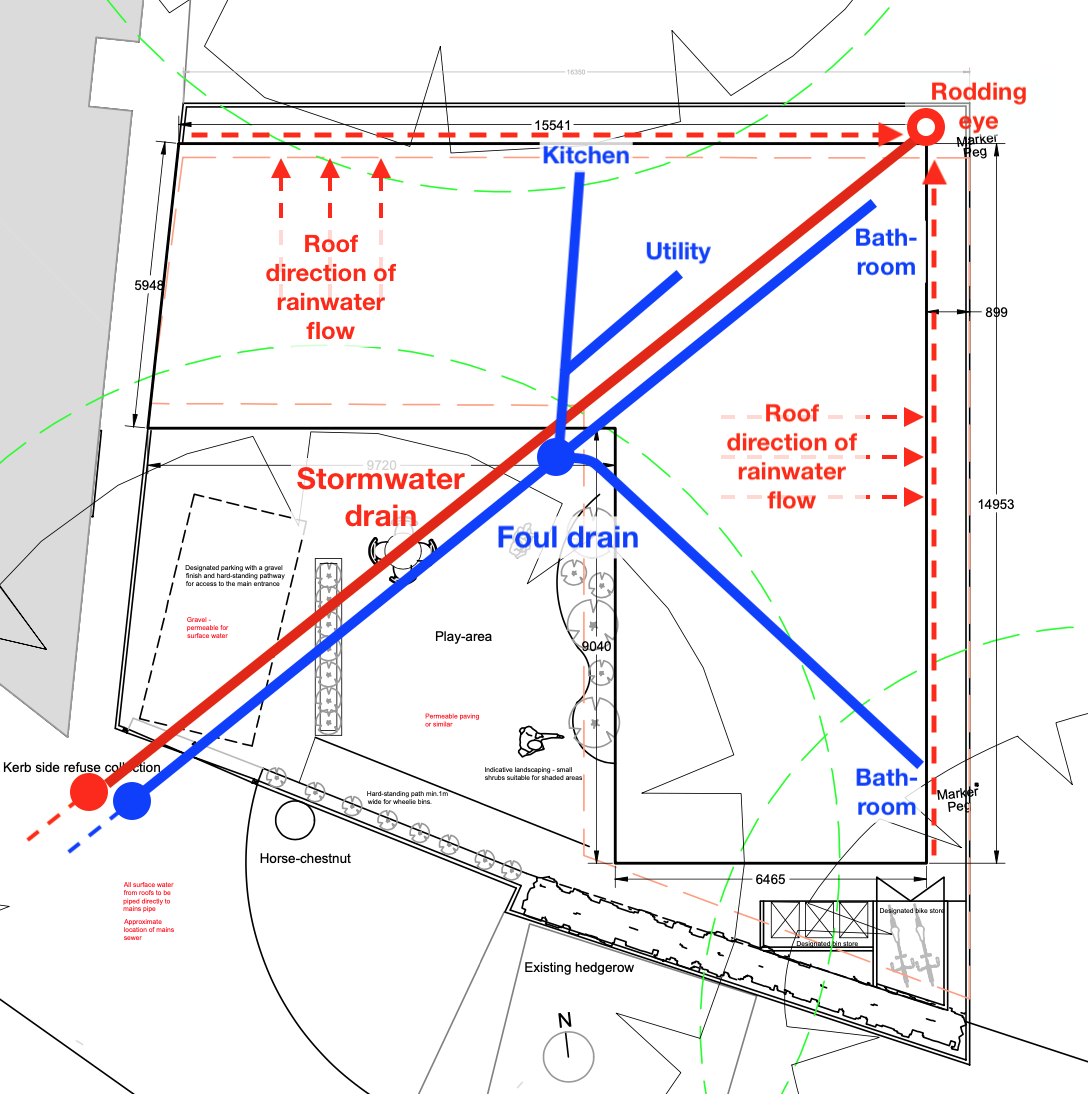
Thanks @Bitpipe. Electricity is already in. I took advantage of neighbouring development to buddy-up and have it connected when they had the road open. I have attached it temporarily to a fence as a TBS. I am assuming I will need to pay to have it moved again into the house but I honestly have not given it thought yet. Good point about the DNO perhaps wanting to look in the trench. I have made a note. Re fouls, yes falls look OK. There is a slight slope on the plot in my favour and the foul sewer in the road is quite deep (1.2 m). Rainwater will be discharged to a stormwater sewer in the road, which is next to all the other pipes in the access road. No soakaway (in fact months of work, and the addition of a green roof to the design, because there was no possibility of having a soakaway). Only concern with the SW sewer is that sewer it looks to be concerningly deep (2.2m) so will need quite a hole. My plot is quite orderly in one respect. All the services, without exception come on the plot together in one corner and my utility/plant room is at the diametric opposite corner, as is the single downpipe from the gutters from my flat roof. A mammoth trench connecting the two points appeals to my sense of orderliness D. (TBS = "temporary builders supply" of electricity).
-
Fascinating. Which boards are you using? Anything exotic like Habito or just plain old plasterboard? Really sorry @Visti, don't want to hijack your search for a contractor.
-
Fine question. Three reasons. (1) the trenches on my plot need to be dug by hand through and tree-root preservation zone, watched over by an arboriculturalist with his meter running, so keen to make them as simple as I can; (2) I realised everything will start from one point and generally needs to end at roughly the same point within the house; (3) I like neatness and simplicity, . What do you think?
-
Out of interest, why was it perforated duct? I assumed those were used only for drainage solutions.
-
Yes, make sure you can gat the CAD files and that the architect is OK about the IP (they should be). Regarding IP, the principle I have encountered is that it is OK to use the design from your architect for the purpose intended without their further involvement (i.e. building that house in that location). Its not OK to then sell it on as a generic solution to others. That would breach the architect's IP rights. Getting the CAD electronic files can be trickier. I have them for my build. Added: I agree with @Sensus. Ensure your agreement with the architect entitles you to receive the CAD files. Some architects may baulk at this, in which case move on.
-
@Oldsteel I tried an attenuation tank as an option but I could not bury it on my site (no dig restrictions), it would have been sitting on the surface. It was rejected as a solution by the council SUDS-person as being a potentially temporary structure. I imagine the your tank will be buried and thus will be an undoubtedly permanent solution and so cannot not fall foul of such an objection.
-
Sorry I can't help with a specific contractor recommendation for you, @Visti. My impression was that any drywall contractor could do it but that they will inevitably grumble. I have heard of some bodge jobs so, like you, I'd be certainly be looking for someone who'd had some experience with it. Generally. I am interested in your decision, I am seriously considering Fermacell myself, because of the lack of the need for any plastering, but in my case I am tempted to try and DIY it as I have the time.
-
Which foul drain runs is better, red or blue?
Dreadnaught replied to Dreadnaught's topic in Waste & Sewerage
Good point. It is not an adopted road, indeed it not owned by anyone, but it it is open to the public, although I shall be the only regular car driver across it as just beyond my entrance there is gate blocking the road which I have never seen opened. -
Which foul drain runs is better, red or blue?
Dreadnaught replied to Dreadnaught's topic in Waste & Sewerage
Thanks everyone! Superbly helpful. Here's the new plan based on all your comments. Got it down to just 3x ICs (from 8x in the plan by the engineer). What does everyone think? Is it OK to have the ICs just outside my gate? Nobody owns the road. Would help to keep the IC's off my paving. The road is concrete. The gutters (shown as red dotted) are long, about 15m each. Is that OK with a single downpipe serving both gutters. I tried a few online calculators and think it is but not sure. Roof is 142 m². The foul run is 12m to the IC and then about 12m to the bathroom, so the max allowable. The rainwater run is about 24m, which seems OK as Part H says 45m max from rodding eye to IC (!). In the road, the storm main drain is alarmingly deep, 2.2m. The foul main drain is just 1.2m deep. Think I will need a trench box. Then I just have to convince the engineer to change his design and tree people to let me (hand-) dig nearer the chestnut tree. D. (IC = inspection chamber. Part H = building regs.)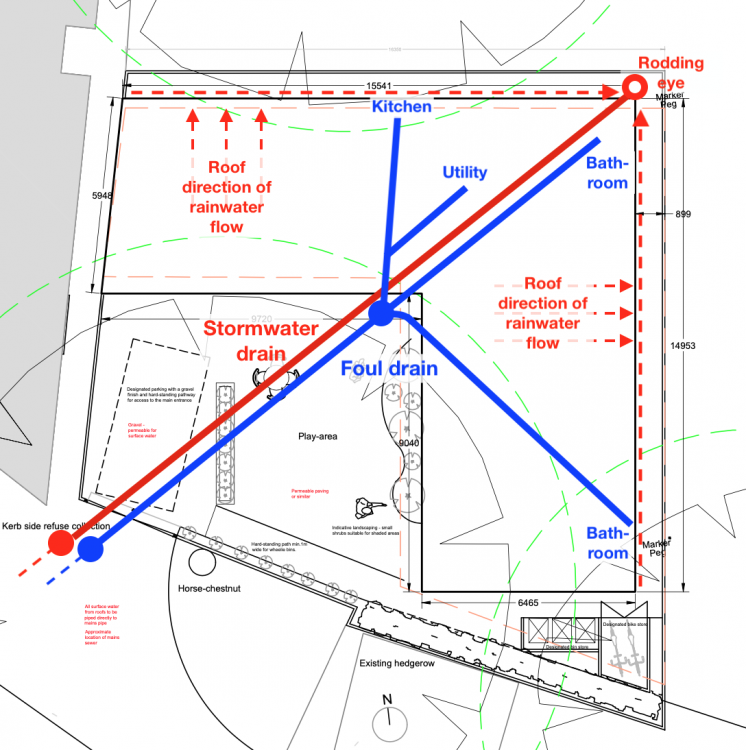
-
Which foul drain runs is better, red or blue?
Dreadnaught replied to Dreadnaught's topic in Waste & Sewerage
Yes, thank you @Bitpipe. My engineer initially specified four ICs for the foul drains and yet another four ICs for the rainwater drains, eight in total. With the advice from BuildHubers, I hope now to get that down to just two ICs for each, four in total, saving quite a lot of money and effort.