SteamyTea
-
Posts
23866 -
Joined
-
Days Won
200
Everything posted by SteamyTea
-
How have you setup the IP, dynamic or static, if static, how did you manage it in Jessie Lite? (I never tried to set up the eth(0) on mine in Jessie Lite after the disaster of trying to setup the wifi as a static)
-
You should have added another 50mm of insulation and stuffed any remaining space with rockwool, and then only heated to 50°C. How I got my losses down to about a 1 kWh/day. Two things that appeal to me about the Sunamp is that it is compact and easy to fit. I am about due a failure of my DHW cylinder as it is now 30 years old, 3 neighbours (50%) have had them replaced, so only a matter of time for me. A direct replacement in copper is about £400, but an Ecocent clone is probably about the same. Now I know the downsides of the Ecocent, but can mitigate them to a certain extent with some ducting and the mild weather down here. Just the seemingly high cost of the Sunamp that puts me off.
-
 Must be a couple of achers
 -
A lot of it will be down to the time between charging up and discharge, a short gap between them and there are less losses. I put a secondary timer on my E7 DHW so that it only heated up during the last 3 hours of the period, rather than the first few hours. I then generally used the water within an hour of it reaching maximum temperature. This reduced losses significantly, which increased efficiency.
-
That is near a makes no difference 90% at the 5 kWh limit 87% at 4 kWh It would be easy to get silly with efficiencies, especially if PV and a HP is incorporated in the mix (as Jeremy has).
-
Rock, Rock and more Rock
SteamyTea replied to Barney12's topic in General Self Build & DIY Discussion
Thanks, got a trip to Wickford at end of month, will be useful. How do a say 'they dropped her in that hole over there', it is a funeral I am off to. -
Are you putting in a few temperature sensors? May make for useful data.
-
If you set up a PI as a TOR router, is it still possible to log in remotely and be secure? I set one up a while back when I had 'proper internet' and could log in locally easily enough. Just wonder how easy it would be to log into when away from home. I know that this can be done via a VPN, but I am always interested in other secure methods, and it is hard to beat TOR at the moment.
-
I have known two people that have worked for Klargester. Being polite, they were both slapdash in their attitude to quality.
-
I think 4 of them now work at the bakers in Helston.
-
Why knowing what you need is so important. Time for a jug, a clock and a thermometer.
-
One thing to add (or is it take away) with the SunAmp is the cost of uncontrolled heat losses when compared to a regular water store, be it a simple E7 cylinder or an all singing and all dancing thermal store. My basic cylinder can easily loose 2 kWh/day (have since reduced this with extra insulation). But at 1 kWh/day and E7 at 8p/kWh, that is £30/year.
-
There is RHI on ST as far as I know. But then there are maintenance and running costs too. And a more complicated plumbing and storage design. First things first though is to measure your water usage, and energy to heat that, without that information it is impossible to make a proper decision.
-
That demo video reminds me of Blue Peter. "and some sticky backed plastic" I wonder what it is like to fit on a wet and grubby, let alone windy, building site.
-
https://www.youtube.com/watch?v=tML48HtUIS8
-
How about a decent pair of cushion soled shoes/boots. When I worked in toolshops, which all had concrete floors, some days after my drive home I could hardly walk (still have same problem in the mornings thesedays, but I am older), but found decent shoes made a big difference.
-
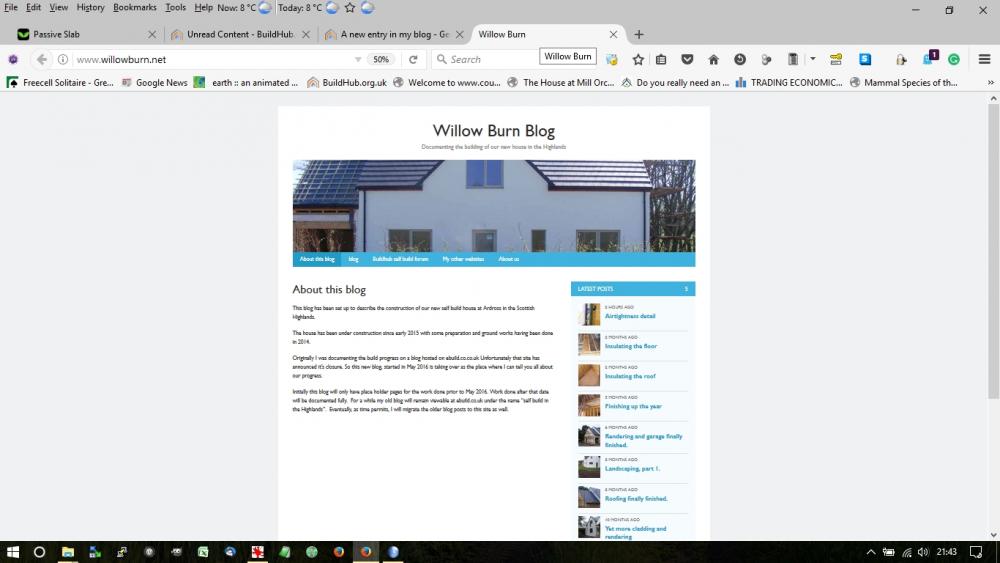
So that people know the difference, I have done a screenshot of Palemoon and then Firefox.

-
As long as it works, the rain and flooding in Cornwall is better than other places
-
Not going to look at the details, just ask a question (I have mains drainage that overflows onto a beach when it rains, makes a change from seeing dog turds). How well/easy is it to anchor to the ground? In other words, what is to stop if floating away if the ground floods?
-
Should I or shouldn't I go for MVHR?
SteamyTea replied to Archie's topic in Mechanical Ventilation with Heat Recovery (MVHR)
Why are you concerned about condensation? A condensation risk analysis should have been done when your house was designed. Also, what are the details between the SIP panel and the ground/floor, there has been much discussion about this in the past. -
Don't you want the glass to cover the top, stops rainwater pooling at the lower edge. Or you could just mastic on a second sheet of glass to totally cover it.
-
I don't think that heat losses from convection are much of a worry.
-
Generally speaking. PUs don't catch fire these days, they have a retardant in them as part of the mix (remember the Manchester Woolworth's fire 1979). If the celotex, or similar, is not in direct contact with the cans/tubes, then there will be little distortion/melting. http://www.talkcomposites.com/22732/celotex-in-a-composites-oven
-
I was told that you should never use a soldered joint on solar thermal. May be just on high temperature or pressurized systems though.
-
Take half an hour out of your life and listen to this: http://www.bbc.co.uk/programmes/b08n2v3f