SteamyTea
-
Posts
23866 -
Joined
-
Days Won
200
Everything posted by SteamyTea
-
From scratch. Was not that hard, i wrote up about it over at the other place. Probably time to make a Mk3 version with better fans and a cheaper to make exchanger. And add some logging gear to it. Having a bit of a complicated week or two at the moment, but should be back to normal soon. Then can get working on some ideas. Maybe the electronic boys can think up a simple fan controller that can be used from a Raspberry Pi. I have some thoughts on that too.
-
I made mine. Still up in the loft working away. I also have some other ideas on how to make it easier and cheaper.
-
 I shall let you know after she has popped out for a cuppa at mine
 -
6 and a half years on, not much has changed. What you are talking about here, I think, is an active system to pump in a bit of warm air when the temperature behind the tiles is higher than the internal air (or high enough to be useful). The first thing to work out is the resource you can use i.e. the total tiled area, the amount of air that can be passed behind it (the m3/min or kg/s), the expected temperature rise from some local weather data (try weatherunderground for a station with a solar meter). As for connecting it to the MVHR, I would think that plumbing it in after the exchanger would be the way to go. It may make the balancing a bit strange, but you would be pumping in fresh heated air, so the heat exchanger may be rather redundant during those times. Think of it as a positive ventilation system.
-
No, but your local off licence/drug deal does
-
See if your local library can get hold of a copy. They get some of them down here.
-
How much do you want to spend, and how much time do you want to spend on it. You could buy a few temperature sensors and wire them into a Raspberry Pi. Then log the temperature differences between the input air, the output gasses, the water input and the water output. Or just use a cheap infrared thermometer to do the same thing. Keep a record of the mass of anthracite you use for each burn. Fair bit of number crunching at the end, but simple enough to set up in a spreadsheet. http://www.engineeringtoolbox.com/boiler-efficiency-d_438.html You can possibly compare the amount of losses up the birds arse with this. http://www.engineeringtoolbox.com/fuels-air-flue-gas-d_170.html And http://www.engineeringtoolbox.com/stoichiometric-combustion-d_399.html
-
The export limit is there to stop over voltage on local network, nothing to do with stifling innovation. If too many people had high capacity systems, too close to each other, the voltage would rise above the maximum threshold. There is then no choice but to automatically disconnect those systems. No one is a winner then.
-
Bit here about putting in temperature sensors:
-
Modelling the "Chunk" Heating of a Passive Slab
SteamyTea replied to TerryE's topic in Boffin's Corner
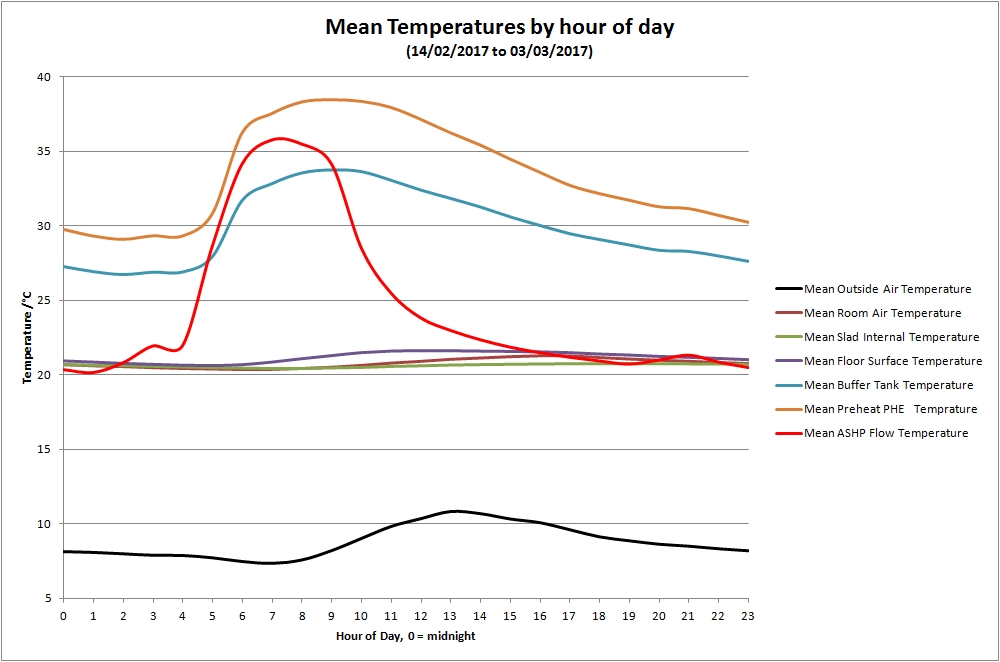
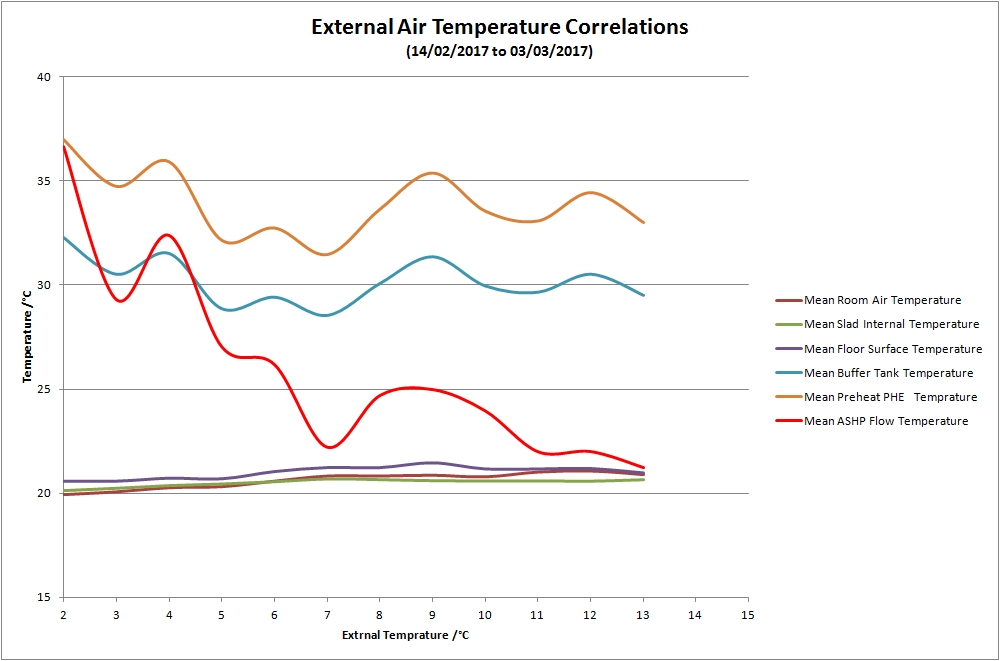
This is a good time of year to try things out as the sun is getting more powerful, and air temperatures are becoming reasonable. It looks like anything below 10°C mean external temperatures you need some heat input. This is probably caused by the MVHR hot being able to recover, at a useful temperature, as much energy. -
Modelling the "Chunk" Heating of a Passive Slab
SteamyTea replied to TerryE's topic in Boffin's Corner
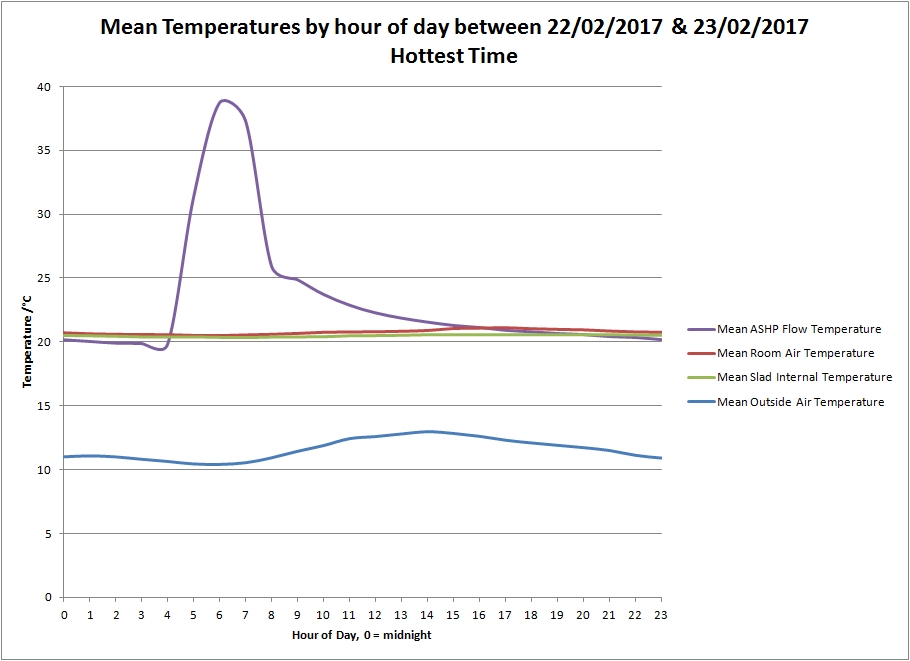
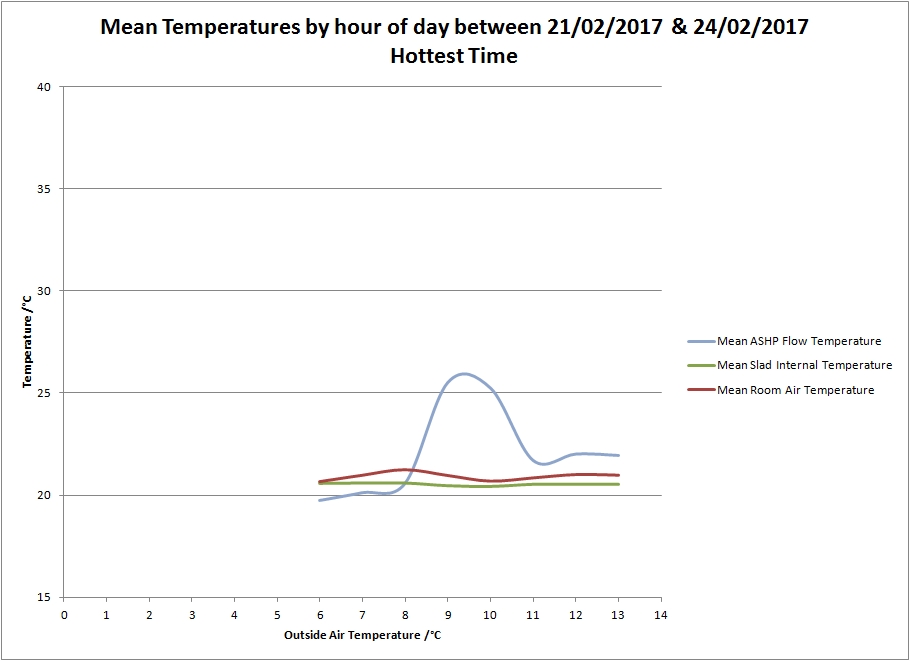
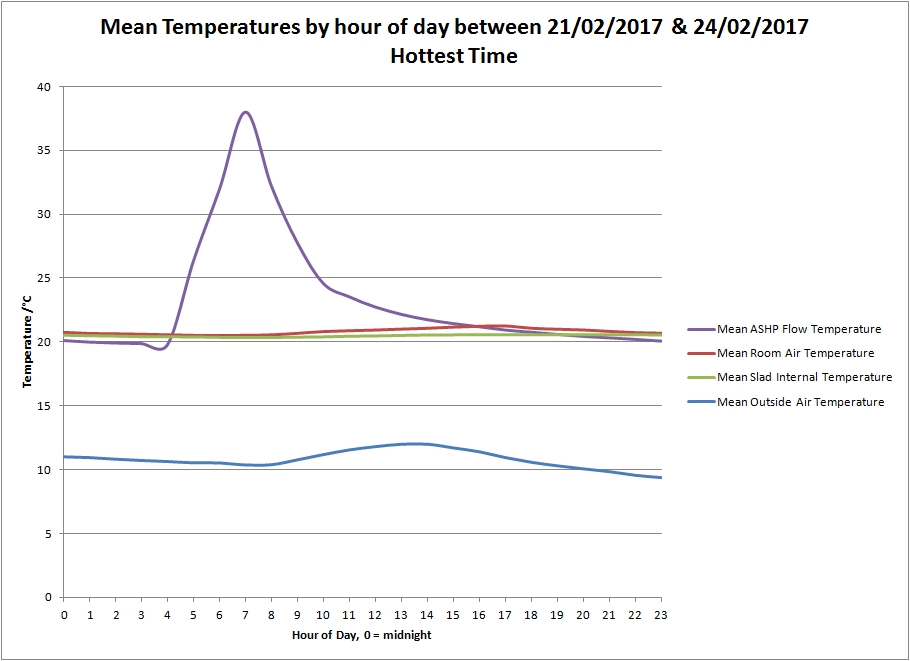
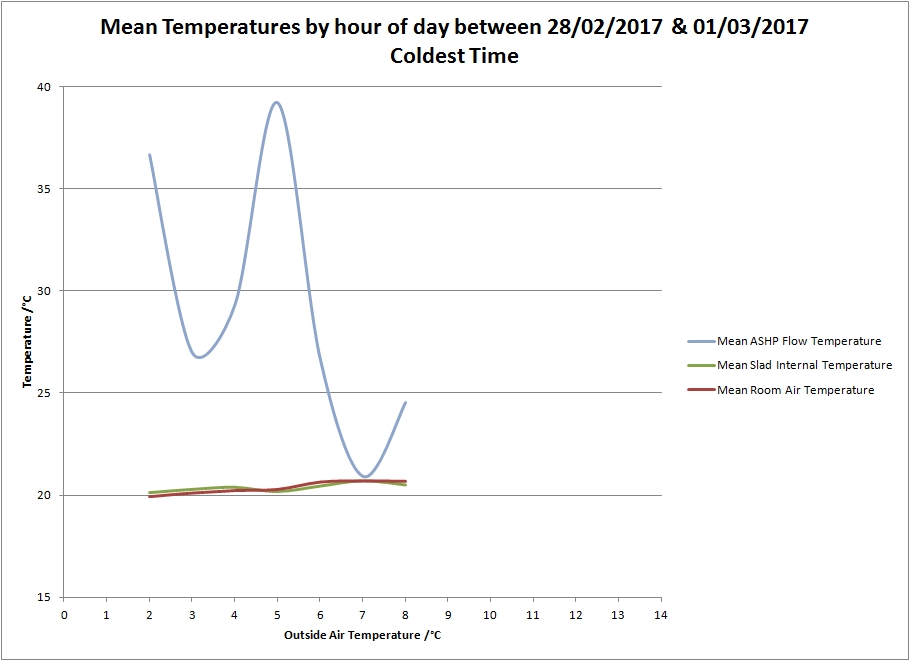
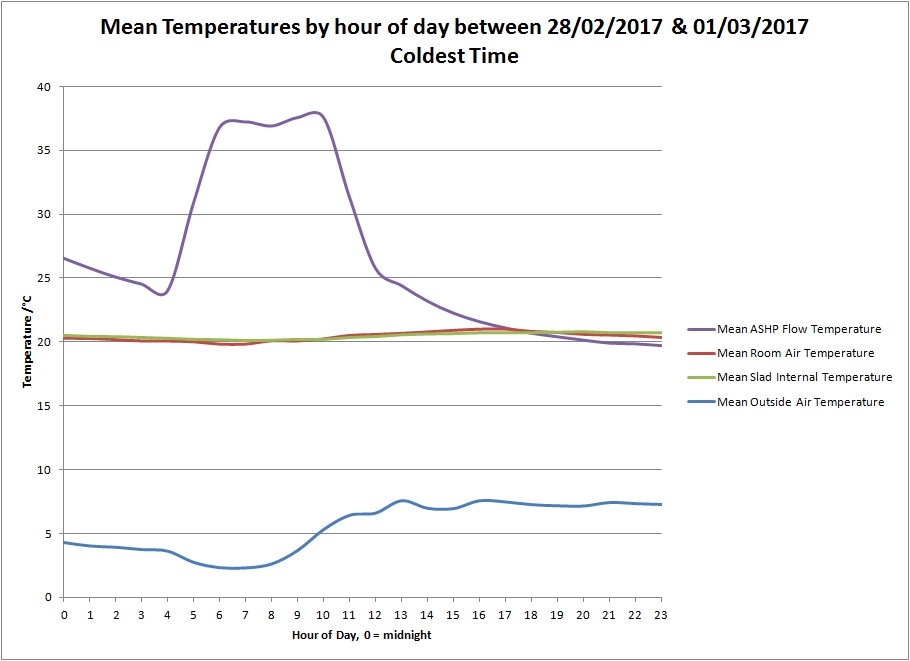
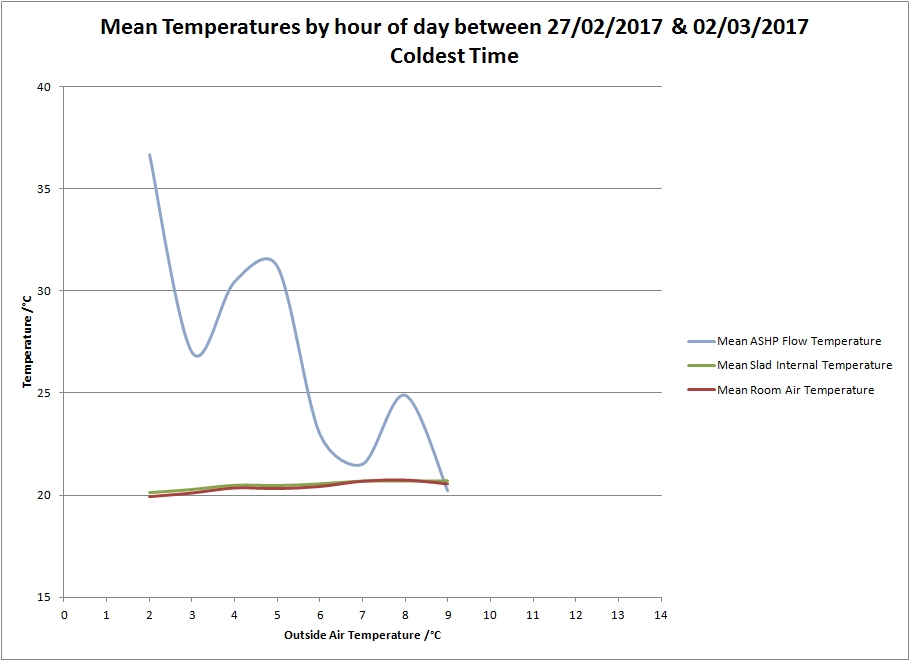
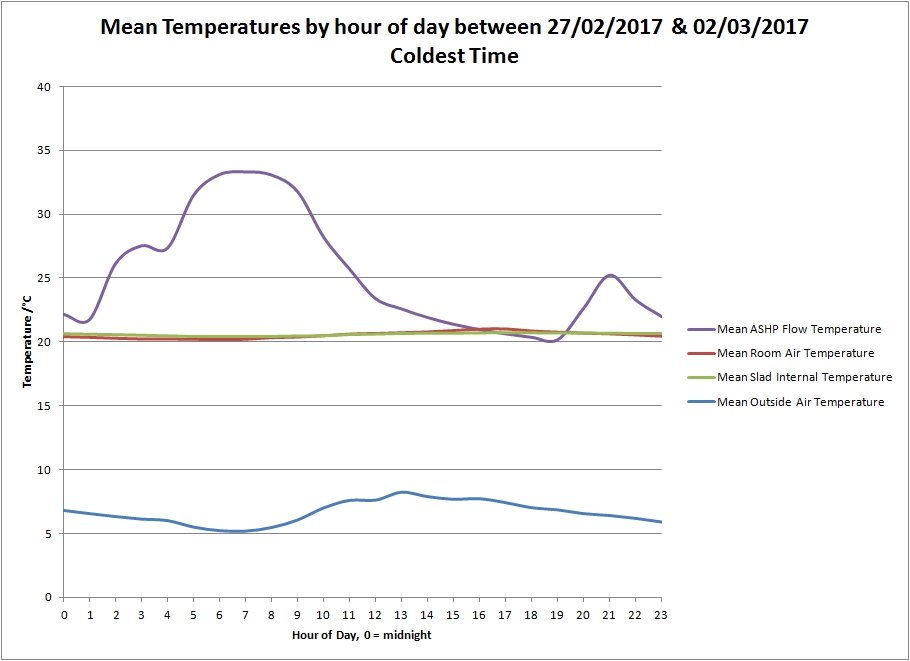
Right, a few more pictures. I notice that the time between maximum ASHP Flow temperature and there it crosses the slab temp plot on the cooling cycle is pretty consistent at about 8 hours. Not sure what these plots really show, other than you could shift the time that the ASHP is working to take advantage of the PV without affecting the house temperature unduly (less than a °C I would think). This would take away for car charging time, which is probably a greater cash saving. The charts, are for the hottest day and then including the two days either side, then the same for the coldest time.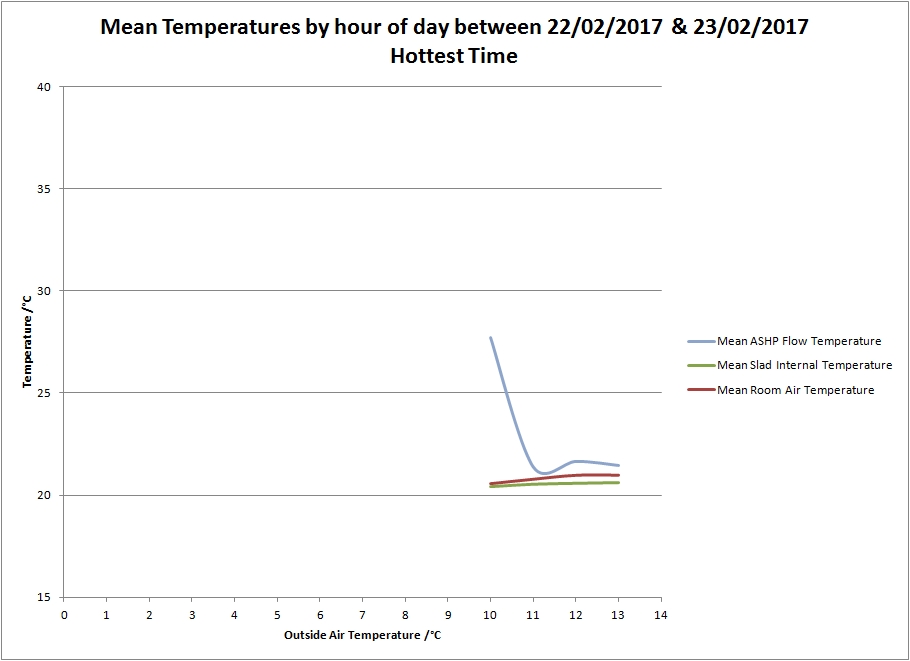
-
Modelling the "Chunk" Heating of a Passive Slab
SteamyTea replied to TerryE's topic in Boffin's Corner
So once you are living in the place full time, you could tinker with the pump timings and maybe shift the maximum temperature times to suit your lifestyle and the seasons. It may also, once more data is gathered, allow for some simple weather compensation using a Met Office forecast for temperature and cloud cover (I think your house is more affected by sunlight than temperature). Might be fun creating an infrared thermometer that points up into the sky to gauge the cloud cover, though wind direction is the best indicator that I can find for the UK. -
Modelling the "Chunk" Heating of a Passive Slab
SteamyTea replied to TerryE's topic in Boffin's Corner
One advantage of this mini test is that you can fairly safely assume that slab temperature sensor is good enough to get a proxy for the slab surface temperature. Not sure of it is good enough for the air temperature as we have not had any high air temperatures yet. Am I right in thinking that you circulate the water though the slab constantly and then just inject from the ASHP/Buffer when heating is needed? If that is the case, it may be worth looking at the thermal losses from the Buffer and the PHE as they have very long tails and significantly higher temperatures than the slab (7 - 10°C). I shall try and have a look at what is happening at the daily level as I can just use the limited datasets of Slab Internal, Room Air, Outside Air and ASHP Flow temperatures to make it easier to look at. Though in reality, one day off either a bit hotter or a bit colder does not make any real difference to the overall energy usage. -
Modelling the "Chunk" Heating of a Passive Slab
SteamyTea replied to TerryE's topic in Boffin's Corner
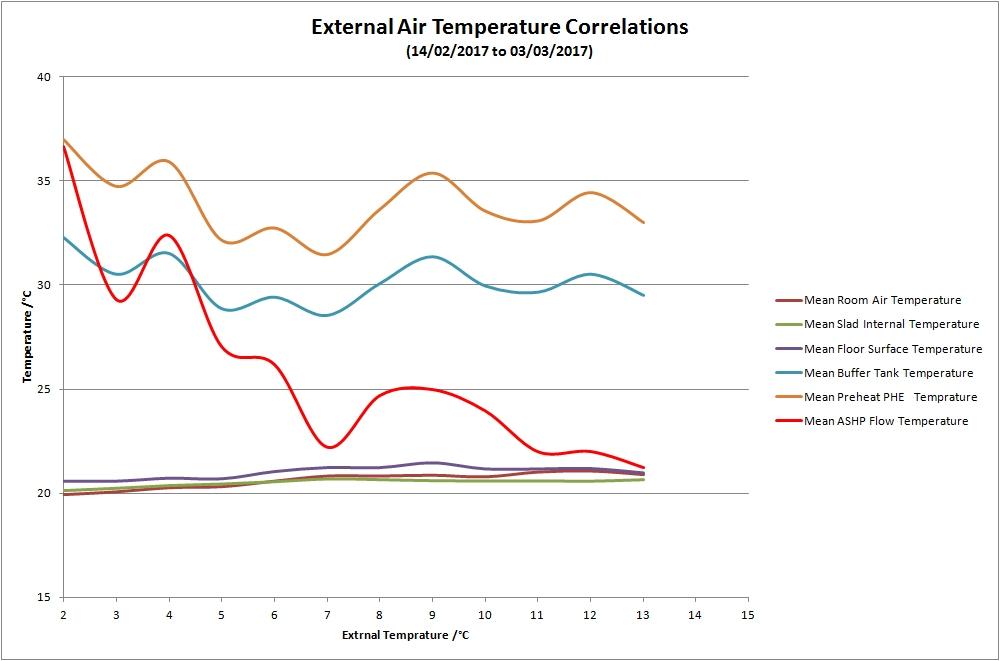
Right, have had a little play this morning and produced two charts. One is the correlation between the invariant of external air temperature and the other against time. I picked these two because we have no control over them and can therefore be used to both correlate and draw implications. There is really not enough data to draw very precise data for the long term, but as the floor surface, slab internal and room air temperature are amazingly stable (basically within the accuracy of the sensors) the 11°C external temperature swings that have recently happened are a good indicator of overall performance. As Jeremy a already said, the ASHP is coming on at around 3AM for about 3 hours. This fits in with the coldest part of the day, though may not be the best time to start heating. That depends on lifestyle and how you like your house heated (It would suit me as I like a warm evening). The slab, on average, has the highest temperature at about 2PM until 1AM. Room air temperature peaks at about 4PM. On the Correlations, everything is pretty flat except the Mean ASHP Flow Temperatures. This is to be expected because if the outside air is warmer, the ASHP will be working less often, rather than delivering a lower flow temperature. This will force the mean flow temperature downwards. I shall try and have a better look later, but life got in my way this morning and only just managed to get home again to pick this up.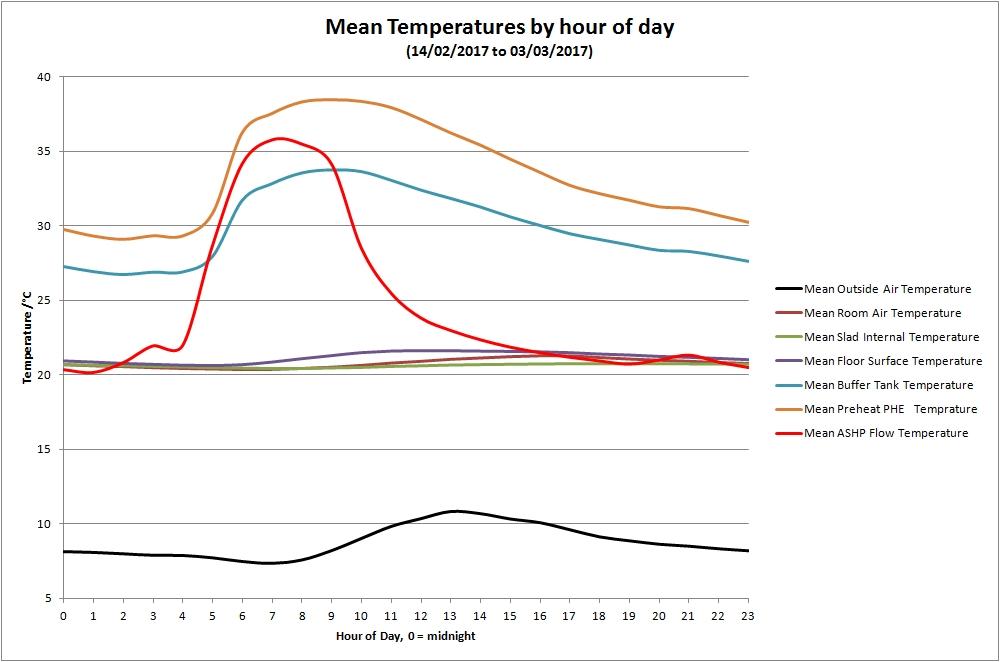
-
Put some money on the Tote, you may get lucky at Kempton Park and can get someone else to carry the tools. https://en.wikipedia.org/wiki/The_Tote
-
Help me deal with a neighbour!
SteamyTea replied to hmpmarketing's topic in General Self Build & DIY Discussion
Show him the bit that you have quoted in blue, you can be indignant about it as well. If he had hot taken an interest in the planning notice, that is his look out. 33 years ago I had trouble with a neighbour and his large van blocking the road. Eventually my next door neighbour contacted the company he worked for who explained that they had built him a garage to park the van in (how times have changed). The company went to his place, asked to look in 'their' garage and found he had been hoarding stuff from work. That cured the 'van' problem. Though we did get abusing notes though out letterboxes for a few months. -
Where and how best to install temperature sensor in UFH screed
SteamyTea replied to readiescards's topic in Boffin's Corner
When collecting data you need to know what you are hoping to achieve. With just one sensor, in one fixed location, all you can collect is he temperature at that spot, at the time you took the reading and only within the accuracy and precision of the sensor. There are a few statistical methods that will allow you to reduce the inaccuracy, but with single point measurement it is impossible to infer what is happening over the whole slab. You say you want to log the 'relative' day by day temperature. This is known as an anomaly i.e. the deviation from the central tendency. This relies on historic data, so as time goes by, it gets more accurate. By only sampling one point, and that point is not that important as you are looking at change, the sampling rate becomes important. So if you only sample once a day, say midnight, you will get a different mean from two samples a day, say noon and midnight. There are two ways around this: More samples, say every 10 minutes Random sample times, say between 120 minutes down to 1 minute Fixed sampling is generally the easiest to understand and gives you plenty of data points to play with later, you can easily 'bin' the data into both time and temperature bins. Random sampling will generally give you a better overall picture of what is going on, but takes longer to collect data for every time bin. As data is easy and cheap to collect, store and process, fixed sampling is probably the easiest. The location of the sensor is a bit harder. Too close to a pipe and it will over read, too far from a pipe and it will under read. This is why we generally use multiple sensors at different locations. Then use a weighted averaging technique (just an arithmetic method to make the sensors show the same temperature regardless of position) to show the temperatures. If I was using single point sampling, then I would place the sensor either 1/3rd or 2/3rd from the pipework. Ideally I would use 3 sensors in one location and a 4th sensor outside of the slab. The 4th sensor would be the 'true' sensor and the one that the others are calibrated against. You can keep this sensor separate an use it to calibrate any other sensors. By using 3 sensors in one location, if one fails, then the other two are still useful, and the sensors are really cheap, I think the lot that turned up yesterday were under £2 each. So for an extra £4, it saves having to pull a wire out, replace and calibrate a replacement, and then feed it back in. And they will fail. One mistake I made when writing a bit of Python script to check and read that sensor was that if the sensor failed, the script stopped. I am not a programmer and have little interest in it, but if it is part of a larger program, it can crash the whole thing, so worth thinking about how to loop around this. One thing I have found out about the DS18B20 is that they do not like high humidity, so either get some ones that are already encapsulated or put them in after the slab had fully dried. -
Green Building Council report and a quick request for help!
SteamyTea replied to Jeremy Harris's topic in Housing Politics
There is a nut and bolt just infront of the cat that don't seem to be fully tightened, is that normal? -
Did not matter at the time as they were always on a holiday abroad.
-
We used them on our spa bath installations. Could get then up to 9 kW. Is it called a Willis Heater after Willis Carrier, the heat pump man.
-
I was at 'posh school' when I was 11, it was French
-
Where are you from?
-
Old friend of mine's brother died cutting up trees after the 1987 storm. Sometimes it is better to "assessing the risk of removing it!"........FFS!
-
Perfect boiler temperature re ufh?
SteamyTea replied to DH202020's topic in Boilers & Hot Water Tanks
Log down your gas usage at the same time. It is easy to get external temperature data afterwards to correlate it with. -
I used to be able to post stuff up as it was for education and research, but technically not allowed to now. An online calculator is probably good enough. http://myelectrical.com/tools/cable-sizing-calculator