


SteamyTea
-
Posts
23866 -
Joined
-
Days Won
200
Everything posted by SteamyTea
-
I seem to remember that the permissible voltage drop was 1% for PV, not the normal 5%. More to do with metering that anything else. Inverters sense the impedance of the incoming supply and if it goes outside some set limit (no idea what), it shuts down for safety reasons. That is nothing to do with generation or metering, purely a safety issue. I have no idea how it is sensed of where it happens, other than inside the inverter. All black magic to me.
-
Or the gagging
-
Not ever going near a muck spreader again! http://www.falmouthpacket.co.uk/news/4588410.Pervert_got_sex_kicks_in_slurry/
-

General Election Predictions 2017
SteamyTea replied to Ferdinand's topic in General Self Build & DIY Discussion
Or does not work -
General Election Predictions 2017
SteamyTea replied to Ferdinand's topic in General Self Build & DIY Discussion
I think everyone in Maidenhead needs to vote for Lord Buckethead! I still wonder how much anger there is against Cameron from traditional Tory voters for getting us into the terrible mess. Will it be enough to seriously damage May and her girlfriend Rudd. I hope so. I need to text my Irish mate who lives in Scotland and ask him to vote Tory. Whoever he votes for fails to get in. And email my local Green candidate to ask for his solution to air pollution down here (We have one road that has a serious problem). If he gives the answer I don't want to hear, he does not get my vote. I am well and truly a disenfranchised voter now. -
The cycling is a tricky one. 50 years ago we were still recovering from WW2 and no one expected cycling to become the middle class leisure activity it has become. More specific to MK is this: http://tritalk.co.uk/forums/viewtopic.php?p=564097&sid=3d2e21849109dedcb5e3e6e2fc4e573a
-
I went for a walk, and included Chapel Street, plus at the bottom of Market Jew Street (not sure what it is called). Chapel Street has 71 businesses, 7 of which are closed, so about 10%. It has 5 Estate Agents in it. Causeway Head has 62 businesses, 7 of which are closed, so 11%. It has 2 Estate Agents and 3 Charity Shops. Market Jew Street has 125 business, 15 of which are closed, so 12%, it has no Estate Agents but 4 Charity Shops. I have no idea if those figures are good or bad for an area, and it is just a straw poll. It is interesting that Charity Shops come in for some stick down here by local traders (reduced rates, cheaper goods, adding nothing to the local economy, relying on volunteers etc), but with a total of 7 (3%), I don't think it is a problem. Now Estate Agents, at 7 as well, definitely don't add any value to the shopping experience I think Kirsty Milksop said something about this on the radio a while back. I had to get a lodger in when I bought my first house. I have probably mentioned a work mate who complains that he cannot buy a house in the village he grew up in. What he is actually saying is that he cannot afford to buy the ex council house his parents own (a 3 bed semi in what is now a 'posh village, even though I think it is nothing special). Interesting that in 10 years his cash savings have not increased (and have now probably decreased as he overpaid for a second hand car, same as his Dad had as a company car, sums him up, no imagination).
-
That could be considered the same as an undergraduate degree, so somewhere between £20k to 40k. Not sure if it should be added to or take away from the price though
-
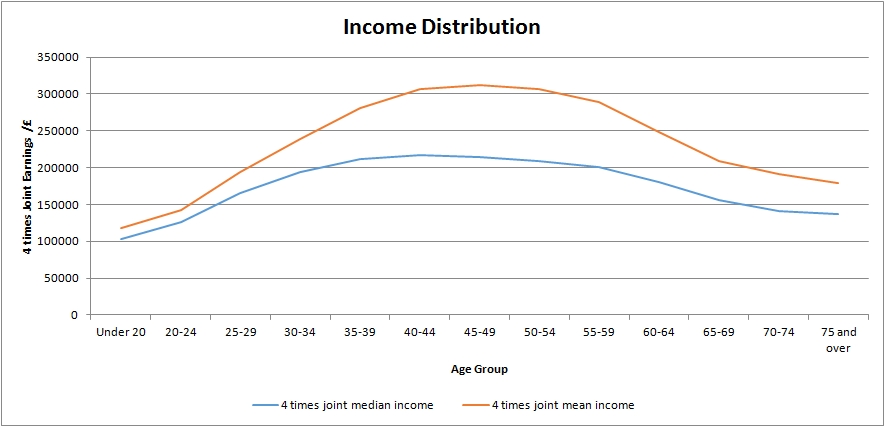
I have had a look, and if you take 2 times joint income (male + female) and multiply by 4, then you get this. Not far off what the UK mean house price is. Odd. Though there is an economic argument that says if everything is sold, then it was too cheap.
-
The governments and local authorities did a good job with Milton Keynes. It took 50 years to get to where it is today, billions in investment, and really benefits from being on the M1. It does show what can be achieved though. I recently went to Wickford in Essex, as I drove though Basildon, where I lived in the 60's, it seemed a lot wealthier than where I am in Cornwall. I am going into Penzance today, I may count the number of closed shops in the two main streets (they are regenerating Chapel Street, so not a good gauge). I personally think that developing new towns and cities is a better way to go that trying to save old depressed places with all connected infrastructure problems and prejudices.
- 15 replies
-
- 1
-

-
- politics
- plnning permission
- (and 2 more)
-
Purely as an academic exercise, has anyone tried to work out house prices based on current income distribution. If one makes some basic assumptions that young people generally buy smaller and cheaper places, families have larger places and retired people have smaller, but more expensive places in "nicer areas", and assuming that a standard income multiplier of 4 times earnings is 'sustainable' (at current interest rates), then a more realistic price for property should be calculable. I suspect it will be below 50% of what we currently pay.
-
@JSHarrisbuilt one of his plane I think, but as I pointed out, it was a hobby, and, like me, he likes building things (I am still building my "£100" boat, on Mark 2 now). @recoveringacademichad a spreadsheet about his costs, what struck me was the amount of money he had spent before he even started the real building work.
-
I am more intrigued as to why people think that self building is going to be cheaper. We don't self-build cars, washing machines, TV's. I have never heard anyone mention that it would be a good idea to self build a railway system, or an equivalent to a A320. So why housing? Where are the savings to be made, nailing a bit of skirting, running a few metres of copper pipe. Or is it that self builders treat it as a hobby?
-
I think our Jeremy is the man who knows about these @JSHarris 4 kWp of PV is not much, and if self installing should not cost much. You may find that adding more modules and putting the juice into your DHW is pretty effective and cheap to do. There was a programme on the radio the other day about Lithium, I think it explained that even though lead was a better material, lithium had the better power density figure, not that it matters a toss for static installations. I think it was this programme: http://www.bbc.co.uk/programmes/b08pdzxq When you have spent all our cash on batteries, and you run out of power, you can use the lithium salts to cheer yourselves up
-
Small vented cylinder with a 3kW electric heater in it. Cures the electrical supply problem and the storage problem. Pretty cheap to fit too. Does take up a bit more room, but may be it could be installed outside. I think plumbing is way to complicated. You either store water and heat it, or heat it on the fly. Good job we don't get a plumber in to make the tea, it would never happen
-
I did this a few years ago for a giggle
-
Lifting and Lowering (useful "rule of thumb")
SteamyTea replied to B52s's topic in Project & Site Management
Back in 1991 we were building a new workshop inside our factor unit. I was holding up one end of an small RSJ while standing in the window opening, probably 4 foot off the ground. I started to feel unbalanced (still am) and decided to jump down while still holding the RSJ (which was not too heavy). That night I slipped m disc in bed, took me 4 hours to crawl out of bed and down the stairs to the phone. Got taken to hospital and they gave me pain killers that made the sky go pink and suspended reality. All very strange. Was the most painful thing I have had, and that includes my serious car accident that left me in hospital for weeks. And that curious incident with the camera earlier this year. I still have trouble now in my lower back, neck and shoulders 26 years on -
May be worth starting a new topic on this, then people that have managed cooling mode can post up ho wit was done on different models. It would be a very useful resource, especially if the manual was uploaded as well.
-
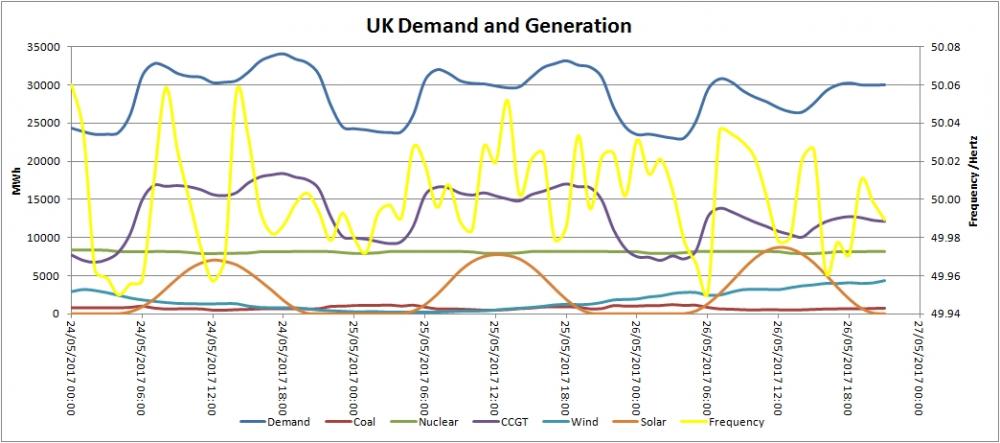
What I find interesting about the graph is that frequency does not correlate well with demand very well on the 25th. I am not sure if that was just a 'bad day' for the grid, or there is something much more fundamental going on. One of the problems is that the power auction for each half hour block to help balance the grid closes about an hour and a half before it is delivered. Then something unexpected can happen.
-
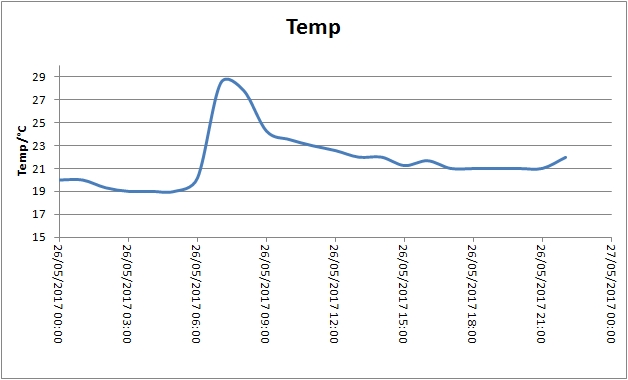
I think the morning sun hit my temp sensor.
-
I just heard the Beeb report. The thing that struck me about it was that they mentioned that around Noon it was producing more than our 8 nuclear installations. Hopefully that should being the message home. It is much easier to get few large consumers to use power than 30 million domestic consumers. I don't have a problem with that. A quick chart I have just knocked up.
-
They may have a point about how the West can corrupt. We have been shafted by the New York Times already.
-
Well Robert McNamara said "never answer the question asked of you, only answer the question you wish you were asked". So did the East Germans fells safer because they were being spied on by their own people, not did they feel they had to show willing
-
Ian You have had experience of an oppressive police state. Did all the controls forced upon the general public make them feel 'safe', or just a bit miffed that they are all potential enemies of the state?
-
Not sure. They did in Northern Ireland, was not a great success.
