SteamyTea
-
Posts
23269 -
Joined
-
Days Won
187
Everything posted by SteamyTea
-
Yes, the analysis has to include thermal conductivity as well, but that's a separate factor, and I think needs to be kept separate, if only to remind people that you can have two thermal elements with the same U-value, but widely differing thermal mas (or thermal inertia... or whatever you choose to call it), and as a result they will perform differently in terms of transient thermal response. Copied straight from good old Wikipedia, with minor editing to make it legible. The main point is that thermal conductivity is very important and not a separate factor. Thermal inertia[edit] Thermal inertia is a term commonly used for modelling heat transfers. It is a bulk material property related to thermal conductivity and volumetric heat capacity. For example, "this material has a high thermal inertia", or "thermal inertia plays an important role in this system", mean that dynamic effects are prevalent in a model, so that a steady-state calculation will yield inaccurate results. The term is a scientific analogy, and is not directly related to the mass-and-velocity term used in mechanics, where inertia is that which limits the acceleration of an object. In a similar way, thermal inertia is a measure of the thermal mass and the velocity of the thermal wave which controls the surface temperature of a material. In heat transfer, a higher value of the volumetric heat capacity means a longer time for the system to reach equilibrium. The thermal inertia of a material is defined as the square root of the product of the material's bulk thermal conductivity and volumetric heat capacity, where the latter is the product of density and specific heat capacity: I = (k.p.c)0.5 See also thermal effusivity k is thermal conductivity, with unit [W m−1 K−1] p is density, with unit [kg m−3] c is specific heat capacity, with unit [J kg−1 K−1] I has SI units of thermal inertia of [J m−2 K−1 s−1/2]. Non-SI units of Kieffers [Cal cm−2 K−1 s−1/2] or [1000 Cal cm−2 K−1 s−1/2] are also used informally in older references.[5][6] For planetary surface materials, thermal inertia is the key property controlling the diurnal and seasonal surface temperature variations and is typically dependent on the physical properties of near-surface geologic materials. In remote sensing applications, thermal inertia represents a complex combination of particle size, rock abundance, bedrock outcropping and the degree of induration. A rough approximation to thermal inertia is sometimes obtained from the amplitude of the diurnal temperature curve (i.e., maximum minus minimum surface temperature). The temperature of a material with low thermal inertia changes significantly during the day, while the temperature of a material with high thermal inertia does not change as drastically. Deriving and understanding the thermal inertia of the surface can help to recognize small-scale features of that surface. In conjunction with other data, thermal inertia can help to characterize surface materials and the geologic processes responsible for forming these materials. Thermal inertia of the oceans is a major factor influencing climate commitment, the degree of global warming predicted to eventually result from a step change in climate forcing, such as a fixed increase in the atmospheric concentration of a greenhouse gas. But if you are in a meeting about this, and you hear people using the incorrect term, and showing little understanding of the subject, one tends to loose confidence in them.
-
It was, in reality, a 1/3rd more to pay each month as we were starting from around 10%. So it would be similar to rates going from 5% to 6.5%. And it was fairly short lived. We were used to the interest rates fluctuating on a regular basis back then. It was used as a political tool. At the same time, the country was considering entering the Euro zone, this destabalised the value of our currency against others. Sometimes it was stronger, other times weaker. Fiscally it was all a bit of a mess.
-
Yep that's it. Thanks.
-
There was a bit on the Radio last week where they discussed connected homes. They had some industry experts on it. Can't remember what show it was, possibly You and Yours. May be worth a search on the Radio 4 website. I think the take home message was 'don't'
-
 Trust is what is required.
 -
My neighbour paid 85k September 8 for an identical house to mine (except my garage was attached, his was in a block, borrowed 10k to put a new kitchen in, then had it repossessed in 91. It sold for 38k, in 93 the same price I paid for mine in 86. What a nob. Even at the time I knew it was way over priced. The price I paid was 3 times my wage at the time. I suspect, knowing what he did for a job and where he worked, that he borrowed 6 times his wage. I think mortgage rates were about 10% then.
-
By giving a few months notice that MIRAS on two incomes was ending caused a property boom in 1989. I think my mortgage was down from £30,000 to £26,000 as I had overpaid. I had a standard, variable, repayment mortgage. By 1991, when rates went up for a few weeks, my mortgage was even less, but I did loose my job, so was 'on the dole'. My sister, who had started with a £12,000 mortgage a few years earlier than me had an endowment mortgage, one that was fixed rate for 12 month, then fixed again for 12 months and so forth, and she borrowed extra cash against her house to buy a car. She did not put money aside when rates when up, so paid a heavy price the next year. Then she found out the endowment was under performing. So had to pump more cash in. Eventually she should up, at a huge 'profit' and moved. She got a repayment mortgage. I eventually paid my mortgage off 20 years ago. Was a good feeling. With property, cash is king, never run out of it.
-
Thermal Inertia is really just how a capacitor charges and discharges. So knowing that, where do you stand?
-
There is a saying that the milk should never, ever, touch the tea before the water. Not sure how that is going to help decide between construction methods, but I find that tea helps the thought process no end.
-
Why only 0.19 W/m².K. I thought walls had to be 0.16 W/m².K now. Is that just the starting point or a typo.
-
How big is this kettle, a deep bathfull.
-
Still the wrong way to make tea. Because plumbing is pretty unsophisticated and cannot, or will not, be designed properly. You could have a solid timber floor and get similar characteristics, but the price is prohibitive.
-
It is also affected by the laws of cooling, so as it gets closer to equalibrium, the time constant lengthens. But that is true for any material that is solid, fluids can behave a bit differently. Especially if they change phase, but that just means more sums. Not insurmountable to calculate.
-
There are loads of examples, one that narked me the other day was Caroline Lucas MP talking about "wellbeing", if she wants to be taken seriously by the world, stop using wooly, meaningless and unmeasurable terms. She said another word that had no meaning, but I can only remember my dispair and anger.
-
This has more to do with the thermal conductivity. Materials are odd things, their characteristics are not correlated to mass. So you cannot assume that because something is heavier, larger, more massive, denser, or whatever measure you want to associate with the count of stuff in it, that it will perform as you imagine it should. 20 seconds on Wikipedia, or Kaye and Laby, will show you that. Always worth a look.
-
It is the same thing after a bit of algebraic rearrangement. It is why I like it. With a bit of extension it can take shape into account.
-
You have to include conductivity as well. Do a dimension analysis on what you have done and you will see it does not make sense. Yes. And this is why we have confusion like this. It is not hard or difficult scientifically or mathematically, but by just giving things random names, or titles, or units, nothing can be worked out properly. You may not like the science methodology, or even understand it, but I am sure you can appreciate it when you buy things and travel, without standardisation and agreement, nothing can get done. The arguement that we have been building for thousands of years is pretty poor, where are all, not just some, of these old buildings. Estimation is a major tool in the scientist bag, we use it to establish whether something is close to correct, or total bollocks. Have a listen to this week's More or Less on radio 4, they had s great example of estimation. The real problem is that most people did not receive a good science education, and this is costing, in cash terms, billions. A quick estimation of £1bn is 15 quid for each person in the country.
-
I know what I call it, and it is the correct term. Thermal Inertia I (that is italicised and capitalised i) One may well catch fire, but if you limit the temperature then there is not a great deal of difference These are the figures for my experiment. Material Volume /m3 Mass /kg Density /kg.m-3 SHC kJ/kg/K Thermal Conductivity U-Value Notes I PU 0.0017 0.06 35 1.4 0.2 Boxes moved on 25/06/2018 3.143621 Timber 0.0017 0.88 518 2.3 1.8 46.29318 Concrete Brick 0.0017 3.83 2253 1 1.1 49.78188 You can see that Timber and concrete have very similar I values
-
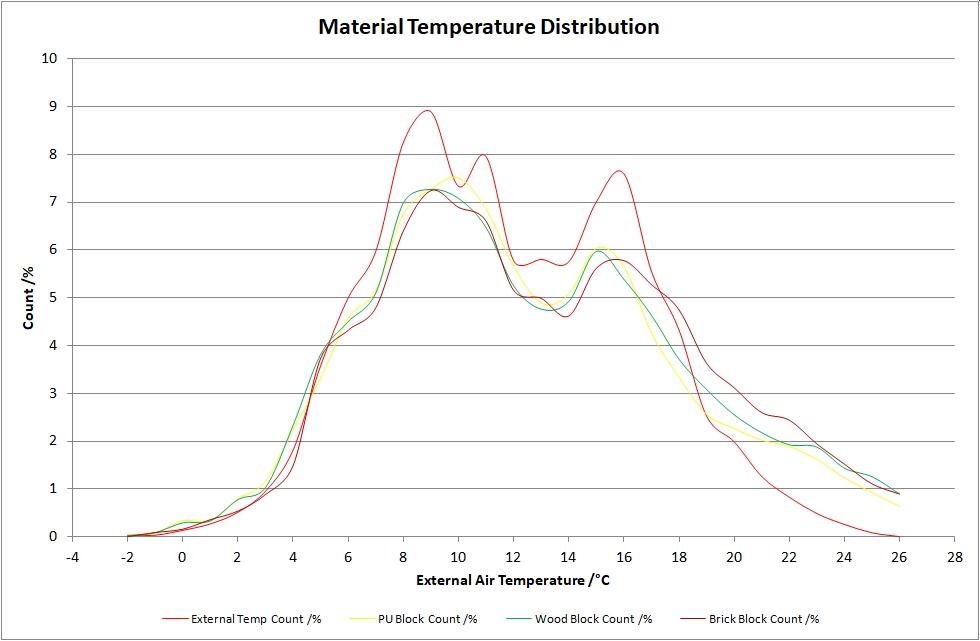
One last chart to show how little difference the materials make. This one shows that the distribution of material temperatures is very close to external air temperature, even though the mass of the materials, and there thermal characteristics, are all very different. I have not looked at the probability of error, just that the slope of the lines are very similar, but I estimate that they are at the 99.99% level.

-
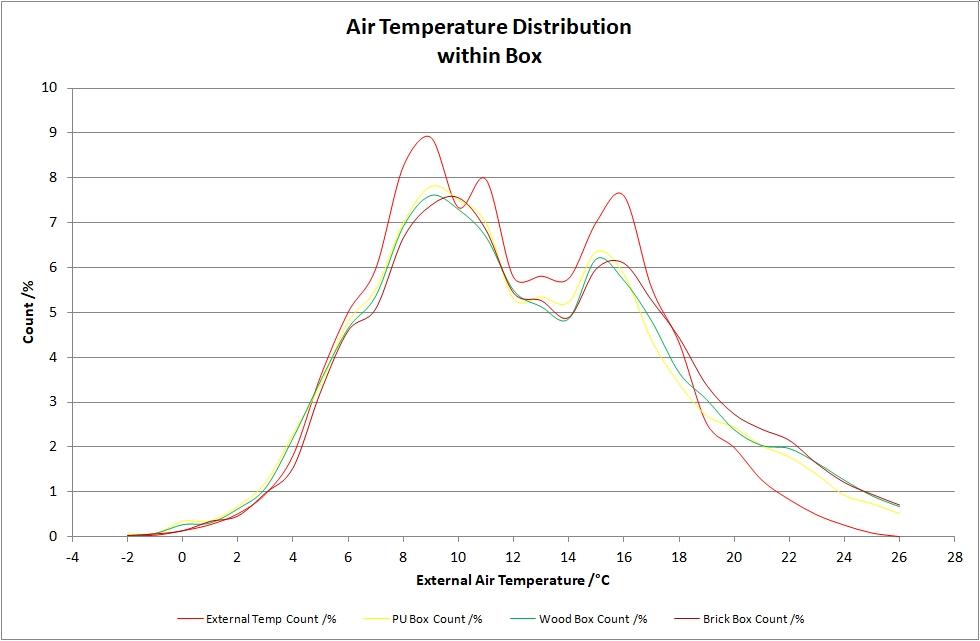
Probably. Without context and a full explanation of the experiment, they're pretty meaningless. Well the context is there. You don't really need to know it to read the charts, but for more clarity, the experiment was 3 identical translucent boxes, each with 3 identically sized blocks of different materials in them. They sit outside, in the weather, and temperature readings are taken every minute. Then the fun of creating generalised rules, via statistical analysis happens. As @JSHarrisasked, and I teased about, what is the SI unit for thermal mass? I know the answer, but without others knowing it, confusion will continue. I think the root is deeper than that. Many people assume that mass is weight, and when we have purchased things in the past, we associate weight with quality. Now there may be some truth in that for some products, but it is not true for many industries. Aviation and hiking being two extremes.
-
I think you have misread the charts. They show distribution, not a time series. So basically they show how often a temperature happens when the external air temperature is the 'bin'. The reason for this is that housing is not a steady state situation, temperatures, irradiation and windspeeds are constantly varying, and that is before you put in the effects of rain and evaporation. I think the problem is that most people, including me 20 years ago, assumed that mass was the governing factor. This axiom is wrong, it is the material's thermal characteristics that govern, so is a combination of volume, density, thermal conductivity, heat capacity, installed shape, exposed area and other things.
-
@Clive Osborne Any news on the tests yet?
-
I get quite excited when I see loads of insulation. Am I odd?
-
Does anyone get paid to find out why the cracks are happening?
-
OK So I have wasted 3 years at university studying this, plus ten years thinking about it, and the last 2 years testing it. Can you show me the significant difference in these two charts.