SteamyTea
-
Posts
23836 -
Joined
-
Days Won
200
Everything posted by SteamyTea
-
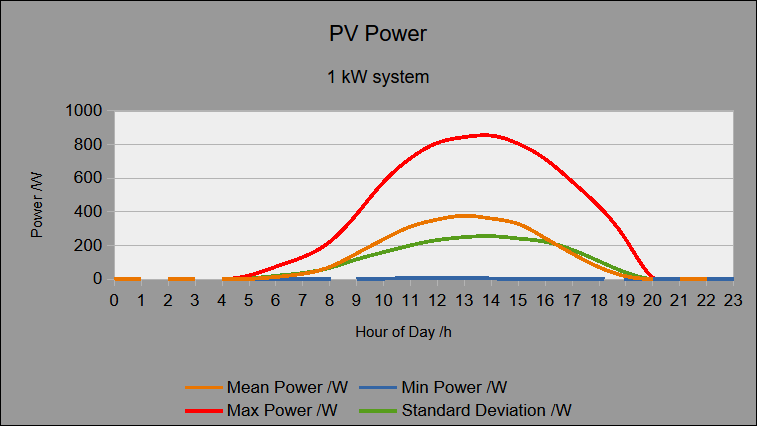
Right, here is a better chart of what really happens. It shows the mean power, based on 18 years of hourly data, plotted for a whole year (I shall do some monthly charts once I have finished my supper). It also shows the minimum power, if that power is greater than 0 watts, and maximum power. The Standard Deviation, in watts, is the middle 68% of the mean power. This allows you to accurately estimate the usable power. You will quickly notice that there is a huge difference between maximum power and mean power.
-
Right, apart from my normal nag about units, don't use mean averages. The important point to keep in mind is that PV is variable. It can swing between 10% and 100% maximum rated output in a few seconds. What this implies, in practice, is that you cannot use the output to run household appliances in real time. This is why storage is used. The cheapest type of storage is thermal. The most useful form being hot water. This is just a case using a standard cylinder, with an immersion heater in it, but controlled by a PV diverter. All the diverter does is sense when there is excess PV, which would be exported to the grid, and diverts that to the immersion heater. This is usually done at the 1 Wh level (usually one flash from the LED on your meter), though some diverters use a minimum current e.g. 5 amps as the switch (usually older systems). Diverting to resistance heating can be done in a similar fashion. Battery can be charged in a similar fashion, but they are more expensive to install. The economic case is probably not realistic when looked at in isolation, but may be positive when variable import tariffs are taken into account. As you have some usage data, and PVGIS can show you hourly expectations from a PV array in any orientation, you may want to spend a few hours doing some modelling and work out the cheapest system that gives you the most useful saving, this may involve you looking at your usage patterns and seeing if they can be changed e.g. your 8AM peak (is that electric showers, storing PV charged DHW can reduce that). Batteries can also reduce that, just a case of working out where the biggest savings, over a year, are to be made. One of the problems with PV installation is historical. When the FiT system started, the emphasis was in maximum yield per year, as this maximised payments, things are very different now. You may find that an optimally angled system i.e. south facing 35° pitch produced more than you can use for the 4 summer months, and almost nothing in the 4 winter months. It really is a case of modelling it and not totally relying on storage, which may have to be topped up from the grid. Start by visiting PVGIS and getting some data, I always use a 1kWp system as a default then scale up once I have found the most useful orientation.
-
Keeping an eye on my readings showed that my consumption had risen significantly, was the fridge packing up. New fridge (cheap ones seem to last a decade) and back down to around 4 kWh/day from 8 or 9 kWh/day.
-

Openreach taking the proverbial for tree lopping
SteamyTea replied to BotusBuild's topic in Electrics - Other
Wildanet are a local company with a good reputation. https://wildanet.com/about-wildanet Not sure how much they are involved in new connections.- 16 replies
-
- 1
-

-
- tree lopping
- openreach
- (and 2 more)
-
Openreach taking the proverbial for tree lopping
SteamyTea replied to BotusBuild's topic in Electrics - Other
-
Damp fiberglass insulation during build
SteamyTea replied to Robsco1's topic in House Extensions & Conservatories
Moisture will get though anything, don't worry about it. -
Longevity of a Victorian slate roof
SteamyTea replied to Tony Williams's topic in Roofing, Tiling & Slating
When we used to fit PV back in 2012, we had to install on dozens of old slate roofs (they are pretty common down here). Nearly all got damaged and most had to be reinforced. As I was the 'engineer' for the company, I suggested to the sales team that they either said no, or doubled the price. Thankfully the company went bust, so they only ruined about 30 houses. -
ASHP installation - great new invention
SteamyTea replied to JohnMo's topic in Air Source Heat Pumps (ASHP)
I suspect it is easier to deal with one company that manages a few thousand houses, than a few thousand customers that have 1 house each. The glycol saving is probably a real saving if it is changed on a regular basis, as it should be. -
ASHP installation - great new invention
SteamyTea replied to JohnMo's topic in Air Source Heat Pumps (ASHP)
Had a quick skim though, seems like a reasonable idea. Not idea how it will affect overall SCoP. -
Is that Scottish-Japanese company still going. Akai
-
Let the fun begin!
SteamyTea commented on Benpointer's blog entry in Contemporary build in north Dorset
Good on you. As you have vaulted ceilings, is there going to be above building reg insulation. I understand why you want pocket doors, will make you life easier. They do tend to be noisy, but I would think that there are quieter ones, just a case of putting in rubber wheels, rather than nylon ones. -
Damp fiberglass insulation during build
SteamyTea replied to Robsco1's topic in House Extensions & Conservatories
I would think it would dry out naturally. If there was 100g of water per m2, which is quite a lot, then it will take 226 kJ/kg of energy to vaporise it. That is 0.063 kWh. So not much in the scheme of things really. (As with all things science, it is not as simple as that, but a good enough first approximation) -
Hard to believe, considering he is from Pisstool.
-
That is a lot of trips to the picture house.

-
Seems icon, instead of the image, have been uploaded. You can usually copy and paste an image into a post, some formats are not supported though. Pasting in file paths does not work, which is what seems to have happened here.
-
TL:DR You ideally needs to split your PV across the phases you use during the daylight hours. Net Metering may be possible with your energy company, but check first, and check if you can get a Net Meter fitted. And, kW is power, kWh is energy.
-
Insulating walls (and a flat roof?) with perlite?
SteamyTea replied to Garald's topic in Heat Insulation
Sounds like Sierra Leone when it comes to deforestation. -
Insulating walls (and a flat roof?) with perlite?
SteamyTea replied to Garald's topic in Heat Insulation
How about cross laminated timber (CLS). Typical k-value of 0.13 W.m-1.K-1. -
Insulating walls (and a flat roof?) with perlite?
SteamyTea replied to Garald's topic in Heat Insulation
May be worth looking to see how much PIR sheets cost. Applied externally, and then covered in a weatherproof membrane or coating should help a lot. You may find that the costs are not that high, Europe is a high mark up country after all. -
Insulating walls (and a flat roof?) with perlite?
SteamyTea replied to Garald's topic in Heat Insulation
PV and Air to Air Heat Pumps then. Heating and cooling taken care of. Not been to Chile, only Venezuela and Columbia, I lived just of the coast of Venezuela when I was a teenager. -
Probably made with a fire retardant resin. MDF is really hard to set alight, as are some ply woods. Depends on the binder/adhesive used.
-
Not sure how it works. Grid supplied electric will have a CO2 intensity. Domestic PV will also have one, but no idea what the current figures are.
-
Insulating walls (and a flat roof?) with perlite?
SteamyTea replied to Garald's topic in Heat Insulation
The Nobel Poet? I would have thought that Chile, with it's advanced mining industry would have a strong industrial base that manufactured most products. Solar gain can be counteracted with reflective surfaces cheaply. -
Insulating walls (and a flat roof?) with perlite?
SteamyTea replied to Garald's topic in Heat Insulation
At first reading/quick glance, it seems sensible. Does have a lot of drawbacks compared to mineral wool (internally) or ESP/EPX/PU boards (externally). I am not sure how the embodied energy (EE) figures compare to other materials. I had one of these to keep me warm when I was a teenager. Though others like this.

-
Streamlining the planning process for small sites
SteamyTea replied to -rick-'s topic in Planning Permission
In my experience, whenever a government tries to make things simpler, all that happens is that a new, overcomplicated, system is created. Think MCS microgeneration. I did hear on the wireless this morning, that heat pumps can be fitted within a metre of a neighbouring boundary (without planning permission), will we interesting to see if the noise limits get changed.