SteamyTea
-
Posts
23836 -
Joined
-
Days Won
200
Everything posted by SteamyTea
-

Spain/Portugal blackout
SteamyTea replied to Beelbeebub's topic in General Alternative Energy Issues
I am the expert at that, why my house only draws power half the time. Most people can't work out E7, and truly believe that storage heaters don't work (but oddly believe that oil filled heaters are better) and that is the problem. Best to leave power delivery and management to the people that know about it. -
Spain/Portugal blackout
SteamyTea replied to Beelbeebub's topic in General Alternative Energy Issues
To show what I mean about using local substations, rather than individual houses to store energy, here is the current usage map from UK Power Networks for the SE of England. Would be pretty pointless putting local storage into the green areas, and there really is not that much red and yellow.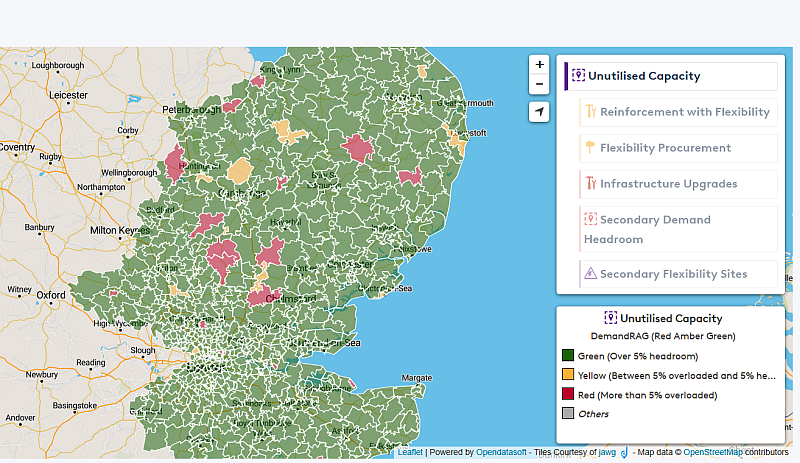
-
Especially if they got an effective tax rebate at the highest rate they pay on their pension contributions.
-
Spain/Portugal blackout
SteamyTea replied to Beelbeebub's topic in General Alternative Energy Issues
How large is 'lots'. If you take the evening peak being in the region of 40 GWh (10 GW increase for 4 hours), that is 40,000,000 kWh, or close to 1 kWh per house. But as that would be extremely expensive to install (this 2014 paper shows installing smart meters costs £215/household), probably in the region of £1500 for the first kWh, then around £500 per additional kWh), it would be much better to install at the local substation. The advantage of that is better system reliability, monitoring and control, and that is before safety risks are considered. -
Spain/Portugal blackout
SteamyTea replied to Beelbeebub's topic in General Alternative Energy Issues
Apart from the reduced generation is predictable, we can use landfill gas to generation electricity. In 2020 it generated 3.2 TWh (365 MW). If we separate our food waste better, that will improve, though I would like to see a LCA on it. Power from sewage is another technology already in use, as are farm anaerobic digestion systems. Add in some more small scale hydro, a very underused resource in the UK, and I think most of the gaps can be filled. As much as no one likes the idea of usage control, much of it can be done behind the scenes i.e. turning off freezer in supermarkets for a couple of hours. -
Had never heard of this process. From a website: "Sioo:x essentially consists of a unique combination of silicon and potassium – two natural substances found all around us and which together create a natural shield similar to nature’s own wood protection." All elements are natural, but usually not found in their natural state, I am not sure how toxic they are, don't mix up silicon with silicone. Elemental potassium explodes in water, so assume it is not on its own, silicon dioxide is nasty.
-
Yes. Hard to get that message across. In some ways, having higher taxation on discretionary purchased is a good way to raise extra income. Not as if the Range rover or Tesla driver is excluded from driving a Dacia or Kia (though they would still drive like pricks probably).
-
Will be raining as I think that is half term week.
-
Spain/Portugal blackout
SteamyTea replied to Beelbeebub's topic in General Alternative Energy Issues
Might be being set by pumped storage, batteries or nuclear, depends what the auction price was. Not enough of our generation is in the CfD system. But it is totally barmy that after 3 years of primary energy volatility, we have not sorted this out. There must be some emergency laws that allows the contracts to be broken. -
Spain/Portugal blackout
SteamyTea replied to Beelbeebub's topic in General Alternative Energy Issues
As far as I know it is just as an import. Just for a laugh here is the French grid data for the last week.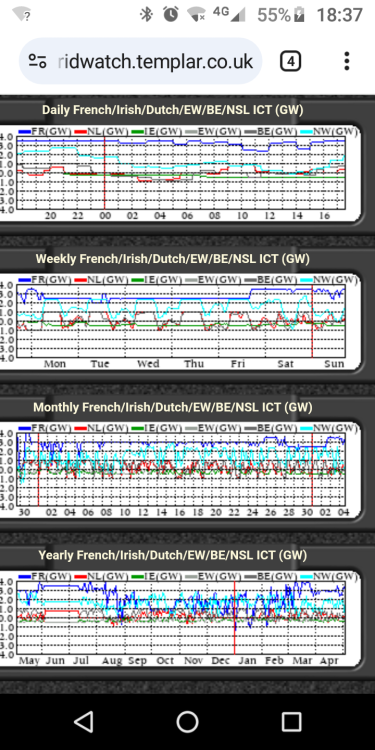
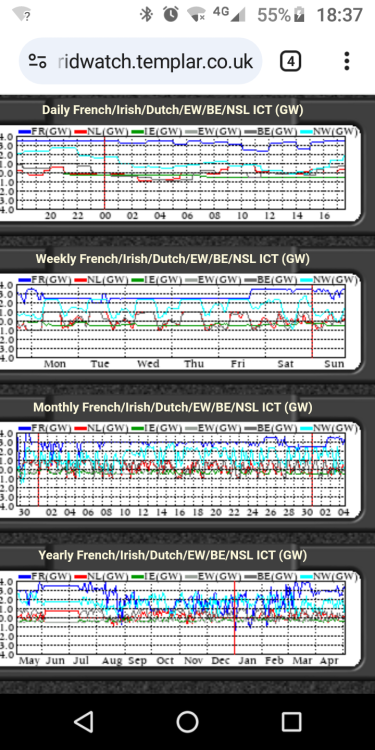
-
Won't be long till we have a day of drizzle. That will make your hole moist.
-
Spain/Portugal blackout
SteamyTea replied to Beelbeebub's topic in General Alternative Energy Issues
It is the 20+ years of gobbling up £1bn/year and producing nothing that gets my goat. 20 years ago that would have bought a GWp of wind turbines, they would be producing about 3 TWh/year. Then next year, 6 TWh, then 9 TWh.... By now, the money spent on Sinkley Hole would be producing 60 TWh/year, 3 times what Wankey Won't is not producing. We could have stopped installing wind turbines, and assuming that another £10bn will be spent there (just to get rid of the rat infestation) and spent that on battery storage at £500,000/MWh, we would have 20 GWh of distributed storage. And all that while Winkey Wank Hole is still not producing. If I can do the above sums (which may be wrong, sitting in cafe in 15 minutes, it makes me wonder what complete (expletive deleted) allowed it to happen. Not as if no one mentioned to them it was a white elephant. -
Spain/Portugal blackout
SteamyTea replied to Beelbeebub's topic in General Alternative Energy Issues
Don't forget our 1957 contribution. Windscale -
Spain/Portugal blackout
SteamyTea replied to Beelbeebub's topic in General Alternative Energy Issues
I wonder, Hinckley C is going to be produce about 20 TWh/year, at today's prices of £130/MWh. Natural gas is about 80p/therm, or about £27.3/MWh. Assume a thermal efficiency of 50%, that is still only a third of the nuclear price. -
Spain/Portugal blackout
SteamyTea replied to Beelbeebub's topic in General Alternative Energy Issues
I did a quick search earlier on the government website, about CfD and they do use CPI, for the most part. -
Spain/Portugal blackout
SteamyTea replied to Beelbeebub's topic in General Alternative Energy Issues
Pop it into autocorrect. I am still not sure how bit and byte are abbreviated, I assume b for bit, B for byte, only bemuse one is bigger than the other. -
They are not your real friends then. Real friends would be helping.
-
Spain/Portugal blackout
SteamyTea replied to Beelbeebub's topic in General Alternative Energy Issues
MWh The Bank of England has an inflation calculator that uses consumer price index. £50 in Mar-12 is now £71 £90 is now £128 (CPI is probably not the best indicator for industrial inflation) -
They should give the car to the nearest neighbour. That would really rub their noses in it.
-
Ah, you really are showing your age.
-
Quite common to do charts like that in the social sciences when the data is often qualative, rather than quantitative. But the data sources are there. I have just been listening to Any Questions, quite an interesting debate about the power outages. What made it interesting is the polarisation i.e. it is renewables, or lack of fossil fuels, or just the drive to net zero, the BBC not trusting the public. Shame that no one said that getting to netball zero involved many different systems being integrated. It is probably that integration that is the real problem. Did make me wonder about how much money gets passed through the London Stock Exchange for high and low carbon industries. Many of those trades will be investing in overseas companies, which should be accounted for when calculating national carbon budgets.
-
Were are these restrictions, I still have a car, can book a flight, get on a train, even ride a bicycle if I want. Generally yes, but most people do not realise it has to be paid for somewhere. Would it be fairer to charge individuals for their personal usage, charge companies registered in the home country, take it out of general taxation, whichever is applied, there will be a large vocal group that thinks it is wrong. As for health care, we are not doing too bad compared to the rest. https://www.commonwealthfund.org/publications/fund-reports/2024/sep/mirror-mirror-2024

-
My Peugeot 309 TD was the same, major fade after 30 metres, then smoke.
-
Live and earn, and regardless of how you earn. 'The last refuge of a scoundrel is patriotism' S. Johnson, 1774
-
But a stone age with cheap, safe food, education, health care, societal safety nets, justice systems, integrated personal transport, public entertainment, very cheap communication.... The world gets better every day. It is too easy to take one personal example and assume that it must also apply to everyone else. Personally I am quite happy that part of my local taxes goes in housing the homeless, I don't want to walk up Market Jew Street and see a dead body in a shop doorway again.