


SteamyTea
-
Posts
23853 -
Joined
-
Days Won
200
Everything posted by SteamyTea
-
Let's hope not, could have long term ramifications for whoever shot blasted it.
-

The sun, our Eddi and my SunAmp: keepin' me guessin'
SteamyTea replied to ToughButterCup's topic in Energy Storage
Think we have a thread on it somewhere. It may sense the fusion temperature, plus and minus a degree or two. Which may account for it not being able to be charged up untill it is 75% depleted. That bottom 25% may be the energy it can take when the magic wax is fused. -
I have 10-15 years to plan everything... how would you use the time?
SteamyTea replied to JayUK's topic in Introduce Yourself
Do an Open University BSc in Physics and Mathematics. And another one in Law. -
Insulate the cupboard, not the cylinder. Then pipe out the warm, damp air with the MVHR. Or buy a washing line for a quid at Poundland. You are at home most days.
-
Calculate the total energy losses over a year. U-Value is power loss, not the same thing.
-
Exactly. But it is not that hard to reduce the losses. Just make the area it is in airtight and well insulated. I use a combination of sheet PU and mineral wool (to fill in the gaps). I posted up my DHW temp profile somewhere else. https://forum.buildhub.org.uk/uploads/monthly_2021_05/image.png.587b8c485e11d47456cbb9cbf007e46f.png
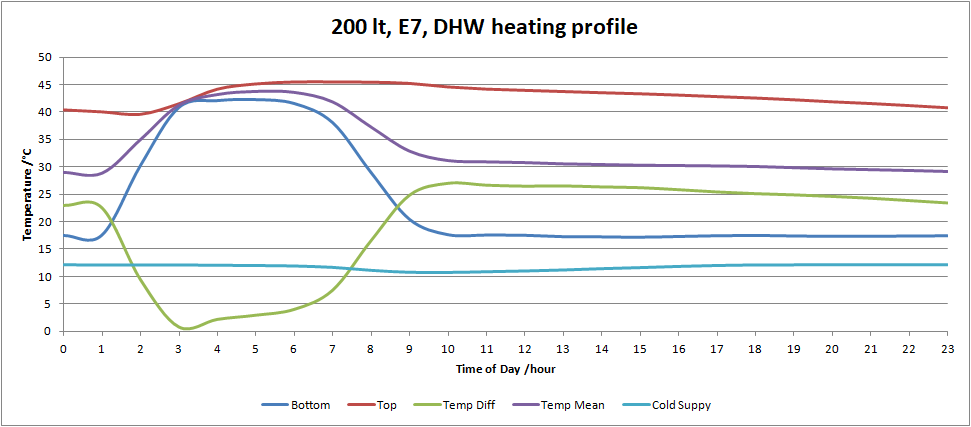
-
Cheap and easy to I stall, especially a vented system. Reliable, but also easy to fix (vented as you can diy it). Controllable temperature, can be just about anything you like between just over 0⁰C and under 100⁰ C (okay that is silly, but usable between 35⁰C and 65⁰C). If vented and pumped, flow rates of your choice. Can have multiple thermal and electrical energy inputs. You get an airing cupboard. I am sure there are others. Downside is size and standing losses if installed without consideration to thermal losses.
-
The sun, our Eddi and my SunAmp: keepin' me guessin'
SteamyTea replied to ToughButterCup's topic in Energy Storage
Only a flow meter and a couple of temp sensors. Then: E = SHC x Mass Flow Rate x Time x ∆T. Calculate that number, then turn on the inbuilt heater for the appropriate amount of time. Or junk the overpriced lump and fit a basic vented or unvented system. You can easily store excess energy by upping the store temp when the sun is shining (though you may export more PV the next day). -
Put in 250mm. What you want to do is reduce the losses to 0.1 to 0.15 W/m².K. As the floor going to be warmer that the air in the room, you have to calculate on a greater ∆T. Ignore building regulations and get your U-Values and air change per hour figures as low as possible. And remember that your floor and loft areas are probably your greatest areas, so they have the greatest overall losses. Don't fret over a door or window that has a 0.05 difference. The areas are too small to make a measurable difference.
-
The sun, our Eddi and my SunAmp: keepin' me guessin'
SteamyTea replied to ToughButterCup's topic in Energy Storage
Why we should use the MJ, megajoule, as a unit of energy. -
The sun, our Eddi and my SunAmp: keepin' me guessin'
SteamyTea replied to ToughButterCup's topic in Energy Storage
kW is the power, kWh is the energy. Think of it as how fast your car can go, and how much fuel is in the tank. They are different things. -
The sun, our Eddi and my SunAmp: keepin' me guessin'
SteamyTea replied to ToughButterCup's topic in Energy Storage
No you don't. The main reason it cannot tell you how much is left inside, is because it does not know. A normal storage cylinder could just use 3 or 4 temperature sensors at different heights and a simple calculation based on those temperature differences. A Sunamp basically only has one temperature, the phase change temperature. You could put a heat meter on it, then ditch the crappy built in controller, and just pump in the appropriate amount of energy. -
Could knock up something similar with angle iron and a very cheap welder.
-
Same here. Only viable long term covering.
-
Drive and half shafts. Kind of defeats the purpose of them. Strange some how people like modern kit in a house, but want to own a 70 year old design crap car.
-
To translate a compound noun to English, because they are: Posycrapunreliablecostlyuncomfortabledreadfulwasteofspace. Easier to say they are just shit. You can tow with a normal car. I towed a 22 foot spa bath to Gibraltar, behind a 309 diesel.
-
I am not sure it was really.
-
@Ed21 pointed this out on another thread. BS 5385 Pt 1 https://www.tiles.org.uk/tta-urges-awareness-of-changes-in-british-standard-bs-5385-part-1-2018-wall-floor-tiling/ So ask the grant people if the fitter is really qualified and ask to see the certificates.
-
You need more on the ground floor. Can you get 200mm in. The reason is that UFH will be at about 35⁰C, so a ∆T of at least that when 0⁰C outside (assuming a ventilated void). Also look at making the structure airtight, with the airtightness layer on the exterior side of the insulation. No point putting in loads if cold air can bypass it.
-
I learn the same thing every morning, my body aches.
-
Workshop: Advice wanted, and very much needed!
SteamyTea replied to Omnibuswoman's topic in Garages & Workshops
@Roundtuit sums it us nicely. -
Workshop: Advice wanted, and very much needed!
SteamyTea replied to Omnibuswoman's topic in Garages & Workshops
I have heard that as well. I can understand it if it is a single sheet, bonded at the sides. But then I have never seen a sheet that does not have a few holes in it. A sheet of polythene is pretty cheap to buy and installing is only a matter of not being a bad tempered knob on a fixed price, and who does not understand why it is there. So that will be most builders over 35 years of age, or stones, makes no difference. -
Seems it is running at too high a temperature. Has the outside unit frosted up at all? This has been covered a few times on here, have a search about and see if you are experience thee same problems, usually the DHW temperature is too high and it is using the built in resistance heater.
-
Water will wiggle about till it finds and easy route, why it is really hard to find a leak. Wind direction and rainfall can confuse even more. I know, I live in even wetter and windier Cornwall. I suspect that the problem is where it joins the roof, the GRP work looks alright, if a little rough. As @joe90 says, we would have put some fall on, but then we know what we are doing when it comes to GRP, unlike most builders. Either way, it can be sorted. The Problem and then the solution.
-
Apart from where the water is coming in at the back, which is poor design, rather than material failure, is there a problem? Can you sort the roof to flat roof interface and get that section relaminated?

