SteamyTea
-
Posts
23407 -
Joined
-
Days Won
190
Everything posted by SteamyTea
-
Now go back and see what capacity factors I was comparing, before you get all high and mighty.
-
To building regs minimum or better?
-
Have you got your self build Community Infrastructure Levy exception in place (if your local authority has one). Cooling a building is the same as heating one. Work out the heat gains and the temperature differences, and that is the size of system needed. The rest is detail, i.e. condensation risk, slab or forced air.
-
Are you just restating what I said? Numbers are for the feeble minded remember, you can sort all the worlds problems out with words and made up scenarios if it suits you beliefs better.
-
That is just mothballed, there will be some on standby, either at spinning reserve or hot spinning reserve, so not so bad. We could also, if need, convert some old coal fired places, that have not been fully decommissioned yet, to biomass. There is also a lot of standby diesel generation. But a word of caution. That is installed capacity, not generation, so not directly comparable to nuclear, which has a very good capacity factor. A GW of nuclear is probably worth 2 GW of wind, to be on the safe side.
-
Should really convert that to kilograms, then it is pressure and temperature independent. PV/T =C
-
There are three aspects to how the air part of an ASHP work. One is the relative difference between the cold side of the HP and the external air. Two is the amount of air moved. Three is the chances of the external radiator frosting/freezing up, that is related to humidity. The amount of specific energy in air is pretty fixed at the temperatures they work at in the UK (there is a slight drop as the temperature drops, but not much, about 0.8PPM over 60K https://www.engineeringtoolbox.com/air-specific-heat-capacity-d_705.html). What can happen is the if the ASHP is running at close to full capacity when highly water saturated air hits the cold side, it can freeze, this both impedes the airflow and insulated the fins. This is why there is a defrost system built in. This uses little energy in the scheme of things, so not worth worrying about in a correctly sized system. The most likely temperature to cause freezing is not 0°C (273.2K), but ~4°C as this is when water is at its most dense, so there is more to condense out than at 0°C or below. As @Iceverge points out, they shift a lot of air, so location i.e. sun or shade, makes no real difference. Fit them where there is good airflow and the external pipework/wiring is short. Don't try to run an ASHP at its highest rated temperature, that is like driving a car at top speed all the time, it will end in problems (I suspect a gas or oil boiler would break, if it was run 24/7 at full rated power, fairly quickly). If you get into calculating thermal efficiencies, they stop using the celsius scale and use the kelvin scale, the kelvin scale is a truer model of the kinetic energy of air molecules, and there is no minus temperatures to fool you.
-
I am very impressed with my Russell Hobbs one. RH601H401B. I did not do too much research, just landed lucky. was one of the cheapest from AO as well. Yes it is. Was from Aldi. I went into the store to buy one for my boss, they did not have any there. Asked and they said they come and go, so still made, just not on the shelves at the moment.
-
Come back in 4 to 5 years time and show us you were right. Otherwise you are talking horseshit.
-
But PV can produce effective power for a greater part of the year, and in lower light levels.
-

Unfinished Grand Design for sale
SteamyTea replied to Temp's topic in General Self Build & DIY Discussion
It is too fa from the sea to get a proper view. -
Who absorbs material cost increases?
SteamyTea replied to gc86's topic in General Self Build & DIY Discussion
They do, in a general sense. If I sell a family a meal for £100, that is £100 less they have to spend on 'other things'. Those other things may be the same thing I spend on, or may not. We are currently awash with cash because of low interest rates, QE and the furlough scheme. Inflation is, or more likely stagflation, is probably going to happen, what we are currently seeing may be the start of this, something that we have not seen for 2 decades. My point is, both customers and supplier should be aware of this and not let it become a shock. We want to avoid a dead cat bounce, which may be what is currently happening. On Nick's point about customers being in too deep (for some reason I cannot quote). How much of this is to do with the knowledge imbalance between the lay person (the customer) and the professional. This is one area where we need to educate the general public to not trust a contractor to do as they say, at the price they agree upon. We really need a new topic on this and point all new, hopeful, self builders to it. May save them thousands. As a friend of mine once said, 'don't do something if you are no good at it'. -
Who absorbs material cost increases?
SteamyTea replied to gc86's topic in General Self Build & DIY Discussion
We put up our prices before the headlines started (some of us remember the late 1970s). We anticipated three things. General price increases, increased footfall and lack of supply (we knew that as our suppliers warned us a year ago). We also reduced our menu options and allowed for more flexibility. So if a relatively small cafe (in the scheme of things, though it is large for the area) can cope, and we have coped (two all time record breaking weeks at both the places I work), then I fail to see how other professions cannot have done the same. There is a difference between being proactive and reactive. That seems to be my criticism of the building industry, along with being too reactive. If one enters into a project during times of turmoil, then plan for the worse and hope for the best, and have access to cash at all times. As Jack pointed out at the beginning, and Ferdinand restated, get the contract right at the start, not hope to change it halfway though. If the builder is not willing to work on a firm price, then they are not the builder you want. If you cannot afford the price, or the extended time to finish the project, then reassess the project. I think the real problem is that there is too much emotional investment in our homes, this clouds judgement way too much and we expect the trades to have the same enthusiasm for the project. Now that is a logical fallacy. -
Gas, nuclear and petroleum have also gone down. It certainly looks like total primary energy as it is in Mtoe. 1 Mtoe is 11.630 TWh
-
Coke is the second bet drink there is, end of.
-
Who absorbs material cost increases?
SteamyTea replied to gc86's topic in General Self Build & DIY Discussion
We have high fixed cost and probably £2.5m in assets that need servicing, so the business model is different. There is a reason that eating out cost a stupid amount of money compared to eating at home, it is to keep in business while being able to absorbing price shocks. I am sure that the large construction companies are not too bothered by the recent price volatility, they will concentrate their resources to the most viable projects and mothball the least profitable. That is just basic business economics. -
Specific heat capacity divided by thermal conductivity.
- 20 replies
-
- 1
-

-
- sunamp
- dhw ( domestic hot water )
- (and 2 more)
-
Who absorbs material cost increases?
SteamyTea replied to gc86's topic in General Self Build & DIY Discussion
Ohh, touchy. So you don't like an alternative view and think others should not contribute. An odd attitude. -
Can the rafters go upwards rather than downwards into the room. It is the depth of the beam that gives it strength, not the width.
-
What I need to go with tonight's supper by the sea.

-
I think that there is a larger question here: It the forum biased to low energy or low emissions? The easy and cheap way to lower emissions is to use less, but there is a limit how low one can go. Some things need a fixed amount of energy to perform correctly/safely. The last 5 days I have used 4 kWh/day to run my house.
-
Who absorbs material cost increases?
SteamyTea replied to gc86's topic in General Self Build & DIY Discussion
It is the whole issue. No one likes a price change, but my point is that professionals in the trades should have costed this in. If I go to buy lunch in a cafe, I expect the price to be as advertised, it is not an 'invitation to treat'. And if you want to see price volatility, look at wholesale food prices and supply. My point is that no one should be blaming COVID-19, BREXIT or the general state of the economy for poor costing or supply issues. These were known knowns. Bit like part building a wall and expecting it to stay up, the wind can change direction and blow it down, a rare event maybe, but one with a known risk and known outcomes, to the contractor if not the customer, that, as @Ferdinand points out is to do with the contract. If a customer does not fully understand the contract, they should get a legal person to deal with it, but I suspect not many self builders do, they prefer to save a few quid. There is a reason that there has never been a Marvel movie where the superhero is a builder. They would turn up late, with the wrong kit, want to renegotiated, with the threat of leaving in a huff if they don't get their way, and do a pretty piss poor job anyway. -
Who absorbs material cost increases?
SteamyTea replied to gc86's topic in General Self Build & DIY Discussion
So no one saw this coming a year back? Isn't that just part of job though. We all know trades that have to pop off to the supplier to get nails, screws, cable and pipes. Do you think oil companies send a man out in a dingy to bring a couple of kegs of crude to finish the batch off. What I am saying it that we all had enough warning that there would be turmoil, if we failed to plan for that, and we really have had plenty of time to plan, then we can only blame ourselves and not look to blame others. -
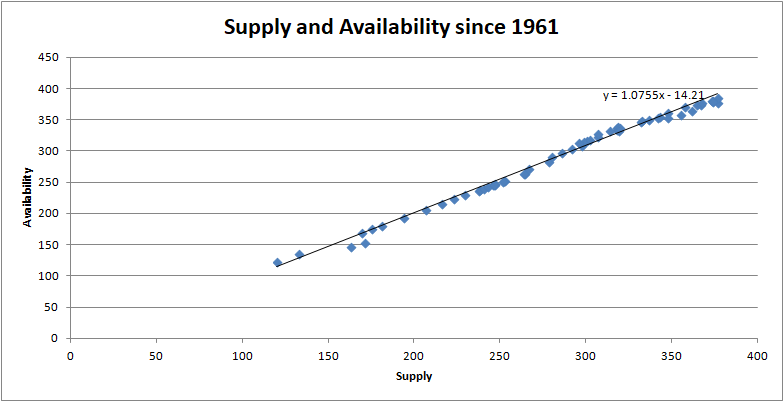
Rather than speculating, here is some historical data from the ONS. For the last 60 years, the UK has almost always (3 day week and other industrial action being the exception) managed to over supply by 7.5%, on average. In recent years this oversupply has got larger. I don't believe that is a coincidence and it is only armchair speculators and keyboard worrier that think they really know what is happening.
-
Bonkers idea or a great idea?
SteamyTea replied to canalsiderenovation's topic in Landscaping, Decking & Patios
Can get a cream for that.