-
Posts
23548 -
Joined
-
Days Won
194
Everything posted by SteamyTea
-
Welcome Once you have power on site, consider a cheap A2AHP to keep it warm. Something like this. https://www.appliancesdirect.co.uk/p/tf-12000ch/telefunken-tf12000ch-air-conditioner-air-conditioner Then you can tell m how easy it is fit.
-
How long to heat DHW with ASHP
SteamyTea replied to AdyHoggs's topic in Air Source Heat Pumps (ASHP)
Thanks I hope it makes sense, and I got all my letters and numbers right, and the invisible when typing strikethough has gone. -
House is overheating
SteamyTea replied to Savage87's topic in Mechanical Ventilation with Heat Recovery (MVHR)
Me to, wish I wasn't. I brought my box of electronic with me, which I think includes an IR Thermometer for a Raspberry Pi. If I get the enthusiasm over the next few days, I way get around to making that simpler and more accurate energy monitor and link it in with some other environmental monitoring. -
How long to heat DHW with ASHP
SteamyTea replied to AdyHoggs's topic in Air Source Heat Pumps (ASHP)
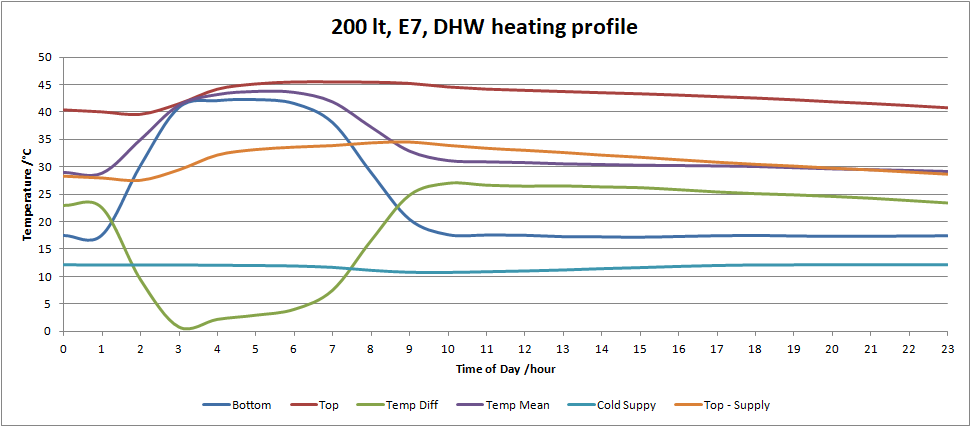
Welcome. There is an easy answer 1 and 3/4 hours. The better answer is to understand what it all means. I shall start with the ASHP power, the 5 kW (that is lower case k for 1000, and upper case W for watt, watt is lower case, unless at the start of the sentence or referring to James Watt). Now a watt [W] is a joule per second. A joule, J, is the SI unit for energy and is named after James Prescott Joule. Any SI unit that is in capitals like W or J, is a derived unit. A joule is derived from the kilogram (kg), the metre (m) and time (s). The kilogram is the odd one out in the SI system as it is the base unit, even though it is made from 1000 grams. So 1 J = 1 kg.m2.s-2 So all that is really saying is that you are moving energy with respect to time. 5 kW = 5000 J.s-1. This may seem a bit pointless, until you get to the bit about specific heat capacity of materials. Which is coming now. All materials have the capacity to store energy, so if you heat up a stone in the sun, it has absorbed some solar energy and increased in temperature. Always remember that temperature not energy. You can look up what the different amounts of energy that are needed to raise a material by 1 K or 1°C (note that it is an upper case K as it is named after a person William Thomson, better known as Lord Kelvin). It is generally better to use the kelvin scale, even though the scales match, once the offset is taken into account, 0°C is 273 K, well close enough). Now liquid water is a strange material in that it has a high density compared to its solid and gaseous states, 1000 kg.m-3 (at 277 K, 4°C). This works out nicely, and close enough for all intents and purposes at 1 kg per litre. The energy needed to increase water 1 kg, by 1 K is 4.18 kJ. This is usually written as 4.18 kJ.kg-1.K-1 or 4.18 J/kg.K. Now you have 200 litres of water at mains temperature (we shall call that 283 K or 10°C) and you want to raise it up 38 K, to 321 K So now it is just a matter of doing the arithmetic. Energy (kJ) needed = 4.18 [kJ.kg-1.K-1] x 200 [kg] x (321 [K] - 283 [K) Energy (kJ) needed = 4.18 [kJ.kg-1.K-1] x 200 [kg] x38 [K] Energy (kJ) needed = 31,768 All those letters, except the kJ cancel out to leave just the energy figure. So that is the energy required, assuming perfect energy transfer and no losses. Now remember that the power of your ASHP is 5 kW, which is 5 kJ.s-1. If you divide the energy needed, 31,768 kJ by the energy input, 5 kJ.s-1, you get left with the number of seconds. So Times (s) = 31,768 [kJ] / 5 [kJ.s-1] Time (s) = 6,353.6 Now we know that there are 60 seconds in a minute, and 60 minute in an hour. Time (minute) = 6,353.6 / 60 Time (minute) = 105.89 Now as that is below 120 minutes, or two hours, if we take away 60 minutes, the remainder is the minute part of the second hour. 105.89 - 60 = 45.89 Call it 46 minutes. Now add on the 1 hour. 1 hour 46 minutes. You will find that people often talk about their water cylinder storing some number of kWh (be careful with this one, it is as typed, not Kw/h, KW per Hour, or kill wot our). All a kWh is, is a constant amount of power, the kW part, multiplied by the time it is delivered, or consumed. That is why it is kWh, 1000 [k] x power [kW] x time [hour]. Now there are 3,600 seconds in an hour (60 minutes x 60 seconds). If we divide the kilo joules needed by 3,600 seconds, we get the kWh needed. kWh = 31,768 [kJ] / 3,600 kWh = 8.82 If you divide 8.82 [kWh] by 5 [kW] you get 1.76 hours. Which is 105.89 minutes. In reality, there are losses, and the closer the sink temperature (the water in the cylinder) and the source temperature (the water from the ASHP) get to each other, the less energy is transferred, so it will actually take longer, but that is another lecture in thermodynamics. (as usual, I may have made an error somewhere, and I am sure others will pull me up on it) -
Get rid of Gas - replace heating / DHW boiler, with what?
SteamyTea replied to tex360's topic in Air Source Heat Pumps (ASHP)
How much are they going to charge you for off peak power. Be interesting as the prices have risen. -
@JohnMo Is that multifoil insulating the area? Have you ever checked the thermal losses from your combination cylinder?
-
House is overheating
SteamyTea replied to Savage87's topic in Mechanical Ventilation with Heat Recovery (MVHR)
@Russdl If you have an IR thermometer, may be worth taking some measurements during the day and night. You may find the rise in temperature is just the air temp. -
Would an exhaust air heat pump be easier. I think @Gone West had one in his old place.
-
House is overheating
SteamyTea replied to Savage87's topic in Mechanical Ventilation with Heat Recovery (MVHR)
And less reflection off the panes, and less absorption by the panes. -
House is overheating
SteamyTea replied to Savage87's topic in Mechanical Ventilation with Heat Recovery (MVHR)
My two points. The sun is at a lower altitude in the sky, you you may be getting in more radiation that you think. More than 'summer', which is generally cloudy and wet where I am. How much daylight do people actually need in a house. Like artificial lighting, most people put in a lot more than, in my opinion, is comfortable. But I have had my cataracts replaced with shiny bright acrylic lenses. -
Or they have bought carbon offsets from companies like Tesla. Customer choice has little effect on RE generation capacity. Legislation is what is driving this. 3 phase is basically 3 separate electric supplies (they are connected, but offset by 120⁰, at the generator). So expensive to install and pay the ongoing meter rental. You can get an instantaneous, inline heater that can take a hot water supply. So a small cylinder, heated at night on E7 (or other time of day) may be possible. But look at reduction first. Not many people really need a half hour shower at 20 litres/minute flow rate. 3 minutes at 8 l/min would get the normal dirt off.
-
Add in a carbon cost into the spreadsheet. A penny a kWh would be a high starting point, at 0.15 p per 1 kWh would be about today's cost.
-
Possibly. I just picked one source. it is too easy to pick multiple sources to get conflicting figures. I can't actually see an annual tonneage figure in the report you linked to. But I am doing other stuff right now.
-
I got the numbers from the individual country page, not the main page I linked to. Assumed they would be the same units. Vietnam 56,641,097 Tons UK 41,459,830 Tons I hate all units that are not SI. The updated numbers are not hugely different.
-
I have some 'plans' for the next 9 years, some of them are legal. Vietnam consumes 56,641,097 tonnes of coal a year. UK 41,459,830, So about 16m tonnes a year less. https://www.worldometers.info/coal/coal-consumption-by-country/ They have about 30 million more people than us.
-
You can get a 300 W PV module for £135 on eBay. That is 1.6m2 of coverage. B&Q will sell you, for £1000, a rooflight that is 1.5m2 of coverage. How cheap do you want PV to become?
-
Regardless of the heating system, heat losses and maximum heat demand will be the same. You can't fool nature. The reason that the government is pushing heat pumps is that they are the only practical way to supply thermal energy to home in a low CO2 emissions manner. This is because we are cleaning up our electricity generation. This is expensive, hugely expensive, but in the last decade we have reduced that sector emissions 5 fold. There is an alternative to use resistance heating, like we did between the 1960's and the late 1980's. This would mean we would have to add a lot more generation capacity. This is possibly cheaper, in the short term, than retrofitting heating systems. But there is a land issue. The UK does not like having wind turbines and solar farms on its land. We have convinced ourselves that only the best farming land will be used for this, will kill every bird within a mile of a turbine and the glare from a solar farm will give every child cataracts. It is all bollocks of course, but perception is more important than fact. So it is basically down to us to upgrade our homes. If your roof is suitable for PV, add it. It is cheap to self install and could probably do 70% of your DHW needs (with some diverter trickery) Airtightness and insulation really need to be considered together. External wall insulation is usually the most cost effective and will (should) improve airtightness. It is like putting a windproof winter jacket on. There will always be areas that air can bypass this that may have to be address after the installation. This may well be hard to get at area i.e. between loft space and the rooms below. These can possibly be addressed when fitting PV as scaffolding will be on site. Ideally you would convert your roof void to a warm roof system, then mechanically ventilate your house. This is expensive. So go down a layer and make the interface between room ceilings and loft space airtight, then ventilate the rest of the house. Some internal insulation may be useful. The ground floor is a large area, that is usually connected to the ground, which is cold. Insulating the floor will help a lot. This is not always easy as door and ceiling heights are important, as is the first step on the staircase. Digging up the existing floor, adding in 200mm of insulation, screen and UFH pipework is not really a viable option. But 20mm of insulation will help. Now back to ventilation. You have probably read that systems with heat recovery are not effective unless the ACH are below 3. I have never calculated this, but it intuitively make sense. So get the airtightness sorted out. It is more important than having a wall U-Value of 0.1 W.m-2.K-1. Fitting MVHR is a bit disruptive as it usually requires boxing in some pipework between floors. This does depend on the house layout. Through the wall systems are available, but they are not as efficient as proper systems, but are cheaper. Ditch any thoughts of a log burner. All these do is add CO2 to the atmosphere (what we are trying to avoid), put holes in your walls and roof (what we are trying to avoid), fill the house and street with particulates (there is new WHO guidance on this), cost a lot to run and smell. Fitting an ASHP is probably the easiest option if you have room for radiators (really convectors), but plinth heater can help in tight spaces. All these are, are fan heaters, with the heat coming from hot water, rather than an electrical element. I have no idea how noisy they are in a domestic setting, only experienced them in offices, where I never noticed them. The main thing is to not be tricked into thinking that there is some wonder technology that will sort it all out, cost less to install, have zero running costs and the government will pay for it all, and reduce your income tax to 10p. So if you hear the terms Far Infra Red, Reflective, Nano, Eco, Sustainable, Multifoil, Easy, or other such nonsense, laugh at them and walk away. Yes
-
Isn't that about 60% greater than building regs suggest?
-
We used to sell HP heaters for swimming pools in the 1980s. Nothing new. They worked well. The Jubilee Pool in Penzance got a load of cash ~£1.8m (£540m was my money) to have a geothermal heating system fitted. While drilling they hit problems. So abandoned drilling to 450m (I think) and started pumping up some warmed water ~30°C and put it though a Water to Water Heat Pump. This heats a small area of the pool, a few square metres, not the whole pool. What narks me is that this is a seawater pool, so part of the warm Atlantic Ocean is constantly pumped in and out of the main pool. I suggested that using the Atlantic as the heat source would be a lot cheaper, especially as there is a company in Cornwall that already makes sea W2WHPs. My estimate was £300k to do this. But forgot the council was involved, and hippies.
-
λ Sheep wool = 0.039 W.m-1.K-1 How many sheep would you need if you wanted to have a U-Value of 0.15 W.m2.K-1 R = l / λ Where l = thickness in metres U = 1 / R I have no idea what the thickness of a fleece is, or the area, or how much is lost after cleaning, treating and processing into batts. But after listening to this: https://www.bbc.co.uk/programmes/b093hdkw I may go out and kiss a goat.
-
IFTTT (if this then that)
SteamyTea replied to Russdl's topic in Networks, AV, Security & Automation
I read the book, can't see how it would help.- 12 replies
-
- sunamp
- octopus agile
-
(and 2 more)
Tagged with:
-
MHVR and high humidity
SteamyTea replied to George's topic in Mechanical Ventilation with Heat Recovery (MVHR)
So it is near saturation point. When close to that it tends to feel damp. Rainfall tends not to increase RH in itself, it is the evaporation and condensing of the water vapour that does that. -
MHVR and high humidity
SteamyTea replied to George's topic in Mechanical Ventilation with Heat Recovery (MVHR)
How you actually 'feel' is related to temperature and humidity. Where in the country are you? -
What's buried in your build?
SteamyTea replied to Conor's topic in General Self Build & DIY Discussion
And pound coins -
That is basically what they did with the MCS. It could be argued about the level of training to bring a pipe fitter up to the standard of a real engineer. That usually takes 3 years at university.