SteamyTea
-
Posts
23393 -
Joined
-
Days Won
190
Everything posted by SteamyTea
-
Yes, the temperature range may be larger, but it still depends on the midpoint target temperature. So say you want to run the UFH at a mean of 30°C, with a variance of ±2°C. The buffet needs a lower band of greater than 32°C, with a higher band of less than 36°C to allow for mean full energy transfer. Water heating will need a higher overall temperature, and a much larger variation range to keep within the optimum 50% transfer window. Say 40°C to 55°C. The lower bound may seem lower than the desired DHW temperature, but it allows for efficient heating from below that temperature. Ideally the ∆T between flow and return will have a mean difference value of ±50% of the desired storage temperature, and very upwards as the store temperature increases. Plus a degree of two for losses
-
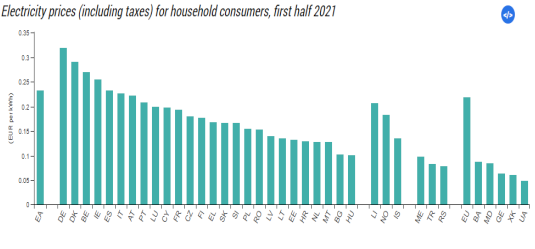
Shall we have a war of words with all the NIMBYs that have, over the last 25 years, stopped on shore RE development. We could be so far ahead now. But it seems we were at a relatively low level compared to out nearest and dearest. https://ec.europa.eu/eurostat/statistics-explained/index.php?title=Electricity_price_statistics Electricity prices (including taxes) for household consumers, first half 2021 </> EADEDKBEIEESITATPTLUCYFRCZFIELSKSIPLROLVLTEEHRNLMTBGHULINOISMETRRSEUBAMDGEXKUA(EUR per kWh)00.050.10.150.20.250.30.35 Sweden: data not available Kosovo: This designation is without prejudice to positions on status, and is in line with UNSCR 1244/1999 and the ICJ Opinion on the Kosovo Declaration of Independence. Source: Eurostat (online data codes: nrg_pc_204) This article highlights the development of electricity prices both for household and non-household consumers within the European Union (EU). When available, it also includes price data from Iceland, Liechtenstein, Norway, Montenegro, North Macedonia, Albania, Serbia, Turkey, Bosnia and Herzegovina, Kosovo*, Moldova, Georgia and Ukraine. The price of energy in the EU depends on a range of different supply and demand conditions, including the geopolitical situation, the national energy mix, import diversification, network costs, environmental protection costs, severe weather conditions, or levels of excise and taxation. Note that the prices presented in this article include taxes, levies and VAT for household consumers, but exclude refundable taxes and levies for non-household consumers. *This designation is without prejudice to positions on status, and is in line with UNSCR 1244/1999 and the ICJ Opinion on the Kosovo declaration of independence.
-

DIY hot water system needs replacing - Sunamp?
SteamyTea replied to Nelliekins's topic in Boilers & Hot Water Tanks
Can still get robbed though. -
If the ΔT is too small, the HP will be running, along will all the circulation pumps/control gear, but little thermal power will come out the system. Think of it as a car idling outside a school. Generally, maximum power transfer is when you get half the energy out of something, it is why cooling curves are not straight lines. Takes two minutes to drop 50°C, then over 10 minutes to drop the next 50°C. So you may be running your complete system for hours, while it is only delivering a few watts. A buffer will allow you to set up the HP in its most efficient range, then switch off, then the heating circulation pump, which is not bothered by the temperatures involved, it just pumps, is controlled by the thermostat. Once the buffer drops to the lowest set temperature point, the HP starts up again, until it reaches the highest set point. So the buffer temperatures are what turns on the HP, not the room temperatures.
-
Will I need a back up for my ASHP in winter?
SteamyTea replied to Nina F's topic in Introduce Yourself
It is the same here under the MCS system. 99% of the time. All that means in reality, is those 3 or 4 days a year when it is extremely cold, your house drops down a couple of °C, no the system cutting out and refusing to do anything. My old house in Aylesbury, which was on gas, did the same one. Took me ages to realise it was just extremely cold outside. -
Will I need a back up for my ASHP in winter?
SteamyTea replied to Nina F's topic in Introduce Yourself
@Nina F Can you send a link to the article you read please. As others have said, size it correctly and you will not have problems. At worse, a fan heater or two will get you out of short term trouble. When you say a well insulated house, do you know the target U-Values for each component, and remember the floor has to have a lot more than building regs as it is warmer than the house air temperature. When you build, airtightnes is important. -
Depends on the flow rate and the temperature lift up from mains water temperature. 3 kWh seems high, but then a 10 minute shower seems long to me.
-
First year Heating Energy Use in Passive(I hope) House
SteamyTea replied to Iceverge's topic in Boffin's Corner
Are while building as most on here take several years. Should be cheap enough to knock up a very basic unit that can run off a battery. -
First thing to do is to model your current hourly usage. Then you can see what can realistically be time shifted.
-
Coincides with times of peak load also. There can easily be a 2 fold difference is minimum and maximum grid load. Industry and commerce in general uses huge amounts of electricity.
-
Yes. I notice that at my Mother's house. Seems to be pulling ~250W constantly.
-
That would heat my house. Why is it so high?
-
Don't worry, nobody's gonna know ...
SteamyTea replied to ToughButterCup's topic in General Construction Issues
White, educated, upper middle class lecturers. Context is removed to protect the guilty. As it is published knowledge I can mention one of the students. A rather gobby, late 20s, heroin addict. Like most heroin addicts she used methadone to top up her habit. She lived the usual squatters life, worked as a prostitute, and stole from all her friends. For some reason the senior course tutor convinced her she was Cambridge material and got herself on a Doctorate program. Then the trouble really started. She stole from her family until they were bankrupt and somehow ended up in jail for fraud. What made me smile was her attitude to others, she thought she was invincible. "Nothing you say can upset me". Bet the judge saying she is going to prison did. -
Don't worry, nobody's gonna know ...
SteamyTea replied to ToughButterCup's topic in General Construction Issues
It is how conspiracy theories start. People that truly believe that the earth is flat, or the moon landings never happened can happily be ignored as oddballs. But when that spills over into public policy, miss using scientific methods, it becomes very dangerous. Anti vaccination, climate change and war have the same casualties, the truth. I had the misfortune to lecture statistics to a group of second year social science students. That really highlighted the difference between them, and real science students. I should have realised because of their own personal backgrounds/histories i.e. drugs, child abuse, gambling etc, they saw the tails of a normal distribution as the important part, because it includes them. To them, the other 97.5% of the chart was an irrelevance. -
I can see the ASHP helping to use up PV generation as that has displaced another energy source. Don't see how a battery makes a great deal of difference, unless you use a lot of energy during hours of darkness. Not as if modern lighting used much (though some in here seem to think they need a kW of LEDs to get them in the mood). A large TV with sound system may burn though a bit, but 8 kWh, probably not. Instantaneous electric showers may help, but even a 10 kW one is pretty pathetic compared to one run off a cylinder.
-
How I tell who is Emmet back home. They are the only ones that look proper relaxed in shorts.
-
DIY hot water system needs replacing - Sunamp?
SteamyTea replied to Nelliekins's topic in Boilers & Hot Water Tanks
On an ordinary browser use Ctrl+a to select everything in the text box, the del to get rid of it. Not found a way to do it in my Android phone except by closing the thread, then going back to it and starting a new reply. The misquote will appear with the option to clear the editor.
-
Don't worry, nobody's gonna know ...
SteamyTea replied to ToughButterCup's topic in General Construction Issues
I am with you on this. It is like the term 'Thermal Mass'. The words seem make sense, but as there are no actual units for 'thermal', it is a nonsense term. I suspect that when the Intelligence Test started there was a lot of criticism about what it actually meant, and what it was actually assessing. It is very hard to compare 'things' that are assessed on different criteria, and the poxy social sciences thrive on mixing unrelated units and using it to make a model that fits the data. From 1996 Elusive EQ - Emotional intelligence could be one of the big ideas of the 1990s—if we can work out what it is, how to measure it and what to do with it 26 April 1996 IN the late 1980s, two American psychologists, Peter Salovey of Yale and John Mayer of the University of New Hampshire, were casting around for a pithy way to sum up human qualities such as empathy, self-awareness and emotional control. For a while, the phrase they hit on – “emotional intelligence” – languished in academic obscurity. Then Daniel Goleman, a writer with The New York Times, picked it up and nailed it to the mast of his best-seller Emotional Intelligence: why it can matter more than IQ. Now the phrase is popping up everywhere. On the Oprah Winfrey show. In magazines that challenge you to “know your own emotional IQ”. On Internet sites which offer to test emotional intelligence or “EQ” with scenarios such as: “You’re on a plane that suddenly hits bad turbulence. Do you (a) continue to watch the movie (b) go on the alert for an emergency (c) do a little of a and b (d) not sure – never noticed?” Score 200 points and you’re an emotional “genius”, 25 and you’re a “Neanderthal” in need of psychotherapy. Emotional intelligence may have started out as an academic catch phrase, but it is fast becoming the psychological mantra of the mid-1990s. And mostly for some very obvious reasons. Blaming today’s epidemics of violent crime, marital strife and teenage drug abuse on poor morals and a decline in national character sounds blimpish and defeatist. Blaming these ills on deficiencies in EQ, on the other hand, doesn’t sound so bad. After all, it might be possible to improve levels of emotional intelligence in the young to equip them for life’s trials. And there is much about emotional intelligence that sounds like plain common sense. Isn’t it obvious that the ability to, say, control rage or develop empathy is likely to make a better indicator of future success than the kind of abstract intelligence measured by IQ? But even if it is, there are two big questions. Can emotional intelligence really be measured in a meaningful way? And if so, can young children found wanting in it be taught the necessary skills? Can EQ become a tool for fixing failing education systems? Crusaders for emotional intelligence seem unreservedly optimistic. Not because they believe they have the tools today to reduce the concept of EQ to a numerical yardstick in the manner of IQ (Internet questionnaires are for fun, not science), but because of the remarkable predictive power they claim for something called the marshmallow test. Back in the 1960s Walter Mischel, a psychologist at Stanford University, gave marshmallows to groups of four-year-olds and then left the room, promising that any child who could postpone eating the marshmallow until he came back, some 15 to 20 minutes later, would be rewarded with a second marshmallow. Years later, Mischel discovered that the kids who triumphed over their desire had grown into teenagers who were socially, emotionally and academically more competent than the four-year-olds who ate the marshmallow at once. Self-control in the face of a marshmallow at four was shown to be “twice as powerful a predictor of later academic prowess as IQ”, says Goleman in his book. Goleman sees the ability to delay gratification as a master skill, a triumph of the reasoning brain over the impulsive one. But does it really provide a fundamental measure of emotional IQ? Unfortunately, the marshmallow test turns out to conceal some very complex mental behaviour. Mischel went on to discover that the successful children were able to think of something else. Some would sing, tap their feet, tell themselves stories, imagine the marshmallow was a fluffy cloud – anything to avoid eating it. One held out by falling asleep. So putting off rewards is not a single skill that educationalists can easily pinpoint and work on, but depends on complex cognitive abilities. Not only that, but what is true of the ability to delay gratification may be even more true of other, subtler components of emotional intelligence, such as self-awareness, impulse control, self-motivation and empathy. Can we measure these? Some psychologists have serious doubts. “The idea that you can measure emotional intelligence like IQ is very misleading,” says Ross Buck, professor of communication sciences at the University of Connecticut. Emotional skills are slippery and relative in a way that IQ isn’t, he concludes. “Your communicative ability with someone you know is different from your communicative ability with a stranger, and each relationship will have its own characteristic emotional communication.” Paul Harris, lecturer in experimental psychology at the University of Oxford and author of Children and Emotion, agrees. If you try to measure empathy, he says, your measurement will depend on who the child is being empathetic towards. In other words, every emotional response is embedded in its social context. Behavioural research, aided by the advent of the video camera, shows how early in life this begins. Studies by Vasudevi Reddy, a psychologist at the University of Portsmouth, show how expressions of shyness in very young babies depend critically on social context. Young babies will sometimes turn their heads, avoid gaze or raise their arms to hide their faces – but precisely when and how often they do so depends on who they are with. But even if we could measure such emotions in infants and the young, teaching their control to children, as Goleman suggests, would be no small task. Individual differences, coupled with the way emotions depend on social context, make it hard to imagine a training programme that could fit the needs of different children. “If someone has a tendency to be aggressive, you can train them to recognise and control their feelings,” says Buck. “But training an extrovert will be different from training an introvert. And it’s not the same as saying this person is or is not empathic.” And there is another stumbling block for would-be teachers of empathy or self-awareness. Talk to your average five-year-old about empathy and you won’t get much response because expressing an emotion is not the same as understanding it. Harris, for example, concludes that four and five-year-olds have yet to discover that emotional lives are strongly influenced by a knowledge of other people’s feelings. At this age, he says, children believe that happiness and sadness depend simply on whether or not people get what they themselves want. Only later does their conscious emotional universe expand to include such notions as pride, guilt and shame. Despite these complications, some psychologists and educators in the US are having a determined crack at improving “emotional literacy” with the aid of specially designed teaching programmes. At New Haven, for example, the Augusta Lewis Troup Middle School provides lessons in impulse control in which children are taught to think of traffic lights. About to hit out in anger? “See” the red light, stop, calm down. Amber light means think through the problem. Green light, a positive, nonaggressive solution. Goleman’s book abounds with enthusiasm for such programmes. Yet their value to the majority of children remains unproven. According to Harris, the emotional analysis and training of children is certainly effective at the extremes of emotional illiteracy, for instance with children who’ve been severely maltreated or have specific needs. But Harris doubts such programmes could be extended effectively to the general population. Even Goleman quotes the Nicomachean Ethics, in which Aristotle says: “Anyone can be angry – that is easy. But to be angry with the right person, to the right degree, at the right time, for the right purpose, and in the right way – that is not easy.” The concept of emotional intelligence may have helped people realise that the emotional skills are important to intellectual achievement, but we may not be much nearer understanding how to measure or develop it than Aristotle was more than 2000 years ago. And this from 2015 Self-mastery can be yours with three pillars of emotional wisdom If you think you're an emotional dunce, don't despair. Anyone can improve their emotional life by honing three key skills HUMANS 30 December 2015 By Linda Geddes RILEY is moodily picking at her dinner. Noticing that something is amiss, her dad asks how school was. Inside Riley’s brain, a small green girl called Disgust flicks a switch, and Riley rolls her eyes: “School was great, all right?” she replies sarcastically. Sitting at the control panel in Dad’s mind, a skinny man called Fear reports the eye-roll to a character named Anger, who seems to be in charge. “Make a show of force,” he orders. “Riley, I do not like this new attitude,” Dad responds. The situation escalates until Riley screams: “Just shut up!” A big red button inside Dad’s head is pressed: “That’s it. Go to your room!” This brain’s-eye view of emotions in Pixar’s recent movie, Inside Out, is entertaining, but it reinforces the questionable idea that our emotions control us – that they are powerful, primal forces we struggle to understand both in ourselves and in others. Popular though this picture may be, it is one that psychologists would like to dispel. Other animals may be slaves to emotion, but human emotional life is more complex and cerebral, they argue. What’s more, mastery of your emotions is important not just for psychological well-being, but also for success in many areas of life. The concept of “emotional intelligence” surfaced two decades ago and was an instant hit. It tantalised us with the idea that we each have an EQ to our IQ, and promised to let us measure how emotionally clued-up individuals are. But it has its problems, not least in suggesting that people with a low EQ are forever saddled with it. EQ tests also often fail to do what they say on the tin: allow employers to find the most emotionally savvy candidate for the job. As a result, psychologists are falling out of love with emotional intelligence. Instead, they have identified three skills that can help us all become more emotionally adept, and reap the benefits. “Emotions are like a language – one that all humans share” Trace emotions back to their origins, and the notion that we are in thrall to them doesn’t seem so misplaced. Emotions evolved to help animals react quickly in life-or-death situations. The fight-or-flight response is a classic example. Before you are conscious of feeling fearful, your body and mind are already primed to act – your heart is racing, your vision focused, and you experience a hot rush of blood to the head and perhaps an urge to lash out. Emotions generate such physiological changes in all animals, but for us they are more than just subconscious calls to action. “Human emotions are enormously tilted towards social situations,” says Mark Pagel, an evolutionary biologist at the University of Reading, UK. “We have jealousy, sympathy, a sense of injustice, and guilt. It’s these social emotions which really mark us out as a species.” They are also what make our emotional lives so complicated. Some people are clearly better at coping with this complexity than others. This might help explain why the idea of emotional intelligence was so eagerly received in 1995, following the publication of psychologist Daniel Goleman’s book Emotional Intelligence: Why it can matter more than IQ. An international bestseller, it launched an industry peddling tests to select emotionally intelligent candidates for management positions and careers such as medicine. But for all the hype and the money spent, there has been a sense of disappointment – not just among employers. “People ask, ‘what the hell was it good for?'” says Klaus Scherer, director of the Swiss Center for Affective Sciences in Geneva. “Mastering the language of emotions requires three key skills” One problem with the tests is that they often ask participants to rate their own abilities – for example, to keep calm in difficult situations. Assuming respondents do not lie, they may still lack the self-awareness to give accurate answers. Another concern is that rather than measuring how well we use our emotions, the tests really measure personality and general intelligence. It has become clear that if you take these two factors into account, emotional intelligence scores say almost nothing about how competent someone is likely to be in the workplace. Emotionally fluent Scherer notes that the concept of emotional intelligence caught on before it had been properly researched. We now know far more about human emotions, in particular, that although some people are naturally more emotionally adept than others, all of us can learn to master our emotions more effectively. The notion of emotional intelligence is confused, in part because the very term EQ suggests an innate and unalterable measure – akin to IQ – even as its proponents promise that employees, students, indeed anyone, can learn to boost their score. Many psychologists now prefer the term “emotional competence”, because it signifies an ability that can be honed. Many also think of this ability as a sort of language – one that all humans share (see “One language, many dialects“). This, in turn, suggests how we can become more emotionally fluent. Just as learning a language entails recognising words, understanding how to use them, and controlling a conversation, so mastering the language of emotions requires three key skills – perception, understanding and regulation of emotions. Perception is the bedrock on which the two other skills rest. Perceiving emotions is not as straightforward as it might sound. Traditional tests of emotional intelligence probe this skill using pictures of faces. “The tests are too easy,” says Katja Schlegel at Northeastern University in Boston, Massachusetts. For a start, expressions of emotion extend beyond the face to gestures and movements, plus tone of voice and other sounds. Aural and visual cues can interact; for example, one study found that the way people interpret laughter and crying sounds is altered by the facial expressions accompanying them. “The same laugh is perceived as sounding significantly happier when paired with a smiling face than when paired with a sad face,” says César Lima at University College London. A static picture isn’t even a good representation of the way our faces express emotion. “The human face is equipped with a large number of independent muscles, each of which can be combined and activated at different levels of intensity over time,” says Rachael Jack at the University of Glasgow, UK. Her studies using computer-generated faces that randomly combine facial expressions, such as lip curls and raised eyebrows, suggest that each emotion has an associated sequence of facial movements, which she calls “action units”, unfolding a bit like the letters of a word. Action units strung together in specific patterns create “sentences” that communicate a more complex social message. Schlegel is working with colleagues at the University of Geneva, Switzerland, to develop a better way of assessing how we judge emotional cues in everyday life. Named the Geneva Emotion Recognition Test (GERT), it involves a series of short videos of actors expressing an emotion by uttering meaningless syllables. People’s scores can range from 0 to 1, and preliminary research suggests that they are meaningful. When Schlegel invited pairs of strangers to negotiate a work contract, those with higher scores both negotiated more successfully and were perceived as being nicer and more cooperative than people with lower scores. “This is why I think emotion recognition is such an important skill,” she says. “It is difficult to convince a person of your ideas if you’re not paying attention to their needs and interests.” So, how can you improve your emotion recognition skills? Schlegel teaches people to look for the appropriate cues in the face, voice and body, then gives them video clips to practise on, and get feedback. In one study she found that undergraduates trained in this way achieved an average GERT score of 0.75, compared with 0.6 for controls. Lima’s group, meanwhile, has been looking at whether musical training can help. They found that adult musicians are better than non-musicians at judging the emotion in someone’s tone of voice. Brain imaging studies suggest that this reflects more than simply a general sensitivity to basic aspects of sound, says Lima. “Music training can modulate brain responses known to be more specifically associated with emotions and with our ability to interpret others’ minds.” Recognising emotions is not enough, though. You also have to understand how they are used – and that’s the second skill. “Not everyone smiles when they’re happy, or scowls when they’re angry,” says Lisa Feldman Barrett, also at Northeastern University. Indeed, she has found tremendous variability in brain activity, both between people and in the same individual, in response to different types of threat. This suggests that there is no “essence” of fear or anger. “Somebody who is highly emotionally competent has a very broad vocabulary of emotion concepts that are highly flexible,” she says. “They know how to impose meaning on smiles and scowls, frowns and vocal cues.” They can take emotional signals – both from the outside world or their own bodies – and make sense of them. The ability to understand emotions in this way is not innate. “None of us are born knowing the difference between feeling overwhelmed and worried, elated and ecstatic. It’s a language that has to be taught,” says Marc Brackett, director of the Yale Center for Emotional Intelligence. In an attempt to do that, a decade ago he helped create a programme called RULER, now used in some 10,000 US schools. It teaches children and young adults to interpret physiological changes in their bodies linked to emotions, label them, and learn strategies to regulate their emotions. “It’s remarkable work that has a tremendous impact on kids’ competence,” says Barrett. “When you can take a physical change in your body and understand it as an emotion, you learn to make meaning out of that change.” Evidence also suggests that it improves the relationship between teachers and students. Other researchers are investigating whether having a broad and accurate vocabulary for your own emotions can make you more aware of other people’s emotions. “It’s still an open question,” says Agneta Fischer at the University of Amsterdam in the Netherlands, who is leading one such study. Once you can recognise and make sense of emotional signals, then you need the final skill – the ability to regulate your feelings. “Emotion regulation is important, both to ensure that you properly analyse and appraise a situation, and also that you conform to social standards and don’t allow yourself to show certain emotions at certain times,” says Scherer. Again, this isn’t something we are born with, and as we develop, some of us learn ineffective strategies for doing it, such as avoiding emotionally charged situations or trying to shut down our emotions completely. Research shows that people who address emotional situations directly rather than avoiding them have higher levels of well-being and are better able to cope with stress. There are ways to improve your regulation skills. One approach psychologists favour is “reappraisal” – trying to put yourself in someone else’s shoes so as to be more objective, and change your emotional response accordingly. When a team led by Ute Hülsheger at Maastricht University in the Netherlands taught this strategy to hairdressers, waiters and taxi drivers, they found that it resulted in more tips. “Reappraisal helps you to display authentic positive emotions, and that is rewarded by customers,” she says. But rethinking your emotions from scratch requires a lot of effort. Another promising approach is mindfulness – observing the coming and going of your emotions without action or judgement. In a separate study, Hülsheger randomly picked members of a group of 64 employees to receive mindfulness training, and monitored them all over 10 days. Those who got the training reported more job satisfaction and less emotional exhaustion. “The idea is that when you just see emotions as they are, as thoughts and sensations, you gain a sense of perspective and the ‘hot’ aspect of the emotion dissolves,” she says. Everyone knows that mastering a language takes time and practice. Some people are naturals. Others struggle to communicate effectively. But when it comes to the language of emotions, making the effort to improve is surely worth it, because the proponents of emotional intelligence were right about one thing – being emotionally fluent really does bring benefits. (Images: Mohamad Itani/Millennium Images, UK, Rita Scaglia/Picturetank, Randi Sidman-Moore/Masterfile/Corbis) One language, many dialects Charles Darwin coined the term “the language of the emotions”. But do all people speak the same language? To get at an answer, David Matsumoto at San Francisco State University studied thousands of photos taken at the 2004 Olympic and Paralympic games in Athens, Greece, comparing the facial expressions of athletes who were born blind with those of their sighted counterparts. “You can rule out any possibility that they visually learned to put these expressions on their faces,” he says. “We found that there are seven categories of emotion that are universally produced on the face.” His list – anger, contempt, disgust, fear, happiness, sadness and surprise – closely matches the universal emotions identified by psychologist Paul Ekman, who pioneered the field in the 1960s. But although we all express pure and unfettered emotion in the same way, everyday variations arise, Matsumoto suspects, because we regulate our emotions to conform to cultural norms, with knock-on effects on the way we interpret emotion in others. One study, for example, found that American and European students frequently reported feeling pride, anger or irritation, whereas Japanese students more often experience feelings of closeness, shame, guilt or debt to another. Another study found that white Europeans could easily distinguish between facial expressions of surprise, fear, disgust and anger, whereas east Asians often confused disgust and anger, and fear and surprise. Eye-tracking revealed that the white Europeans looked at all areas of the face equally, while east Asians focused on the eyes. What do such studies tell us? According to Batja Mesquita at the Catholic University of Leuven (KUL) in Belgium, if you live in a culture where an emotion like anger is viewed as disturbing and selfish, you will not be rewarded for expressing it, and over time you may even cease to feel it as frequently or intensely. She has found that immigrants gradually adapt their emotions to the norms of their new home. It’s as if we all speak the same language but adopt the local dialect. This article appeared in print under the headline “Control yourself” -
Don't worry, nobody's gonna know ...
SteamyTea replied to ToughButterCup's topic in General Construction Issues
There is a small building due in the town I work in. Nice lads, both have Asperger's Syndrome. They seem to survive as a company. -
As close as I could get. Better beaches. Not enough coral or colourful fishes though. Sharks are larger, but the birds are dull, and you can read into that whatever you like.
-
Welocme I am a bit late to this beach party. Used to live about 550 miles SW of Antigua. Only got the tail end of one small hurricane when I was there. All the cast concrete house had no real problems, Tin Town was not very pretty, but rebuilt within a week. I have often wondered how easy it would be to build in the Caribbean as all the island I have been to have felt like home to me.
-
It is probably the best site to assess PV production. This is the link. https://re.jrc.ec.europa.eu/pvg_tools/en/ Not sure if it works on a mobile.
-
Once I picked myself up, I was not too interested, was as much as I could do to get back to the car. https://en.wikipedia.org/wiki/Floor_slip_resistance_testing
-
The best, Cornish. Does that actually tell us anything?
-
Do you know how slippery when wet granite is. I am nimble and lithe, with cat like reaction. Stepped on one, slipped, broke my pelvis. Would have been worse but my Pentax DSLR broke my fall.