


SteamyTea
-
Posts
23849 -
Joined
-
Days Won
200
Everything posted by SteamyTea
-
Cellulose insulation works well to deafen sound.
-

Is there a reliable and fool proof occupancy sensor for WCs out there
SteamyTea replied to MikeSharp01's topic in Lighting
That should be a Smelly considering the job it is going to do. -
That is the nub of it. I have tried for years to set up a basic energy understanding course. No takers. People carry so much baggage with them that, in all reality, it is not worth doing. Only got to look at the two camps in here, no point education the people that have self installed PV, and no point educating the ones that think it is not worth doing, even though we know they are misguided. All I do now is tell people what and where to buy. Then it is up to them. It really is not hard for most households to lop 30% off their electrical usage, 60% is possible, harder though.
-
Designing new flat roofs with PV from the start
SteamyTea replied to low_and_there's topic in Photovoltaics (PV)
Sorry, missed this earlier. Seems reasonable production. Flat roof systems do perform quite well when cloudy (scattered light). Did you take into account some slope to allow water to wash dirt off? -
Why, it is just a temperature distribution, which is close enough to a normal distribution to not have to worry.
-
Do I have Efflorescence on my walls?
SteamyTea replied to ennogs's topic in Bricklaying, Blockwork & Mortar
Because you did not build it. -
Do I have Efflorescence on my walls?
SteamyTea replied to ennogs's topic in Bricklaying, Blockwork & Mortar
Set my OCD off
-
How does your garden grow?
SteamyTea replied to recoveringbuilder's topic in Landscaping, Decking & Patios
I did that and got told off. -
We should have installed air conditioning… now what?
SteamyTea replied to Adsibob's topic in Other Heating Systems
All about the Lambertian reflectance. Colour is not the overriding property. -
Welcome. There is a reason that you cannot find that much about it, it does not work as sold. Green bling. There is some research done in Colorado which is often touted as the proof needed. Quick look at an atlas will show you that Denver is a lot further south than even Cornwall. The weather regime is also very different to the western side of the UK. Just go for regular PV, roof integrated, and store the excess energy in a thermal store.
-
You need a Deepa Janga, can wallpaper the hall though the letterbox.
-
How does your garden grow?
SteamyTea replied to recoveringbuilder's topic in Landscaping, Decking & Patios
First bud.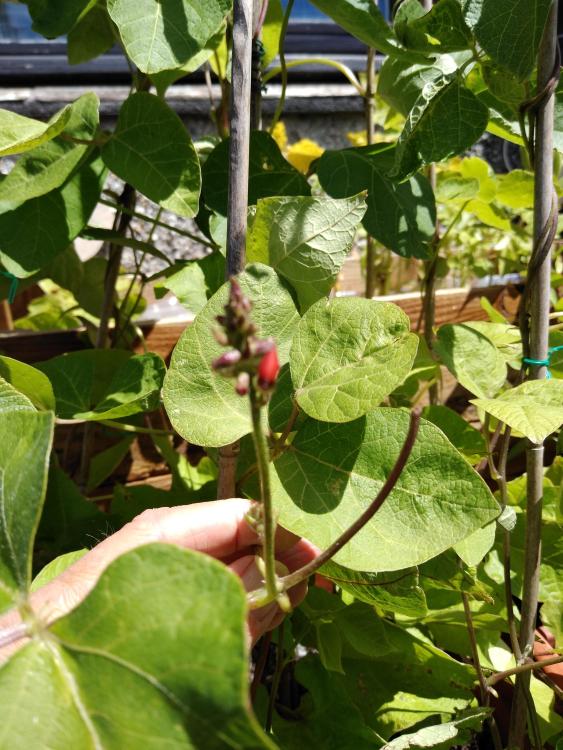
-
CAD Plans - Required?
SteamyTea replied to Mulberry View's topic in General Self Build & DIY Discussion
It is interesting this whole IP thing. I do understand that people want to keep control of their ideas and designs. But in the real world, this is almost impossible. Not as if you can hide a house from view. It may be worth getting the people to place the files in a secure folder that uses normal encryption, so that only you (or whoever you give the password to) can use it. There are a number of ways this can be done. There are also methods for tracking images and files on the internet, but I suspect that designers would not be bothered to enforce it. -
Feel like silly questions but may not be.
SteamyTea replied to MikeSharp01's topic in Networks, AV, Security & Automation
Regular as clockwork, 7 every morning. Trouble is, don't get up till 7:30. -
Interesting. I assume that tax is paid on that, so may be equal to just what domestic customers pay. Taking just EDF because I am with them, is that the UK side or the whole group, which is, in effect, a nationalised company.
-
CAD Plans - Required?
SteamyTea replied to Mulberry View's topic in General Self Build & DIY Discussion
Yes. All they are trying to do is minimise the risk of someone copying their designs. Probably because they cannot afford to enforce them. I do find it odd that IP can be applied to standard bricks, timbers and steels. There was a Sci-Fi story about a man that made film props. He was working on a film and the aliens came down and accused him of steeling their design, then took him away. Was MacArthur era. -
Feel like silly questions but may not be.
SteamyTea replied to MikeSharp01's topic in Networks, AV, Security & Automation
Those were the days, sitting at your desk, full ashtray, while watching the 'properly dressed' young girls in the typing pool bend over to get stuff from the filing cabinet. Clean air and a PC is not the same. @pocster's hard drive is exempt from this, obviously. -
I did a bit about this a few years ago on DriveTribe. We have (well had then) enough spare capacity, without doing anything at all i.e just plug those BEVs in when you feel like it, to charge 3.5 million vehicles. Switch that to night usage and it was 7.5 million. There is currently less that 0.5 million pure BEVs on the UK roads. So till plenty of headroom. The biggest problem is the governments fixation with nuclear power, which takes 25 years to build.
-
Interesting point. Say there are 30 million houses in the UK, and they each use around 3 MWh a year. With VAT at 5% on domestic energy, that is £42/house.year. So the treasury is taking £1.26 bn a year. Are the greedy shareholders getting this much?
-
When ICE cars started, one sent the Butler to the chemist to get a can of gasoline. It is really early days in this journey, and by highlighting the problems now, there is more chance that it will be done right.
-
Yes, one of the criticism of smart meters. I suspect, in reality, when we are all BEV, the vast majority of people will fast charge at public charging points.
-
I am sure there is one in there somewhere. (expletive deleted)ing autocorrect.
-
Ecodan standby power consumption
SteamyTea replied to LA3222's topic in Air Source Heat Pumps (ASHP)
Yes, took me a while to find out what was gobbling power and what I could get rid of. It was a sudden increase in daily usage that made me realise that something was wrong. Fridge had gone faulty. -
How does your garden grow?
SteamyTea replied to recoveringbuilder's topic in Landscaping, Decking & Patios
I always liked astable multi vibrator -
So you drive from your flat to your workplace, and find that because demand is high, you cannot charge up at work. Won't this just drive (pun intended) an amateur to make their own.



