SteamyTea
-
Posts
23849 -
Joined
-
Days Won
200
Everything posted by SteamyTea
-
 Set it up so you can have unshaded PV in the roof as close to South facing as possible.
 -
Say electricity is 28p/ kWh, then £468.72. Gas at 7p, £684.53. Gas would need to be 0.04793p/kWh.
-
Octopus Smart Meter Display suddenly showing export rate
SteamyTea replied to NSS's topic in Photovoltaics (PV)
Very much not random. The k is always lower case, the W always upper case, the h is usually lower case, but as it is not an SI, or even a derived unit, can be either. Convention has time as always lower case, so t for time, s for seconds. S, is allowed at the beginning of a sentence. -
Octopus Smart Meter Display suddenly showing export rate
SteamyTea replied to NSS's topic in Photovoltaics (PV)
Surprising, normally kWh. -
Octopus Smart Meter Display suddenly showing export rate
SteamyTea replied to NSS's topic in Photovoltaics (PV)
in Money or Energy units? -
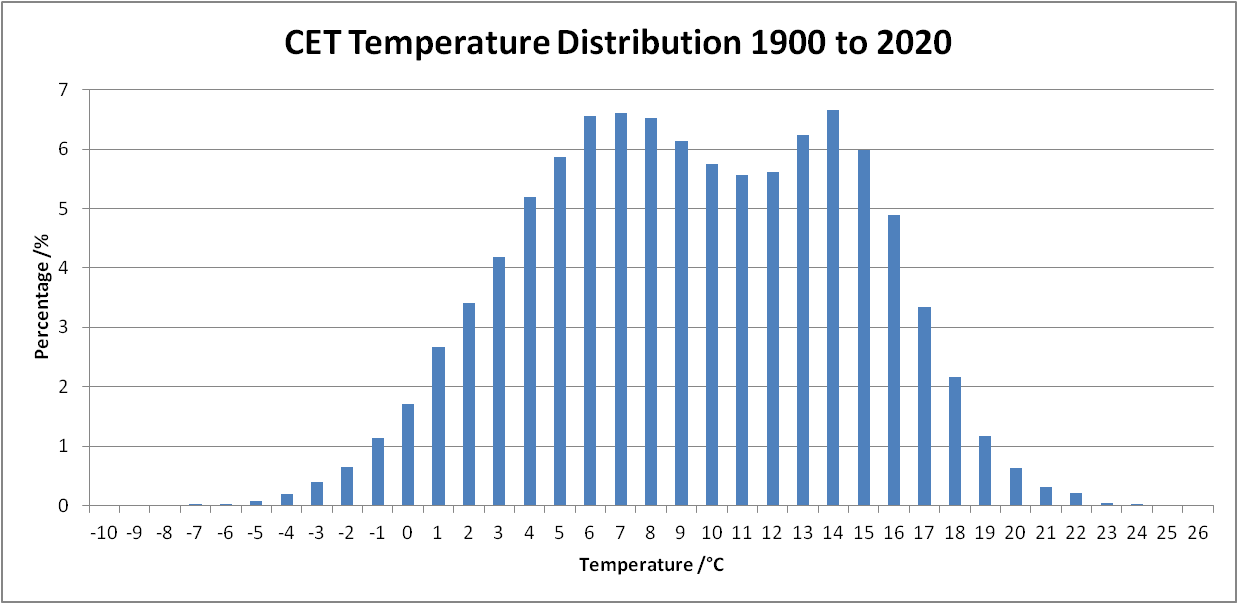
How cold do you think the UK usually is in winter? Not many of us live in the frozen north. Very really below 5°C, 20% of a year, 73 days) Only 0.75% is -3 or below, 2.7 days. (Central England Temperature data set) So a fan heater can sort that out, but ASHPs still have a greater than unity CoP at that temperature.
-
Have you considered roof integrated PV, similar price to some roofing materials.
-
Do we know how long the meters pulse the LED for, could that cause a multiple reading? @ProDave will be proud of you. He would sit in a sauna, on the hottest day of the year, just to save exporting 1p of electricity.
-
When I was studying for my ResM, I had to visit a lot of farms. They treat the rules as if they do not apply to them.
-
@Radian TL;DR. Shall have a look later when I get home. Going to have a go at rewriting my code with interrupts. Looks simple enough. What to add a temp sensor to my sensor as well. Sometimes I just want a rainy day and no car, only way I get things done at home.
-
Not deep enough then. Many boreholes around me are only a few meters deep. Full if those careless farmers' pollutants. Farmers claim to be the stewards of the countryside. They are really criminal polluters who play in people's emotions because 'they feed people'.
-
MVHR with adiabatic cooling
SteamyTea replied to Garald's topic in Mechanical Ventilation with Heat Recovery (MVHR)
A number of things going on in your home at once, hard to keep track sometimes. I am a great believer in doing 1 thing, but doing it really well. So separating heating, cooling and ventilation may be better. A traditional MVHR system is not designed and installed as a heating or cooling system. MVHR is really just to replace the air in an airtight building, in a controlled manner. The HR side of it is really just a bonus and a simple modification that scavenges some energy from the expelled air. With any heat recovery system, efficiency changes with the temperature difference. It is possible to make a material difference to internal temperature and humidity levels with an air based heating and cooling system by oversizing the pipework and increasing the flow rates. This takes up more space and costs more to run. So probably only worthwhile in exceptional circumstances. Having said that, it may be possible to have just one or two rooms that have a greater flow rate, and fit FCU (fan coil units) in just those ducts. FCUs can be run from an ASHP in both heating and cooling mode. You can also get MVHR units with build in heat pumps that can make a small difference. As usual, there are many ways to sort out the same problem. But basically all you need to do is control internal air for temperature and humidity, without causing condensation problems. -
Have you read the terms and conditions, your other 2 posts are coming across as adverts.
-
"With the exception of bare, polished metals, the appearance of a surface to the eye is not a good guide to emissivities near room temperature. Thus white paint absorbs very little visible light. However, at an infrared wavelength of 10x10−6 metre, paint absorbs light very well, and has a high emissivity. Similarly, pure water absorbs very little visible light, but water is nonetheless a strong infrared absorber and has a correspondingly high emissivity." Really not worth the bother in my opinion. An extra €1/m² on curtain material will make a much bigger difference.
-
Have you had a proper heat loss calculation done. That is the very first part. Just knowing the size of a property is of little use.
-
Rainwater Harvesting...
SteamyTea replied to Mulberry View's topic in General Self Build & DIY Discussion
Larger pump and an accumulator. 2 parts that way. -
Borehole.
-
Don't get caught, you will not be allowed to teach ever again.
-
Did he use your appraisal?
-
Part G of the building regs. Just do what they recommend, you can change things later.
-
Is that a 4 hectare solar farm? Obligatory kW, not kw.
-
MVHR Active Carbon Filter
SteamyTea replied to Ultima357's topic in Mechanical Ventilation with Heat Recovery (MVHR)
Good stuff. Do you have pictures and prices? -
Rainwater Harvesting...
SteamyTea replied to Mulberry View's topic in General Self Build & DIY Discussion
Very good point. I don't have a lawn, and would never water one if I did. I have the most expensive tap water in the country, so don't wash my car either. -
Yes. https://en.wikipedia.org/wiki/Emissivity
-
What if I get abducted by aliens?
SteamyTea replied to puntloos's topic in Project & Site Management
My old cat never liked the vets after the first trip.