SteamyTea
-
Posts
23368 -
Joined
-
Days Won
190
Everything posted by SteamyTea
-
https://www.simplesurvey.co.uk/article/the-beginners-guide-to-section-6-party-wall-notices/ "Within 6 metres where your excavation will intersect a line drawn at 45° from the bottom of your neighbour’s foundations." How deep are the neighbours foundations?
-
I found Pocster's play list.
-

Vaillant ashp (my battle with).
SteamyTea replied to zoothorn's topic in Air Source Heat Pumps (ASHP)
I warned you all back in August 2023 with the below statement. -
Rising carbon dioxide levels now detected in human blood
SteamyTea replied to SteamyTea's topic in Boffin's Corner
It could be, maybe that is addressed in the source paper. -
How modular homes are rebuilding Portugal’s ruins
SteamyTea posted a topic in Property TV Programmes
From the World Service (that is the stuff on the wireless for insomniacs). https://www.bbc.co.uk/sounds/play/w3ct6s3j- 1 reply
-
- 1
-

-
Rising carbon dioxide levels now detected in human blood
SteamyTea posted a topic in Boffin's Corner
Rising carbon dioxide levels now detected in human blood by The Kids Research Institute Australia edited by Sadie Harley, reviewed by Robert Egan Rising carbon dioxide levels are being detected within the human body, with new research warning a key blood marker for the gas could near its healthy limit within decades if current trends continue. The findings are especially relevant for children and adolescents, whose developing bodies will experience the longest cumulative exposure to rising atmospheric CO₂. Tracking carbon dioxide inside the body In a study published in Air Quality, Atmosphere and Health, researchers from The Kids Research Institute Australia, Curtin University and The Australian National University (ANU) analyzed more than two decades of U.S. population data and found steady shifts in blood chemistry that closely track the rise in atmospheric CO₂. Using data from the U.S. National Health and Nutrition Examination Survey (NHANES), the team examined blood results from around 7,000 people every two years between 1999 and 2020. Average levels of serum bicarbonate—a marker closely linked to carbon dioxide in the body—have risen by approximately 7% since 1999. Over the same period, average calcium and phosphorus levels have declined. These changes mirror the rise in atmospheric CO₂, which has increased from about 369 parts per million (ppm) in 2000 to more than 420 ppm today. Author Associate Professor Alexander Larcombe said the findings suggest the human body may already be compensating for a changing atmosphere. "What we're seeing is a gradual shift in blood chemistry that mirrors the rise in atmospheric carbon dioxide which is driving climate change," A/Prof Larcombe said. What changing blood chemistry could mean Bicarbonate plays a central role in maintaining the body's acid–base balance. When CO₂ levels rise, the body retains more bicarbonate to stabilize blood pH. Over time, however, sustained compensation may carry physiological consequences. "If current trends continue, modeling indicates average bicarbonate levels could approach the upper limit of today's accepted healthy range within 50 years," A/Prof Larcombe said. "Calcium and phosphorus levels could also reach the lower end of their healthy ranges later this century." Humans evolved in an atmosphere containing roughly 280–300 ppm of CO₂. The average annual increase over the past decade has been about 2.6 ppm per year, with 2024 recording a 3.5 ppm rise. Fellow Author Dr. Phil Bierwirth, a retired environmental geoscientist who is affiliated with the ANU Emeritus Faculty, said while the study does not prove direct causation, the consistent, population-wide trends are difficult to ignore. "I actually think that what we are seeing is because our bodies are not adapting," Dr. Bierwirth said. "It appears we are adapted to a range of CO2 in the air that may now have been surpassed. "The normal range maintains a delicate balance between how much CO2 is in the air, our blood pH, our breathing rate and bicarbonate levels in the blood. "As CO2 in the air is now higher than humans have ever experienced, it appears to be building up in our bodies. Maybe we can never adapt such that it is vitally important to limit atmospheric levels of CO2." A new dimension of climate risk The researchers say the findings point to an emerging dimension of climate risk, one that extends beyond heat waves, extreme weather and sea-level rise. Rather than viewing rising CO₂ solely as an environmental issue, A/Prof Larcombe says it may also need to be considered a long-term public health variable requiring ongoing monitoring. "We're not saying people are suddenly going to become unwell when we cross a certain threshold," he said. "But this suggests there may be gradual physiological changes occurring at a population level, and that's something we should be monitoring as part of future climate change policy." The study calls for atmospheric composition and population biomarkers to be tracked alongside traditional climate indicators to better understand how gradual environmental change may influence human biology over decades. Reducing CO₂ emissions remains critical to limiting global warming. The researchers' findings suggest emission reduction may also be important for safeguarding long-term human health, and that the potential physiological effects of rising CO₂ should form part of future climate policy discussions. More information Alexander N. Larcombe et al, Carbon dioxide overload, detected in human blood, suggests a potentially toxic atmosphere within 50 years, Air Quality, Atmosphere & Health (2026). DOI: 10.1007/s11869-026-01918-5 -
https://www.independent.co.uk/news/duke-of-edinburgh-forced-to-apologise-for-racist-remark-1111947.html Where is the apology, whoops, apostrophe. So theses Caribbean holidays you have, anything you want to tell us about what you saw, and more importantly, what you did not see.
-
Yes, one of the first ones deployed.
-
What was it that Prince Phillip said in a Scottish factory back in 1999, when looking at a fusebox?
-
Raised Tiles on Fibreglass roof Balcony
SteamyTea replied to Robbb's topic in Roofing, Tiling & Slating
What gap will remain between roof covering and tile base? While GRP is water proof, the life is shorted by constant immersion in water, and freezing/heating cycles can cause problems. Have you thought of just using a suitable waterproof grout to adhere them in place? -
A couple of people I was at university with, and who I happened to lecture to as well, have both been invited with marine turbines. It is an interesting area, but does seem to be getting reliable now. It is better than wave energy that has a dreadful reliability problem.
-
So a UK mortgage provider has gone into administration.
SteamyTea posted a topic in Housing Politics
No, I had never heard of them either, but the ones they have borrowed from. I have. https://www.reuters.com/business/finance/barclays-shares-fall-possible-losses-collapse-market-financial-solutions-2026-02-27/ -
Same way that Cornwall does. If local wages, as opposed to national average wages are taken into account, the ratios change quite significantly.
-
Exploring the ratios and losses between building elements
SteamyTea commented on SteamyTea's blog entry in Energy Ideas
Needs to be highlighted I think. It is why 'scientists, get a bit despondent when talking to lay people. No matter how often limitations are stated, these will be ignored and the 'in the real world' 'facts', based on a sample of 1, for a very different scenario, will be quoted as the truth, loudly. -
Exploring the ratios and losses between building elements
SteamyTea commented on SteamyTea's blog entry in Energy Ideas
Not really as it is not about houses per sec, it is about form factor ratios, fabric thermal properties and ventilation losses, for a simple cuboid. The real world is very different. -
UFH - do I need floor probes?
SteamyTea replied to Great_scot_selfbuild's topic in Underfloor Heating
The floor temperature will be pretty close to the mean flow temperature, so no real need for extra sensors. Extra sensors would be good for data collection and analysis, but not many people are as nerdy about that as me. -
Tell me again about how leccy prices are goin to come down…
SteamyTea replied to Alan Ambrose's topic in Housing Politics
Yes, and it never helped the fisherman. -
Tell me again about how leccy prices are goin to come down…
SteamyTea replied to Alan Ambrose's topic in Housing Politics
It is all going to be fine, the Cornish have come to the rescue. https://www.bbc.co.uk/news/articles/cewzg77k721o All I will say is that we have been here before. https://www.cornwallislesofscillygrowthprogramme.org.uk/hot-opportunity-european-investment/ -
Exploring the ratios and losses between building elements
SteamyTea commented on SteamyTea's blog entry in Energy Ideas
That is the hard bit. That is because I was being a bit flash to work around the charting limits in LibreOffice. I would recommend downloading the portable version as it does not install itself on a PC, just runs from a memory stick. I have some data about ground temperatures that I am looking at, so may be able to make some sense from it. -
Exploring the ratios and losses between building elements
SteamyTea commented on SteamyTea's blog entry in Energy Ideas
Was about 2 hours, over a coffee, but 45 years of studying. -
Upgrading rafter ties to proper joists
SteamyTea replied to SimonD's topic in Garage & Cellar Conversions
Use an adhesive. You could do a couple of tests and see how it 'feels'. -
Not as much trouble as when you find out it will only increase your energy usage.
-
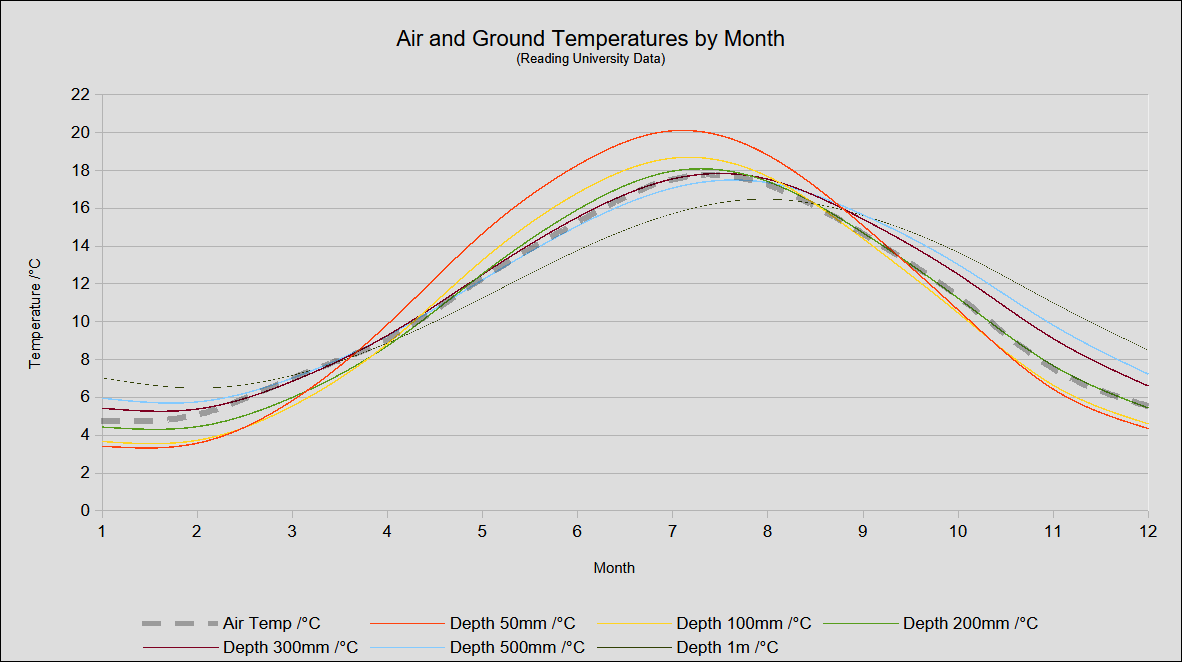
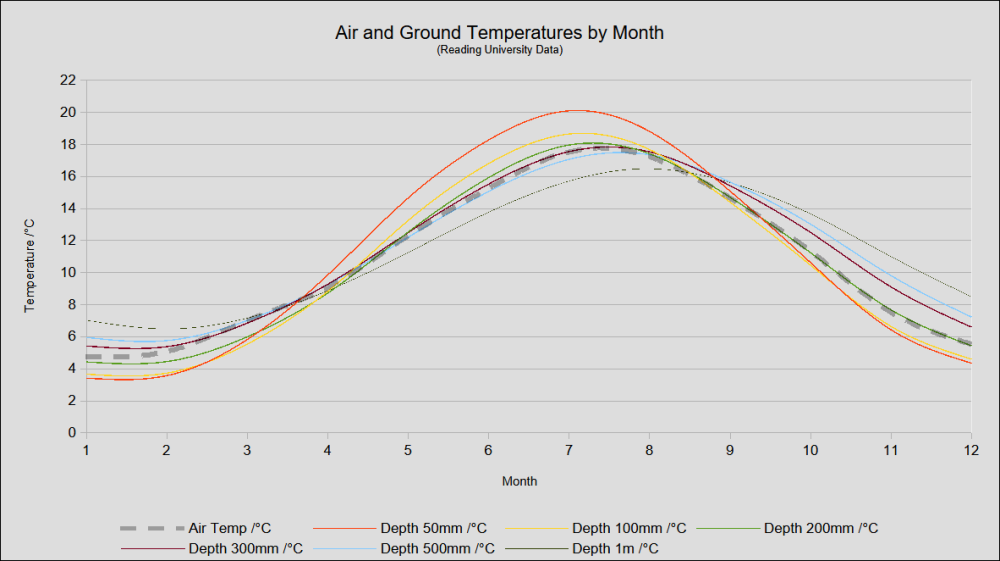
Well at 0.1, 0.2, 0.3 and 0.5m depths, which is about the normal depths for foundations. There are many things that will affect the temperature at different depths, hours of sunlight and rainfall are probably the biggest factors. I think that data is available from the RU website. Wish I had more time to look at it all.
-
I just happen to be looking at some ground temperature data. I am not so sure it is a good idea to bury air pipes in the ground, even at 1m depth, it is only from mid March to September that the ground is cooler than the air, and then only by a maximum of 2°C. At the half metre it is about 1.5°C cooler. I also suspect that the energy transfer efficiency is not too good.
-
Upgrading rafter ties to proper joists
SteamyTea replied to SimonD's topic in Garage & Cellar Conversions
As this is temporary, could you not cut some plywood up that is deeper than the current beams/joists/rafter (not really sure of the correct terminology) and sister then up to the existing beams/joists/rafter. With correct trimming at the ends, they could bear onto the top of the wall. They could be cut to make the beams/joists/rafter either deeper or taller. Something like this. Or better still, if you are boarding, the other way around, so the original timbers are at the top.