SteamyTea
-
Posts
23383 -
Joined
-
Days Won
190
Everything posted by SteamyTea
-
He never leaves his heating on long enough to warm the structure. Has he had his new heating system fitted yet, winter is on its way.
-
 I think they did not introduce driving test until 1976 or something. I was listening to Radio 5 when the Donnington European GP was on (1993). I had a higher average speed. Great place. My French cousin was on holiday in the South of France with my Belgium cousin. My French cousin had no problem puling women, while my Belgium on had no luck at all. When the Belgium one asked what was the French ones secret, the French on says he puts a potatoes down his Speedos. Next day, my Belgium cousin tried the same, but still had no luck. "I don't understand, we look similar, act similar and I am wealthier than you, just still cannot pull" he said to my French cousin. My French cousin replied "try putting it down the front"
 -
You could get some made in white I would have thought. Usually goes into the mortar joint. But can be stuck to a wall, and with the right preparation for the rendering system, rendered over.
- 1 reply
-
- 1
-

-
Worth installing PV on entirely West facing roof
SteamyTea replied to Huckleberrys's topic in Photovoltaics (PV)
Getting rather off topic this is. The main problem is comparing like for like -
Worth installing PV on entirely West facing roof
SteamyTea replied to Huckleberrys's topic in Photovoltaics (PV)
No, been known for decades. It is one of those zombie statistics that refuses to die. -
Worth installing PV on entirely West facing roof
SteamyTea replied to Huckleberrys's topic in Photovoltaics (PV)
No specifically. Read up on organic vegetables, they have no nutritional benefits at all. Just to be controversial, if all meat was factory farmed in sheds, on preprocessed fodder, meats would be a lot cheaper. Then buyers could decide if they wanted to buy a product raised in that manner. I assume they would not want it, so that would free up a lot of land resources for other uses. Kind of veganism via the back door. Normal milk has all the fat removed at the dairy, then put back in at 1, 2 or 4% by volume. How they keep the quality so good. -
Is a manufacture, but properly done GRP will outlive the building easily. How big is the area?
-
BMW, VW, Mercedes, Bosch from Germany. Toyota, Honda, Nissan, Kawasaki from Japan. Cheese and Red Wine from France, ad a surly attitude. But we have JCB, Nigel Farage and Alan Sugar. And the Rolling Stones (well the almost living ones).
-
Worth installing PV on entirely West facing roof
SteamyTea replied to Huckleberrys's topic in Photovoltaics (PV)
-
Decking paint failure, why and what to do about it?
SteamyTea replied to ProDave's topic in Decorating
Probably. Was your decking timber treated? Some treatments try to create a polar repellent on the air side, then when you paint them, the paint dries the wrong way around, so acts as a sponge, then it will never last. Other treatments just try to kill fungi and bacteria, not sure what their polarisation is, but it will have one, and Sod's Law say it is the wrong way around. Other treatments may just form a barrier, think wax. These only mechanically stick as they are, in effect, just a layer that repels water, all over. Hydrogen is positively charged and oxygen is negatively charged, but they make a covalent bond, so a slight positive charge on the surface, but no overall charge internally, why it is a hard molecule to crack apart and has fantastic properties. It also dissolved almost everything it touches. -
Decking paint failure, why and what to do about it?
SteamyTea replied to ProDave's topic in Decorating
Water repellency works by having the opposite polarity to water at one end of the polymer. The other end is attracted to water, or carbon. When water based paints dry, the water is, in effect, pumped from the hydrophobic end to the hydrophilic end, it is the hydrophilic end that is attached to the substrate i.e. the wood. This causes an excess of water molecules to form and evaporate away. As the water evaporates from the polymer, the polymer shrinks and closes the pores and gaps that once held the water molecules. This is why water based paint needs to be very well stirred. The ratio of polymer to water molecules is important (so not always a good idea to water it down). Once fully dried, those pores are now to small to allow a liquid water molecule into them, and because of the opposite electrical charge, the water is repelled. So knowing that, the main reason that these types of paints often fail is not to do with the paint at all, more to do with the substrate they are trying to attach to. If the substrate is damp, too smooth, or very cold, there will be a surplus of liquid water at that end, this will hamper evaporation, so the paint will not dry properly. High air humidity has a similar effect. It may initially look and feel fine, but under the skin, it is still liquid, but because the skin is hydrophobic, the water molecules cannot escape, so just collect between the end of the polymer chain and the substrate. Come the next bit of hot/cold weather cycling, the outer skin expands and contracts, eventually a time will come when the movement passes the yield point of the polymer and a tiny crack forms. Now the fun starts. The free, unwanted water molecules are now able to evaporate, leaving a hydrophobic surface to repel more water, but more importantly, not stick to the substrate, that wants the hydrophilic end of the molecule. Water molecules now shift towards this hydrophilic end and get trapped, then more expansion and contraction causes more cracks, fissures and holes at an increasing rate. The failure accelerates and soon there are large flakes falling off. So what to do. Basically follow the manufactures instructions. They employ clever people that know how their paint works, how to apply it, and when to apply it. Do as they say. Paint onto slightly roughened surface (larger area to stick to), make sure it is not too hot or cold, not in direct sunlight, the correct moisture and the air is within the 40 to 70%RH. So paint under cover. Oil and PU based paints are different, the above is for water based. Oil paints need an etching primer, then they chemically bond to that, and are generally more elastic, so can cope with greater expansion and contraction. PU paints are a bit more weird. They need moisture to cure, the hydrogen in water combined with the polymer molecules, the oxygen causes a harder skin though oxidisation. But again, too much water during application and they fail. I wish I had stayed awake during chemistry lessons, but I found it very boring. I still do. 20 oddly made up words, just rearranged in an odd fashioned to part of an elements name. It is more Scrabble than science. It is for people with good memories and no imagination. -
Copyright dispute with timber frame company. Help.
SteamyTea replied to Paulp1's topic in General Self Build & DIY Discussion
I paid Microsoft for a version on Windows, I don't own it, just the right to use it. Really a case of each component needs to be paid for, and that should be made clear at the start, as well as who keeps ownership. If, as some architects think, only they can own a design, even whether paid for or not, then the terms need to be clarified at the very beginning. May be worth picking the design apart and finding out which parts are genuinely new and unique. Bet the windows and doors, roof and guttering are not. That just leaves walks and location of them, probably not hard to find something similar with Google images. Then ask them what they have actually come up with that is unique. https://www.gov.uk/copyright Seems all the nonsense I spout on here is copyrighted. You are all (expletive deleted) -
Adding a new Solar Array - existing 10kWp FIT in place
SteamyTea replied to Ferdinand's topic in Photovoltaics (PV)
While raising venture capital no doubt. -
Adding a new Solar Array - existing 10kWp FIT in place
SteamyTea replied to Ferdinand's topic in Photovoltaics (PV)
It is how micro-inverters work. -
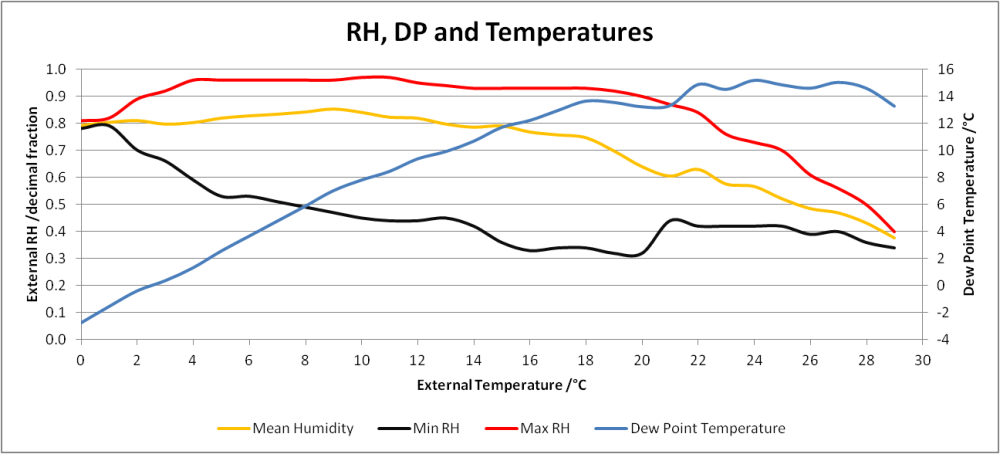
Yes, just costs a lot to get it dry again. There is, at a fundamental level, no difference between a new brick and an old brick, or a new stone and an old stone, or concrete. Really just where they are placed and what the environment around them is. Here is what the environment is like around my house. Gets close to saturation i.e. RH=1, but not quite (basically means very few foggy days this year) Got to within 0.5°C. This basically means that there is, in an unoccupied building, little risk of condensation. Increase the internal temperature and there is no risk. But add some people and cook, bathing, clothes drying, then there is, so ventilation is needed.
-
It does, but think it depends just how big a part the part load is.
-
Done it already, sapped all my juice
-
What energy rating is your HW cylinder?
SteamyTea replied to Adsibob's topic in Boilers & Hot Water Tanks
Lentils, more kWh for your one English Pound. -
So not really answered the questions at all.
-
Imagine you live in a terrace, a 3 doors away they are on the same electrical phase. So your PV us generating nicely and your load sensor sends the spare to your 3 kW immersion heater. All good, little goes out if the house. Then your same phase neighbour turns on a big load, say 6 kW. Will this force your diverter to get confused and make you export to your neighbours? Or are the local wires fat enough to not cause enough of a local voltage drop? What happens if you don't have a diverter and just use a timer to get the most probable times of greatest generation to top up your cylinder?
-
Discount Offers of the Week
SteamyTea replied to Ferdinand's topic in General Self Build & DIY Discussion

-
Adding a new Solar Array - existing 10kWp FIT in place
SteamyTea replied to Ferdinand's topic in Photovoltaics (PV)
Are you going to design (size) the veranda (lean to) roof to make it easy to fit PV modules? Probably cheaper to self install off grid and get some thermal and electrical storage, you can get 'islanding' systems that keeps everything easy as normal 230V switching, cabling and rules/regs apply. Cheapest, and most useful electrical storage is probably an EV, though not sure how easy they integrate into an islanding system. -
Power requirements for external swimming pool and pool house
SteamyTea replied to Thorfun's topic in Electrics - Other
Will work well for a week or so. Leaky pools are such fun to deal with. -
Worth installing PV on entirely West facing roof
SteamyTea replied to Huckleberrys's topic in Photovoltaics (PV)
Too right. I am not going to push a car a mile for 50p. A human needs around 2 kWh a day, that is a a fifth of a litre of diesel (ish, would not matter if it was a quarter). My local Tesco is charging £1.80 for a litre. So 2 kWh is 30p (and some clubcard points). The best value for calories food that is easily available is lentils, my local Tesco sells a kg of them for £1.80. They have around 4 kWh of energy in a kg bag (about the same energy content as timber or other biomasses). So to get 2 kWh cost 90p, 3 times as much as pump diesel. That is before processing costs i.e. boiling. To cook half a bag will take take around 10 minutes boiling (for the split red ones). On my induction hob that will be around 0.1 kWh of electricity, or 3p (ish). Washing up about the same. So close to 4 times the price of pump diesel. Now my favourite curry is, just by chance, a dhansac, a lentil based dish. For £8 I get about a half kilo of it. OK, it has some ghee, very high energy content, and some meat, also high, and a lot of flavour. But I can get all the ingredients for less than a £1 (I can if I want also spend £10 on ingredients at the artisan shops, but it tastes the same and I have to wash the dirt off). So as tonight is my night off, I am going to fill the car up, get a curry and tomorrow, fart the lentils out in a satisfying manner. Ok, probably going to cost me 90 quid in all today, once I add in a drink and a packet of fags. But at least I know what terrific value filling my car up (the major cost, I will drive it about 450 miles next week) is compared to the rest (except the fags, they are calories free). -
What energy rating is your HW cylinder?
SteamyTea replied to Adsibob's topic in Boilers & Hot Water Tanks
Yes. Thanks, makes interesting reading.