SteamyTea
-
Posts
23375 -
Joined
-
Days Won
190
Everything posted by SteamyTea
-
The battery embodied CO2 is very much dependant on where the lithium comes from and where the materials are processed. But MIT estimate somewhere between 30 kg CO2 and 200 kg CO2 /kWh. This is away above the UK CO2e Grid Intensity, which today's forecast is 0.231 kg CO2 /kWh, not an unusual figure. So somewhere between 130 and 865 kWh delivered, for the battery alone to reach parity, then it becomes the energy supply carbon intensity and local inefficiencies. I have read in the past, a hand-wavy figure that the inverter/controllers/mountings etc is a similar magnitude. I shall pick the median point of 115 kg CO2, inverters can last decades, so not really an issue.
-
 Wood wool board I think. You will have to look at the product specification sheet. Was that the one you first used?
 -
This is a bit of an old copy now, but still valid as a comparison to see which uses the least and most energy and embodied carbon dioxide. https://greenbuildingencyclopaedia.uk/wp-content/uploads/2014/07/Full-BSRIA-ICE-guide.pdf As for the reflective insulation, it does not come as any surprise that it underperforms.
-
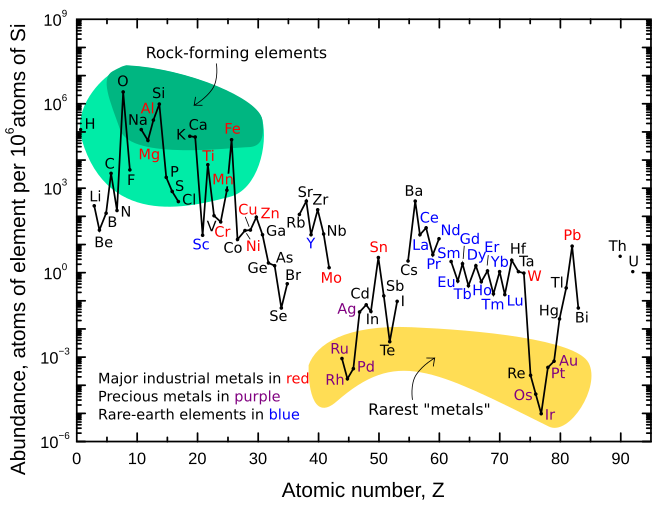
Not that precious https://www.bbc.co.uk/news/articles/cm28mg3zkmxo And the misnamed rare earths. They are 'rare' because they were hard to isolate because of the similar atomic sizes. Or for context, as rare as lead and copper.
-
The Psychology of Visual Heating
SteamyTea replied to ToughButterCup's topic in Other Heating Systems
As most of you know, for a number of reasons, I think 'real fires' are pointless. But I have often wondered why they are not fitted outside. You can have a fire and airtight windows in the wall for the visuals and a bit of heat, but all the nasties only affect your neighbours. Now I seem to remember that the OP, @ToughButterCup, complained about his neighbour's cess pit smells. 'do unto others as you would have done to yourself' -
The Psychology of Visual Heating
SteamyTea replied to ToughButterCup's topic in Other Heating Systems
Give her 20 quid and tell her to take her mates to the pub. Odd how smoking is going to be banned in pub gardens, but open log fires inside the building isn't. -
Octopus, did i imagine this?
SteamyTea replied to Post and beam's topic in Air Source Heat Pumps (ASHP)
What are the U-values. Probably won't get planning permission anyway. -
@ToughButterCup It is an emerging science with a sample of 1, bound to be some large error margins at this stage. It is amazing how good the predictions have been so far. Environment Once we pass 1.5°C of global warming, there is no going back We might not be able to cool the world down again after overshooting the 1.5°C warming limit – and even if we can, a lot of irreversible damage will have been done By Michael Le Page 9 October 2024 Carbon emissions have pushed the world to the brink of 1.5°C of warming Dennis MacDonald/Shutterstock It is clear that the world is going to exceed the 1.5°C target for global warming, leading to an increasing focus on plans to cool it down again by removing carbon dioxide from the atmosphere. But there is no guarantee that we will be able to achieve this – and even if we can, some changes can’t be reversed. “Deaths are not reversible,” says Joeri Rogelj at Imperial College London. The focus needs to be on urgent emissions cuts to limit warming now, he and his colleagues are warning after studying various “overshoot” scenarios. There are at least five big problems with the idea of overshooting climate targets and then cooling the planet back down, according to their study. The first is that many such scenarios give a misleading picture of the uncertainties and risks involved. For instance, in its last major report, the Intergovernmental Panel on Climate Change (IPCC) looked at an overshoot scenario in which the world reached 1.6°C above preindustrial levels by around mid-century, just 0.1°C past the limit in the Paris Agreement. But because of uncertainties in how global temperatures will change in response to a given amount of CO2 in the atmosphere, the level of emissions assumed in this scenario could in fact result in anything up to 3.1°C of warming. “For the same emission levels, there would be about a one in 10 chance that warming exceeds 2°C,” says Rogelj. “A one in 10 chance of a potential existential threat is not small.” The second issue is that there is no guarantee warming will stop even if we stop adding CO2 to the atmosphere, so-called net-zero emissions. For instance, warming could trigger stronger positive feedback effects than expected, leading to higher-than-projected emissions of carbon from, say, peat and permafrost, precipitating continued rises in global temperature even after we reach net zero. What’s more, achieving net zero requires removing CO2 from the atmosphere, because for some activities such as farming, there may not be any way of reducing their emissions to zero. But there might be no affordable way to remove large enough quantities of CO2 from the atmosphere to compensate. That is also the third big problem with overshoot scenarios. Cooling the planet after reaching net zero requires the removal of massive quantities of CO2, above and beyond those required to simply maintain net zero. Even if the technology could be developed to do this, governments may baulk at the costs of something that, at least in the short term, is pretty much all loss and no gain. “In most cases the only benefit of carbon dioxide removal is that it removes carbon,” says Rogelj. “But otherwise it uses energy, it costs money, it requires investment and long-term planning.” Such carbon removal could also have some disastrous side effects. For instance, one idea is to grow energy crops and burn them in power plants, capturing the carbon released during combustion and locking it away. But forests are still being cleared to create farmland for growing food and biofuel. Growing crops for carbon capture would make this problem worse and lead to even more habitat and biodiversity loss. Our plans to tackle climate change with carbon storage don't add up Modelling that shows how the world can remain below 1.5°C of warming assumes we can store vast amounts of carbon dioxide underground, but a new analysis reveals that achieving this is extremely unlikely The fourth problem is that even if we do manage to remove enough CO2 to get temperatures back down again, it is going to take decades, says team member Carl-Friedrich Schleussner at the International Institute for Applied Systems Analysis in Laxenburg, Austria. That means we are still going to have to adapt to the higher temperatures while they last. Yet as the last IPCC report pointed out, even adapting to the relatively small changes so far is proving more difficult than expected. “We have an overconfidence in our ability to adapt to [an] overshoot,” says Schleussner. The fifth issue is that bringing temperatures back down won’t reverse all the changes. If more people die in extreme weather events or from starvation due to crop failures, there is no bringing them back. Nor it is likely that species that go extinct can be brought back, for all the talk of de-extinction. Damaged ecosystems may not be able to recover, at least on human timescales. And higher temperatures, even if eventually reversed, will still lead to higher sea level rises in the following decades and centuries. The worst-case scenario would be that overshooting triggers a tipping point such as the collapse of the West Antarctic ice sheet or the drying up of the Amazon, which will be impossible to reverse for many millennia. “Humanity is making a reckless gamble on overshooting dangerous climate change,” says James Dyke at the University of Exeter, UK, who wasn’t involved in the study. The work shows that irreversible consequences result from global warming exceeding 1.5°C, says Dyke. “[This is] an outcome I would argue is now inevitable, given increasing carbon emissions and continued finance and political support for fossil fuel use.” However, Dyke thinks that by estimating how much CO2 removal would be required in various scenarios, the study implies such feats are feasible. “To propose we can overshoot 1.5°C or any amount of warming and then lower temperatures with gigatonne-scale carbon removal is to essentially propose a time machine in which decades of political delay are unwound by technological solutions,” he says. “Unfortunately, these carbon-removal technologies do not exist at scale and evidence of past attempts do not inspire confidence this will change anytime soon.” Journal reference: Nature DOI: 10.1038/s41586-024-08020-9
-
I am surprised no one mentioned this as there was a heated debate about it a while back. https://www.theguardian.com/environment/2024/oct/14/nature-carbon-sink-collapse-global-heating-models-emissions-targets-evidence-aoe
-
Octopus, did i imagine this?
SteamyTea replied to Post and beam's topic in Air Source Heat Pumps (ASHP)
Closed now. It is in an old folks home, you moving in? -
Octopus, did i imagine this?
SteamyTea replied to Post and beam's topic in Air Source Heat Pumps (ASHP)
[Bob Dylan's Talkin' New York; Verse 7] Now, a very great man once said That some people rob you with a fountain pen It don’t take too long to find out Just what he was talkin’ about A lot of people don’t have much food on their table But they got a lot of forks ’n’ knives And they got to cut something -
Is it, at the levels we see, a real problem. https://www.gov.uk/government/publications/formaldehyde-properties-incident-management-and-toxicology/formaldehyde-toxicological-overview
-
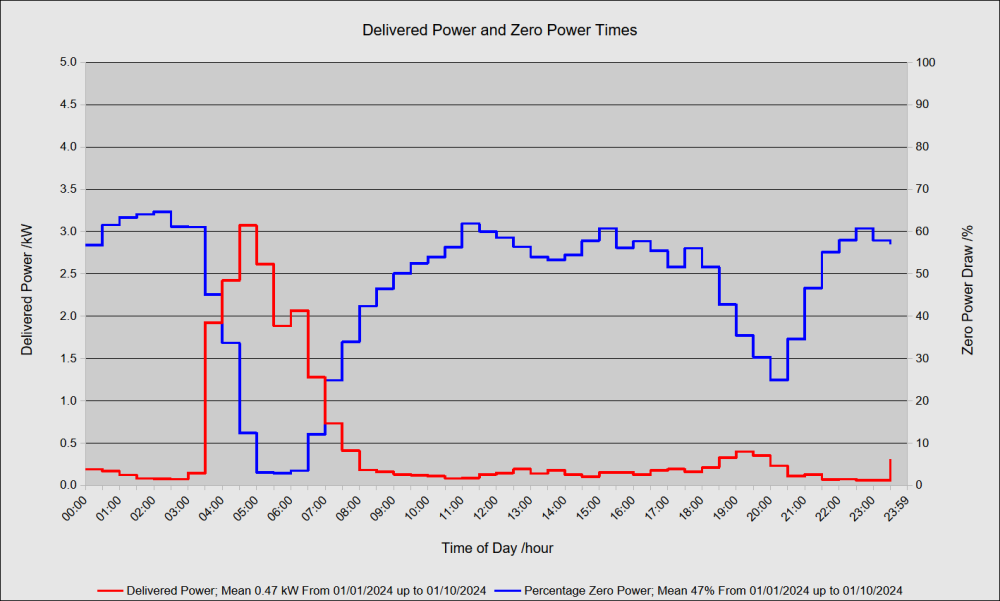
I have the same problem. Here is when I use power. As I mentioned in my blog, if the inverter needs a minimum power draw, a lot of the time I could not used stored energy.
-
Tool to cut a 2" pipe close to a surface?
SteamyTea replied to Ferdinand's topic in Tools & Equipment
That sycamore tree 'up north', know anything about it. -
Tool to cut a 2" pipe close to a surface?
SteamyTea replied to Ferdinand's topic in Tools & Equipment
Our maintenance boys had to go on a safety course before they could use an angle grinder on site. Was more to do with hot working and fire risk than personal safety. So even if one council department says yes, another will be along that says no. -
I think you will have to lift the floor. Laminate flooring is fairly moisture resistant, but it is also quite vapour tight, so getting a few litres of water to evaporate though it is going to take a long time. Most MDF swells when wet, and does not return to the original dimensions. Get the insurance to sort it.
- 1 reply
-
- 1
-

-
1. It is the water company's charging policy, not mine. Yes, and they are not very moral. I think the problem there is that we are not very good at predicting local rainfall. If the Redruth Amazon depot cannot store enough water, then it has no choice than to discharge, which will go to the local river. It is that river that ends up at Portreath. The sewage works there is not large enough and frequently has to discharge onto the beach 200m away. I think that there is one thing that the UK does not suffer from is scarcity of water. Extremely poor management of the resource yes, but not lack of resource. Yes, and I think this is where OFWAT/Government can play a part by changing the billing regime. It seems wrong to me that we get charged, regardless of usage, for a substandard service (I actually get a small annual rebate because the government has recognised the unique problems down here).
-
Tool to cut a 2" pipe close to a surface?
SteamyTea replied to Ferdinand's topic in Tools & Equipment
Only with the correct disk. Make sure it is a metal cutting one, a stone one will just make a lot of noise. It is illegal to damage others properly, and I doubt that any council would give permission for this to happen. Letter to local MP and get the local TV involved. They are desperate for local news, they even filmed us at work recently. -
Octopus Zero Bills
SteamyTea replied to Little_Miss_Tidy's topic in General Alternative Energy Issues
And there is the problem for me, that is a third of my annual electrical usage, I just can't shift that much without spending more than it is worth. Octopus will stop that 'incentive' and replace it with another. There is no such thing as a free lunch: divide your total annual bill by the kWh consumed, then see what the real unit price is. -
Octopus Zero Bills
SteamyTea replied to Little_Miss_Tidy's topic in General Alternative Energy Issues
EDF are offering free electricity on some Sundays. Except it isn't free at all. It is a swap scheme i.e. use less at a certain time and get a bit back. I did not bother to read into the details too much. Not as if I can realistically use less without investing a few thousand. -
That still seems funny to me, and the moon being upside down.
-
Tool to cut a 2" pipe close to a surface?
SteamyTea replied to Ferdinand's topic in Tools & Equipment
It can cut it off at below ground level if you want. Can always take a sanding disk with you to grind it flush. -
Tool to cut a 2" pipe close to a surface?
SteamyTea replied to Ferdinand's topic in Tools & Equipment
I keep saying that for every law we have that makes something illegal, we have another law that makes it compulsory. Just bend it out the way. -
That is the case down here. But it is morally wrong to use the sewage system to discharge your own collected water. It is a tricky problem, morally. We have very high water charges in Cornwall, but it is a unique area. We have a low population density for 10 and half months of the year, then it swells by 3 or 4 times. Our towns are generally on the coast, so sewage has to be pumped away, treated, then pumped back for discharge. We have high rainfall, this over powered the systems. We want clean beaches, rivers and streams. We have a very restrictive planning system, and lots of farmland. What is not farmland is often old mine workings, which are horribly polluting even 200 years after closure. Just had a quick look at the current water charges, £2/m³ for water, £6.10 to take it away. Plus the £61/year to be connected.
-
Over here, in cold, wet England, we have to put the vapour control layer on the warm, moist, inside. I suspect, like the Southern USA, you put yours on the hot, wet, outside. To keep imported energy usage down and limit internal temperature rise, are you going to cover the roof totally in PV? I am not sure how well MVHR will help with temperature control, unless you duct in A/C as well. How viable is rain water harvesting in Australia? Our mains supplied water is so cheap that nothing really comes close to it financially.