


SteamyTea
-
Posts
23836 -
Joined
-
Days Won
200
Everything posted by SteamyTea
-
 I think we should add a new one. PT = Plasterboard Tent.
 -
Read this about the worlds largest solar thermal generator. https://www.riazor.org/news/ivanpah-solar-plant-mojave-desert/2929/ Now I love a decent engineering project, but I hate pointless systems. So I did some sums. This system will produce around 240 kWh.m-2.year-1. An installed capacity PV system at 200 W.m-2 would produce 455 kWh.m-2.year-1. Why bother with this idea when PV is cheaper and easier to deploy.
-
Heating / Construction type.
SteamyTea replied to Ryan 2023's topic in General Self Build & DIY Discussion
As above. Don't fall into the trap that 'it meets building regs'. The Laws of Thermodynamics are universal, so spend the money where it has greatest effect. Watch out for overheating caused by overlarge glazing. A house should just be a well insulated, airtight box with the energy inputs and outputs controlled. -
The extra loads are easy enough to work out, then it is just a case of finding the right size beams and rafters to take those loads. What a structural engineer does all the time.
-
Recommendations please for “quiet” chimney pot top
SteamyTea replied to joe90's topic in Ventilation
No, but will recommend a CO alarm. -
Not down here. Yes. But it is a very cheap moulding and they could probably use a different plastic and solve the problem. Not as if the handle is the expensive part. The expense is in the marketing, packaging, distribution, merchandising and mark up.
-
I think you can use WAGO connectors as a permanent fix, ask @ProDave as he knows what he is doing up your way. Who knows, electricity is a quantum phenomena, so all sorts of magic is happening. There may be another problem that has been masked by this small amount of damage i.e. shared neutrals, but you need to change that bit of cable anyway, so nothing lost really.
-
Can the flow temperature be too low?
SteamyTea replied to JohnnyB's topic in Air Source Heat Pumps (ASHP)
In some ways it does, but it is really highlighting a failure in our old Victorian sewage systems. We flush potable water down the bogs. Where I work we have automatic flushers on the urinals. This time of year we are only open 6 hours a day. So 18 hours of flushing nothing but clean water away. A borehole gets around that problem as the catchment area can me many thousands of m2 per house (housing is about 3% if the UK's land area, all urbanisation is about 12%). The real problem is waste, not portable, that is what we have to redesign (especially down here in Cornwall, have I mentioned that we have the most expensive water and waste in the country, which will make it one of the most expensive in the world). -
" solar panels have just arrived and work will continue next year with the installation" Are they roof integrated?
-
So how you going to fix it?
-
I just want to emphasise that I used to work for a small turbine manufacturer, we made a 5 kW turbine. It cost about £20k to install, and that was 20 years ago. Even on a good site, it would struggle to produce 10 MWh/year. Most likely half that, so no better than PV, except it works at night and in winter. I would, if going off grid, go with CHP, PV and a modest amount of storage.
-
Not silly large then. It should be fine.
-
Who took the fizz out of physics. Probably someone from Scunthorpe.
-
Why not a generator and some battery storage? You could, with a bit of simple plumbing claim some thermal energy from the generator. The main thing with off grid living is to reduce usage to a ridiculously low level. This will probably mean a total redesign if your home. May be too late to do that if you have planning already. Small, domestic, wind turbines are pointless. The physics is against you. It is very easy to think you can live with a log fire and a couple of lights, but realistically you want a washing machine (about 2 kWh per wash), a fridge and freezer (0.5 kWh/day), extractors, maybe off grid sewage and lights (another 2 kWh/day) and you have already used up your winter PV production. Find a decent mechanic and make a small CHP unit on a petrol engine (gasoline us 15p/kWh).
-
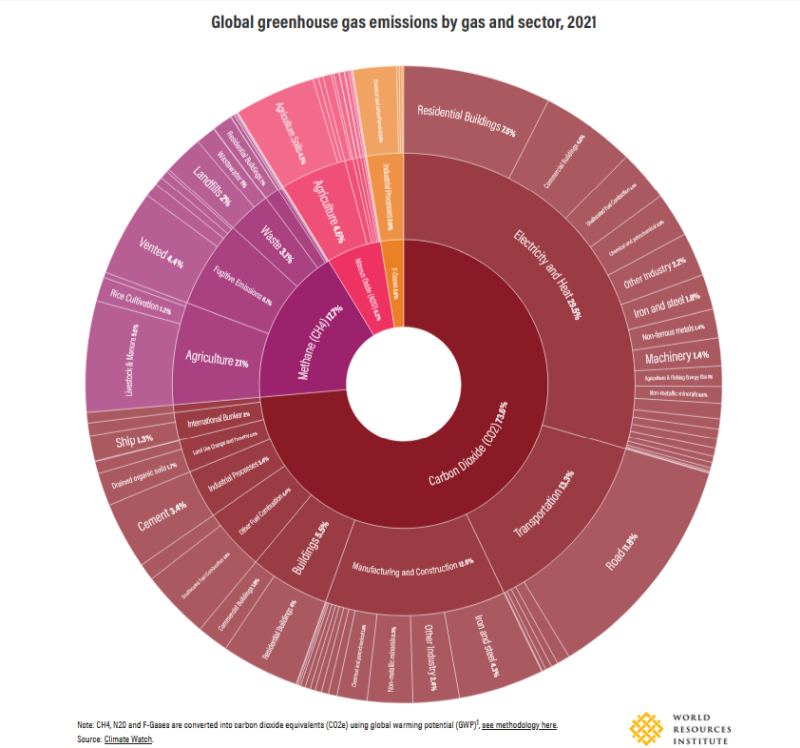
I have not looked at the raw data, but it seems that most sectors have a lower CO2 per capita lower than previous years. That is a good thing as it means we are getting more efficient at producing. Now the naysayers will be along and claim that the problem is population, and if we just reduce that, then everything will be fine. Well we had half the population in 1974, but over half the emissions (20 Gt, 38 Gt). While not good that we produce more gases, it shows that we can be much more efficient.
-
It is almost the end of the year, so a new chart is out from wri.org. The interactive is here. Don't beat yourselves up about concrete and flying, that is not the main problem.
-
I had one of those. After a few years I had to change my machine, twisted the lever, and it snapped off.
-
How large (dimensions in metres) and which way is it facing? It is, we severe gale 8 this morning, so 50 to 55 MPH, with gust going to 70+ MPH. Alright if your are not in a boat.
-
I (expletive deleted)ing hate that term 'hacks' but the programme is fairly solid considering it is pitched more at the arts than the sciences. https://www.bbc.co.uk/sounds/play/m00260sl
-
Can you get all my mistakes edited as well. Go back to at least 1970.
-
Thank you. I could refine it a bit more and say they transfer the contents between buckets. That is closer to what is happening in the quantum realm (photons and electrons swapping over). It is, except that as things get hotter, they radiate more energy, so heating up, past a certain point, gets rapidly harder and harder. For the same building, the heating and the cooling curves will be different. Yes. If you look up the densities of all the materials that make up the 'insulation', you will find that the solid part is quite a small fraction of the overall mass. I used to have a spreadsheet of material properties (Kaye and Laby, NPL) that was useful for picking desired mechanical properties out.
-
Can the flow temperature be too low?
SteamyTea replied to JohnnyB's topic in Air Source Heat Pumps (ASHP)
From my weekly comic back in 2022. A recent report by the European Commission's Joint Research Center showed that almost half of the European Union's (EU) territory and Britain are at risk of drought in July. Drought conditions and water scarcity are affecting energy production and reducing crop yield. TEMPORARY bans on using hosepipes to fill up paddling pools might seem like a parochial issue. But such modest efforts as most of England nears drought are a reminder that even countries perceived as perpetually rainy will need to get serious about saving water in a warming world. Drought is part of many countries’ natural weather cycles, including the UK. But dry conditions are also expected to become more frequent and intense as Earth moves beyond the 1.2°C of climate change we have seen to date. The worst is yet to come, which is bad news given how nations are faring today. Almost half of the European Union is in drought-warning conditions. France is experiencing its severest drought in history, with forecasts of corn harvests being down by almost a fifth and nuclear power output curbed by warm, low rivers. Half of the US is in drought too. This scarcity of water adds to the pressure on the existing global food and energy crises, both linked in part to Russia’s invasion of Ukraine. Drought can also lead to more climate change by stressing and ultimately killing forests that act as vital carbon stores. So what to do? Start taking this vital resource seriously, rather than for granted. That will require behaviour changes as well as technological fixes. Mandatory water efficiency labels to help people pick better products like toilets and washing machines would be a start: the UK is readying these now. Household water meters are a must. UK water firms’ goal of halving pipe leaks by 2050 isn’t good enough. We need other big water infrastructure projects too, and we need to start now because they take time. A huge reservoir being built in the south of England won’t be ready until 2028. Better planning is needed: it is inexcusable that the UK’s only major desalination plant is currently offline. As Christine Colvin at The Rivers Trust in the UK puts it: “This dry period needs to bite hard now, so we are ready for the future.” Inaction will result in worse than tears over empty pools. -
Insulation can be thought of as reducing air movement. The material that the insulation is made from does not make a huge difference, it is picked for its mechanical properties, not it's insulating characteristics. In reality, well Physics, thermal conductivity is much more complicated and depends on the material's phases and structures. Using as a model, you can think of these little Gnomes (how I see them) passing buckets of heat to one another. They initially pass them in any direction they like (radiative scattering), but eventually realise to be of any use, they have to take the most efficient path, which is the thermal gradient. Downhill for cooling, uphill for heating. The shorter the path, the steeper the gradient is, so the Gnomes can pass buckets faster to each other.
-
That should be W not W.m-2
-
To me it says that the two radiators that stop working have a higher pipework resistance to them, or from them. Like electricity, water will take the path of least resistance. So it is probably a case of balancing (maybe a greater flow rate will help), but if there are TVRs fitted, then that complicates it all.

