SteamyTea
-
Posts
23836 -
Joined
-
Days Won
200
Everything posted by SteamyTea
-
 This is from the government website that tracks these sorts of things https://www.gov.uk/government/statistical-data-sets/monthly-domestic-energy-price-stastics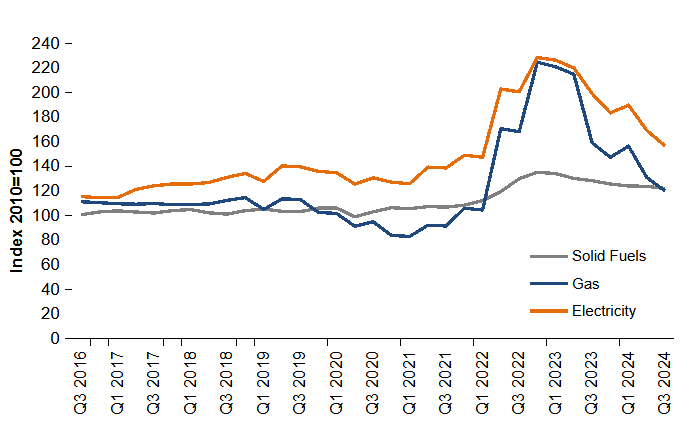
-
I think this is something us 'older ones' know more about as we lived though the Cold War. The turning off of the gas line through Ukraine was one days news, and now chip wrappers. Having grown up around oil refineries, the conversation at home was often the price of oil. If it went down to $20/barrel, the refineries reduced capacity. The refined products then kept their value. A few years back, think it was 2006, we had a spike to $160/barrel, and armchair predictions that the new normal would be $200/barrel. It settled at around the $80/barrel and has been there for ages. Don't confuse local prices with oil prices, one is international trading of a future delivery of a product that is still in the ground, the other is local policies. People down here moan about the cost of petrol and say that the energy companies are ripping us off. I am one of the few people that travel up country on a very regular basis and noticed that our prices are lower than most. Also, it is often claimed it is because we are so far from an oil refinery. Well most of the UK is far from an oil refinery, but out depot is in Plymouth. Not far at all (between 0 miles and 80 miles). I do wish that all energy was taxed on two criteria, the energy content and the CO2e emissions. Then there would be a much more level playing field.
-
Until it costs more, then it is Ed (I assume Milliband) telling you what to do.
-
Not really. That is the maximum efficiency when everything is already up to temperature, the flow temperatures are idea, and the air temperature is high (ambient air temperature affect open combustion). Be better to work on 70% efficiency to take into account cycling.
-
Off Grid Challenges Recently, there has been a few people talking about off grid living. This is an admirable and romantic idea, and something I would like to do myself. Then reality kicks in. First we must agree what we mean by off grid. To me it means not connected to main services, but usage of public services i.e. roads, domestic rubbish, healthcare, education, policing, food, clothing etc is allowed. Basically it comes down to water, waste and power. I have come to these limitations because I cannot live without the others. No one want to see me in handmade clothes and washed only in spring water. So the first thing to look at is how much energy I actually use, and when I use it. Luckily I take a keen interest in this and log my electrical data every few seconds (a mean of 8.5 seconds). Internal temperature data is also logged. Initially, to keep things simple, I work with monthly data, but will drop down to weekly, daily and half hourly data when needed. The chart below is the big picture of what I use. Chart 1 I am generally quite happy with my overall usage and internal temperature. This winter I am experimenting a bit with the temperature as my working hours have changed after 15 years of working evenings I have gone back to working days. As Chart 1 shows, January to April shows I have my storage heaters on and use a Mean Power of between 0.7 kW and 0.4 kW, then it drops to 0.36 kW in March, then down to 0.25 kW until the end of October. As you will have noticed, there are two Mean Power lines. One is the ‘normal’ interpretation of the Mean i.e. the sum of all readings, divided by the number of readings. This obviously includes the minimum readings, which are 0 kW and sustained maximum 4.33 kW. ‘Sustained’ in this instance means for at least half an hour. There are times where the Maximum Power peaks at 13.16 kW when looking at half hour data, but this may be for just a few seconds or minutes. By filtering out the 0 kW times, one gets a more realistic idea of what is actually being drawn and when it happens. This is important as it can help when choosing storage and delivery systems. Without changing anything, including usage behaviour, I could get an inverter that has a maximum power delivery of 14 kW and know that all my usage would be covered. Storage, for one day, without any inputs, would need to be at least 26 kWh once 20% efficiency losses are taken into account. The 20% losses are based on a ‘best guess’ as this is a very variable percentage based on different power draws, battery charging and discharging temperatures and the state of charge they are at. So what do I use my energy for. Luckily, being on E7, I can easily see what is used for water heating and what is everyday usage. By looking at my April to November night usage, I can get a fairly good estimate of my domestic hot water usage. Chart 2 Chart 2 above shows the half hourly usage between April and up to November, when there is no space heating on. The mean usage over that period is 4.2 kWh, so apart from the washing machine usage and the fridge switching on, it is fair to assume my daily water energy usage is around 4 kWh/day. This is bourne out my my higher than average water usage. One of my many failing is that I like a bath, every day, and would have two a day if I did not curb my enthusiasm. If I fitted a heat pump, to heat the water, I could probably reduce that down to 2 kWh/day. Or if I took showers, less than 1, but I dislike having a shower, though they are good at getting the day’s fat, blood and grizzle off my body after work. Chart 3 Chart 3 shows the same data, but for January and February when the storage heaters where on. The daily mean, for space and water heating, has increased to 12.25 kWh/day, so 8 kWh/day are for space heating. This works out as a power delivery, for my house, of 27 W.m-2. Using a heat pump could reduce that by a factor of 3, so less than 2.6 kWh/day or 9 W.m-2. Looking at the mean internal air temperature, I see they are within 0.5°C. This is good as it shows that my heating regime is working well and does not need adjusting. So having got my usage figures, and estimated some usage figures if I changed to a heat pump, what can be done about generating energy on site to cover approximately 8 kWh/day. My house is small, and the roof will only support, at the very most, 3 kWp of photovoltaic. It is also less than ideal facing with the optimal side facing South West. Looking at PVGIS to get an estimate of what I could generate, highlighting December because it is the worse month and with similar usage to January, it shows that there would be a total generation of 24 kWh. That works out as around 0.75 kWh.day-1 It is not until April that I could cover my usage, and by October a deficit would be showing. The deficits are in the table below. Month Usage /kWh PV Generation /kWh Deficit January 248 31 -217 February 232 58 -174 March 248 129 -119 October 155 83 -72 November 180 38 -142 December 248 24 -224 Whiles the above energy deficits are not that large, they need to be covered. Even if a battery storage system was installed, without the generation capacity, regardless of how spasmodic the generation, it would still not be covered. The only realistic generation method is to use a small generator. Using December’s data, as it is the worst month overall, on average, a 2 kW generator would have to run for 4 hours a day once efficiency losses where taken into account. During these 4 hours, a battery system of 26 kWh capacity, could be efficiently charged with 8 kWh of energy. By having an oversize battery storage system, more effective charging and discharging can take place, and the system will have a longer lifespan. It also allows for some days to probably not run a generator at all depending on the weather. My choice for a generator would be bottled gas (LPG). While diesel may offer a small improvement in efficiency, they are noisy and if the stored fuel gets some water in it, can be expensive to rectify or repair. Gasolene to LPG is a tried and tested conversion. Ideally a combined heat and power (CHP) unit would be used as these offer the best possible efficiency with about 30% of the fuel input turned into usable thermal energy and 20% into electricity. Unfortunately there are no easily available small CHP units or around 5 kW total output. This would mean that a DIY solution would have to be made. This would be an interesting project. There are some small capacity, water cooled, twin cylinder motorcycle engines that may lend themselves well to this application. There are also cheap, permanent magnet, low speed, direct current current motors that can be driven as a generator. Noise would be the biggest problem with a generator, but as it may only run for a few hours a day, then it can be used during the daytime. It can also be buried in an earthen bank, with secondary inlet and exhaust systems fitted. Modern cars are very quiet at low revolutions, no reasons that a modern motorcycle engine should be any different. My car, and old diesel is quite quiet at tickover, and it is using 1 kWh of fuel per hour. So to conclude, while it is not possible for me to be ‘off grid’, with a larger, more isolated property, and the use of a generator, and about £25,000 of investment, I could be off grid.
-
I plugged in efficiency losses into that, I suspect that oil is similar in price. Some on here are buying in electricity at ~5p/kWh.
-
But less wrong that armchair commentators.
-
Have to look 3000 miles to see one here, unless I look towards Goonhilly and see the 20 year old land based ones. I have mentioned this before, but about 17 years ago, I added up the capacity of the wind turbines in Cornwall, and worked out that they could be replaced with just 1, 5 MW one. As that was based on installed capacity, that 5 MW turbine would have produced about 30% more energy, and been half the price.
-
Mathematics is applied philosophy. That will be subtraction then.
-
That is because we had a moratorium on building them, thanks to Cameron's 'Greenest Government Ever', it is not because of technical problems. And the medium term to ordinary people.
-
How I miss the beechwoods down here.
-
I prefer arithmetic for most of it. The geometry, trigonometry, statistics and calculus can wait for another day.
-
Getting a corded Shark for home, it is lighter than the rechargeable ones. They are good vacuums, but I know from experience that we would get though 4 a year at work, because we have just replaced, for the third time, the work Shark in 8 months. Sooner or later they will stop replacing them under the 5 year warrantee (which has another 4 and a bit years to run).
-
No it isn't. We are moving towards distributed generation. I don't often see new pylons where a new wind or solar farm is built. Most of those cables are underground. I am surprised that you keep saying this as you understand demand diversity very well: we don't put in new cables to houses when they add an extra lightbulb. And show me the times, from the UK grid data, when solar, hydro and wind fail to supply because of winter high pressures. Actually don't bother as I have already looked for it. It does not happen. Yes we have reduced RE output, but your installed RE capacity is still quite low. As is most of the rest of the world. The UK is not working in isolation on Climate Change policies. I sense that change is the biggest problem, not the technology. As for What you mean is wasteful. Thankfully productivity and energy use are decoupled now. We make a lot more with a lot less.
-
Those Numatics are mean suckers. Tried to do the restaurant carpet with one (410m2), nearly killed me. Went to buy a new vacuum for home yesterday as I bust my 20 year sold Hoover at work. Curries had been broken into, so nothing till Wednesday. Then my comments about fitting it outside may be useful. Wood pellets are about 12p/kWh once delivery, VAT and efficiency is taken into account. Which is about the same as I pay for my E7 night rate. Except that electricity prices are artificially high because they are based on gas prices. This could change, and must change, if we are to tackle climate change, especially if around 70% of our generation is now low carbon. It is wrong to blame renewable energy on high prices. It is now the cheapest form of electricity.
-
Why is the path on the left a bit patchy, is something running under it line a sewer?
-
MGH Where M is mass flow rate kg.m-1.s-1 G is gravitational constant 9.81 m.s-2 H is head height in metres, m So say you want a 2 kW generator. 2000 [W] = M x 9.81 [m.s-2] x 15 [m] 2000 / 9.81 x 15 = 15 kg.s-1 With a 500,000 litre store you can generate for 33,333 seconds, or 9 hours.
-
I bet if we could be bothered to go back into the history on Buildhub, a decade ago, people where saying that where we are now was impossible. Any new generation from now on will be low carbon, except for maybe some replacement CCGT. I am currently condensing the last decade electrical generation data down to half hourly means, mins and maxes, it takes a while, but will be useful information.
-
New Home - "Upgrade" to Weather Comp or OpenTherm??
SteamyTea replied to Barnacles's topic in Central Heating (Radiators)
May be better to fit some outside temperature sensors to the exposed walls, then solar gain can be taken into account. The difference between the NE and SW sides of my house is often over 3K depending on time of day. -
I was going to go out yesterday afternoon. Did not bother. Not as warm as you yet 05/01/2025 08:35:50,10.125°C
-
Not great really. I have had an early morning rant about it already.
-
As usual, when the weather gets chilly, people start to think of getting a wood burning stove and extracting as much energy out of it as possible. Now there are many reasons to not use a WBS which are well documented on here, and it seems to me there is only one reason to have them. But regardless of all that, my concern is that people think they can successfully make their own, or modify existing ones. A bit of physics. When a carbon based fuel is combusted in air, there is a rapid rise in temperature as the carbon atoms in the fuel (usually a molecule of carbon, hydrogen and other trace elements) combine with the oxygen in the air mixture (around 21% oxygen, 78% nitrogen, 1% argon and traces of the rest). This mainly produces carbon dioxide, some water vapour and a lot of nitrogen. Because these gases are at a high temperature, they have a lower density than the surrounding air, so rise up the flue and are expelled to the atmosphere. What really happens. As a combustion process is not 100% efficient, temperature is not even, the fuel is not homogenous (randomly lumpy) and the airflow is turbulent, many other chemical reactions take place. There are three reactions to be wary of. Carbon Monoxide. This is a killer. Now many things produce CO, car exhausts being a major concern. A modern car produces about 5-15 ppmv (parts per million by volume), and WBS 5000 ppmv. The LC50 number (lethal concentration to kill 50%) is 3614ppm. Nitrogen Dioxide has an LC50 of 176, this does not seem particularly high. The problem is that NO2 is a secondary by-product that is created from nitric oxide (NO, aka NOX). This gas has an LC50 of 1739. Then there are the PM10 and PM2.5 particulates. This is a huge problem with about 22% of the total emissions coming from domestic stoves and fires. There is a lot of nonsense spoken about them i.e. the levels where higher in the past (when people frequently died from heart attacks in their 40s) to "I only use properly dried timber" (particulates can form after combustion though chemical reactions), and my favourite "I live in the countryside" (as if there are no pollution problems there). A problem when extracting energy. As a rule, you cannot extract all the energy from combustion, entropy (a fascinating subject) does not allow it. With thermal combustion, and especially with small domestic burners, the incoming air is at a higher density than the outgoing gases (they are not as as we think of it any more). This difference is created by the higher temperature in the grate and is what 'draws the gases up the flue'. Energy is effectively extracted from these gases after the combustion process has taken place (though there is a small radiative effect from the points of combustion). If too much energy is removed, the difference between the incoming air and the outgoing gases temperatures, and therefore density, is reduced. This stalls the airflow though the combustible material, creating more pollutants. This is why the advice is to burn fiercely for a short time. This does not happen in reality though. The initial period of combustion is slow (maybe an hour) and the tail end is slower still (grate is still warm in the morning), maybe several hours. This means that optimum combustion times are very short, and the more energy extracted, the longer the partial combustion periods are. Concluding. There are many DIY stove designs available, then someone comes along and suggests adding a water jacket to heat water, adding mass around the stove increases the efficiency (it does not), then someone else suggests that more energy can be extracted from the 'waste' flue gases ("my exhaust temperature is only 26°C, how good is that"). These are, without proper understanding and design (which generally does not come from a bearded sage on the internet) potentially deadly heating equipment. So if you really must, usually for vanity purposes, fit a WBS, get a properly designed and built one, fitted correctly (even though we all hate legislation), maintained properly (we spend hundreds doing that to our cars, and are thankful that aeroplanes are services), use only small amounts of timber, that is properly dried (not just one end and assume the fire will dry the rest out). I have suggested in the past that WBS could be fitted though the wall, with a sealed window on the inside. You get your focal point but all the shit is kept outside for the rest of us to enjoy. It is a similar idea to fitting out ASHPs, PV modules and Wind Turbines outside
-
Heat Loss through Double-Glazed Windows
SteamyTea replied to windowproblem2025's topic in Windows & Glazing
Yes. Just some cheap styrene sheet, a frame made from thin moulded timber and stick on foam draught excluder. As I have wooden window frames I just screwed them in place. -
Heat Loss through Double-Glazed Windows
SteamyTea replied to windowproblem2025's topic in Windows & Glazing
Right, not read everything in detail. Rather than fixate on one components i.e. your windows. Work out all the external areas i.e. walls, windows, doors, roof/ceiling, floor. Get an idea of what the U-Values are and then work out the losses. It does not have to be very accurate, just a good estimate. You will probably find that your roof/ceiling is the largest area, so improving the insulation there with some properly fitted wool will help a lot. 3 winters ago I made some very cheap secondary glazing to cover my old timber framed double glazed units. This is the difference it made.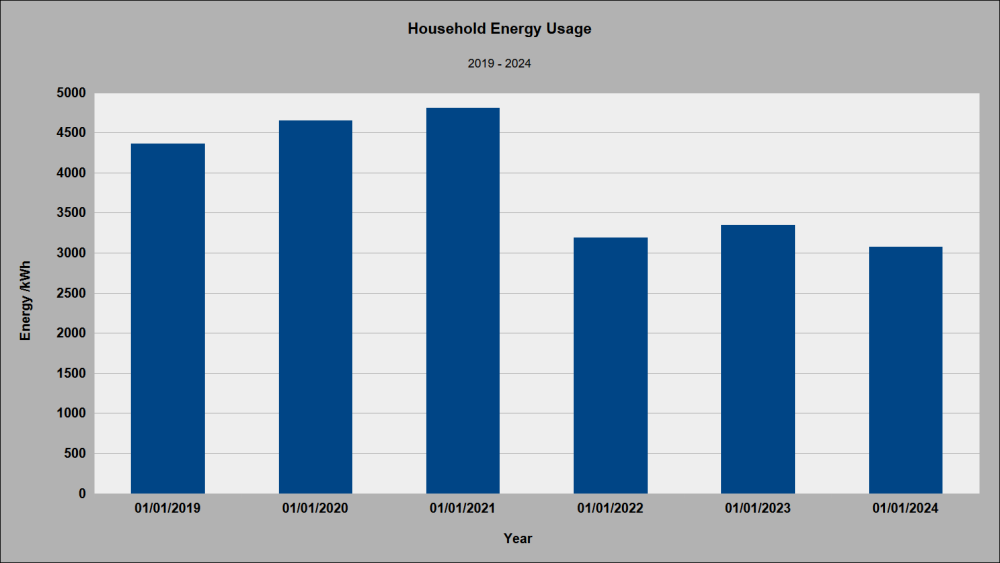
- 15 replies
-
- 1
-

-
- heat loss
- double glazing
- (and 1 more)
-
Well not at 573 K, it would be a steam engine then. But yes, you can store energy effectively in water. The big advantage is that everything is easily purchased. I will say that if energy storage in fluids and solids was effective, we would have been doing it for centuries, burning fossil fuels is relatively recent.