SBMS
-
Posts
1075 -
Joined
-
Last visited
Everything posted by SBMS
-
Are these MVHR numbers correct?
SBMS replied to SBMS's topic in Mechanical Ventilation with Heat Recovery (MVHR)
Sorry typo before. I read the above and worked out that the BR ventilation rate is 124l/s. 43l/s as per your table plus the adjustment as the floor area is greater than 100sqm. (370 - 100) = 270 m² × 0.3 l/s/m² = 81 l/s 81+43 from the table is 124l/s. Which I think requires a unit size of circa 450 cubic meters per hour. Seems close to the ideal 60% most recommend running a unit at although I wonder if the BR calculation is on the high side. Paul heat recovery calcs just seem a bit on the low side but I don’t know. -
Are these MVHR numbers correct?
SBMS replied to SBMS's topic in Mechanical Ventilation with Heat Recovery (MVHR)
To be fair the AI calculated the BR value which I checked and it was correct (111l/s). The occupancy figure was around 120-130l/s. So fairly similar. -
Not for new builds. They require developer contribution capped at 2k. Although sliding scale - the more you build, the cheaper it is.
-
Are these MVHR numbers correct?
SBMS replied to SBMS's topic in Mechanical Ventilation with Heat Recovery (MVHR)
It’s coming out at around 650-720m3 according to the ChatGPT estimate… who knows which is right?! -
Are these MVHR numbers correct?
SBMS replied to SBMS's topic in Mechanical Ventilation with Heat Recovery (MVHR)
I asked ChatGPT to do me an estimate and it was surprisingly useful. It asked me bedrooms, volume, sqm etc and concluded with the following: 🧮 Here’s what that means in practice: Normal continuous mode: You can expect around 400–460 m³/h (≈ 110–130 L/s), depending on your ducting layout (). Boost or peak mode: Up to 600 m³/h (≈ 166 L/s), assuming your duct system doesn’t exceed 200 Pa pressure drop . Free-air (no duct resistance): Might get up to 700–750 m³/h, but this isn’t realistic once ductwork is in place (). ✅ So: Is the Q600 enough for your needs? Continuous operation (~430–470 m³/h needed): ✅ Yes, Q600 handles this well, especially with low-pressure ducting. Boost mode (~650–720 m³/h ideal): ⚠️ It’s a bit below ideal, maxing at ~600 m³/h. You might see slower clearing during showers/cooking, but this is a common and workable compromise. -
Are these MVHR numbers correct?
SBMS replied to SBMS's topic in Mechanical Ventilation with Heat Recovery (MVHR)
Would You agree with Paul heat recovery’s assessment of the size of unit required or do you think the unit would run undersized? -
Are these MVHR numbers correct?
SBMS replied to SBMS's topic in Mechanical Ventilation with Heat Recovery (MVHR)
If ventilation is nothing to do with volume why do all the calculations and sizing reference volume and why do the units have sizing related to volume (genuine question as this repeatedly confuses me. If ventilation is to do with number of occupants generating co2 then shouldn’t mvhr units be based on number of people in the dwelling?) -
Ours was not - openreach wouldn’t entertain it apparently in the last 12m they had sought advice from hmrc who stated it could not be zero rated.
-
Are these MVHR numbers correct?
SBMS replied to SBMS's topic in Mechanical Ventilation with Heat Recovery (MVHR)
The thing for me is the fact they’ve excluded the volume of the hall and landings as that is quite a bit of volume. -
Are these MVHR numbers correct?
SBMS replied to SBMS's topic in Mechanical Ventilation with Heat Recovery (MVHR)
Same dilemma. And Paul heat recovery have over estimated mine as the top floor bedrooms are rooms in roof so not 2.4m high for the whole room… -
Are these MVHR numbers correct?
SBMS replied to SBMS's topic in Mechanical Ventilation with Heat Recovery (MVHR)
Who have you had quotes from? Have you tried Paul heat recovery (what did they say if so?) -
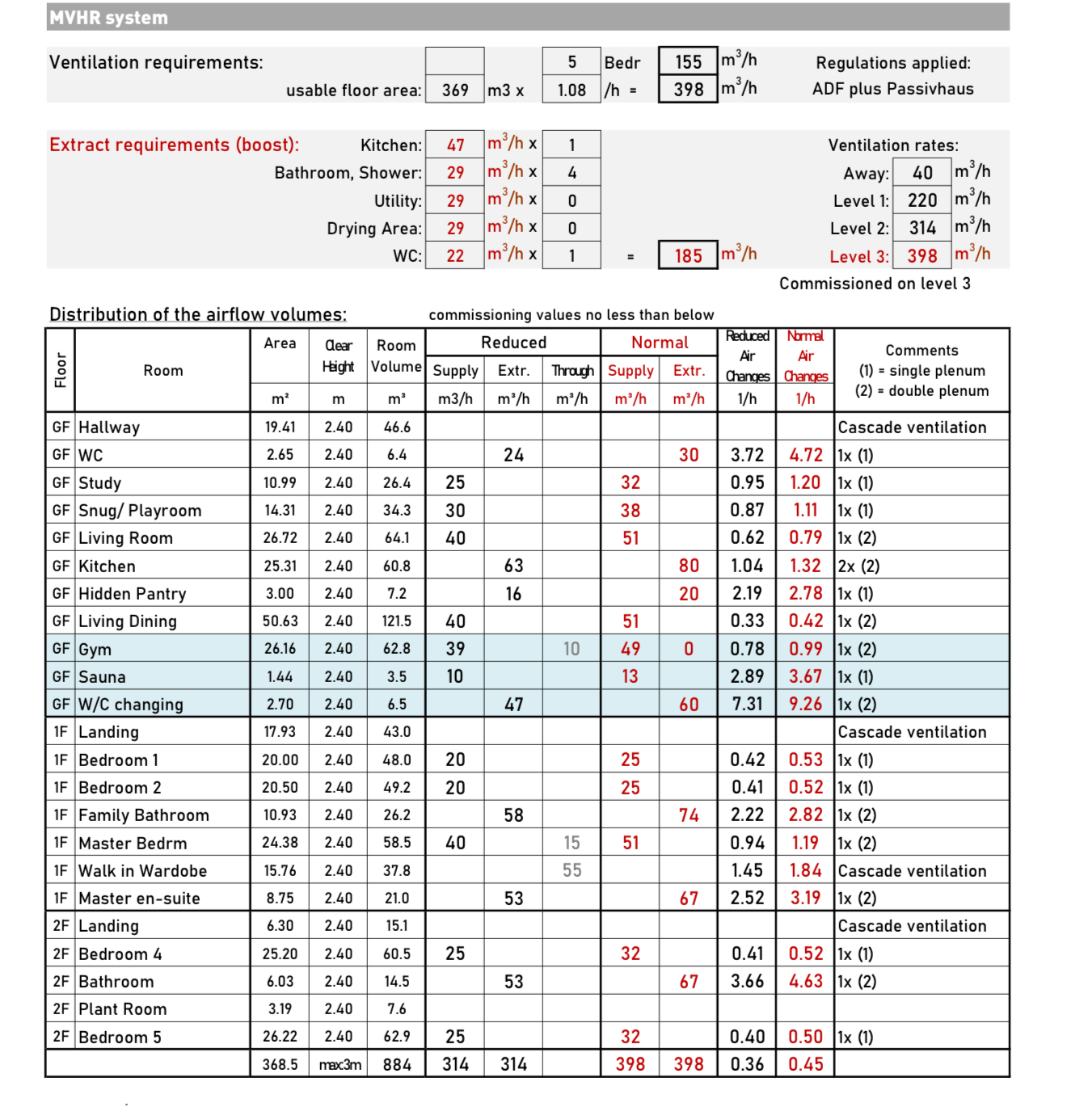
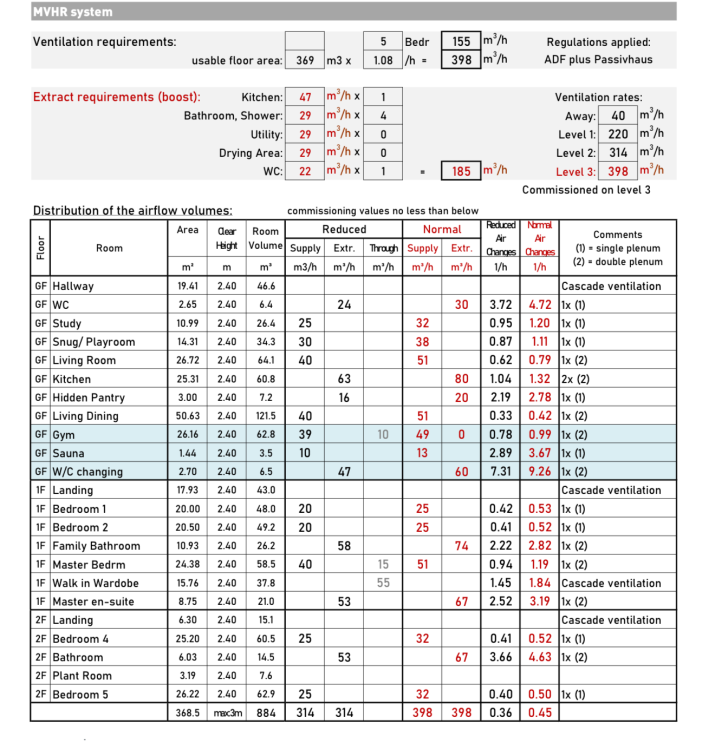
So we’ve got a fairly large sqm required for MVHR - circa 400sqm. A couple of other MVHR suppliers (including BCP) have suggested large units such as airflow and komfovent to shift up to 900m3. However Paul heat recovery has come back with the zehnder comfoair q600 with a much lower estimate required for airflow. Does the below look right? In particular it looks like they exclude the hallway and landing areas from their estimates (cascade ventilation)?
-
A2A + A2W ASHP or a more powerful A2W ASHP?
SBMS replied to puntloos's topic in Air Source Heat Pumps (ASHP)
@joth currently got the same dilemma and I am erring towards option a as well. Did you put any heat emitters upstairs or do UFH upstairs? My rudimentary calculations indicate my downstairs UFH surface area is enough to heat the whole house and therefore upstairs emitters not necessary. Nice side effect of A2A upstairs is if it is chilly I can put the units in heat mode to top up. Downside is I am struggling with our preferred installer who considers that for the MCS install and BUS grant for the heat pump they need an emitter in each heated space including upstairs… -
Conditions imposed on a planning application approval - fight back
SBMS replied to Bancroft's topic in Planning Permission
You dont really need to appeal. It’s easier to put in a follow up application to remove the conditions which requires a full and reasoned report on why they can’t (or they will). Planning authorities will be much more cautious following this route because their arguments in the decision for the removal of the conditions are then specifically subject to an appeal as opposed to the appeals process which can consider all matters in your application. This is how many applications around us by a prolific planning consultant has had permitted development rights reinstated for many new build approved applications. The council have since rarely imposed removal of PD rights following this. -
Your BCO shouldn’t really be questioning a construction detail like this independently unless they are suitably qualified. I would ask your BCO to provide a counter argument to your professional’s assessment as to why the detail doesn’t ventilate appropriately. What, in reality, they would do, is use a checking engineer to validate the detail (I wouldn’t expect a BCO to be qualified to counter - but they could be and if so should provide a reason why your SE’s assessment is incorrect).
-
Would it have been better to use a full application and use the volume of these buildings rather than PD? Or had you already got rid of them?
-
Fair enough. Am no expert so perhaps someone will be along here to agree with acoustic strips! We designed in counter battening from the start for our ceilings but agree if you haven’t got the height that would put me off
-
10m of acoustic tape.. £8 10m of treated battens… £5.40
-
Hardly… a few 25mm tile battens, nail gun could have it done in a day? Much easier than faffing around compromising your hangers in my mind. Apparently it’s better for plastering - less likely to crack so I’ve been told. Is that true @nod?
-
Thanks @Thorfun - got it. Do you mind sharing a ballpark of what a lighting designer costs?
-
GPDO does not reference subordinate. The operative phrase is required for a purpose incidental to the enjoyment of the dwellinghouse The term subordinate comes from case law and planning appeal decisions, not the legislation. It is used by Inspectors and courts to help interpret what “incidental” means in practice. I think in the instance referenced it’s hard to imagine an outbuilding that is larger than the dwelling house being incidental, Even including a pool. A 10mx5m pool for example would be 50m2… a 200m2 pool room is enormous.
-
Counterbattening your ceiling is what we are doing. Solves this problem, strengthens the floor above and mitigates any potential issues with plaster skim cracking as the floors settle. you can also shim under your counterbattens if not perfectly level.
-
What was the size of your dwelling house?
-
I have been researching home automation and looks like loxone is a firm favourite. I’m moving on to look at lighting design. Would anyone (a) recommend getting a lighting designer and, if so, (b) have any recommendations. @jothand @Thorfun I seem to remember you used a lighting designer - any recommendations?
-
Did you set this up? What were your thoughts?