


SBMS
-
Posts
1075 -
Joined
-
Last visited
Everything posted by SBMS
-
Looks nice. You laying it yourself? Where did you get the tobermore from?
-
We are still debating what drive surface to use. We’ve got a lot to cover as well - resin far too expensive. What’s up with gravel? Did you put crates down?
-
Yes, I think you're right. The gap will be bigger than shown in the black diagram above I feel more reassured from you guys that at least he’s not on to a terrible idea. You’ve made me think about the bit below the tray though so might speak to builder if he does a split lintel. Maybe get him to stuff that void with dritherm just in case. I could also be patient and wait 3 weeks… I’m just impatient and I know he’s got lads ready to crack on with the second lift
-
😂 he can def get them I think it’s the fact we’ve been let down and now having to wait 3 weeks for them! The floor has arrived and waiting to go on so I think that’s why he’s looking at alternatives!
-
I wondered about that but there shouldn’t be anything stopping them flowing around and under the tray? I also wonder if these in 200mm are what he has struggled to get. Most places online seem to only stock up to 165mm cavity version. Maybe 200mm are special order?
-
Ah okay.. I thought all lintels needed a tray above no matter what.. The one piece that was specified (it was a catnic) still had a tray specified by architect.. I might show that to builder
-
Probably! To me the thermally broken one is just a split lintel but they’ve supplied the insulation??
-
I think this is what the cavity tray is for and then directs out to weep holes?? I think the closer sits below all this but I’m guessing to be honest. I think the nhbc detail Shows this. one thing I am trying to Work out as I cant think in 3d… Would pumped beads get to the cavity below the tray indicated below??

-
Yes sorry it’s my fat fingers drawing on an iPhone 😂 the nhbc detail at least marries up with what I was thinking and what the builder explained to me. My main question is that a split lintel seems much better for thermal bridging. Is it just labour and cost as to why people use a One piece?
-
Sorry forgot to say that’s the cavity tray
-
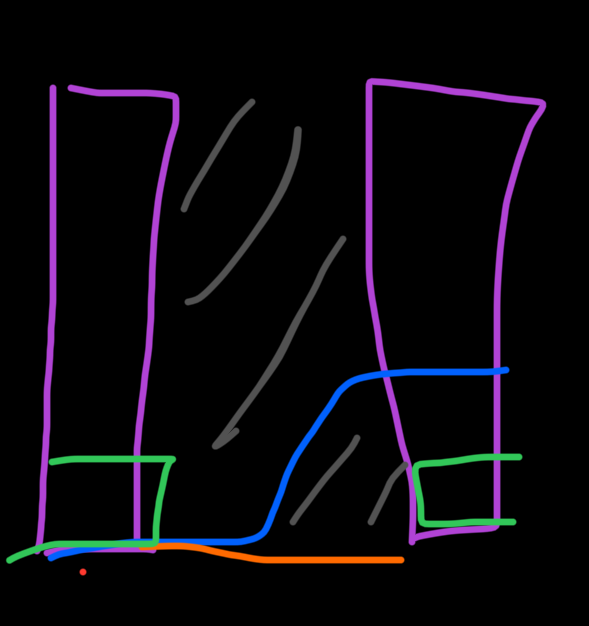
I think he’s priced that split lintels will be cheaper and the beads will provide the insulation between the two leafs? I’ve tried to draw how I think itll work - does this work with getting the beads between the cavity tray and the cavity closer? pink is outer/inner leaf grey is beads green are box and inner lintels orange is cavity closer
-
The cavity would be need to be closed at the head of the window - as with the sides. I assume there will still be a tray above but I assume the beads will get ‘between’ the tray and the head closer? Best advice comes from anonymous people on the internet!! 😂
-
Thanks - are these recommended/needed (with the polystyrene insulation in middle) if we are doing beads? Or is the polystyrene on the product image just an example?
-
Internal brickwork in swimming pool/spa hall
SBMS replied to SBMS's topic in General Construction Issues
Thanks -the pool has very marginal chemical levels as it has a uv and sand filter so may only need small chemical treatment. I was more concerned with the humidity level affecting the bricks… I guess if it does become an issue I could tile over the bricks?? -
We’re building brick and block with a 200mm cavity. EPS beads blown in. Our engineer specified (notionally) a one piece lintel. Builder has had lintel company let us down and now those lintels are a couple of weeks out. Floor Is ready to go on so he is suggesting we do steel split lintels. Is there anything anyone would advise as to why not to go this direction?
-
Internal brickwork in swimming pool/spa hall
SBMS replied to SBMS's topic in General Construction Issues
Anyone? -
Kingspan Kooltherm K103 Floor K108 Cavity wall 0.019 W/mK
SBMS replied to Caroline's topic in Heat Insulation
Also architects always specify expensive kingspan at 0.019. They specified 150mm 0.019 boards for our flat roof - super expensive. Two layers of 90mm were thermally equivalent and less than half the price! -
Kingspan Kooltherm K103 Floor K108 Cavity wall 0.019 W/mK
SBMS replied to Caroline's topic in Heat Insulation
If you have the benefit of a new build then why constrain yourself to such a small cavity width? I would absolutely widen the cavity to 200mm and pump EPS beads in. 0.15 u value and anything more was diminishing returns (brick tie expense, wider trench blocks etc). With the floor we settled at 180mm PIR (two layers of 90mm) which gives 0.1 U value. Again anything more is diminishing returns and that was the sweet spot when we did the calcs for UFH heat loss. -
We are looking at an in ground, indoor swim spa. It has a roller cover so will be covered 95% of the time. 8mx3m in a 10mx5m room. Two of the walls are pretty much glazing and the other 10m wall we are thinking of doing the internal skin in face brick and then just leaving it exposed as a feature. It’s a cavity wall with outer brick, 200mm beads and then inner brick. we will manage the humidity in this room using mvhr, but it will naturally be more humid than normal. Would it be advisable to seal the bricks internally, can they be left as is? My simple brain says ‘well bricks outside are left exposed’ but not at the humidity levels experienced here. Anything to consider with the mortar or anything over many years?
-
Plant Room Distance from ASHP - 25m too far?
SBMS replied to SBMS's topic in Air Source Heat Pumps (ASHP)
Did you do a pressure drop calculation for your 25m run? Or was it less risky with a smaller ASHP? -
What’s your actual rafter depth and then we can help advise?
-
Plant Room Distance from ASHP - 25m too far?
SBMS replied to SBMS's topic in Air Source Heat Pumps (ASHP)
We are looking at the vaillant aerotherm 12kw so that sounds useful re the pump - is its internal pump powerful enough to push 25m? -
Plant Room Distance from ASHP - 25m too far?
SBMS replied to SBMS's topic in Air Source Heat Pumps (ASHP)
Stupid question (I know little of plumbing) but if a secondary pump were needed can it live at the end of the 25m run, in the plant room? Or does it need to be next to the ASHP? -
Plant Room Distance from ASHP - 25m too far?
SBMS replied to SBMS's topic in Air Source Heat Pumps (ASHP)
Thanks all 👍 -
Plant Room Distance from ASHP - 25m too far?
SBMS replied to SBMS's topic in Air Source Heat Pumps (ASHP)
Does this pump typically exist in the heat pump (outside) or in the loft?

