SBMS
-
Posts
1075 -
Joined
-
Last visited
Everything posted by SBMS
-
Community Infrastructure Levy (CIL) HELP PLEASE
SBMS replied to Caroline's topic in General Self Build & DIY Discussion
You do not NEED to provide offset calculations for the CIL. Say the council charges £100 per sqm CIL and you are building a 250 sqm new residence. Ordinarily you would be liable for £25k in CIL costs. if you are replacing existing buildings - say 100sqm - that are compliant for offsetting you can net that from the 250 to reduce your CIL cost by £10k. This is what your council is referring to I believe. However, it’s not mandatory and you can choose to forgo offsetting and just receive the 25k bill. The council will require evidence of the compliant usage to grant you the offset. So if it’s a bungalow, they’ll want pictures or google maps evidence of a bungalow. If it’s a barn - the same. And the final piece is no matter what your final CIL bill, based on the above, the entire amount can be reduced to zero if you are a self builder. So in many respects it is irrelevant what your final CIL charge is because it will be reduced to zero. Planning consultants will often advise you reduce it as much as possible using offsetting in the event you have to move within 3 years or you die as then the liability is owed. However this is up to you. Note that self build exemption is a very prescribed process. You must submit the application for exemption first and only once approved can you submit the commencement notice. You can’t submit it all at once. So in summary - task 1 - agree what the CIL liability is by offsetting existing replaced floor space (if applicable and compliant) task 2 - apply for your self build exemption based on the final CIL charge issued by the council above. -
Just to be clear @Iceverge because I massively respect your input and opinions here, and you’ve helped on so many aspects of my build.. are you saying that interstitial condensation is NOT a consideration and having vapour permeability is NOT a requirement if a near perfect level of interior airtightness is achieved? Not even as a belt and braces approach?
-
This was the recommendation from the manufacturer who I assume I need to comply with in order to secure the BBA certificate: ”Using a 22mm OSB internally and a 12mm OSB externally won’t work, as there isn’t enough differential in vapour resistivity of the 2 layers (it doesn’t meet the 5:1 ratio). A vcl would need to be fitted to the 22mm OSB to ensure safety.” Is that not correct?
-
Yeah that sounds about right. I priced it up and it was around 5k for the glass wool slabs without fitting. I like the fact that the cellulose blows into all the nooks and because I’ve got posi rafters will blow into the metal webs as well further reducing thermal bridging.
-
Not if it’s cellulose filled though? OSB on top and underneath I think produced a condensation risk the manufacturer said. They recommended something vapour permeable like propassiv or a vcl.
-
I asked the architects To pop the options on for contractor quoting because we hadn’t settled on a roof makeup 😉We have now. We are using steico wood fibre sarking boards which do not recommend direct tile fixing and recommend battens fixed through to rafters to pin the board on. So that’s what we are doing.
-
We are using slates and counter battening. Warmcel (cellulose provider) recommended counter battens.
-
This is my makeup if it helps
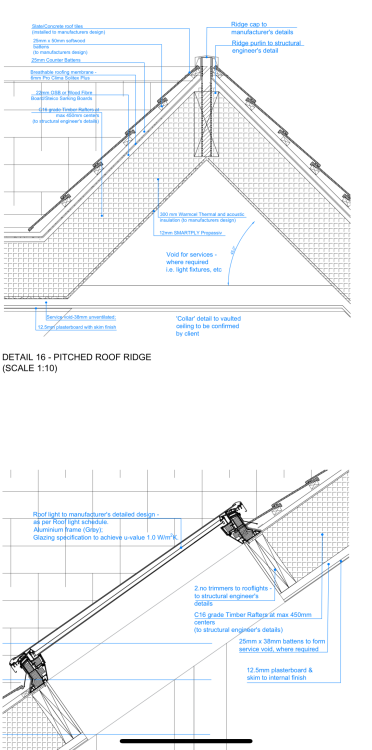
-
Yes 38mm service void probably. 22mm steico woodfibre board. Haven’t thought of stuffing mineral wool in the service void… that will probably get me to 0.11 actually 👍
-
I was the OP and the first post on this thread is my makeup 👍
-
7k was about the same as mine - including all fixings though. Posis won’t work easily into a valley between two roofs if that’s what you’ve got. Those rafters are being done in engineered/glulam. Couple of things to factor in… connectors and hangers. Our posi joists are being hung from our steel ridge beams. Those hangers quickly add up and could be as much as 1k-2k so factor that in if they haven’t been for JJIs. If you’re fitting the roof then fair play. If a joiner is I would say it’ll be easy to burn through 2-3k in labour cutting and fitting… I think posis can span further because larger rafters can be used but you might not need that. I’ve also made it so that our posi rafters oversail the wall plate for a ready made fixing for the soffit/fascia. Yes - we got a quote for supafil - 12k vs 7k for cellulose. Roughly the same thermal performance if I remember correctly.
-
Our first build we did PIR. I have switched to cellulose and deeper rafters for our second build - again with rooms in roof/attic rooms. Firstly, cutting and fitting pir is time consuming and difficult to get right. Wood expands and contracts and even with the best fitting there is the potential for gaps to open up. If you’re not fitting it, even less likely to be a good job. PIR also doesn’t have as good decrement delay as cellulose or Rockwool. Factoring labour costs I think blown cellulose was slightly cheaper or maybe a wash - but you’ll get a better end result and won’t risk your thermal performance on installation. For me, I have tried to engineer out as much reliance on skilled labour when it comes to the superstructure as possible. So engineered floor joists, blown eps beads in cavity, posi rafters roof, blown cellulose in roof, aerobarrier for air tightness.
-
biodiversity Net Gain Exemption and LPA conditions!
SBMS replied to Lincolnshire Ian's topic in Planning Permission
Sign. Pay. Move on and build! -
I got a quote for this - was nearly double cellulose for some reason for the same thermal performance.
-
Yes we are having vaulted ceilings. Out of interest what was the price difference? My posi rafter roof is designed so there isn’t any cutting onsite needed?
-
biodiversity Net Gain Exemption and LPA conditions!
SBMS replied to Lincolnshire Ian's topic in Planning Permission
In a few months/when you’re building, this will be a distant memory -
biodiversity Net Gain Exemption and LPA conditions!
SBMS replied to Lincolnshire Ian's topic in Planning Permission
Clause b requires you to inform the council of the occupiers before construction of the dwelling. That’s what prevents You selling it - you can’t build it before you’ve completed the deed to their satisfaction. Be careful you do this! -
biodiversity Net Gain Exemption and LPA conditions!
SBMS replied to Lincolnshire Ian's topic in Planning Permission
I wonder whether that deed has ever been tested as reasonable, appropriate or sufficient. For example - no timeframe for the inspection of the property by the council. No specified notice period so they could turn up when you’re in the bath. What happens if You refuse the inspection. That clause is probably unreasonable and unenforceable in its current form. There isn’t a sanction if you default because this is a restrictive covenant deed. This means that, should You break the covenant, the council can apply to the court for an injunction to cease the breach. The purpose of this deed is most likely prevent the property sale; a buyer’s solicitor would find this deed and immediately realise You’re not in a position to legally sell. However, it would be more difficult To enforce if you decided to rent the property. For example, the deed doesn’t define principal residence and whilst there’s a reasonable argument this is well understood, the deed doesn’t exhaustively define it. But fundamentally, your restrictive covenants are designed to prevent sale of the property within your restriction period so is unlikely to be missed by a conveyancer if you did sell. -
Are the ones that you fit under the joists effective?
-
Isn’t this on top of the floor?
-
ASHP - Weather Compensation AND Zoning?
SBMS replied to SBMS's topic in Air Source Heat Pumps (ASHP)
So if a single zone is left on, the heat pump would just be running for that zone? Would that work? New build, well insulated, 85mm screed. -
I was speaking to a potential installer today re ASHP and asked about his thoughts on zoning. His view was to install individual room stats, but in such a way that the room stats were not able to call for heat from the heat pump, and were set 1-2 degrees higher than the ideal temperature to prevent overheating. The heat pump would then operate solely in weather compensation mode. He stated that this would stop short cycling on the heat pump, but also prevent individual rooms from potentially overheating. I think I understood but wanted to double check... In this arrangement am I right in thinking that the heat pump continues to operate and circulate to all the UFH zones, no matter whether zones are calling for heat or not, but that an individual zone (room stat) has the ability to close its flow down in the event it gets to over temperature? If my understanding is correct, what happens if all zones get up to temperature and the heat pump continues to operate, but there's no call for flow to any zones?? What is the heat pump...heating?
-
Currently looking at UFH options for our first floor - posi joists with 22mm chipboard. Heating contractor is recommending nuheat clippa plate. We have 480mm joist spacings so can probably fit one spreader between joists. Has anyone had good (or bad) results from UFH That is between and under joists? (We have decided to have heating upstairs for belt And braces even though might not be used much. )
-
Has anyone had any experience using coloured tarmac/asphalt (such as ulticolour)? Would you recommend it and how much more ££ was it than regular black?
-
What’s your construction method? I asked our insulation supplierto model most of the junctions which they did for free..