


Mr Blobby
-
Posts
616 -
Joined
-
Last visited
Everything posted by Mr Blobby
-
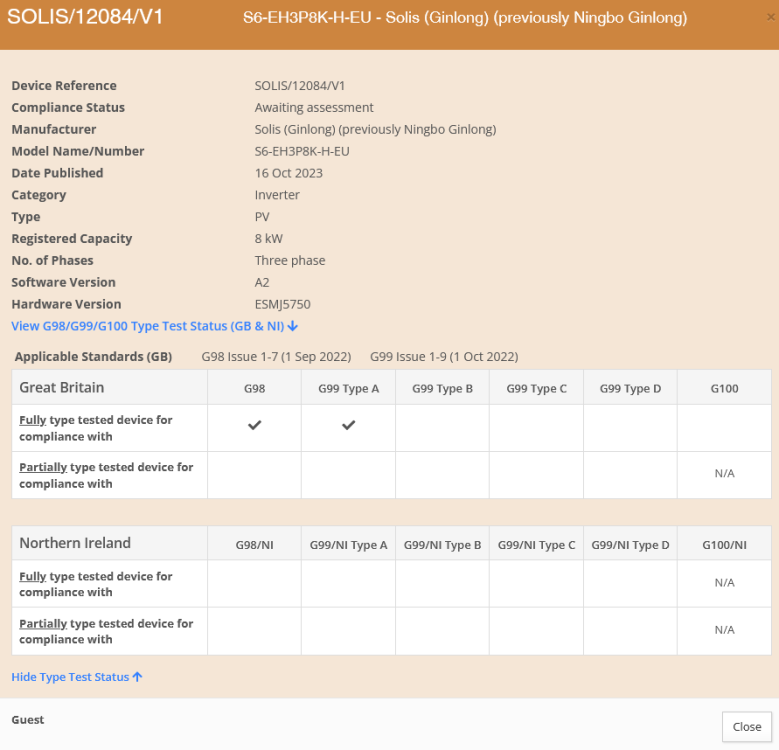
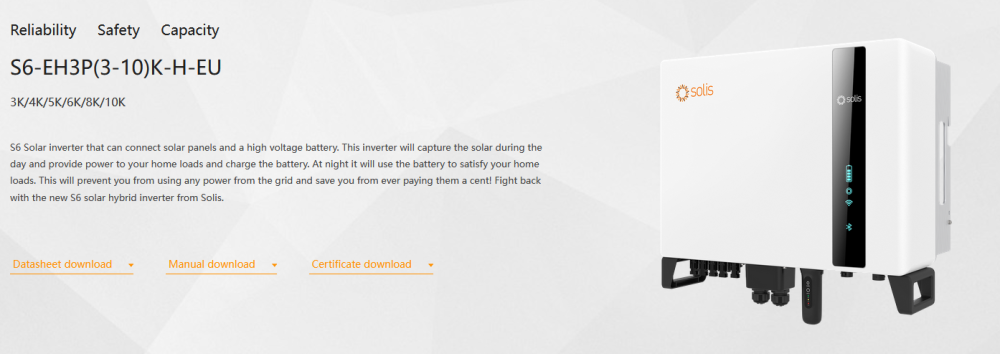
I quite fancy the 8kW version of this newish hybrid inverter https://www.solisinverters.com/energy_storage_inverters10/5_10k_s6_H_PRO_en.html because it has, quite unusually, 4 MPPT trackers which is great for spreading across different sides of our roof. Yes I have 3-phase power and this inverter and battery will come in at half the price of a solar edge equivalent. Before even thinking about buying this inverter, I wanted to check it is fully G98 compliant. The inverter spec sheet lists the AC output as 12.2 Amp per phase and the spec sheet also states the inverter is G98 Compliant. It isn't for sale anywhere in the UK but available online from various EU states. The G98 certificate is not available online (AFAICS solis don't publish G98 certificates online) so I emailed SOLIS to ask them for the G98 certificate. They are a bit useless. They first told me it was not G98 compliant because it is > 3.6kW. Duh 🤦♀️ After explaing to SOLIS that the G98 limit is 16A per phase they said they'd look again. They then came back and told me that ENA are awaiting assessment. I had checked the ENA database before contacting SOLIS so I knew this already, but I thought that ENA don't do the G98 test, this is done by the manufacturer and then the manufacturere may send the certificate to ENA if they choose to do so. I thought ENA were just a library of information, not a testing and approval agency as such. Here's the ENA page..... Are solis fobbing me off here? The spec sheet for the inverter says it is G98 compliant so surely Solis would have a G98 certificate already, as otherwise that woul be a bit misrepresentationy? Am I correct in my understanding that it is Solis that test and issue the G98 certificate? Would the G98 certificate normally be in the box with the inverter?
-

Closing cavity at the top for blown beads
Mr Blobby replied to MortarThePoint's topic in Heat Insulation
Yes we went back and forth a few times looking at the warm roof option, which was originally my first choice. An extra problem for us is the top covering is standing seam, and this requires a ventilation gap anyway, plus an additional layer of ply/osb for a warm roof added extra cost. And then to get the required u-values we needed really long fasteners for the PIR. Taken together a warm roof didnt really work for us. Our roofer would agree, he suggested pushing some insulation into the cavity below the rafters because he said the balls may come through otherwise. My latest worry is the insulation falling into the cavity, but as long as that doesn't happen it looks pretty good I think. (although being typically obsessive compulsive I'll check those small gaps under the rafters)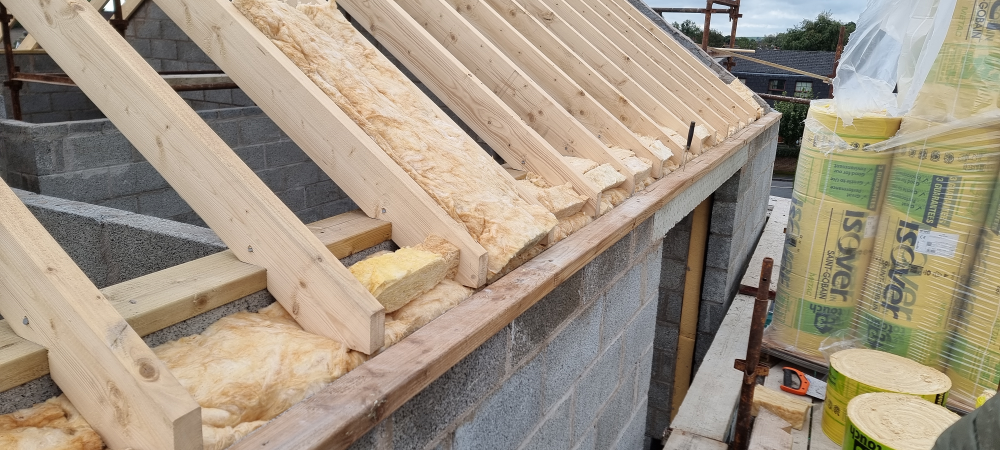
-
Burns gas like everyone else. This last Thursday for example, at 7 am peak, Scotland was at about 35% gas generation. 20% nuclear. But most of the time it is mostly wind. Which is very good of course.
-
Closing cavity at the top for blown beads
Mr Blobby replied to MortarThePoint's topic in Heat Insulation
Sorry, roof is ventilated cold roof / warm loft with insulation between and below rafters. Like this: The only change from the above is the removal of the cement board and PIR as the cavity closer, replacing it with stuffing the Metac further down rafters to the top of the cavity. Its a detached house and general approach here in NI (and it seems on this forum) is to close the cavity with insulation. So my only question here really is whether the Metac is ok to close the cavity. My roofers asked the question so thought I'd best check 🤔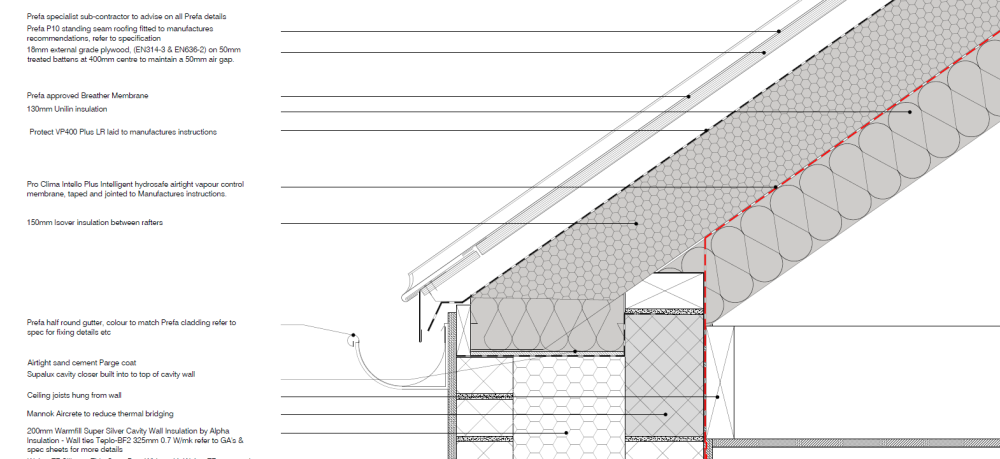
-
Closing cavity at the top for blown beads
Mr Blobby replied to MortarThePoint's topic in Heat Insulation
To reserrect this old thread, we are going to use 150mm isover metac glass wool to full fill between rafters and up to the breather membrane. (Metac seems about twice the price of knauf frametherm which looks like the same product so may need to review this 🤔) The plan is for the glass mineral wool to be pushed all the way down to close the cavity and then for the blown beads to go up to meet the mineral wool. Here's a pic from earlier today: Wall plate to be attached to top of outer leaf. 250 cavity. So the roofers have asked if the insulatoin is suitable to close the cavity and also suggested to close the cavity before the breather membrane is installed on top of rafters. Which seems like sensible advice. So, just to reassure me here, is it ok to close the cavity with between-rafter glass mineral wool? It seems sensible enough to me. Do I need to do anything else? To close the cavity I assume I can just squeeze the Metac/frametherm between the rafters without any need to cut it (to accomodate the bump at the inner leaf wall plate) or anything. Am I missing something? I welcome any advice here from those who actually know what they're doing.😬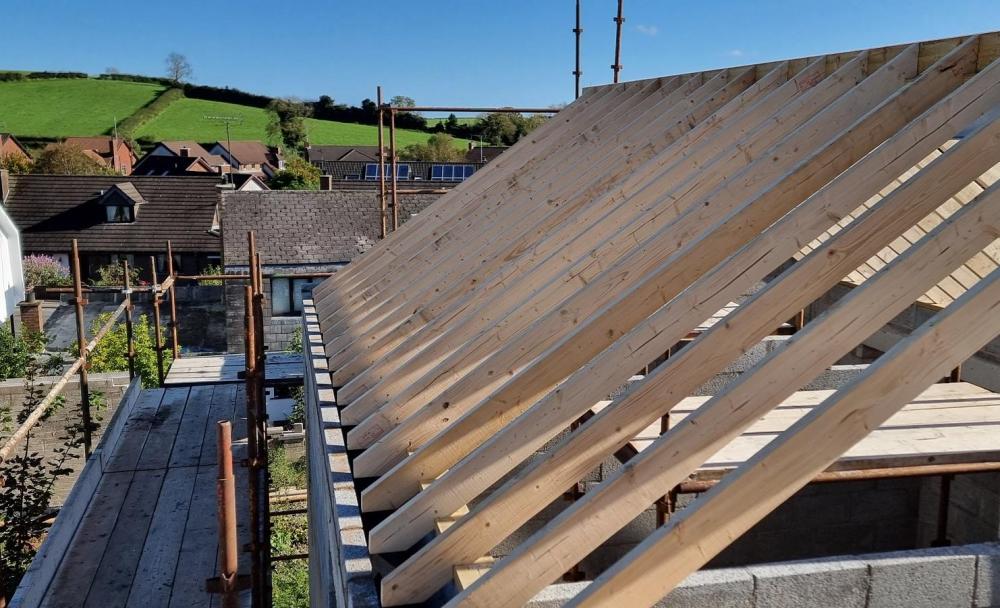
-
+1 for demolish and start again. We started renovating and soon realised it was a terrible idea so demolished and started again with a blamk sheet of paper. So much easier.
-
Used for frequency response. Attached to existing power stations because they have the connection to the grid. They sit at 50% charge level all the time, discharging, charging a little.
-
Yes capacity is not the same as generation. Here in Ireland the move to renewables is years ahead of GB, admittedly for a smaller system, but also the political will is stronger and less NIMBYism about onshore wind. Northern Ireland is decoupled from the GB national Grid because the single all Island market was set up as part of the good Friday agreement. The Irish grid has a target of 75% renewables. No nuclear here so mostly wind. Currently at about 50% wind generation. Above that yes demand management is key to grid stability. There is still however thermal plant available to step in here when the wind doesn't blow. I've seen no evidence of storage moving ahead. It is not technically or financially possible for battery storage to take up the slack and replace GWs of thermal plant. As far as I have seen batteries are used for frequency stability and, very rarely, a few seconds of reserve. There would need to be a massive step change in technology and cost for batteries to play any significant role in energy supply when the wind doesn't blow. As you say, demand management will play an increasing role for instant response, but mostly it's gas turbines in the UK that step in when the wind doesn't blow. But that's ok I think because most of the time the wind does blow.
-
For every GW of wind capacity there needs to be a GW of conventional thermal plant for when the wind doesn't blow. We still build gas turbines to match wind generation capacity. We have a gas network so it's easy for us to build CCGTs that are more efficient and very easy to run compared to coal plant. Thermal plant is also required for network stability like frequency and voltage regulation. The more wind capacity the less reliance on thermal plant, but the thermal plant still needs to be constructed as an insurance policy for when the wind doesn't blow. In the UK there are a lot of gas power stations that sit idle most of the time but they still get built. Similarly in China constructing coal plant is not the same as running coal plant. But most people have no idea that China is building more wind capacity than the rest of the world. And China will be the world leader in EVs because of massive long term investment while the European car industry is years behind.
-
The term isn't that relevant really, the principle remains the same. Besides, the five year fixed parliament act was repealed in March 2022. Elections can be called at any time.
-
Anything to get votes. Anything at all at whatever cost. Meanwhile China is installing more wind turbines than the rest of the world and investing billions in electrification of transport and decarbonisation. How does China do it? Because China is a dictatorship that doesn't have a four year election cycle with politicians prostituting themselves for cheap votes. Democracy is destroying the planet. How strange a world we live in.
-
Off on a slight tangent here, but if running an airtight membrane under the roof-joists-wall-plate into the loft, then how are the holes driled through the wall plate to fix it to the wall made airtight? Squirt some airtight sealant like orcon-f into the hole? Or some other sealant? And what membrane is suitable? Something like intello?
-
Steels it is then 👍 I will tell builder to crack on when I meet him on site in half hour.
-
Indeed. Our SE has looked at this and we have a ridge beam going in. As well as the two purlins. I think we probably needed a ridge beam all along anyway because we have a section of vaulted ceiling. 🤔 Anyway, moving on, our ridge beam will be supported in two places near the centre of the roof as well as at the gables. Its a long roof. Our builder has suggested steel columns in the loft to support the ridge beam instead of building two walls of blocks up into the loft to the ridge. We do have existing horizontal steel beams at ceiling height to support either steel columns or a wall. The cynic inside me suspects our builder has suggested the steel columns because it is easier to schedule roofers and go forward quickly. I can't see a downside of a steel column but then I generally have no clue about such things. Is there anything wrong in using steels to support the ridge beam? Is a block wall in the loft (with an opening to walk through of course) a better solution? Structural Engineer is happy with either option.
-
Peak demand in the house will be less than 100 amp on a single phase so its looking increasingly likely that everything in the house will run off a single phase. The three phases will run out to the EV chargers. The problem with three phase inverters, as I see it, is getting things like diverters for Zappi EV chargers and immersion heaters. Three phase appears to be poorly supported and not well understood by installers and I can do without the hassle and the cost for little benefit. I think the big question is whether the DNO will let me install an inverter bigger than 3.6kW on a single phase with the export limited.
-
The plan is for panels on three roofs something like this: SW: 3.5 kW S: 2.4 kW NE: 3 kW Solis have a new 3P hybrid inverters with 3 MPPTs. The problem is its so new that they don't seem to be on sale in the UK yet.
-
Ouch! Our price was £450 for a thousand, and delivery had to be for a full lorry load. I think block prices vary a lot by region. Here in Northern Ireland blocks are a lot cheaper than the South West. And my builder seems to get good prices on stuff from his various trade accounts of course.
-
Do you have a local manufacturer? We have a quarry half a mile away that makes and sells concrete products. Our builder got ours from the quarry for 45p per 100mm medium density block delivered. Which is pretty good I think.
-
We liked the idea of a raised washing mashine until we saw our friends intsallation with a peice of pipe insulation wedged between their washer and dryer to stop them acting like giant castanets. I think if done right and raised like @Buzz then it can be very nice. But it can be done badly which is not so great. If I remember correctly I think some of the German Kitchen manufacturers install a steel frame to support the appliances of the ground. Which is probably the way to go.
-
ooh, not seen this before. Time for some reading.
-
UPS function for critical circuits would be nice I just assumed that net metering was standard. I guess it must must be like that for billing, the net import position. I think for hot water and EV charging it would make life easier to get to a zero export position Probably. I'll be talking to the electrician soon to finalise all this hence looking at the PV options now.
-
Yes I think running the PV off a single phase inverter will be a lot simpler. I think the DNO is ok as long as the export is limited to 3.6kw on a single phase. The problem is the 3 roofs so either a 3 MPPT invertor (which are almost non-existant) or solaredge optimisers.
-
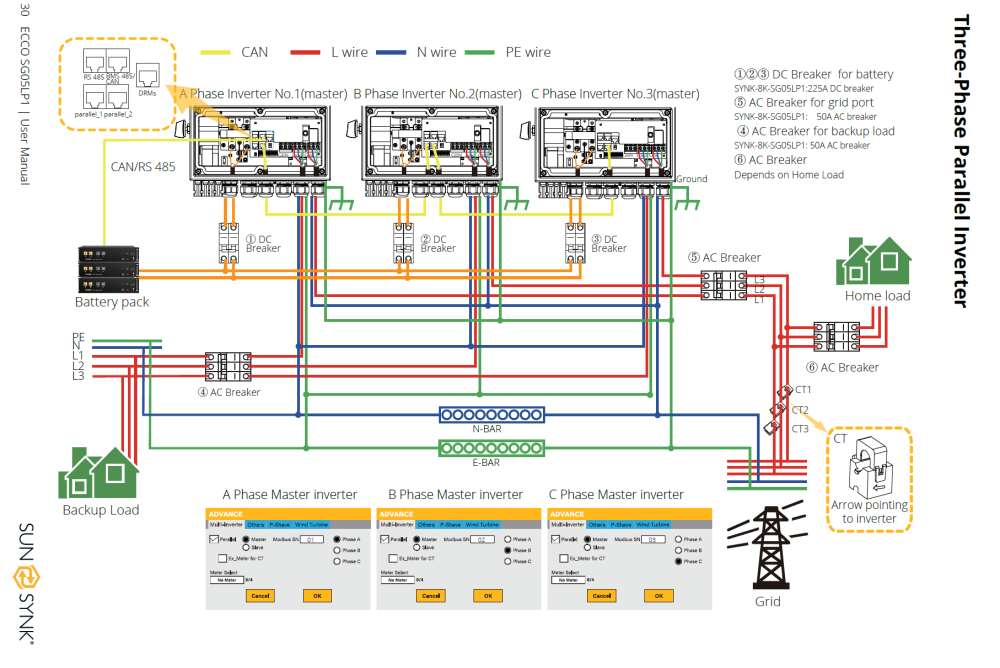
Three phase power with panels on three elevations. And hybrid inverter with batteries and diverer to DHW and EV. Talk about a challenge 😬 Any advice on her about the best way forward? I think its either solaredge 3 phase hybrid inverter or three hybrid inverters, one on each phase. The problem is the that the solaredge invertor only works with expensive batteries https://www.itstechnologies.shop/products/8-000w-storedge-hybrid-inverter-48v-three-phase?variant=40410089881698 Something like sunsynk can be configured in parallel, as below, but this is a lot more work to set up. And does this configuration mean the inverters work together to avoid importing from the grid or do they see only their own phase load/ battery charge level/ meter position and fight each other. I can't seem to get an answer from the suppliers. What should I do? Any advice? Please?
-
Integrated/ flush solar panels on a metal standing seam roof
Mr Blobby replied to WisteriaMews's topic in Photovoltaics (PV)
Just to jump in here, we are also looking to install panels into GSE frames on standing seam. Our architect has done this before but the panels were not as recessed as I think they could be: I reckon the end result could be better with a larger batten under the ply under the standing seam and then a smaller batten under the GSE panels to sink them lower. Just an idea of course 🤔 The S-5 clamps look to be the best alternative because you can omit the rail and install the panels closer to the seams. But then the panels must be installed in landscape mode. If fitting GSE panels then savings in ply and zinc should be possible. @WisteriaMews Please update here with your findings. Any photos post them please.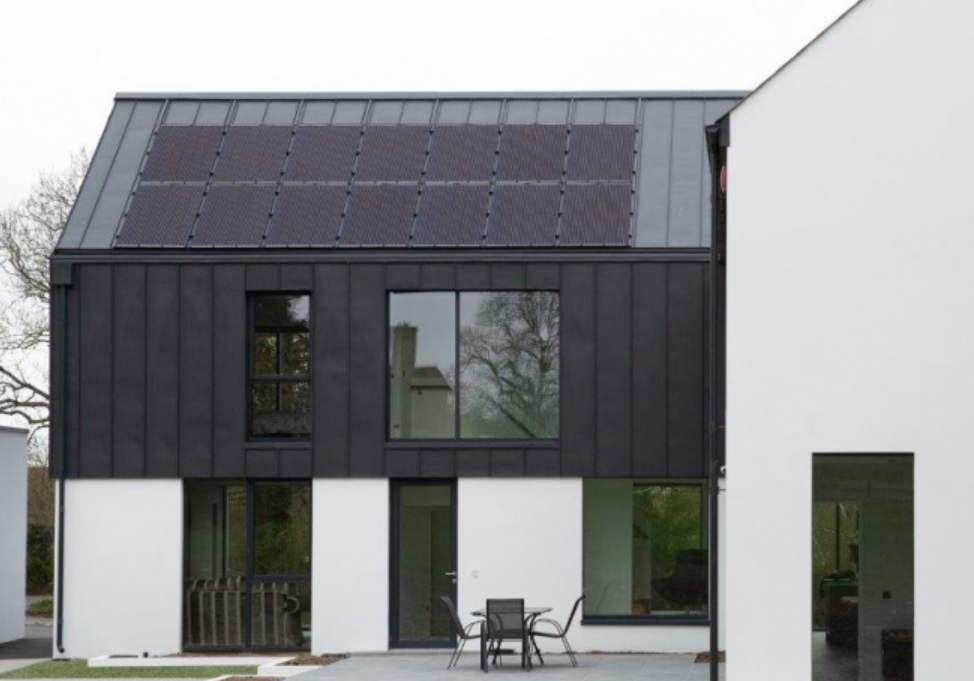
-
Tesla (our curent EV) used to support 22kW (32A) but have downsized to 11kW (16A). I think its the extra weight and cost of the in-car charger that is difficult to justify. Saying that, we are going to install two 3P 32A chargers to cover all bases.





