


Mr Blobby
-
Posts
616 -
Joined
-
Last visited
Everything posted by Mr Blobby
-

Solar Quote
Mr Blobby replied to bob the builder 2's topic in Environmental Materials & Construction Methods
No GSE frames in the quote? What's the standing seam made of? Zinc, aluminium? Integrating the panels in GSE frames will not only look better but will save money on the standing seam. Just make sure to put some ventilation underneath. -
The OP asks about connecting up the towel rails to the DHW flow, not the central heating circuit, so will be hotter than UFH flow temps. It makes no sense to me because the times I want hot water are not the same as when I want to heat the bathroom towel rails. If I wash the dishes in the kitchen, for example, then heat is sent to the towel rails in the bathroom. Its bonkers. I take your point about the time to heat the electric towel rail, however, so we can always put them on a timer. The important part for me is that the towel rail control is completely seperate to heating the hot water.
-
The towel rail in our bathroom is connected to the DHW feed and I really hate it. Its awful. We have the DHW on for several hours a day; who needs towels that hot? The bathroom is either too hot, or if we turn of the tap at the radiator, too cold. A TRV would probably help but its a crap rented house so we just put up with it. The shoulder months are the worst as you can imagine the bathroom is like a sauna and the rest of upstairs freezing cold. House we are about to start building will have electric towel rads. Maybe controlled by a PIR sensor.
-
AFAIK the panasonic controller regulates the heat pump flow/return temps in one of two heating modes : WC or fixed flow/return temps. So what exactly does Brendon Uys mean when he describes the heat pump as controlling the temperature in Test 3? Has he set up test 3 with a fixed flow temp of 35C? That would be convenient. And would return a good COP but has nothing to do with the buffer tank. Brendon Uys has changed two variables in his test 3 (6 below), he has reduced the flow temp setting and removed the buffer tank. Surely a more scientific approach would have been: 1: Flow temp 50C + Buffer 2: WC + Buffer 3: Flow Temp 35C + Buffer 4: 50C no buffer 5: WC no buffer 6: 35C no buffer If, as I suspect, Brendon Uys has examined the COP from 1,2, and 6, and reduced the flow temps to 35 C when he removed the buffer then of course he will get a better COP. But that has very little to do with the buffer tank and everything to do with the lower fixed flow temps. Why not test the system with all combinations, to include a fixed flow rate of 35C and a buffer? That would return better COP, although it may be at 36C to maintain a steady simulated house temperature after the buffer losses. But at least the COIP would be better than allowing the HP to increase the flow temps.
-
I share your uncertainty about the 3-phase credentials for the inverter. The user manual is not an easy read but I did try. For about 5 pages. From what I can see (I'm no expert) it looks like you have been quoted for a single phase invertor that can be configured with two others for a three phase configuration, with one inverter on each phase. Perhaps that explains the single phase meter. If your quote is for a single phase inverter and 8 KW of PV attached to one phase then I think that would exceed the DNO limit of 4KW per phase. I'm sure someone will be along soon who knows what they are talking about and give a better informed answer. I hope so as our requirements are very similar.
-
Ah, I see. Wet plaster because this is best for airtightness is it not? Until the kitchen fitters arrive and drill loads of holes in it of course. 🙄
-
That's very helpful Nick thank you. But what exactly is a 'continuous layer of dab' 🤔 and is it also a good way ro protect the plaster (for airtightness) as well as provide a service void behind the units?
-
... and that's the million dollar question... do I batten out the entire wall behind the kitchen units to run the services and protect the plaster airtight layer from the kitchen fitters.
-
Thanks. Running them up there in the ceiling would be one less thing to worry about when laying the KORE slab 😏 Did you chase the pipes in to the wall? I could run the pipes down in a void at the end of a run of units in the utility, but then would need to go behind the washing machine and dryer to the sink. That seems sensible to me, is it? I guess need to ask the kitchen supplier about the service void, if any, at the back of the units.
-
Old thread I know, but did you run the pipes in the ceiling void OK? My builder was appalled when I suggested similar. Says pipes always go in the floor.
-
Not yet, but only because I haven't complained. But I will. I had an eye injury in September that turned into a detached retina that needed surgery in october and only recently getting back to normal. Wife is keen I complain about the QS as she thought he was a total crook. Looking back, it seems likely he arranged a cartel with his introduced builder as cheapest that he said I should engage with but refused to give any cost analysis to justify his quote. For example, his bulder included 50k prelimiaries without any breakdown. The aluminium roof was overstated because the QS failed to deduct the cheaper GSE and PV panels. And 10k for installing ethernet cabling. And on and on, and yet he told me it was standard practice to always accept the lowest bid without any analysis of the costs. Every QS has to have a complaints procedure. I did get this a while back. It says I complai to the QS first and then to RICS if the complaint is not resolved. I will get my complaint in and I will complain to RICS regardless of what the outcome is and I will update here the outcome in due course. If I were to use a QS again I would exclude them entirely from the tendering process, and ask for a bill of quantities and a cost estimate only. This way the QS has less opportunity to screw over their client.
-
Zehnder Q350 + ComfoPost CW12
Mr Blobby replied to BartW's topic in Mechanical Ventilation with Heat Recovery (MVHR)
Our M and E guys laughed at my suggestions to install UFH cooling and fancoils. They insisted comfoposts were the only option despite my objections that the heat capacity of air and flow rates would be insufficient to make much impact. Not installing comfoposts. M and E guys are history. UFH cooling and blinds on the big windows. No heating upstairs. -
Not fact at all. Here in Ireland wind is curtailed overnight because total generation exceeds demand. (as @pdf27 rightly points out you need about 25% total capacity thermal generation for reserve and inertia to stabilise system frequency) So when I charge my car on economy 7 the extra demand is taken from otherwise curtailed wind turbines and not from fossil fuel generation. Now of course there are exceptional times when the wind is not blowing but that is pretty unusual here.
-
We were out of contract, and NIE came and took the meter away, so just a made up fee.
-
Our DNO (NIE) disconnected the old leccy supply, removed the meter and the old house was demolished in June. I paid NIE for the disconnection work in the summer and their job was closed, all happy enough. Then this week I get a bill from the old supplier (SSE) for 66 quid disconnection fee. When SSE did not do the disconnection. The robbing shits. Is this second disconnection fee typical? Its a scam. Is there any way to avoid paying it?
-
You seem to think that the wholesale energy market consists solely of a pool in which generators bid in half-hourly (trading period) prices per MWh and all generators are paid at the marginal rate. While this may be a view of the energy market that is easy for Daily Mail readers to grasp the reality is far more complex. You may think that you are the first person to identify the shortcomings in such a market but these issues have been well understood anmd addressed by clever people many many years ago. Let me help you. Alongside the pool is a capacity market and a balancing market. In addition to this sits a set of ancillary (now called system) services, where market participants receive payments for being available, and for being flexible. Whether they are idle or not. Participants (I won't call them generators) get paid whether they are dispatched or not because they provide capacity to secure the network. The capacity market and system services payments for things like ramping margin and reserve provide payments to participants for being available. This is nothing new. When I first worked on industry privatisation back in the 90s availability payments were made to power stations to cover their costs when idle. Daily peaks that requiere small flexible generators to be dispatched for just a few hours of the month in the winter are nothing new. This has always been the case, even long before wind. Just think about it. Peaking plant that comes on rarely are, in my experience on the same site as a much larger power station, relying on the same network connection and administrative functions. Diesel gas turbines can have diesel sat in the tanks without any issue. Its not a big deal to have these units sat idle until required. The Capacity Market and system services pays for this based on their flexibility. What about those other participants that are not even generators. Batteries? DSUs? How do you think batteries are funded when they don't actually bid into the energy market? It certainly would surprise me if the "resulting cost of the output were say twice the normal level" (whatever normal is). While marginal plant is typically higher cost, they are funded by payments that are completely seperate to the pool. The market price is not unduly inflated by their idle time. There are other things that affect the market too, like transmission constraints that would mean the cheapest plant may not be dispatched. And so much more that I do not have time to explain here. The energy market is not perfect. It is fiendishly complex. I actually think a move back towards nationalisation instead of wholesale pool prices would be great but that isnt going to happen any time soon. One thing is certain though. The high cost of electricity at the moment is caused by the high price of gas. It has nothing to do with wind turbines. The increase in wind penetration reduces the reliance on that gas generation. And that is a very good thing.
-
As the blind box is attached to the window frame, then would it be ok to install the required DPM cavity tray to exit above the blind box? Is that what is typically done?
-
Thanks, that's what I thought would be a better solution. In my cloakroom image above, there's no neat way to connect the sink waste to the WC stack right?
-
So our ground floor plans have three seperate details (kitchen, utility and cloakroom) like this: ... where the 50mm waste pipe is intended to go through the wall. (I know this from other section details) This seems a but untidy, particularly as the above pipe would exit the wall at the patio area. Would it be better, in the above cloakroom, to connect the 50mm waste into a new 110mm waste that enters the KORE slab under the sink to run underground to the outside? There is plenty of space to build another void behind the sink to hide the waste. (This would be in addition to the stack on the other side) What's the best option here?
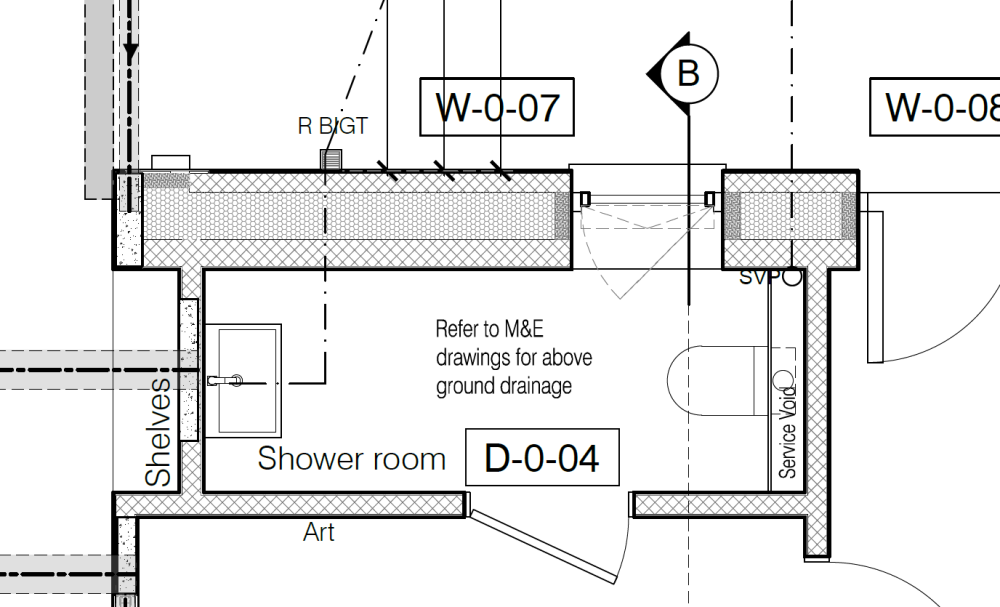
-
... and of course EVs are nearly always charged overnight on cheap rate tariffs, when there is too much generation and not enough demand. EVs overloading the grid is not a real thing, its just invented by those who don't llike progress.
-
So dry trap above ground into sub stack ok. Dry gulley trap in floor (is there sucha thing) not ok ?
-
Ok, so I get it about the AAV on top of the sub stack. But then if there is a boss strap connecting a waste pipe for overflows in the plant room, then the trap in that overflows pipe may dry out and the stink comes back in? No? What am I missing?
-
at the risk of sounding stupid here, how does the sub stack prevent the stink coming into the plant room? It is after all connected to the same waste system and any traps in the plant room will still dry out.
-
That's what I was worried about. So what's the solution if the traps dry out?
-
Why indeed? My paid professionals told me I should install a gulley trap in the plant room, which I took at face value, what with them being the professionals 🙄 There's actually already a stack in the plant room to service the en-suite above, so a boss strap to that for the tundish and overflows then? That makes far more sense for far less effort. As for the garage, is there any BCO requirement for a drain in the floor? I'd like a cold water tap in the attached garage but there is space for a small sink with trap in waste under the sink that seems far more sensible.



