


flanagaj
-
Posts
1349 -
Joined
-
Last visited
-
Days Won
5
Everything posted by flanagaj
-
Heat pump grant. How do you apply?
flanagaj replied to flanagaj's topic in Air Source Heat Pumps (ASHP)
"MCS Umbrella scheme" - thanks, I'll look into that. -
I know this might sound like a stupid question, but how do you go about getting the grant for a heat pump and making sure that is was given and not swallowed up by the supplier. My plan is to purchase a 5K ASHP that can run in both heating and cooling mode and I also want a 250 litre cylinder, but I have no idea whether the price I see listed on websites for the ASHP is with the grant taken into consideration or not. Is it possible to get all the parts as supply only and I can then fit them and get them commissioned when ready?
-
So Jeremy's heat loss calculator gave me a 3.7Kw value. I plugged these details into ChatGPT and it has come up with the below. Anyone care to cast their eye over it and see if what it is suggesting looks correct. Awesome—thanks for the room schedule. Here’s a crisp sizing plan that fits your 5 kW reversible ASHP, gives proper bedroom cooling with dehumidification, and uses UFH for gentle background cooling downstairs. Bedroom cooling (use small hydronic fan coils) Rule-of-thumb sensible loads in a well-insulated UK home: Standard beds: ~35–45 W/m² Master: ~40–50 W/m² (bigger volume/glazing) Recommended FCU sensible capacities (at ~7/12 °C water, 27 °C room): Room Area Est. sensible load Suggested FCU Master 30 m² 1.2–1.5 kW ~1.5 kW unit (quiet on low) Bed 1 19 m² 0.7–0.9 kW ~1.0–1.2 kW unit Bed 2 15 m² 0.6–0.8 kW ~0.8–1.0 kW unit Bed 3 14 m² 0.5–0.7 kW ~0.8–1.0 kW unit Notes Bedrooms are carpeted (good for heating comfort; irrelevant for FCU cooling). These small FCUs give you latent removal (dehumidification)—the key to comfortable sleep. Downstairs cooling (UFH + optional 1 FCU) Polished concrete is perfect for UFH cooling, but radiant floors don’t dehumidify and must stay above dew-point. UFH cooling outputs you can bank on (safe, quiet): With supply ≥18–19 °C and typical UK indoor ~24 °C / 50–55% RH → ~20–35 W/m² Expected background cooling from UFH: Kitchen-diner 35 m² → ~0.7–1.1 kW Lounge 19.5 m² → ~0.4–0.7 kW Downstairs UFH total: ~1.1–1.8 kW Optional add-on for muggy days / solar gain: 1 discreet FCU in the kitchen-diner, ~1.5–2.0 kW sensible, to mop up humidity and peaks. (Highly recommended with big south glazing.) Diversity vs your ~5 kW ASHP Likely coincident demand: Master + one small bedroom + some UFH ≈ 3–4 kW, which your 5 kW unit handles easily. Even with all bedrooms calling, fan speeds modulate and loads are rarely simultaneous at peak. The optional downstairs FCU can be limited by control if needed. Control & safeguards (important) FCU loop: chilled water 7–12 °C, each FCU on a 2-port valve, own small circulator, proper condensate drains. UFH cooling loop: enforce dew-point control. Example: at 24 °C / 55% RH, dew point ≈ 15 °C → cap UFH supply at ≥17–19 °C (controller with RH/temperature input or dedicated dew-point sensor). Modes: Heating: weather-comp 35–40 °C to UFH. Cooling: FCUs on 7–12 °C; UFH at dew-point-safe setpoint. DHW: priority reheat; weekly 60 °C pasteurisation. DHW (2 occupants, occasional 6) Cylinder: 200–250 L, heat-pump coil ≥2 m². Recovery: 5 kW ASHP reheats 200–250 L (10→45 °C) in ~60–90 min. On guest days, schedule a mid-evening top-up. Quick bill of materials (to brief installer) Reversible ~5 kW air-to-water ASHP, min modulation ≤1–1.5 kW. HP-ready 200–250 L cylinder, ≥2 m² coil, DHW priority + weekly pasteurisation. Bedroom FCUs: ~1.5 kW (Master), ~1.0–1.2 kW (Bed1), ~0.8–1.0 kW (Bed2), ~0.8–1.0 kW (Bed3). Downstairs: UFH cooling with dew-point protection (+ optional 1.5–2.0 kW FCU in kitchen-diner). Hydraulics: FCU chilled loop with own pump; UFH on mixing/limit control; 3-port diverter for DHW. Low-loss header only if flow stability demands it. If you want, I can translate this into specific FCU model sizes (wall/console or slim ducted) and a control sequence (setpoints, interlocks, sensors) tailored to your preferred brands.
-
After some deliberation, I think I am going to ask the architect to submit a variation of condition for solar PV in the south facing roof. We have a 17m * 4m roof which is going to be standing seam. I did consider Catnic Solar, but I think the cost will be way too much and I was wondering whether there are any other options to have solar integrated into the roof. I am not a fan of the panels being fitted on top of the roof as I think it looks clunky. Has anyone installed solar PV with standing seam and if so, what did you go with. Pictures would be great.
-
I have started doing my own research, but unsure whether it is correct or not.
-
I have become rather bewildered regarding what aspects I need to do and it what order. The technical architect is currently doing the drawings for building regs submission and another company (UK building compliance) are doing the following. L1A SAP 10 Calculations New Build (inc Design, As Built & EPC)Design Stage SAP L1A Assessments and PEAs a. Assessment under the 2021 Part L Building Regulations; b. Design Final Checklists for Building Control; c. Predicted Energy Assessments (PEAs); d. Thermal Bridging Calculation (y-value) based on Accredited Details (if used); e. Thermal Mass Parameter Calculation; f. Assistance with thermal, heating, lighting and renewable specification (including revisions); g. To include for unlimited specification revisions; h. Access to Dashpivot app for recording of photographic evidence. As-Built SAP L1a Assessments and EPCs a. Assessment under the 2021 Part L Building Regulations; b. As-Built Final L1a Checklists for Building Control; c. BREL report; d. Verification of photographic evidence; e. Energy Performance Certificates (EPCs).1.00310.00310.00 Water Efficiency CalculationsPart G Water Efficiency Calculation/s, consumption to meet requirement of 125L (or less if required) per person per day. Includes PDF Report.1.0095.0095.00CIBSE TM59 Overheating AssessmentDetailed overheating assessment in accordance with CIBSE TM59. To demonstrate compliance with Part O Building Regulations 2021. To include for an appropriate sample requirement & x 1 re-run of the calculations Do I need to wait for the details of this information, before I can start designing the UFH and ASHP? I did put the details in Jeremy's spreadsheet, but I am bemused as to what order to do things. Any pointers welcomed.
-
I'll mention this. Thanks
-
Openreach new fibre connection
flanagaj replied to flanagaj's topic in General Self Build & DIY Discussion
Sorry, but that made me 😂 -
I'm not disputing, but can you explain your reasoning? My only reservation (I am a Luddite), is that a cavity is meant to breath and a cavity that is fully filled cannot?
-
I am glad that the point regarding batts vs PIR insulation has been raised. I have just calculated that I need 252m2 of insulation. If I cost this up for 90mm T&G PIR, it's an eye watering ? 5.7k (£22.50 / m2) which is about 3k more than cavity batts. The architect has done the drawings with a 150mm cavity which will means that we could in theory go 140mm cavity batts? Our property is not sitting high on a hill and is not very exposed to the elements. The top part of the house is also timber clad. Unless there is any real benefit to having PIR, I am considering changing to 140mm with a 10mm gap, or would people just suggest go full fill?
-
Given the cost of adding a UFH loop into the slab is going to minimal in the grand scheme of things, I think that is what I am going to do. Will be a perfect man cave for tinkering away during the dark and dreary 5 months of the year.
-
That's a fair point.
-
Sorry. TA (technical architect)
-
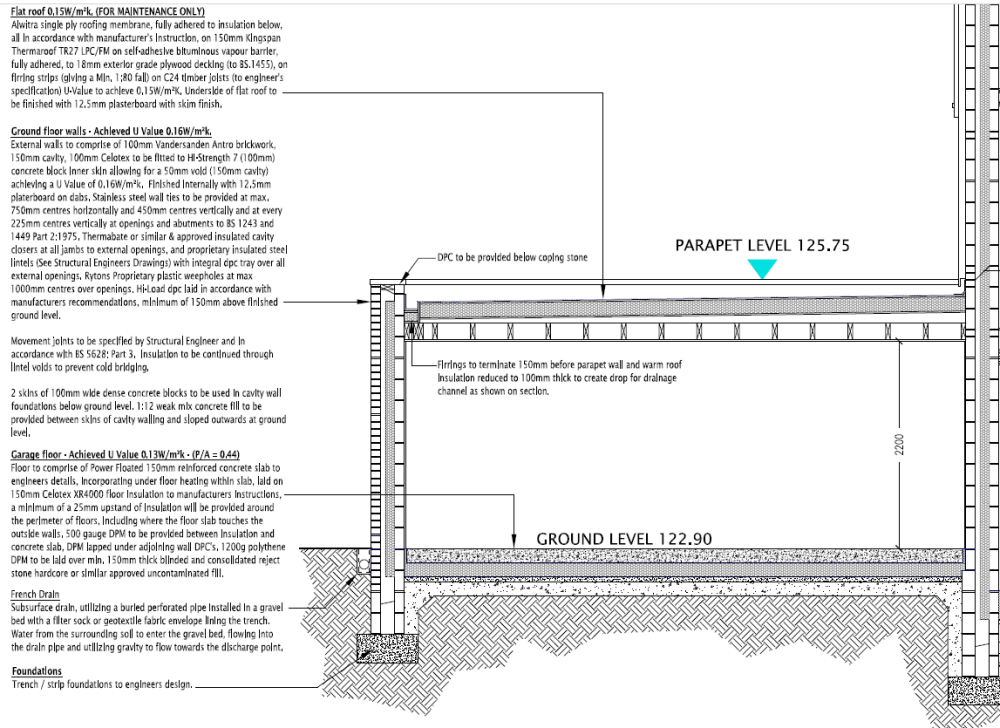
One of the requirements for our build is that I want a garage that is not cold and damp. As a result the TA has specified cavity walls as per the main house, 150mm celotex floor insulation and 150mm Kingspan TR27 roof insulation. This obviously comes at a cost and I am wondering whether it is overkill and I could reduce the floor insulation and also the roof insulation a bit. There is no door connecting the garage to the house. The garage will be my workshop and gym so having something that is not Baltic during the winter months is the main criteria. I am also thinking of putting a radiator in too.
-
Wall for floating staircase?
flanagaj replied to flanagaj's topic in General Self Build & DIY Discussion
Thanks all. I am planning on working with a local steel fabricator for the steel aspects and will manufacture the treads myself. Fortunately, I can manufacture the treads as I baulk at the £200 / tread that people on eBay are charging. One option would be to have steel rods for the balustrade, which are threaded and connect each end of the treads to a steel beam in the ceiling. -
We are planning on having a floating staircase and the TA has not made any mention in the drawings to BC. I assume it will require a SE to see what make up the wall which the treads will be mounted to, needs to be. Just not sure whether a single skin 7N block wall would suffice or even a single skin brick wall. I want the stairs cantilevered from the wall as opposed to having a single central spine below the treads. Has anyone installed such a staircase and if so, how was the mounting wall constructed?
-
That is a joke. If I am correct, does that mean you have to reapply for the permit. If not that, I think it causes existing permit holders a headache?
-
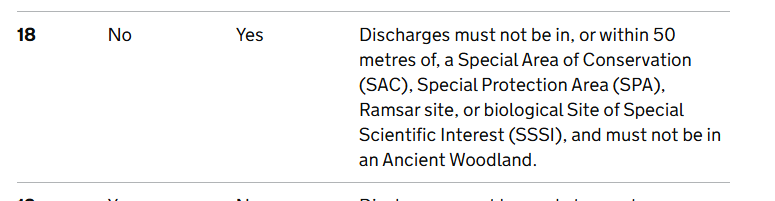
There is no problem. The rules state 'within' and ancient woodland. My drainage field is 43m away from the woodland. I just misread and thought the rules meant that you could not have a drainage field within 50m of an ancient woodland. Another EA document, words the statement with better clarity.
-
I need to learn to read!! I have just given myself a great deal of stress and time completing the EA permit form. The Rules state Rule 18: make sure the discharge point is not in or near protected sites You cannot meet the general binding rules if the discharge will be in an ancient woodland or in or within 50 metres of any: special areas of conservation special protection areas Ramsar wetland sites biological sites of special scientific interest (SSSI) It states in an ancient woodland, not within 50 metres of an ancient woodland.
-
Can I ask what the associated charge is. ChatGpt is telling me it is the region of 2-3k for the permit?
-
We are unfortunately 42m downhill for an ancient woodland, GBR state it has to be 50m. Unfortunately, I cannot move the field so not sure what the alternative is.
-
So having decided that I should apply for a **** EA discharge permit, they have asked where is the nearest sewage connection point to the property and also want a reference. Southern Water use digdat and I purchased a utility search from them before I purchased the land. But as expected, there is no foul water services. From what I can see digdat only provide a search within a given vicinity of your search location and they don't provide a search for something that is probably 2 miles away. Southern Water won't provide the info, but say I can travel to their office in Worthing (2 hour drive) are the clowns for real? Anyone else know how I can obtain "National grid reference (NGR) for the nearest sewer system." Why don't they just allow me to put "> 30 metres, see attached digdat asset map." We haven't even started and I have had enough. At leas the build will be more in my control.
-
Gravity fed or pumped chamber to drainage field?
flanagaj replied to flanagaj's topic in Waste & Sewerage
Thanks. I was unaware of this and thought it just tricked out as new effluent entered the tank. -
Our tech architect has specified a single downpipe for the 17m long roof. I am just worried that over a 17m run it will be too low and the water will come off the roof and miss the guttering. I did search online for recommended fall, but my confidence in the internet was dashed when I read the below recommendation 🤣 " The ‘fall’ is the measurement by which the gutter drops to allow water to drain towards the outlet downpipes. Many plumbers guidelines recommend a ratio of around 1:500 (which is roughly 20mm for every 5m of guttering). But it does depend upon the pitch and size of the roof above your guttering. "
-
I wanted to ask whether there are any merits in having a collection chamber after the sewage treatment plant, which collects and then periodically pumps the contents into the drainage field pipes quickly so that the waste water in dispersed around all of the perforated pipe. Our initial plan was to simply allow the waste water from the STP to drain as and when it is required. I know some STP systems do exactly this and others Graf do not. The logic apparently, is that by pumping a large volume you will utilise all of the perforated pipe, where as, allowing it to trickle out, means that only the early section of the field is used. Obviously, as time moves on the early section of the field will probably slowly start to silt up and the water will naturally travel further into the field. So my reasoning on this one, is that overtime the net result is the same and the field would have the same lifespan. Logic correct or flawed?


