


flanagaj
-
Posts
1349 -
Joined
-
Last visited
-
Days Won
5
Everything posted by flanagaj
-
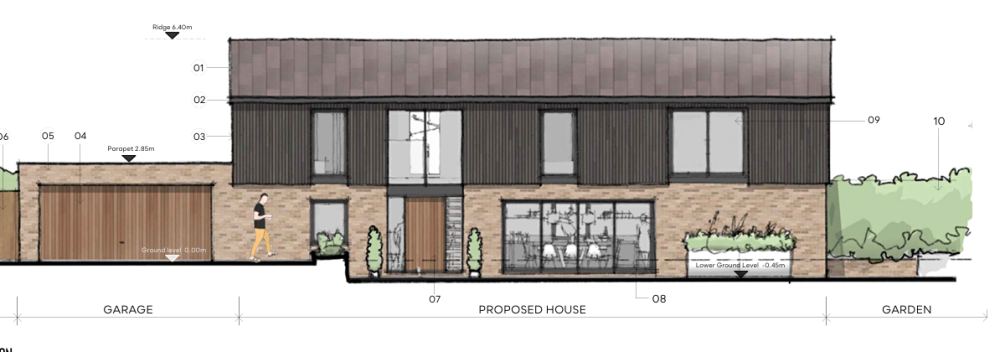
Our approved plans are as below. This is south facing and there is zero shading. The architect hasn't specified eaves and I am concerned that unless we go with solar glass (already baulking at cost just for DG units), then the whole house will be unbearable during the warmer months. Does anyone have any suggestions of things that we could potentially do. We are submitting a NMA shortly and we could always put something on then.
-
Specified ridge height. Relative to what though?
flanagaj replied to flanagaj's topic in General Self Build & DIY Discussion
Can you elaborate as I don't fully understand what you are saying. -
Specified ridge height. Relative to what though?
flanagaj replied to flanagaj's topic in General Self Build & DIY Discussion
I did reach out to the planners today to try and ascertain what the ridge height is relative to, just so there is no ambiguity. Their response was "The planning permission is done against the original ground level. As per the elevation plans approved we would expect that from ground level, the lower ground level is 0.48m below that and the the ridge of the dwelling is no more than 6.4m above the ground level." When pressed what height is ground level, I received the below. "Unfortunately this is not something as a planning officer that I can advise on, you would need to speak to a building surveyor who should be able to help in this regard." So, it's still clear as mud. I think I'll just take the highest topographic point where the dwelling will sit. I am amazed that nobody requested the FFL ASL as part of the planning submission. -
I appreciate that MVHR does not provide active cooling, but can anyone tell me whether it is adequate given the current warm weather. We are renting a Persimmon 3 storey property and last night, the bedroom was 29c. It's a timber framed house and as you climb each staircase, the temperature rises. I really want to avoid building a house that becomes a giant heatsink. With the revised insulation measures and glazing, I can see how it happens.
-
Variation of condition or Non material amendment?
flanagaj replied to flanagaj's topic in Planning Permission
We had 4 objections, so I don’t want to risk making changes and hoping nobody complains. -
Can anyone advise whether changes to the approved style, sizes and location of windows, door colour, garage door colour would require a section 73 or a 93a. It's confusing as we do have the condition below in our planning application. Not sure whether this will make the process more difficult. "The development hereby permitted shall be carried out in accordance with the following approved plans: Location and Block Plan - Drawing No. 24-WLC-PA-01 Proposed Site Plan - Drawing No. 24-WLC-PA-10 Proposed Floor Plans - Drawing No. 24-WLC-P-20 Proposed South and East Elevations - Drawing No. 24-WLC-P-30 Proposed North and West Elevations - Drawing No. 24-WLC-P-31 REASON: For the avoidance of doubt and in the interests of proper planning"
-
Change proposed Graf One2Clean to Tricel Novo?
flanagaj replied to flanagaj's topic in Waste & Sewerage
But we had to purchase Nitrate Mitigation credits. Said credits were calculated using Graf's certified value of 7.9mg/l and the Solido was 10mg/l No. But I will have a look. Thanks -
Change proposed Graf One2Clean to Tricel Novo?
flanagaj replied to flanagaj's topic in Waste & Sewerage
The issue with the Graf, is the depth of the install. I am really liking the sound of the Rewatec Solido Smart. This is apparently super quiet and a shallow install. Only annoying problem. Our planning condition states we have to install the Graf One2Clean. Given the Graf has Ntot of 7.9mg/l and the Solido is 10mg/l, I'm sure any change will require me to shell out more ££ on their Nitrate mitigation taxes. -
The architect specified a granite sett to the road, but I am unsure who can install this and whether it requires a drainage channel before the road. We live on a no through lane, but the council do appear to own a section back from the road edge (hence the not sure). There was nothing mentioned in our planning conditions and only the "hard and soft landscaping" condition might be relevant.
-
🙄
-
If they say you have too many and you have to remove some of them. Does that mean you have to resubmit to discharge the condition, or is it merely a negotiation process between you and the planning department?
-
My aim today is to try and create a report to discharge the condition below. "No external lighting shall be installed on site until details of any lighting have been submitted to and approved in writing by the Local Planning Authority. The equipment shall be installed before the development is first occupied/use commences and shall thereafter be operated and maintained in accordance with the approved scheme. REASON: Details are required prior to any lighting being installed because insufficient information has been submitted with the application in this regard, in the interests of the visual amenities of the area, in accordance with Policies EM1, EM10 and EM12 of the Basingstoke and Deane Local Plan 2011-2029." I am conscious that as we are in an AONB, any proposed lighting needs to be < 3000k and be directed downwards. I am concerned about fitting PIR lighting as I don't want it coming on when animals are in the vicinity. The only reason I thought about PIR was for when you arrive home late and it's dark, or you are going out and want the lights on until you get in your car. Are there wireless options for a key fob or a smart phone app that you can use. This would be ideal and you could then turn the outside lights on remotely and therefore negate having PIR sensors.
-
I am known to procrastinate!
-
A non extraction well next door has the water table depth at > 20 metres, so should be ok. But I take your point.
-
I am aware of that. But that is not what I am trying to ascertain.
-
Here are two different ways of installing a drainage field. The separate trenches requires considerably more space to create the same m2 field, when compared to the excavated rectangle. Question is. do they actually perform the same? I would hazard a guess and say that the separate trenches is a much better design to the other one.


-
I’m installing one shortly and as we are not in a high water table area, I’ll be backfilling with pea gravel. The concrete backfill is a terminal operation and cannot be undone.
-
Graf Infiltration Tunnel 300 In Lieu Of Perforated Drainage Pipe Field
flanagaj replied to EViS's topic in Waste & Sewerage
The infiltration tunnels can store a large volume of treated water. I assume it then means the water can dissipate over night from the tanks, where as a conventional field can store a much smaller volume of water in the pipes. Maybe I’m talking nonsense, but I get your point. -
Graf Infiltration Tunnel 300 In Lieu Of Perforated Drainage Pipe Field
flanagaj replied to EViS's topic in Waste & Sewerage
Can I ask what the cost of the permit was? We are not in a SPZ1, but whilst I can fit a drainage field into the space. The logistics of excavating the area is going to be difficult and if I am honest, a right pain to remove so much spoil. Hence, my motivation to see whether I could instead use the infiltration tunnels. -
Yes. It is the Graf infiltration tunnels as stated in the post you have linked to. I doubt they are BS 6297:2007 as that is the GBR. Which is why Graf are saying that some councils are ok with them being installed and others are not. Maybe said councils should be requiring a permit in all instances.
-
Narrowest retaining wall options for hedge boundary
flanagaj replied to flanagaj's topic in Landscaping, Decking & Patios
You can go shallower, but I think you need to cap the pipe with concrete. -
Can anyone explain to me why you can design your drainage field in one of two ways. For example, say you have calculated your drainage field area at 24m2. You could go with one of the two options below. 1) 40m of trench at 600mm wide and create something like below. 2) Excavate a rectangle of 8m * 3m and fill the whole base with appropriate gravel before laying the pipework. Now option two will have a lot of gravel in the middle of the drainage area that is some distance from the pipework, where as option 1 does not have that. Maybe overthinking this, but I suspect that if you did field tests, you would get different results from the two options. I don't have the space for option 1 and option 2 is going to be difficult as I don't have a lot of space for moving the excavator around. I did speak with BC regarding infiltration tunnels, but they simply told me to apply for permission from the EA. Given it's > 2k to apply for a permit and it seems like a lot of work, i think I will just have to go with option 2. It's rather frustrating, as Graf told me that some councils are perfectly happy with the infiltration tunnels, so long as you are not in a source protection zone.
-
Can I ask a few questions. 1) What was the cost to apply for a permit to discharge via infiltration tunnels? 2) Do you have to pay an annual fee for the permit? Only reason I ask, is that I can fit a drainage field of the required size on our plot, but it is going to be a right pain moving the excavator around and digging the required trenches. An infiltration system requires much less excavation and will be a damn sight easier to install.
-
Narrowest retaining wall options for hedge boundary
flanagaj replied to flanagaj's topic in Landscaping, Decking & Patios
I love the look of metal sheet piles just as they are, but I suspect I'll struggle to find a company that will do them. I haven't ruled out RSJ with horizontal sleepers. They should be quick and easy to install too. -
Narrowest retaining wall options for hedge boundary
flanagaj replied to flanagaj's topic in Landscaping, Decking & Patios
Yes, we are retaining the hedge. As a side can you tell me how the underground drainage works if you come directly through the outer and inner skin and then immediately go to vertical? Our floor make up is 100mm slab / Dpm / 200mm celotex / 50mm sand blinding / 150mm hardcore. If I add that all up, I get 500mm. If I then start my underground drainage with an invert of 610mm, I am already deep and with a 24m run to the STP, I'll be too deep. So I'm assuming that I can come into the house at a level higher than 500mm?


