


flanagaj
-
Posts
1349 -
Joined
-
Last visited
-
Days Won
5
Everything posted by flanagaj
-
I didn't twig at the time, but the valuation performed by the mortgage company valued our plot at 250k (bit of a shock, given I paid 350k) and they valued the house at 950k. It's a 200m2 property. I didn't think too much of it and went and purchased the site insurance / self build warranty on the basis of the figure from estimators online. Namely 350k. I then get an email today from the conveyancing solicitor telling me that Hanley want the site insurance and structural warranty increasing from 350k to 700k. No problem, I said, it will only be a few quid. Cut a long story short, it's another £2800 Moral of the story, make sure you push back against any overinflated valuation of the rebuild cost. 700k to rebuild a 200m2 with an attached garage is a complete joke, but I am not sure if there is anything I can do about it.
-
Pre-cast concrete staircase
flanagaj replied to flanagaj's topic in General Self Build & DIY Discussion
Thanks @Gus Potter for taking the time to respond with such a detailed insight regarding the bending characteristics of masonry walls and whether they provide the required structural characteristics for a cantilevered staircase. Given a steel structure appears to be the best option, I'm keen to understand more. -
I need to order some stuff, so I can finally get started on site. First job is to get a hardstanding down and the second is to install the STP and drainage field. Can anyone tell me what type of fabric I need for the two jobs as I am not sure?
-
That to me is disgraceful and I am surprised it's lawful. If it's a self-build, then it's exempt. Incorrectly completing a form, should not make CIL exemption null & void.
-
Gravity fed or pumped chamber to drainage field?
flanagaj replied to flanagaj's topic in Waste & Sewerage
I agree, but if the sub floor structure is as follows, then the soil pipe needs to be buried below the layers in the diagram below? This will then dictate that the invert of the first IC 28 metres from where the tank will be located?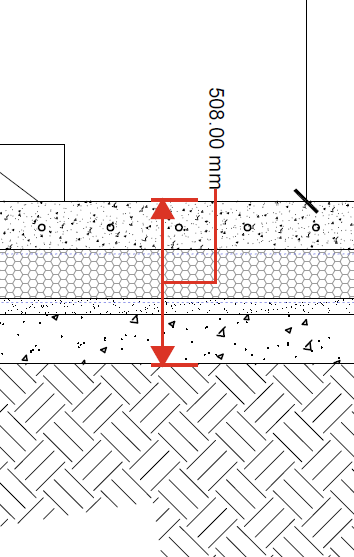
-
Gravity fed or pumped chamber to drainage field?
flanagaj replied to flanagaj's topic in Waste & Sewerage
No. It's the unit where the invert level of the outlet is higher than the inlet. It has a pump that then pumps the treated water to another tank higher up.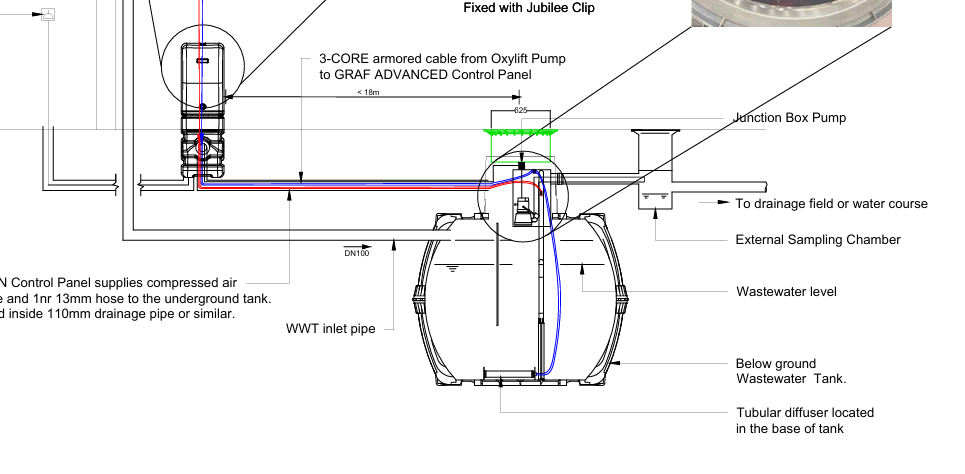
-
You think they would look at the submitted drawings and see that there is no change to the buildings proposed footprint.
-
Thanks
-
Gravity fed or pumped chamber to drainage field?
flanagaj replied to flanagaj's topic in Waste & Sewerage
I was just looking at invert levels again today and as the soil pipe run is 28 metres from the first inspection chamber. The invert levels are as follows. 1:40 - 1340mm 1:60 - 1110mm 1:80 - 990mm This is because the first IC has an invert of 640mm. I don't think I can do anything about that as the slab floor make up of concrete/insulation/sand blinding/harcore is 500mm, add 110mm and you are at 610mm. I assume that the soil pipe has to go under the type 1? The reason for my post was that I was considering going with the Graf pumped option as it would mean the 8m * 4m field that I need to excavate will be 500mm higher than if I went with the gravity outlet option. Just wondering whether the pump will be loud. -
I submitted the VoC last week and today that have come back and requested I complete the CIL form again. The question is not very clear and I am unsure whether I tick yes or no. The internal floor area is not changing and it's some minor fenestration changes, reducing the driveway width. Here are the questions c) Does the application involve a change in the amount or use of new build development, where the total (including that previously granted planning permission) is over 100 square metres gross internal area? Yes No d) Does the application involve a change in the amount of gross internal area where one or more new dwellings (including residential annexes) are to be created, either through new build or conversion (except the conversion of a single dwelling house into two or more separate dwellings with no additional gross internal area created)? Yes No If you answered 'Yes' to either c) or d), please go to Question 5 I did tick No for both, but the wording of c is not very clear(not to me anyway). I assume they want to know whether I have increased the m2 of the house?
-
Are you able to elaborate or show me an example of a connecter?
-
I did think of that, but was unsure whether that would meet building regs.
-
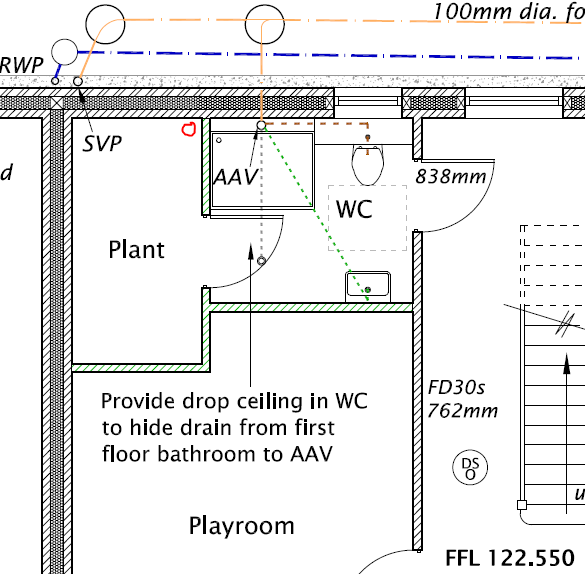
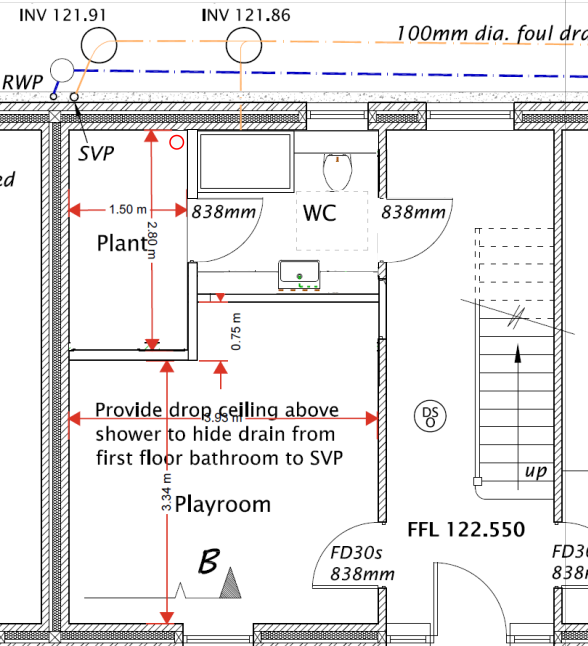
I want to rework the proposed foul drainage for our bathroom as I currently don't like it, but unsure how I handle the WC shown below. I am not sure whether I could simply run it under ground and into the proposed stack shown in the right hand corner of the plant room, or whether I need another inspection chamber outside and stack for it. I wasn't sure whether I could have a stub AAV concealed in the unit that boxes in the wall mounted pan frame or whether the stack would have terminate in the attic. if that is the case then I will need to reduce the width of the window. The Technical Architect has proposed the below, but I think it looks **** and pushes the tray out. I also don't like the door into the bathroom My proposed solution was the below, but that with the boxed in toilet frame might also look naff. It was reworked at the last minute as access to the plant room was from outside and this then meant that although the plant room was inside the thermal envelope it apparently isn't treated as such and the walls needed to have 200mm of celotex. This then made me think that accessing it from the downstairs bathroom made sense. I did think to have the door in the downstairs playroom, but that is actually a proposed bedroom.
-
Pre-cast concrete staircase
flanagaj replied to flanagaj's topic in General Self Build & DIY Discussion
Ideally, no more than 7K -
Pre-cast concrete staircase
flanagaj replied to flanagaj's topic in General Self Build & DIY Discussion
Cantilevered would be the ultimate aim. But it's achieving that without breaking the bank. My plan was something like the following. Ideally, getting the metal structure to counter the forces being applied as opposed to the wall having to do it. -
Paslode 360Xi Framing Nailer Vs Paslode IM350+
flanagaj replied to flanagaj's topic in Tools & Equipment
Surely a SE will not tell you what nails to use. -
Pre-cast concrete staircase
flanagaj replied to flanagaj's topic in General Self Build & DIY Discussion
Do you know whether they require a specialist foundation underneath the concrete slab? -
Pre-cast concrete staircase
flanagaj replied to flanagaj's topic in General Self Build & DIY Discussion
Unfortunately, they are not my thing. I don't like the central spine. I am now contemplating cast concrete stairs, but if that comes with it's own requirement regarding having to have a special concrete floor as opposed to sitting on the 150mm slab we have proposed, then it might be back to the drawing board. -
Anyone able to tell me whether there is much difference between the two above nail guns? The 360Xi has higher Joules, but the IM350+ appears to be more expensive. Just want a nailer that will good for all of the first fix that I need to do. Thanks
-
Power floated slab. Now rethinking micro-cement
flanagaj replied to flanagaj's topic in General Flooring
Unfortunately, I just would not feel comfortable doing that job myself. -
Has anyone investigated pre-cast concrete stairs and if so, do they too require a lot of structural engineer input in relation to the walls / floor makeup of the house? I originally was thinking about a floating staircase, but this requires the mounting wall to be significantly beefed up. So now, I am wondering whether a pre cast staircase could be a better option. In fact, given we want an industrial look to the entrance hall, it might actually be a better option.
-
My original plan was to save time and simply install a 125mm slab with UFH attached to the rebar mesh and then get a company to pour and power float the concrete. That would be the floor finish across the whole ground floor of the house. But now I am wondering whether a) Will I find a company who are good enough to create a power floated finish that will be acceptable as a finished floor, without having to have it polished? b) How do you protect the floor as the brickies will be throwing down block and brick remnants as they build up the internal walls? So I was wondering whether it might be easier and work out similar in cost, to pour the slab without power floating and then apply a 10mm (not sure if that is the depth) micro cement finish. Keen to hear if anyone has done this.
-
Our pole was moved on Wednesday and now sits nicely on the boundary. Next step is to get a connection, but I'm unsure as to the best option for the meter housing, as there is currently no house and we will need a supply so we can live in a static caravan. Is it a case of installing a temporary housing near the pole so a meter can be fitted and a consumer unit added and then accepting that I'll have to pay again to have the meter moved or should I just get someone to build a brick housing for an external meter unit. There is currently no walls or anything that I could use.
-
Alterative option to 150mm celotex + 50mm celotex?
flanagaj replied to flanagaj's topic in Heat Insulation
I was thinking about this again, and am simply going to ask the architect to design a cold roof. I think I can fit the MVHR in the plant room and as long as the ducting is underneath the 400mm blanket of insulation I think it will be ok. Unless I am mistaken, this approach will also mitigate the associated air tightness complexities that I would have had with PIR? -
Alterative option to 150mm celotex + 50mm celotex?
flanagaj replied to flanagaj's topic in Heat Insulation
Yes?
