


Ferdinand
-
Posts
12213 -
Joined
-
Last visited
-
Days Won
41
Everything posted by Ferdinand
-
Checking on Wickes and Todd Doors product, I am not sure they are the same. Looking at 1981x762mm Cottage Oak / Geneva doors (ie oak veneer with detailing like vertical planks): Wickes - weight 27.5 kg, bottom trimming margin 20mm. http://www.wickes.co.uk/Wickes-Geneva-Internal-Cottage-Oak-Veneer-Door-5-Panel-1981-x-762mm/p/214699 Todd Doors - weight 31.7kg (via Web Chat), bottom trimming margin 50mm https://www.todd-doors.co.uk/cottage-oak-door That suggests a different internal construction. In this case I need the extra margin, and want heavy doors, so I will fork out the extra £15 or so per door. Ferdinand.
-

Roof Lights: glass or polycarbonate
Ferdinand replied to ToughButterCup's topic in Roofing, Tiling & Slating
Missed this. The problem is that my feet are very ticklish, so I would not last long. -
One problem then is that the humidity changes as a new house takes 12-36 months to dry out, Argues for engineered or mdf.
-
Welcome. It is good to see part-rebuilders and renovators as well as greenfield or total replacement projects :-o) . Ferdinand
-
Haven't got around to thinking about skirtings yet :-).
-
Is an "engineered" (= fingerjointed) door lining significantly more stable? Example, For me it is worth an extra say £30-35 to get something that will not have to be repaired later. Ferdinand
-
Oooer typo. The maths was good otherwise. I allege.
-
I would defend using the shower cubicle technique on Ikea, No moving parts ==> open shelves, so there is nothing that can break too easily.
-
It is a new section of stud wall, so I can size the opening as I wish, which should be: 1981 x 762 mm for the door = 1991 x 772 with a 5mm margin. = 2051 x 1002 with 30mm for the door set. (Minus the bit I trim off the door to allow for my floating floor, which is not pertinent) Thanks for the replies - not yet confident in this area. @PeterW Thanks .. will take a second look at Wickes. Ferdinand
-
Made the mistake of going to IKEA
Ferdinand replied to ToughButterCup's topic in Electrics - Kitchen & Bathroom
It's a way of keeping the budget under control, so all self-builders hate it . -
I am planning to use these doors on the Little Brown Bungalow x6, (Oak Veneer known as Cottage Oak or Geneva): https://www.todd-doors.co.uk/cottage-oak-door They tell me that this doorset would be appropriate: https://www.todd-doors.co.uk/oak-door-lining-kit at about £72 As I am not that experienced with doors and frames, can anyone confirm that that a good choice, and whether there is a more reasonable alternative. In this case I would be able to paint the doorframe as the existing ones in the house are already painted. Cheers Ferdinand
-
Made the mistake of going to IKEA
Ferdinand replied to ToughButterCup's topic in Electrics - Kitchen & Bathroom
My grandma and me went to IKEA and we bought: 12 Panel LEDs. Two Lamb Shank Lunches. And 2 HYBY hall lights http://www.ikea.com/gb/en/products/lighting/ceiling-lights/hyby-ceiling-lamp-white-art-90347389/ who's next? -
@Lucy Murray Scottish ower wayleave info, including contacts: https://www.spenergynetworks.co.uk/pages/wayleaves.aspx Ferdinand
-
+1 This is Laurel and Hardy with the ladder territory, but we need to be serious when it is serious.
-
Hi Daniel While costs can be squeezed, Quick and Affordable are often at opposite ends of a compromise scale, and to an extent you choose your place along that scale by the decisions you make. It would be interesting to compare numbers with the current costs for Walter Segal style builds. Ferdinand
-
Hi @Lucy Murray (I hope you negotiated your purchase price down or it was low enough already !) While you do not have a Wayleave, you may be able to do something by working with your neighbours who would like their poles moved, or even buying the bit of land where they are located in order to be in a position to deal with your wire via dealing with the poles, as you then *would* have a Wayleave. We have talked about wayleaves and how to move them at some length in this other thread, which was a summary of a previous thread on ebuild: There may be variance of law or terminology due to Scottish Law etc, but the underlying principles should be compatible. Read my long post on that thread and replies for a start in connection with the following summary: 1 - There are two types of Wayleaves - Voluntary and Necessary. "Voluntary" means roughly that you have the basic right to tell them to move it after giving formal notice (maybe a 12 month notice period) - which will be in the Wayleave Agreement. "Necessary" means roughly that they have a right to keep it there, so have a basis for charging you as you want to prejudice their interest. In both cases a nominal rent may be involved. My impression is that Voluntary Wayleaves are more likely with older arrangements, since I do not think that "loopholes" like that would be left open now. (*) The one that I had moved was from the 1950s. 2 - In your case you do not have a Wayleave for your oversailing cable. Asking for one to be created may help you by making you an acknowledged party, and bring in a couple of hundred. That is probably a diversion from the main issue, which is you wanting that wire moved. 3 - One way to move your cable free or less expensively is to know that the poles at each side are Voluntary Wayleaves, and getting the owners of the poles to have them moved. If they are householders they could jump at the opportunity, especially if you are doing the limited amount of donkeywork and just presenting them with letters to sign etc. Obviously keep quiet about the exact amount of money this could save you and that you *must* move it if is so, or some people might play financial games with you. If it is a Necessary Wayleave you need to look at the agreement to see what it says to see if there is any potential benefit or anything you can use. 4 - Another option which may be doable is to buy that square meter of land where the pole(s) sit from the owner, then the agreement is transferred to you and you become the owner able to give notice. May be advantageous to make sure you are not forced to share any benefit with the pole-owner. I think that would be doable, You could also perhaps become the pole owners agent in law, but that is being complex for the sake of it. The easy way is to align their interests with yours and help them with the admin. 5 - You get a copy of the Wayleave Agreement from the relevant network operator by phoning up or emailing and talking to their "Wayleave Department", and giving them the 6-figure Grid Reference and Identity Details from the pole (take a piccy). They like the full address and postcode as well. You may get away without telling them you own the pole - just ask the basic question. But they *may * want* consent from the landowner. I am not sure whether Wayleave Agreements are public data. You could also potentially get the agreementa by submitting a Freedom of Information request, as DNOs (Distribution Network Operators) are Statutory Corporations and subject to FOI law. The question is still whether the Agreement is in the scope public data. Do as much homework as you can, then start by phoning up and asking. Even reception will send you to the right place quickly. Here is a list of DNOs, but dig around their own website to find the right contact as far as you can: http://www2.nationalgrid.com/UK/Our-company/Electricity/Distribution-Network-Operator-Companies/ There is a little bit of homework here, which may achieve nothing, but if the circs are with you it could save you everything. Best of luck. Ferdinand (*) I got the poles on the way to being removed before I sold my multi-house plot which decreased the downside by removing one risk for the purchaser, and this thread explains how background knowledge and digging saved someone £10k. You need to know the relevant stuff they are under no obligation to tell you. (**) Feeding the woodpeckers may help , though they may be high-creosote-content woodpeckers by now. On the other hand the Woodpecker Men may turn up and demand that that pole be left exactly where it is forever! Or you may be able to get the cost of necessary work due to the woodpeckers taken off your quote.
-
I think I would describe the role of SPONS as a sanity check, in particular to prevent huge mistakes through inexperience or ignorance. Paying 25 per sqm OTT for 250sqm of brickwork (say) is a chance to lose a lot in one go. Thtat sits alongside the stuff we all do to different extents to save a few percent here, and a few hundred ukp there. Ferdinand
-
You could have a further door made for the end panel if needed.
-
Which branch did you say it was?
-
Building Regs requesting ramp approach
Ferdinand replied to hmpmarketing's topic in Building Regulations
@hmpmarketing, One neat, and adjustable later should you wish, idea is to use what I call "Patio Feet" made by a company called Wallbarn - as below. They call them "Adjustable Support Pads". They are intended for supporting decks and paving on roofing, or raised off the ground, and cost from about a £2 for fixed low ones to about £5-10 each (depending on the height), and support up to hundreds of kg. IIRC mine were about £4-5 each, and I used them at corner joints between pavers. There are shims available (or we can make our own) which are designed to correct angles, but could be used to create angles for your ramp. For steeper angles one side of the support pad (which is a separate unit to the screw) could be cut off using a saw appropriate to tough plastic. Given appropriate pavers (I used 3x2 pressed council slabs for my patio), a ramp could be created that can be turned into generous steps by adjusting a few supports, or vice-versa should you want steps now and a wheelchair or run-down-the-world buggy later. The one proviso is that these require, or require you to create, a firm base .. though that could be made from a timber framework or MOT Type I (is that the one that turns into a compacted pan?). I guess that those eggcrate-full-of-gravel low impact foundations may potentially be a suitable base. Or breezeblocks bedded 25-50mm into the ground. There is a tradeoff between the size and strength of slab vs qty of patio feet. Not suitable for mosaic pavements. I like that I can raise my patio should I ever need to get underneath for maintenance. Ferdinand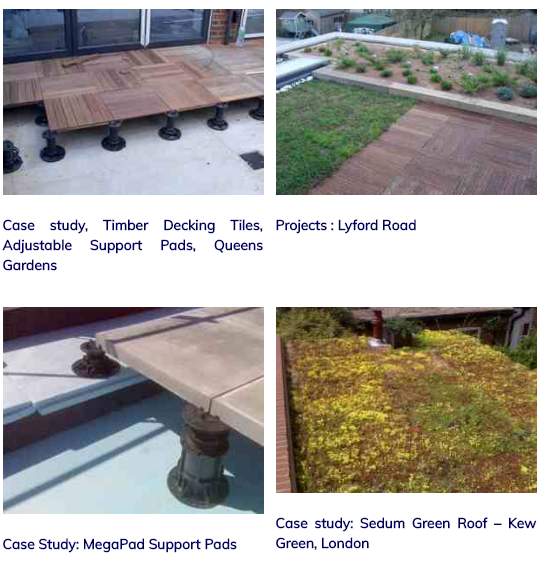
-
@recoveringacademic WHich year edition are you using? I assume it is the Builders' one. It looks like one of those purchases which are worthwhile when doing a big project especially with little experience, and of diminishing usefulness for perhaps the next 5 years as a more and more general guide, but useful as a source for concepts and how to structure thinking. And I guess as a comparison tool for different approaches. I see that there are different ones for Landscaping. Engineering, and Mechanical and Electrical, all at £150 too. Ferdinand
-
Self-sharpening chainsaws
Ferdinand replied to Ferdinand's topic in General Self Build & DIY Discussion
One feels slightly heckled . Last time I asked this question I skirted around the need to buy a chainsaw, however I now have a couple of reasonably sized but not large trees that need a trim. B&Q have discontinued this option, but I see that the Oregan Powersharp system is available on a 2000W Qualqast (!) corded chainsaw from Argos (link) at £79.95. That looks like a good deal if an Electric Saw is suitable, given that the Powersharp system to retrofit costs approx £60. Looks badge engineered in exactly the same way as the B&Q. Chain speed 13.5 m/s. F -
Could someone confirm which are the chainsaws at B&Q with the built in sharpening system? Thanks F
-
Storing your Ball Gown....
Ferdinand replied to ToughButterCup's topic in General Self Build & DIY Discussion
Local dancing friend with a house? Ferdinand -
Planning permission and boundaries & ground level
Ferdinand replied to Carrerahill's topic in Planning Permission
Just to help @PeterW sleep easy tonight, here is the list of 786 Powers of Entry from Primary Legislation: https://www.gov.uk/government/uploads/system/uploads/attachment_data/file/98389/primary-powers-entry.csv/preview and here is the list of 554 Powers of Entry from Secondary Legislation: https://www.gov.uk/government/uploads/system/uploads/attachment_data/file/98391/secondary-powers-entry.csv/preview This is old data (2011) but the best I can find. Peter will be delighted to know that the Outer Space Act 1986 allows them to inspect any of his neighbours who are from another planet: F
