


Ferdinand
-
Posts
12213 -
Joined
-
Last visited
-
Days Won
41
Everything posted by Ferdinand
-
I have an insulated kettle. On chopping boards, I am far happier with a folio of chicken - meat - veg - fish boards for about a fiver in different colours, rather than combine them on a fixed area. if I went for something like a glass item, it would eventually blunt my nice expensive knives. My experience is that the harder a chopping board, the more likely you are to chop off a finger when it slips. Water hardness is variable, so check what it is in your area. Google for the place to look. My Franke sink came with a chopping board on little runners made of glass. F
-
 May be of interest. (Assuming half to two-thirds is from residential development, this is 20k or so per new build house). Source: https://assets.publishing.service.gov.uk/government/uploads/system/uploads/attachment_data/file/685301/Section_106_and_CIL_research_report.pdf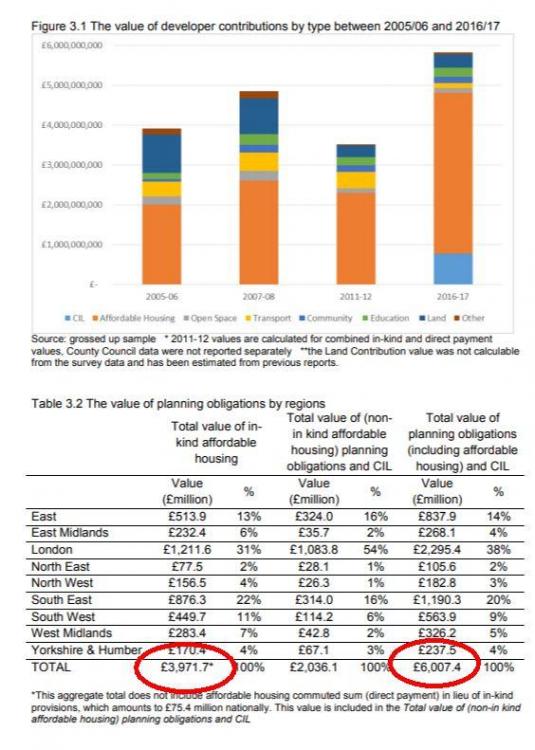
-
Works to an existing access - PP required?
Ferdinand replied to Piers's topic in Planning Permission
Difficult to know what they would do if it was over :-0. Get one of those James Bond helicopter buzz-saws things, and fly it full tilt round the corner to give a full-length Dutch Gable? Does anyone know of enforcement over roof height? I would think it would need to be 2ft too high before they did enforce, if it was already built. F -
Works to an existing access - PP required?
Ferdinand replied to Piers's topic in Planning Permission
"Dear XYZ Thank you for your letter. Whilst I always enjoy visits from Council Officers, in this case I was simply maintaining an existing access into my field, for convenience and in order to prevent mud being spread onto the lane by vehicles - thus preventing a potential hazard. As it is a field entrance, I am entitiled (required?) to carry out such maintenance. I enclose a screenshot from Google Earth, and also a photograph taken this morning. You are, of course, welcome to visit in any case. Rgds etc Basil II, the Bulgar-Slayer, Founder - Varangian Guard" -
Does the council class DIY as Construction
Ferdinand replied to ultramods's topic in Building Regulations
One who did not want to talk directly, which is always understandable. We are on tenterhooks wrt neighbour relations - they may be too. Or someone who a) did not know the rules and wanted chapter and verse, or b) wanted to harass you. I had a case where complaints to the Council every year were used as a form of harassment. Difficult to deal with if there is no 'vexatious' filter; in place - "we have to respond". F -
Works to an existing access - PP required?
Ferdinand replied to Piers's topic in Planning Permission
I think your explanation should be fine. It is a repair. There may be a clearer overhead view in bing.com - photography is sometimes clearer. But are those actually offences, since it is porous? This could just be for form as someone complained. There is also the case that if this is an entrance directly to a field from an unclassified road, you may have the right to create one anyway (or they may not have the right to stop you creating one, even if they do cry into their sarsaparilla). In which case even if it wasn't a repair (which it is) they are whistling in the wind anyway trying to enforce nothing. Perhaps ask what they would enforce on (if you need)? Ferdinand -
That looks to be doable, but why are we not being charged for it? What happened?
-
I might have thought rent a LIDAR for that - it seems to be what the Archaeological TV programmes use now for their Whizz-Bang element , and should be relatively cheap. I like the 3d presentation of the stairs, though (on the subject of 3d visualisations) I see that Richard of Northampton had one of his head displayed in the Norwich Museum. I hope you are better now, after all those years in that car park . Ferdinand
-
Can you send a newsletter to say that the big noise is done?
-
.
-
In that case you will be cleaning the walls, not just the Shattaf.
-
Thought for a minute we were going to have Dorset's answer to Rooster Cogburn on our hands... This subject is beginning to get interesting.
-
Why not do all of it in Eng. Bricks. They only cost about 20p extra each.
-
How easy are things like Silestone to work? eg This 30mm Silestone panel on Ebay at £45 - 555mm x 1085mm - is nearly the size I need, but would need 125 mm taking off the back and pipe holes etc drilling. It already has 3 sides polished. https://www.ebay.co.uk/itm/Silestone-Quartz-Amazon-30mm-Ex-Display/273450425752?hash=item3faaea5d98:g:NTwAAOSwf2pbhAfe Is that simple to do for me or my plumber? Ferdinand
-
Corrected ? Room is about 15 x 19ft.
-
My total worktop length is 89m of 600 deep, plus a 900 x 1400 island, and a 600x600 cubbyhole which used to be a built-in microwave. Plus a 600x600 Ikea moveable trolley which fills in the gap at the end, with a microwave on it. Of that more or less fixed 1m is sink + drainer. 1m is TV and charging gubbins. 1m is range cooker. 600 is kettle, tea, teapot, cafetiere etc. 600 is Gaggia machine. 600 is bread, trays and toaster. Island is used for storage and transient things. F
-
There is also the possibility of a Superloo from Japan / Korea? Do these incorporate sensor controlled adjustable hydro-flo? Or you could fit a Shattaf (bidet shower) to your loo, which would give you a tool for a long-range loo post-clean. They are used by half the world. (New York Waldorf) Ferdinand
-
Is there a chance of your piece being 450mm too long lengthwise, or that your hob is 1200 x 450?? I need a 1200 x 450mm piece :-). My local workshops little man in his little unit - "Offcuts will not be that big. I reckon £300-400."
-
I was in Bathstore the other day, and he was waxing lyrical about "water entry holes all the way round the rim". Or phone up McDonalds and see who they use? Very Hitchhiker, but there it was a Dirty Telephone that killed us off. Try Megabad - I once had a *huge* lecture from a German housemate on this subject, including a thorough examination of the insufficiently cleansed loo. F
-
Yep. Given you only need a guestimate (+/- 10-20%) as we all have different amounts of different junk in our kitchens it can only ever be comparable meaningfully with those error margins, it was just a nice round way to estimate. I have a big chunk of worktop given over to a Gaggia Coffee Machine, a microwave, a TV, a Lazy Susan, and a toaster - for example. Also you can always play games with hidden worktops or having a recessed worktop where a built-in pven might have gone, for example. Ferdinand
-
Add up the metre run of all your base units and multiply by .6 or .5 to allow for hobs and sinks etc.
-
Bi-folds/Slide and Turn Patio Doors in a New Build
Ferdinand replied to Tony99's topic in Windows & Glazing
As a cheapskate, I never consider anything except French Doors. Until I build my Para 79 Haese in the Peak District. F -
Just buy some bloody spiral bricks. https://www.ibstockbrick.co.uk/kevington/specialshapes/spiral-bricks/ If you really want to do it properly, build it solid out of blue engineering bricks, then carve it by hand into statues of a pair of bobbing dogs, and 2 sausages forever just out of reach. F
-
Saving Stamp Duty on Derelict Properties
Ferdinand commented on Ferdinand's blog entry in God is in the Details
I think the one in the case already had Planning. And I think that conceptually the SDLT thing would come under ‘matters not relevant’, as do eg neighbour disputes about boundaries. -
Saving Stamp Duty on Derelict Properties
Ferdinand commented on Ferdinand's blog entry in God is in the Details
it is actually quite spread out, but the test is ‘suitable for use as a dwelling’ on te day of purchase, for residential SDLT to be applied, and it was a 150k transaction including the 3%, I think. The HMRC came up with lots of tangents. The applicant made this case, and the place had had an intrusive asbestos survey, and white asbestos was exposed: It s a good read. Expect ‘suitable for use’ to change to ‘capable of being used’, to try and catch more in the net.


