Marvin
-
Posts
2389 -
Joined
-
Last visited
-
Days Won
3
Everything posted by Marvin
-
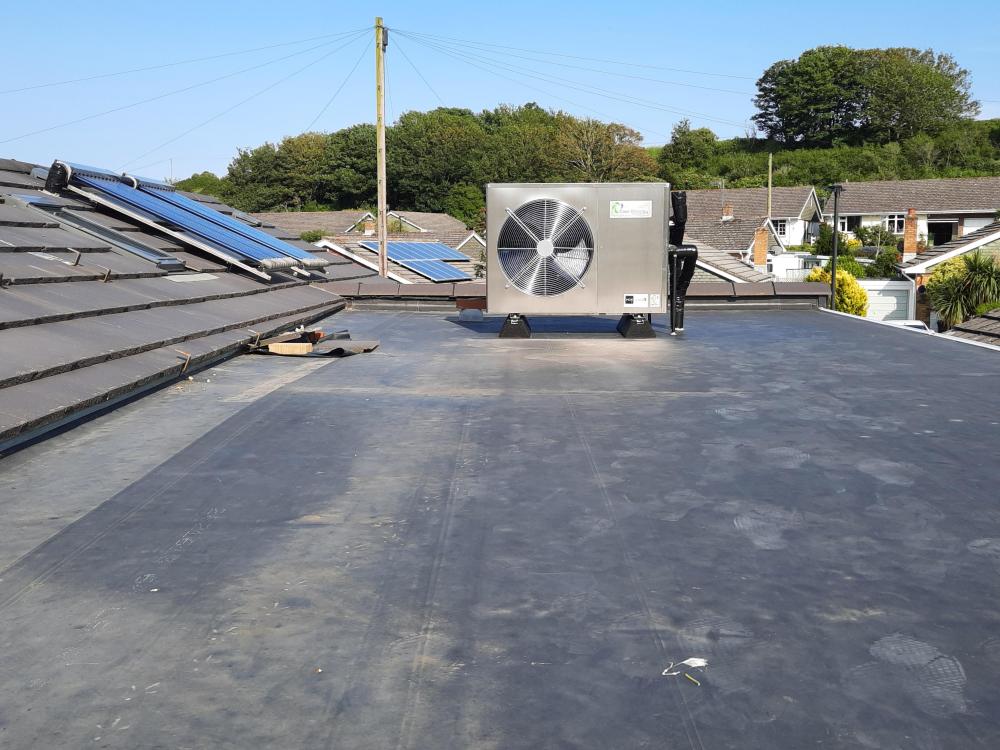
Coolenergy ASHP up and running from yesterday.
-
Beam not installed to spec, should I be worried ?
Marvin replied to Loz's topic in RSJs, Lintels & Steelwork
To be clear its the surface area of the pad stone lying on the blockwork below that is important. A padstone crossing the cavity would be worse because there would be even less surface area on the blockwork walls below. The idea is to spread the load on to a wide enough surface area that the blockwork can cope. -
Beam not installed to spec, should I be worried ?
Marvin replied to Loz's topic in RSJs, Lintels & Steelwork
I understand. It may have been that the pad stone are not available, I have had all sorts of problems with obtaining concrete items. I agree. If it was me I would be asking the Structural Engineer how important the 400mm length of the pads is. Especially as 300 is only 75% of the original length. After all you don't want him to fall out with the builder if a problem arises. Better to face it now rather than later... Good luck Marvin -
Fence panels level or following wall?
Marvin replied to success1980's topic in Landscaping, Decking & Patios
Surely, which ever looks best? How about a picture? -
Beam not installed to spec, should I be worried ?
Marvin replied to Loz's topic in RSJs, Lintels & Steelwork
More information for you Lawrence. https://www.mcandrewassociates.co.uk/post/padstones-what-are-they-and-how-are-they-used Think the 400 length of each padstone is important. Marvin -
and as Bitpipe indicated .. and where all the connections need to go to. Oh and MVHR.
-
From a size point of view it seems that you should be very carefully identify what your thinking of putting in the room. My HW tank is 1600mm tall and its not a tall one. Thinking of a space created below the ground floor makes me believe it would be viewed as part of the foundations to the building and therefore Building Regulations apply? Different heating, cooling and fresh air arrangements for your building could also make a difference as to how it would all work. Air source heat pump air to air? Air source heat pump air to water? Photovoltaics electricity generation? Gas boiler? Passive house standard? Coal fire? Its not just "make a space and stick all the stuff in there" its also " what does it all need to connect to and where would the connections be coming from" As you have indicated, its not if, but how much. However the "how much" is also related to "if more work is required to put the items in the basement rather than elsewhere". So you still have no answer but perhaps you can consider what mechanical and electrical (M&E) your thinking of installing and see if the basement idea still works. Best of Luck Marvin.
-
What cable should be used to extend CT Clamp cable?
Marvin replied to Marvin's topic in Photovoltaics (PV)
Or Is STP cable better as it will need to run near mains..? -
What cable should be used to extend CT Clamp cable?
Marvin replied to Marvin's topic in Photovoltaics (PV)
I was thinking of using Cat5 cable... -
What cable should be used to extend CT Clamp cable?
Marvin replied to Marvin's topic in Photovoltaics (PV)
The inverter is 15m of cable from the grid supply. -
I would lay the tiles using sand and cement morta. M.
-
Not sure flexible floor adhesive is a good idea? Was the weight of the wood burner feet (or a foot) on the tile? My old wood burner was bloody heavy! Was the cardboard scorched? My guess would be an un bedded tile on an uneven surface rather than heat alone. M.
-
Hi What cable type is best to extend the reach of my CT clamp? Marvin.
-
I think the stud is fine for the weight, however the fixing of the radiator to the plasterboard is not best, in my humble opinion. Lots of things to be considered: What thickness is the plasterboard? Is the plasterboard plastered or drylined? Is the wall in a damp room? Can some of the screws fix through the plasterboard into the stud? Is 35kg the dryweight? Is the radiator going to be on a wall that has passing traffic? Years ago, I worked for a national timber framed house builder. One job I had was going around about 32 houses cutting open walls and putting noggins in where the radiators had been fixed to the plasterboard. The plasterboard had slowly bowed out with the weight. Best of luck Marvin.
-
Also the outside leaf of the lintel doesn't look like the plain edge of a catnic CG110/100. Again, I may be wrong.
-
Hi Loz. Can you confirm the opening size and also take a picture looking up at the underside of the lintel?
-
I do not know if this is the case but if I remember correctly, the strength in the lintel is within the cavity space part which supports the leafs holding up the outside and inside wall skins. I believe it is possible that, if you load one leaf too much before the other leaf it can distort the lintel. Anyway I'm sure someone will correct me if I'm wrong ?. Marvin
-
The result is that under the rules I have to apply under a G99 application for anything capable of feeding in more than 3.68kW even if the inverter can be limited to 3.68kW I will upload info later on.
-
For those of you who are not in the know, I am trying to obtain permission to connect my proposed 5.12kW photovoltaic system to the mains electricity using an inverter which would limit the feed-in to the mains to a maximum of 3.68kW thus avoiding having to obtain prior permission (and possible costs) from the distribution network operator (DNO) under G98 rules. The question I am trying to find the answer to is whether this design of a system; able to produce more than 3.68kW, but with an inverter set up, which limits the amount that can be fed into the mains grid to a maximum of 3.68kW, is OK under G98 rules. Latest DNO reply: Thank you for confirming the information below. I have forwarded your email to our MCC Generation Team, if they are not able to assist I have requested that they let me know and I will locate the correct team that can answer your query. Regards
-
Latest: Email received from DNO raising questions. My responses in red: Does your enquiry relate to a new generation connection or existing connection? New generation feed-in to existing supply Site Address for Generator: My home. Type of Generator Photovoltaics Capacity of Generator: Panels capable of generating 5.120kW but limited by inverter to 3.68kW with ct Clamp. Make and model of inverter: Sofar Solar Grid-tied Inverter Product model: SOFAR 6KTLM-G2 with ct clamp. Import and export MPANS xxxxxxxxxxxx This system has NOT been installed yet.
-
Latest: Thank you for your email. Unfortunately I am unable to assist with your enquiry as Distribution General Enquiries at Scottish & Southern Electricity Networks (SSEN) are responsible for raising non-emergency electricity network jobs for central southern England and northern Scotland. However, our G59 Protection Settings department will be able to help resolve this matter as they primarily deal with all enquiries of this nature. I have taken the liberty of copying in our DEPARTMENT NAME team into this reply, and I am sure a member of their team will be in contact with you shortly. Kind regards
-
Oh my! Never take a call on your mobile when your trying to drill holes in a roof. Well it embarrassingly turns out that the call was from Midsummer and not SSE. I had sent an email to both on the same day about roughly the same subject. So I still wait for a response from SSE. I'm sure I will never live this down....
-
And on the isle of wight which is where I am...
-
Ok here we go. This is how it's going for me: SSE phoned to ask if anyone had replied to my email. I said no. Gentleman asked what inverter I purchased. I said I would have a look at the invoice. Gentleman asked where I purchased the inverter. I said Midsummer Gentleman asked if I had the order number. I gave the order number Gentleman then told me the inverter I had and he would raise an order for a CT clamp! He seemed to accept that an inverter with a limiter is ok. Time will tell. I will update when there is progress. Marvin
-
Further delving seems to suggest that ProDave is on the money. I have seen G99 applications when an inverter has a feed-in limiter. Sometimes they are inspected by the DNO to see they are working properly and sometimes locked by the electrician and signed off to the DNO. I wait to SSE's response. M