


Mattg4321
-
Posts
623 -
Joined
-
Last visited
Everything posted by Mattg4321
-
Unvented Expansion Vessel Pre Charge
Mattg4321 replied to Mattg4321's topic in Boilers & Hot Water Tanks
Not sure that I’ve ever seen or heard of an AAV on the DHW side! Fit where exactly and how would it help? -
Unvented Expansion Vessel Pre Charge
Mattg4321 replied to Mattg4321's topic in Boilers & Hot Water Tanks
I've tested the pressure on the balanced cold/hot at 3 bar, so that rules out PRV leaking by? Both PRV and EV only been fitted a week or so - hope they are not faulty already! Gut feeling tells me its something to do with the way its plumbed or the supply rather than faulty components -
Unvented Expansion Vessel Pre Charge
Mattg4321 replied to Mattg4321's topic in Boilers & Hot Water Tanks
Noise was much worse at 2.5 bar than at current 1.5 bar. The flow isn’t the main problem, I just want to stop the noise or mitigate it as best I can! -
Unvented Expansion Vessel Pre Charge
Mattg4321 replied to Mattg4321's topic in Boilers & Hot Water Tanks
Well it’s not a million miles from what I’m getting when I measure it I suppose? -
Unvented Expansion Vessel Pre Charge
Mattg4321 replied to Mattg4321's topic in Boilers & Hot Water Tanks
Looking at it properly I just measured the black alkathene main at 22mm external diameter. According to Google this could be either 15.5mm internal or 14.1 depending if Class C or D. Nominal size is 1/2 inch. This is approx 15m in length from street. Then I have approx 12m of 15mm copper pipe to position of outside tap and kitchen tap where I carried out the test. Internal diameter 13.6mm. Do you still think I have a restriction? The length in total is much further than your calcs - sorry if I provided duff info! EDIT. Also goes through a 15mm stop cock and numerous fittings - mostly copper but including 1 or 2 push fit plastic I seem to remember. Cylinder is 250 litres and the EV is 18 litres. -
Unvented Expansion Vessel Pre Charge
Mattg4321 replied to Mattg4321's topic in Boilers & Hot Water Tanks
Stop cock in street looks new. Last 5-10 years. Blue pipe I seem to remember and definitely has a quarter turn handle on it. Operated by hand easily. -
Unvented Expansion Vessel Pre Charge
Mattg4321 replied to Mattg4321's topic in Boilers & Hot Water Tanks
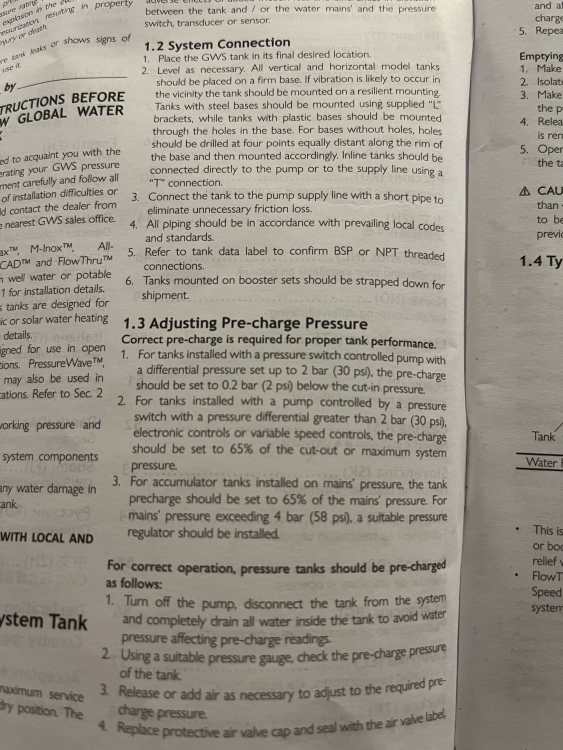
Just checking the EV instructions. I think it says 65% of max pressure. So 65% of 3 bar. Equals 1.95 bar However there is a pre charge acceptance factor table. But I don’t really know what it relates to at a glance through instructions.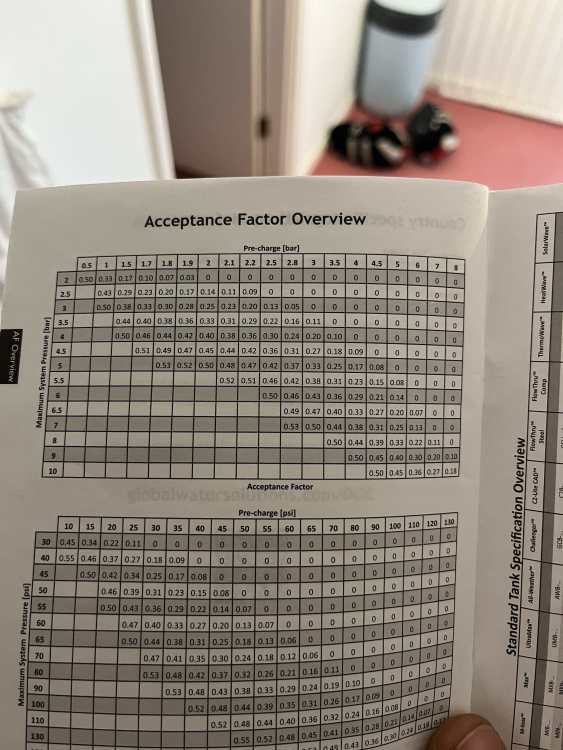
-
Unvented Expansion Vessel Pre Charge
Mattg4321 replied to Mattg4321's topic in Boilers & Hot Water Tanks
I just repeated the test. Pressure measured at the kitchen sink directly off the main. New pipework so won’t be furred up etc Had the outside tap fully open. Also directly off the main. static pressure. 3.6 bar dynamic pressure. 1.4 bar with outside tap wide open flow rate at outside tap with it wide open. 18 litres per minute outside tap fed by 15mm copper not sure what that tells me! -
Unvented Expansion Vessel Pre Charge
Mattg4321 replied to Mattg4321's topic in Boilers & Hot Water Tanks
Thanks. So it seems like I need to get a new main in. 25mm or perhaps even 32mm if there’s any benefit to that? Then fit a 3 bar PRV at stop cock to match the 3 bar PRV at cylinder. Should sort my dynamic pressure problem and potential backfeed problem at new kitchen tap? I tested dynamic pressure on the main. Ie before the cylinder and PRV. So it can only be a problem on the main or the stop cock (which is almost new and fully open) I think? Guessing that black pipe is just too small. The stop cock is 15mm copper as that’s apparently the size of the black main internally. Then steps up immediately to 22mm copper to cylinder. -
Unvented Expansion Vessel Pre Charge
Mattg4321 replied to Mattg4321's topic in Boilers & Hot Water Tanks
Looking like this will be the new tap in the not too distant future. Assume it means I don’t need to worry as it says it’s protected against backflow with an integrated non return valve?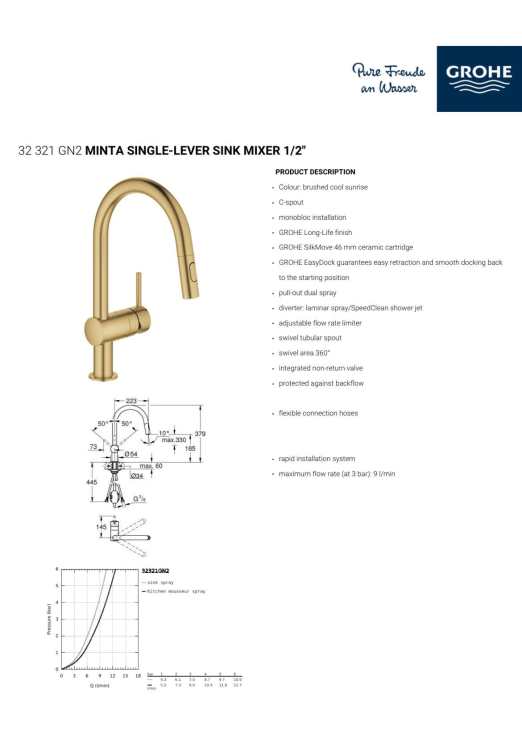
-
Unvented Expansion Vessel Pre Charge
Mattg4321 replied to Mattg4321's topic in Boilers & Hot Water Tanks
It’s in 22mm copper and around 800mm -
Unvented Expansion Vessel Pre Charge
Mattg4321 replied to Mattg4321's topic in Boilers & Hot Water Tanks
At the moment it’s one where the hot and cold are separated right to the spout. But soon to be changed!! -
Unvented Expansion Vessel Pre Charge
Mattg4321 replied to Mattg4321's topic in Boilers & Hot Water Tanks
I do have what I assume to be thermostatic shower. Also a couple of oldish mixer taps. Assume 15 years ish. Balanced cold feeds everything bar an outside tap and the kitchen tap which is teed off near stop cock -
Unvented Expansion Vessel Pre Charge
Mattg4321 replied to Mattg4321's topic in Boilers & Hot Water Tanks
22mm non return valve on hot outlet (at top of cylinder) - not that I can see... No pressure reducing valve at stopcock. Mains pressure at kitchen sink is 4 bar. Everywhere else after combination valve adj to cylinder measured at 3 bar. Not sure what effect those 2 things would have. I've not noticed them on other jobs I've been on either though - not that I make a point of looking. Sure you'll enlighten me! (please) When bath tap is fully on, flow elsewhere upstairs slows to not much more than a strong trickle! -
Unvented Expansion Vessel Pre Charge
Mattg4321 replied to Mattg4321's topic in Boilers & Hot Water Tanks
Yes retro fit into late 60's build with black alkathene main. As per first post I was told that I needed a bigger main, so this isn't a gripe with the plumbers really. More of a question as to whether I can do anything to mitigate the noise in the meantime before I get the main upgraded later this year. Sounds like it may not be wise to drop the EV pre charge below 1 bar, so perhaps it has to be lived with as is now. Plumbers saying 25mm blue MDPE needs to go in. I'm in a fairly large village/small town and water pressure is good (4 bar). Distance from road to stop cock around 15m. Perhaps 25mm is fine, but any benefit to 32mm? I guess it will have to be stepped down both ends to 25mm at meter and 22mm copper in house, so perhaps not really. -
Unvented Expansion Vessel Pre Charge
Mattg4321 replied to Mattg4321's topic in Boilers & Hot Water Tanks
Thanks for the explanation. The gurgling/vibration noise has got better since the pre charge pressure was dropped to 1.5 bar. It doesn't seem to happen if a basin tap is turned on now. Mostly only the bath. With every other tap its a moderately loud hiss for a while until presumably the EV has emptied. It seems it's probably something I have to live with until we get the water main upgraded to 25mm blue MDPE? The dynamic flow pressure of 0.8 bar seems to be the root cause here and everything else is a compromise because of this? -
Hi all Recently had a Joule 250l indirect unvented system fitted. Was told beforehand that incoming main probably needs upgrading. Currently 3/4 inch black MDPE. Around 15mm internal I believe. Plan to do so as soon as funds allow. When hot water is drawn off after it’s been heated/left for a while then we get a fairly loud gurgling noise from the expansion vessel/cylinder area. The plumbers been back and I think released some air from the expansion vessel, which seemed to have made it a slightly less aggressive, but not cured. Im struggling to get them back and just want to get this sorted it it’s something I can do. I’ve checked pressure on the main and on the balanced cold. 4 bar on the main and 3 bar on balanced cold. This drops to slightly around 0.8 bar with the bath tap fully open. A consequence of the main being undersized I think?? Ive checked the pre charge in expansion vessel (after shutting off cold supply and opening a tap to release pressure) and it’s about 1.5 bar. I think it was 3 bar from factory judging by the sticker. From what I’m reading the pre charge should be 0.2 bar below the dynamic flow pressure of 0.8 bar? Setting it to 0.6 bar seems low though and I don’t want to mess about with something I don’t fully understand without seeking some advice! Thanks in advance
-
I wouldn't be using a granny charger unless in an emergency. No PEN fault protection and doesn't comply with Section 722 of BS7671. Step the cable down to 6mm2 and do away with the socket or supply from a local circuit. If not familiar with Section 722 seek assistance.
-
Pretty sure IET code of practice says that EVSE must be on a dedicated circuit. Thats the only way I’d fit one anyway. I’m surprised that it can’t take 10mm2. What manufacturer and model EVSE is it out of interest? Why has a cable been installed that is incompatible with the equipment it’s intended for?
-
That’s poor from what’s usually a good brand. I don’t usually fit their sockets etc though as availability is poor near me
-
What brand out of interest? Never noticed any of them buzz before.
-
PAS63100 says yes. See page 14 below. Although it depends on your definition of mandatory and by whom I suppose. Personally I think you’d be mad not to. The cost is tiny compared against the installation of the PV/Inverter/Battery. I’ve seen loads of comically bad MCS installs though. https://www.pluginsolar.co.uk/wp-content/uploads/2024/04/PAS_63100_2024.pdf
-
Yes, 16th, 17th and 18th!
-
So...I'm about to do Rainwater Harvesting
Mattg4321 replied to mike2016's topic in Rainwater, Guttering & SuDS
Rainwater is good for washing cars too as it doesn’t really leave water marks. If I can be bothered I attach my pressure washer to a water butt, via a simple filter. -
I didn’t fit my windows and in my case the tape was fitted afterwards by me and covered by the plasterboard reveals. I used 15/55 split. Guess it depends on your build type as to whether it can be fitted afterwards though.



