


saveasteading
-
Posts
11094 -
Joined
-
Last visited
-
Days Won
98
Everything posted by saveasteading
-

Discharging rain water onto flat roof.
saveasteading replied to paro's topic in Rainwater, Guttering & SuDS
Is the question 1. Can my ditch take this extra water? 2. Can the extension gutters and pipes take the water? 3. Is it ok to drop this water from existing roof onto the new roof? Why do you think "no"? 4. Other. -
Nobody here doubts that it makes heat. It is the cost of installation and running costs that are of interest and the general view is that this is like Warmup electric matting. ie expensive to run and not for justifiable space heating. Got any costs you can publish?
-
Discharging rain water onto flat roof.
saveasteading replied to paro's topic in Rainwater, Guttering & SuDS
And then where? -
Green raft insulation. Is that Greenguard? I wasn't aware of this bug just looked it up. Makes sense to have extra strong insulation when under such heavy load as must be being designed for. 180mm of this appears to cost £48/m2. I wonder if your SE has made the slab thick just to match the beam, and to spread the beam load wider over the insulation. My stingy take on this is to have no insulation under this industrial floor and add extra elsewhere. Ground isn't a bad insulater anyway. I'd love to see the calc's for this slab as there is something I'm not grasping. OR the SE isn't great on value.... most aren't... only me and @Gus Potter.
-
This design is so over the top. OK the 100mm of concrete isn't suitable as your slab but it is presumably intact and strong. 25mm to 100mm blinding is remarkable. Is it to provide a level surface or hide a grotty surface? But 75mm variance? If anything it's a weakness and will have footprints in it. 250mm reinforced slab on all that? It's not going anywhere. How about zero to 25mm blinding, and 200mm slab? The joint looks industrial too and could be simplified. If this is a steelworks or military tank factory rather than a house then ignore my comments. I apologise for being whimsical, but I've built heavy duty factories and lorry garages with 30t hoists , slightly lighter than this design.
-
Posi joist - This install feels rubbish, thoughts?
saveasteading replied to boxrick's topic in Roofing, Tiling & Slating
Re taking references. Obv the builder only gives the happy customers so it can be a waste of time. This builder could be a decent chap who means no ill, but is not competent I've met many with no idea how a structure works. So in your case he has joined the bits up, and made it fit. If he is insisting on putting it right, then you would need a formal proposal and schedule from a professional expert engaged by him, and very soon. -
Posi joist - This install feels rubbish, thoughts?
saveasteading replied to boxrick's topic in Roofing, Tiling & Slating
A recognised professional is what you need now. They don't need to look at the contract or money, just inspect the roof and write to say that the work is inept as witness ....etc. and the building will be unsafe. The work must be remedied by a competent party and they do not believe the current builder is competent. Along those lines. Unfortunately I think this may be quite expensive because the consultant us buying into your problem: the builder may sue or lawyers contact them. UNLESS the building inspector does it for you. Do you have contact? -
Cages in first? There is surely a proven alternative I'd hope. Or... stick some vertical bars in your pour as anchors and cut them off later.
-
Grey water via bore hole or storage tank.
saveasteading replied to MikeSharp01's topic in General Plumbing
I'd thought of IBC's but don't want to risk it strength or durability-wise. I did link 3 above ground once. A proper underground water tank will cost twice as much and be much more reliable. Then make it bigger to get all the rain. PS. In the costing, allow for extra underground pipe and depth if applicable, compared to nearby soakaways. -
If i understand this design, the slab has 2 layers of mesh, but at the lines shown the slab has additional reinforcing bars (in plane) to render the slab into beams. It seems cautious but isn't hugely expensive. What do you think you might screw to the floor? All I can think of in a house is a kitchen island. Perhaps a stair? Or a particularly heavy column. Anyway the pipes can be laid through the beams before concreting, as it is simply a cage, and can be as high or low as you wish. So lower the pipes lically or divert them around any fixings area.
-
Grey water via bore hole or storage tank.
saveasteading replied to MikeSharp01's topic in General Plumbing
Correct. Sewage assumed to be the same m3 as mains water bought. I don't know if that applies everywhere. -
Posi joist - This install feels rubbish, thoughts?
saveasteading replied to boxrick's topic in Roofing, Tiling & Slating
It's great to avoid unnecessary nastiness, and try to resolve amicably. BUT you say above... "But he constantly keeps shifting blame to me, saying he can put it right, guilt me etc. " So, hard as it may seem, you need to be unapologetic. Just don't say these things. If in doubt, leave it out. Stick to facts so that it is not personal. eg don't say you have built it wrongly and it is awful....instead, say there are serious issues.... that sort of thing. FYI i have shown your photos to the non-technical family members who are around. (They have some feel for construction through exposure to it in family life and business) They spotted some of the issues, notably the screw fixings and the cut beam. So there is no excuse for your builder having left it like that. -
I have seen IR used very successfully in factories, above work stations , heating static worker. Also in garden centres over the tills. The power is quite high but justifiable rather than any other means. I've got a couple of black heaters on an outside wall for heating us on the patio when an evening meal turns a bit chilly for the coffee and another wine. It seemed a great idea at the time, and I was experimenting for professional purposes. But the power use is high, and we would better put on a jumper and hat. And I've got a cheap heater that works with a visibly hot element and light that also emits IR. Described as Halogen AND IR. I use that as it is directional, when watching rugby but banished to a cold room. That, with blanket, works and is a decent compromise for 2 hours. Heating the walls and ceiling is a waste of heat. I can't see the advantage of that at all. I expect the heat loss outwards is also significant.
-
Wall plate removal as part of converting to solid floor?
saveasteading replied to amin's topic in General Flooring
I'd be reluctant to touch it. You can never quite get the support back under the bricks, and they might move during the works. The eps might be a brilliant idea: I thinking. where is your finished floor level? -
Grey water via bore hole or storage tank.
saveasteading replied to MikeSharp01's topic in General Plumbing
Who allowed that building on the island, spoiling the view out to sea? I've done this once with rainwater. 500m2 roof all going to a 10m3 tank. That size got the building through a dry summer. But it was an office, so lower usage. I think it was a big success, paying itself in 4 years as opposed to my forecast 10. The hidden cost is the secondary plumbing: a completely parallel system. There is a hidden cost benefit too, if you are on mains drainage but I assume you are to soakaway. Cost too if the tank pump breaks down, which ours did every couple of years. There was no need for filtering, only a settlement chamber, just in case. If the tank is too small then you run out, and need mains water, but that can be linked in to be automatic. Have never done it again, because a hunch said the parameters weren't right. Instead I have specified mains water but lots of garden rainwater storage.... butts and perhaps a bigger tank in the ground. -
Cracked wall beneath purlin
saveasteading replied to evanthorncliffe's topic in General Structural Issues
Your SE would see the diagonal direction of the crack, and be happy that the beam is supported and the load is spreading as intended. They will likely then say to leave it alone until we see what the winter does. The ground may be very dry and have shrunk, and may close the gap again. This would take many months of wetter weather. However I'm not your SE and can't look at any other factors that may not be shown or explained here. The horizontal crack concerns me very slightly more, but is probably the same thing. . Again perhaps wait to winter..... and let us know. -
It is electric heating so not eco unless from solar. Isn't this simply heating the plaster, so you have a warm wall? Nice to sit next to but basically electric heating to the room and not benefitting from infra red use in any way? I've got an electric blanket under the tiles in the bathroom. Very cosy underfoot but only for an hour a day in winter and not heating the room much.
-
Posi joist - This install feels rubbish, thoughts?
saveasteading replied to boxrick's topic in Roofing, Tiling & Slating
This is strange. The relationship will be awful. You donr trust them. Different contractors will clash. Better to part ways now. sounds a bit like taking some blame/ delete? -
Posi joist - This install feels rubbish, thoughts?
saveasteading replied to boxrick's topic in Roofing, Tiling & Slating
OK. Clause 12 is clear Contractor has the obligation to provide a high quality outcome for the works which are required to meet or even exceed the Client’s expectations. Later it says adjudication is the next stage, but if the builder is refusing reasonable discussion then that is redundant and clause 3u is clear enough: written notice by you, 14 days, contract terminated. -
Posi joist - This install feels rubbish, thoughts?
saveasteading replied to boxrick's topic in Roofing, Tiling & Slating
I don't agree. If there is a recognised formal contract turn the remedies and procedures are laid out, and that is something less to sort out. It is hard, and they may be difficult with you. Stay strong and it gets sorted. Don't pay. Keep notes of all discussions. Remember that this guy purports to be competent and took the work on. If there were changes or difficulties he should have stopped and discussed thrm, not charged on. He is the builder so is responsible. Under any contract, formal or informal, you must give him the chance to remedy, promptly and properly, which it seems you have done, and then the next stage is sacking, and evaluating any monies due in either direction. -
An advantage of age is being surprised and delighted by the same thing. But I'm not as bad as you suggest....yet. I've got it on my desktop page so i will 'find it' again no doubt.
-
with collapsed courtyard roof and some walls too.
-
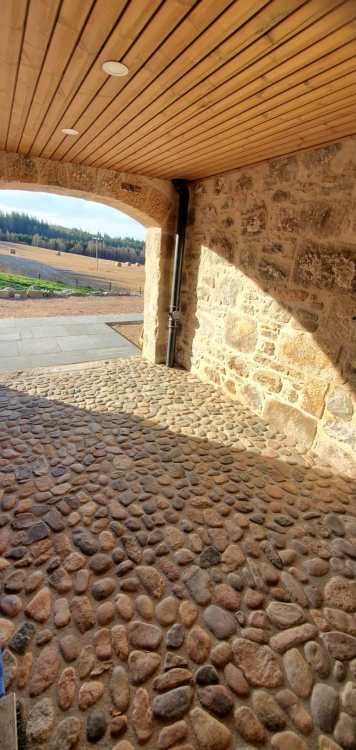
I like to see other people's successes. It is very encouraging. So here is one of ours, taken ages ago but I just came across it. I don't think I posted it before. The cobbles are glacial cobbles harvested from the drainage excavation of sand with cobbles. These were patiently sorted and turned the flatter way up....not something to give to a contractor to do, then laid by family and friends. It's amazing to think that these were ripped from a mountain and made that shape by being rolled along in a glacier, and/or in a river deep within the glacier. The lime pointing was done either by a specialist we were lucky to get hold of, and who did urgent stuff, or my Son-in-Law who is now good at it.
-
Can't connect the SWA cable. Practical help please.
saveasteading replied to saveasteading's topic in Power Circuits
It was in a very old house for one of the family, about 10 years ago . I distributed cables and fitted new downlighters: so the floorboard lifting, drilling of oak joists etc that Mr Sparks wouldn't like. So 8 hours me, 30 mins Electrician. " You're not going to do the mains connection I hope". "No, I'll get Mr Sparks to check it and connect it. ". What I'd done was fine except he didn't like Wagos and redid with terminal blocks. Then I put back the floor. Mine are as the pic above, from SF. All very fiddly inside the box with my big and clunky fingers. I must have had an average of 5 go's with each, then for some reason it would hold. So that was 7 wires x 5. The box instructions simply have a tiny picture indicating "push in wire", which didn't work. -
Can't connect the SWA cable. Practical help please.
saveasteading replied to saveasteading's topic in Power Circuits
I used waco once then got a sparky to do the clever bit. He removed and changed them all. Then these as above this time. I think they are a bit small for the stranded armoured cable. I couldn't decide if I had to lift the lever or is that only for removal... holding that up was a nuisance. I will practice tomorrow and maybe get the hang of it.



