
saveasteading
-
Posts
10107 -
Joined
-
Last visited
-
Days Won
82
Everything posted by saveasteading
-
A roofer will know more. However my thought is that these are lots of drips at nails, ie through nail holes. There isn't a great distance upslope from tile bottom to hole and the tiles are flat, so it could be capillary action plus wind. Do nails show through the felt? What is above the felt in the way of battens or board?
-
 A hood exercise is to think how best to set a fire going at every stage. As a scary example a client had vandals (local kids for fun)) pile up bags of sawdust against a wall and set fire to it. Unlikely to happen, but that's the thought process. Re cavity barriers...if air doesn't flow then fire doesn't spread. It doesn't have to be £21/m. A stack of timber won't blaze, just the surfaces. Keep it tidy. That's the clients job isn't it? Nobody else will. You haven't cleared up your wire ends. 'But they're in sawdust and that's not ours.'
 -
A picture ? To a 110mm pipe you can cut cement board exactly and either slide it over or half it and push on from either side. The others could perhaps be clustered through another pipe as a duct, and the gaps infilled / sealed.
-
Sorry, but that floor construction doesn't seem right to me. Are you trying to invent a method from scratch? My garden shed has a 100mm concrete on earth. For a house as an absolute minimum, 100mm stone then 100mm concrete with mesh, then dpm. after that a timber batten base still feels like a shed to me. THis sort of detail did exist in the distant past, but really isn't right. That's without knowing your site conditions. What is the ground? The U values is way down the list and can follow on from agreeing a structure that will last more than 30 years. So, can you go back a few steps? What is the access for materials like? What is the ground? What is the intended construction, in principle not detail.
-
It will but I don't think it is available. The aluminium product is moulded so that the ufh pipe clips into it. can be painted. We don't do family relationships and politics on here. But the appropriate radiators are made of aluminium too.
-
Tell us more please. The foundations and floor will be made of???? other lorries can't get there either? A bracken on earth floor, driftwood walls infilled with heather and mud. Thatched roof harvested adjacent? OR small loads of concrete. pumps. dumpers.
-
wooden floors is not a problem, unless very thick. Rugs likewise, as the heat will move on and emerge elsewhere. Carpets no. On our latest family project for the rooms where ufh isn't appropriate I am pushing for aluminium skirtings with the ufh pipes in them. No clutter. But you could still put rads in these rooms. 'They' want you to buy bigger kit so push us in that direction.
-
Welcome @HighlandHopeful I agree with @ProDavethat UFH is preferable to radiators. The radiators would have to be very large areas when compared to gas or oil fired, which run at much higher temperatures. Also I think they are more expensive than the basic steel ones. That goes a long way to equalising the cost. That is something that needs more local knowledge perhaps. How many days of not quite enough warmth do you tolerate? Plus there is the comfort issue. Warm feet makes you feel good, and so less energy is needed. And of course you are walking and sitting down there, not on high. You are going to have a lot of heat rising to your exposed roof. It might be worth sucking it back down. Also that is all the more reason for having good roof insulation. The invisible benefit is the absence of rads and pipes on the walls. The heat loss calculation is simply a function of area and U value, so you are on the wrong track. Roof, walls, floors with adjustments for windows etc and it is done. What constructions are you having,, if decided? I am sure one or more of us can send a spreadsheet for this... I'd have to find one of mine somewhere. Controversially? Do you need forced air changes? You have a very big volume and 2 of you. You will be opening doors sometimes, and the cooker hood and wc fans vent whether you want them to or not. I am not convinced they are an essential , have pushed my luck (with client agreement) on much more sensitive buildings than this, and had no issues. Excellent. we may have questions back to you. Car radios a speciality? Have a first heart in anticipation.
-
I once condemned some plumbing that was a total mess. How long have you been a plumber? Since last week.
-
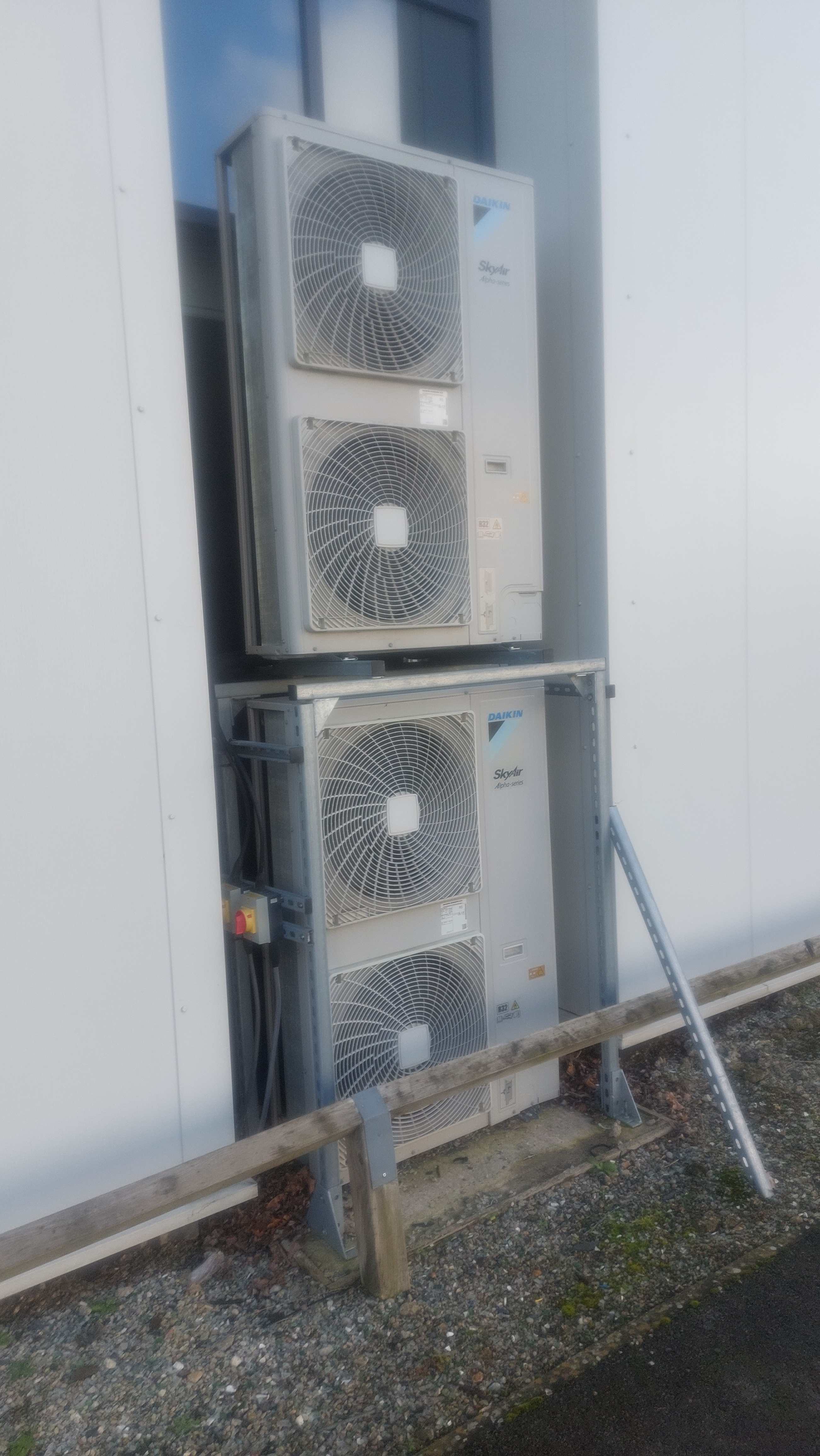
Yes. Covers window, minimises fresh air intake (even more so when vehicles park there), difficult to clean or service. If the bracing was hit by a vehicle.....? I met the supposed expert who was sent by the tenant to justify that and other stuff. He installed it....a fitter really , who should not specify or design, and he assured me it was fine. It is going to be relocated but not by his business. And people say I should trust specialists?
-
On the other hand, it is better than tucking it away too tightly enclosed. Here is an example of why I don't trust most supposed expert installers in this subject. Retrofitted by the tenant for a new server room in that room. Location useless for efficiency obviously, but also that the rear intakes are jammed tight with leaves. But it's tidy.
-
@CemCet has prepared a survey about self-building as part of a degree course. I just did it and it was much more relevant than the average, as most questions made sense and were relevant. I don't know Cem and leave it to you to decide whether to get involved or not. If so, i suggest a private message to @CemCetis best, and not to me please! My name is Cem, and I am a PhD researcher at the University of Nottingham, focusing on self-build housing. My research explores the motivations, challenges, and experiences of individuals who are interested in self-build and self-build owners across the UK.
- 1 reply
-
- 1
-

-
MF ceiling grid - hanger distance from walls
saveasteading replied to Thorfun's topic in General Construction Issues
Seriously now, as @Pocster would expect. I asked a Fire Professor how vulnerable the gaps were in single skin boarding, and he said that fire does not get through there, even if unfilled. * Sound is different, obviously, but usually less dangerous. You could even argue that the resulting tiny gap acts as a sound absorbing resonating tube. Just sheet over it. At the perimeter though, fill any gap, as you have both sheets with gaps coinciding. *There were other reasons, now I think more, but this will justify it if you are questioned. -
MF ceiling grid - hanger distance from walls
saveasteading replied to Thorfun's topic in General Construction Issues
I think you would be the first. I wouldn't. -
Sewage treatment plant - air blower electricity costs
saveasteading replied to David Essex's topic in Waste & Sewerage
There were 3 chamber systems before air or a wheel was added. They work, but not so well. What comes out with the liquid, if not completely clean, is a grey silt. It will then coat the surfaces in the soakaway and eventually just about disappear. As I said earlier, it will take a few years until it needs emptying. I think few people do it annually. -
I hadn't heard of this. So have looked it up. Is it the "simpler" version that is a trolley then has carterpillar tracks for stairs? I dont suppose it goes up a loft ladder though?
-
(Hopefully) a simple drainage design - but help always needed!
saveasteading replied to NandM's topic in Waste & Sewerage
It would take careful timing to have more than one flush at the same time, and it wouldnt usually matter anyway. But it must all be roddable, just in case. Also becsuse people sometimes flush things they shouldn't. Following building regulations is best and you'd need yo be expert to do ut an alternative way. -
Wine doesn't trouble our oak, but water and aluminium does. Chemistry and worn areas of tung oil. But now I have the stuff that removes the marks, albeit many applications sometimes.
-
A phased approach to BC drawings / approval?
saveasteading replied to Alan Ambrose's topic in Building Regulations
I'd venture that this depends on the bco confidence in you and your designers. In any case, there is a risk of non- optimal design if you don't have a complete design strategy at the outset. -
Old felt roofs used to melt in the summer sun. The chippings reflected and absorbed energy, and physically protected it against feet. It used to be sold with a tiny grip already on it,and that would suffice for a shed. But on a flat roof tiny chippings were spread ...I think onto a bitumen sticky layer. I think modern felts don't melt.
-
I went into Howdens. They have it in 1 litre packs. it does 15m2 and needs to be used within 3 days of mixing. £25. They had a small sample worktop and it looked good. Rather glossy though, so doesn't feel as rustic as with the oil. I wonder if this is more for speed and convenience, especially of the fitter, than for beauty. We may try it on our chopping board, which is made from an offcut.
-
They say it on Radio 4 so you can too. I was listening to a bit from the Humph days and it was just as splutter-making rude.
-
I think things are improving, but plumbers can be a little precious in the SE, and want somebody else to do anything that isn't pipes. You have to watch out for them wanting 2 visits. I could do this all , with some clumsiness, in about 4 hours with the right kit all to hand. The wall repair is just filler and is hard in an hour, then you might paint it (or not). 1 hour to remove the rad 1 hour fix the wall and fit the brackets 1 hour fit the rad half day: £150. parts £20. £170 .. add for overheads and add vat... £250????? (x london money = £400.)
-
Sewage treatment plant - air blower electricity costs
saveasteading replied to David Essex's topic in Waste & Sewerage
I have installed 3 Marsh units with air bubbles , like a fish tank. No feedback at all so sounds ok. I have elsewhere a 3 compartment installation with no mechanics at all. It smells a little on occasions. I have had it 20 years and have never had it cleaned....because why? And right here I have a 1920's brick chamber with no mechanics and no baffles: just a manhole with pipes positioned to allow floating and separation. There is no smell off it, but the liquor coming out of it to a soakaway is rather grey and unpleasant.... but not brown. I had it cleaned after 15 years of our use and who knows how long before. There was 100mm of brown crust floating (no smell) and 200mm of grey slurry at the bottom. Ive had another 10 years use since then and no smells occur. I'm saying: don't panic, it is going to do 90% of the work over 3 the chambers, and the stirring or bubbles will do the rest. Most are overspecified anyway (ie on house maximum population). So I'd suggest a timer that runs it for an hour a day. But I'm guessing. The most important thing is not to put bleach etc down it (or minimise toilet cleaner blue stuff). And the other most important thing is where it goes next? Into a rural soakaway and it will be ok. In a small garden perhaps not. Into a stream, definitely not: keep the power on. If it is a recent installation you should have a testing chamber. So you could try 'before and after' tests and report back. -
Do you like the word though? It's a lovely word. and what is the better alternative? My other source of vocabulary is 'I'm Sorry I Haven't a Clue'. this week's: Fauna: a bit more beige.