

saveasteading
-
Posts
10897 -
Joined
-
Last visited
-
Days Won
94
Everything posted by saveasteading
-
Not good news when that happens! A lot of floating insulation carrying up any reinforcement and also pipes if you have UFH.
-

asbestos Asbestos Exposure
saveasteading replied to Gary33's topic in General Self Build & DIY Discussion
I should have added. If you google the subject you find mostly contractors and consultants looking for the work, so they say it is dangerous and to call them in. Hence the HSE document is best. Although the risk is low, and you are allowed to remove them yourself, (not required to be a licensed specialist) you should follow protocols. They are all in the leaflet from hse. For now, if you have already removed some, they should be in plastic bags. the tiles will cut through a normal bag so either use rubble bags, or put the bag into another, with carboard round it to stop it cutting through. if opening the bag, wet it so that there is no dust. When you have made sure it is in 2 layers of plastic bag, your local authority will take it and dispose of it safely. Normally you phone them and they take it from you at an agreed transfer station. no charge, as they don't want it fly-tipped or binned. It gets taken to a special tip and buried and capped for ever. Check out you local authority website for this. Dust. It has been removed already, I'm sure. If you were to come across any pockets in the future: dampen it and brush it up, just in case, but it will probably just be house dust. -
Expanding foam rant...
saveasteading replied to Carrerahill's topic in General Self Build & DIY Discussion
Expanding foam should only be available from specialist suppliers and with a certificate from an Engineer or Architect. Too easy for a builder to squeeze it in wherever something isn't working out....might hold the building together for a while, and meanwhile expand at random and create other problems. So many issues with it over the years. -
asbestos Asbestos Exposure
saveasteading replied to Gary33's topic in General Self Build & DIY Discussion
There is reliable information on this in the HSE documentation, ie saying that the risk is very low. if still concerned, reply and I will find it. Have taken these tiles up many-a-time and it is a normal contractor job, not even specialist. To be dangerous you would have to grind these tiles up to expose the fibres (2% of the total volume) then breathe it in. I don't expect you have done that. Relax. -
Just in passing. In many hundreds of columns I never specified non-shrink grout. I think the very term allows people to be casual and the bases are often only partly filled. I preferred to use a dryish mortar, forced in to refusal. Just me perhaps. But your point is a good one, thanks.
-
Wall Cladding Build-up Query - Flat Roof Detail
saveasteading replied to jamesmonk83's topic in Flat Roofs
Corrugated sheets provide you with the challenge of the corrugations. With a sinusoidal panel the junction to a parapet flashing is rather random. With a basically flat panel you get the upstands at usually 300 or 333, sometimes more, centres. Therefore draw a sketch first dealing with perhaps a flat at one cut end, and a crown at the other. Then imagine a raindrop trying to run in, remembering that water is magically drawn towards any weakness. -
Interesting. So I found this which seems to back your idea up. You would therefore expect to see this on the sapwood (which are widened by the manufacturing process) and not the strength rings (for which there must be a word) Blue Stain Blue stain is a little bit different than the other types of discoloration that we’ve been discussing. Blue stain is caused by a microscopic fungi that sometimes infects the sapwood of trees and uses it for food. As the name sounds, the blue stain fungi produce a blue and gray discoloration of the wood, often in the form of spots, streaks, or patches. It’s also important to note that blue stain does not cause any kind of decay, has no affect on wood strength, isn’t airborne, and isn’t linked to any type of health issues.
-
So great to hear from people who have done it. The design is clear, that 9mm osb is enough, and it doesn't need double footer or header. The reality on site can be different so I didn't, for example, want to show 9mm then find that "everybody uses 18mm" at contractor's insistence and all the dims be out immediately by 9mm (they all add up). More importantly the double header and footer needs to be drawn , to avoid any errors in height. (This will join into existing and so has constraints). I would like the drawing to building control to be close to site practice. I have done this before with 3 storeys and factory panels, but it was a package and these details were not of concern.. It was interesting how different the 2 suppliers were in details at foundation level, (one required a pre-fixed timber and utterly level footer and the other wanted a concrete kerb, also dead level) but there was no use of double headers. I am thinking that the extra footer can be laid dead level to take out inevitable wobbles in the masonry base, and the extra header is a tidy way to build it if making the panels on the ground. But that may not be necessary if all made in place. Have not chosen a joiner yet, so no doubt they will all have different ideas of 'the only way'. I will ponder and report back. Don't stop the suggestions and advice coming though.
-
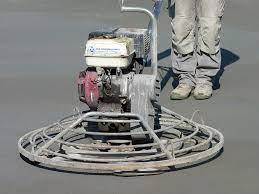
I was guessing what room might want a polished concrete floor. it is fashionable to have an exposed aggregate, or a sprinkle finish, in kitchens. For a polished concrete floor you need a big machine with blades that scrubs the surface with blades a few hours after it was poured. (picture at end) and it really should be done in perfect weather..no rain , warm, and no wind, so indoors. Your concrete will have to more than 100 anyway so that isn't the issue. Otherwise it is a grinding a machine much later. you mean a second layer on the ground floor? then yes, but it isn't an option anyway as you wouldn't get the machine in and out of the building. Joints. You don't need expansion joints as the concrete shrinks. It is a term misused for all joints. If you control the slab size and ensure that there are no barriers to shrinking (such as columns) and control the concrete mix to be drier than the workers will like, then there will be no big cracks. But there are still millions of tiny (possibly invisible) cracks. The normal concrete sealer reacts with any cement that has not been chemically converted into the concrete. If the concrete is well made and poured then this doesn't really do anything and sits on the top. If the concrete is poor, then it penetrates the surface and makes it a bit harder. It will also help a bit in closing miniscule cracks. If I have wrong assumptions again, please say. You will be gathering that I can't see the point, as I see a polished concrete floor as a high quality, economic, but industrial, finish.
-
Advice sought on permission to build.
saveasteading replied to matstand's topic in Introduce Yourself
I think you really must speak to the neighbours. Either they have been through this and can tell you what was involved, or they have ignored it, and it will be short discussion. Also with more research you may find that they are not exactly over.it. Then get advice. I imagine that network rail will allow the construction, but you will have to agree that they are not responsible for any problems that might be due to the tunnel in the future. They will also want to know that you are not piling, or drilling a borehole or such, over or into their tunnel. This would be fair and it is reasonable that they get to consider the effects of any proposal, after all the tunnel was there first. Guessing, but I think they will want to see designs rather than agreement in principle. The agreement will also be part of any mortgage or sale process in the future. Some insurers might not like it, but there is usually one who will....again the neighbours have been there before you. -
Internal stud at 600cc when the roof trusses are 400cc
saveasteading replied to saveasteading's topic in General Joinery
I don't like spray foam anywhere. Once in place it doesn't come out again. Also uncontrollable, as we need a ventilation gap and the only way would be to make a box and fill it And it doesn't breathe. Blown in also needs to be contained. I am not a fan of PIR but this will be within a box contained by VB on the outside, and polythene on the inside, so breathability isn't an issue. I originally favoured wall batts, but they have half the insulation, and we don't want to lose floor space or insulation. breathability will be a 25mm gap between the masonry and the vapour barrier, up to the roof where the same applies. by all accounts we don't have to worry about draughts through the wall, as there will be plenty. But the BCO may want more holes, because he wants holes. -
Sterlingboard class 3 is available in 9, 11, 15 and 18. For now I am going to specify 9mm as the guidance, but allow 'greater thicknesses as desired and available'.
-
It is written. My circumstances require 100cc. 3.1 mm x 50 mm wire nails at 100 or 150 mm centres as calculated That makes 5000 nails in the external walls alone, so a nail gun is rather important.
-
Proper sailing. I don't fancy it much.
-
Not much chance of using the wrong centres with this method. I think I would set up a jig on the floor to avoid constant measuring. I've watched the factory process and it isn't sophisticated, other than computer marking the timbers for cutting and positions. Then it is men with nail guns, and man-handling. Factory panels have a stud at both ends. Presumably site build omits the leading edge stud to save wood and maintain the centres.
-
For export to US? Because some joiners still work that way, then have to find imperial pbd too? But I agree that it should only be sold in multiples of 600 except by request. Not much fun cutting 20mm off every board. Yes the Sterlingboard factory is visible from a long way away. There is a constant plume of.....is it smoke and steam mixed? As it dissipates fairly quickly I like to think it is largely steam. Presumably they use their own timber waste for heating. They say that pilots like it being so close to the airport as they can see what the wind is doing. Have had an aborted landing there recently. It is said that a lot of the timber is coming in from Norway, and most of the product is going to US and China. The new owner of Norbord is a Canadian company. It would be nice to drive in there with a truck and get a few pallets at factory prices. World market cooling, but I wonder if they will reduce production and maintain demand. The main reason I asked about thickness was that I see several old threads where people swear by 18mm. Perhaps when it was much cheaper it was a consideration, and allows a nice nail bite for battens.
-
So this is for ease of construction. Let me paraphrase to check my understanding. Fix bottom plate to foundation masonry. Make a section of wall on the ground, including top and bottom timbers (as if in a factory though this is to be stick-built) and lift panel into place. Nail down and prop in place. When enough panels in place fix continuous header over the top of them all. Hence 13mm osb reduces the weight for the heave into place. Strength of wall increased by extra timber top and bottom. The timber price this way has gone up by £150, but the OSB down by £300 (cf 18mm) and the joiner will surely be very happy, so reduce his quote (or not increase it.) and do you think 13mm on the roof too? I can't see osb3 at 13mm. 11 or 12 depending on source. What size of panel is normal, assuming 2 workers, or if 3?
-
Wall Cladding Build-up Query - Flat Roof Detail
saveasteading replied to jamesmonk83's topic in Flat Roofs
Agreed with Iceverge. OR you need a decent slope and also an utterly watertight seal of metal to roof, using mastic and lots of screws (which you should anyway. I would lap the roofing over the edge so that any stray dribbles go outside your wall cladding. Even better would be to dress the roof covering up a batten that forms an edge. the metal trim is best not being 2 flats faces like that, as that will distort when screwed. better to have it shaped like my dodgy sketch attached. the 180 returns are 'welts' and stiffen considerably, as do the other bends. That will look much stsraighter and allow much tighter (and more watertight) fixing, with a bead of special mastic underneath. That will cost twice what a 90 deg one will, so is up to you.
-
Beautiful if it works, but very risky. All concrete cracks. If poured to perfection the cracks will be invisible but will still be there, to collect dust, and to show up whenever there is a spill. so it needs a lacquer finish. Look closely at the floor in a b&q for example and there are cracks everywhere. If you mean a ground, polished finish, with the stones visible then the same applies. The cracks will be severe if you don't create a box-out around the columns to let it move as the concrete shrinks. I recommend separating the functional concrete floor from the finished screed in a domestic situation. They cannot float it to kitchen specifications. The workers pouring your slab are not thinking about an internal finish. And what if it is raining? You can later screed in many finishes, including very expensive, polished, exposed aggregate.
-
1. Recommendations for OSB thicknesses please. I have designed a section of rebuild in timber, using the Scottish document for it. For the sheathing of the walls and roof they require minimum 9mm OSB class3. That doesn't seem a lot for what is holding up the building. But the cost saving compared to say 18mm is significant. (if I can save 25% on every element of construction, then it becomes 25% of a lot.) What do the experienced roofers and Engineers (and clients) among you think? Easy to say 18mm when specifying and someone else is paying. Walls are 140 x 50 stud, timber clad. Roof raised tie trusses 220 x 50 rafters, and a metal clad surface. (The design guide assumes concrete tiles) 2. Between you , in other posts, you have recommended using double stud at foot and head of the new timber walls. The design guide doesn't mention that as a necessity. In most sketches it shows single and in one sketch it shows double. If the roof trusses align with the wall struts, I cant see why double helps. It does of course stiffen the whole building and provide a substantial longitudinal tie, but that should not be necessary. And there will be treble C24 timbers at lintels, which will pick up intermediate trusses. Comments on the practicalities as well as design theory will be welcomed.
-
Air-to-air ASHP replacing warm air heating
saveasteading replied to Gooman's topic in Air Source Heat Pumps (ASHP)
All I can add, in case it helps, is that we put air-source to air-ducted space heating into our big office. A USA system. The internal circulation was simply a plenum box with a 'hot' radiator in it over which the air was forced. The distribution pipes were about 100 dia then splitting into 50mm tendrils. I think the principle was that all the ducting was much the same length to keep all the flows the same. Worked fine, and when the outdoor temperature was silly low (v cold winters sometimes in SE England) and the four ashp units were struggling, an electric heater kicked in at the plenum. Much easier in an open plan with a single recovery duct than with multiple rooms, I think. -
Min screed thickness to level over hollow core slabs
saveasteading replied to cwr's topic in General Construction Issues
And yet, such slabs are usually specified only for large spans or heavy loads. I can't think I ever specified them for other than that as they need to be craned. Also note that there is almost certainly a crown, so there will be much ticker screed at the ends -
Min screed thickness to level over hollow core slabs
saveasteading replied to cwr's topic in General Construction Issues
So the screed is 'OK' at 30mm but what does the plank need to perform as specified? The screed on a hollow-core floor is an important part of the strength, unless yours has been specified conservatively. Check. -
20 miles from Inverness, but the other side of the Firth.. 1880 farm steading. Proximity doesn't matter, but dealing with similar processes, and to satisfy the same council, does. Happy to help if I can.
-
Internal stud at 600cc when the roof trusses are 400cc
saveasteading replied to saveasteading's topic in General Joinery
Thanks Gordo How interesting. A very different approach. My dislike of insulated plasterboard is the cost. That is near to £50/sheet which is an expensive way to buy polystyrene. 50 x 50 would certainly be a lot cheaper, but the timbers are seldom straight and I would be concerned about alignment, even with a fixing strap, which I don't fancy screwing into granite too often. May consider for shorter heights.. (I have had 50x50 which had a 90 degree rotation in the length, as supplied.) Does 100mm dritherm hold between 50mm studs? It is half the price of PIR but half the insulation, so an interesting balance. Needs a vapour barrier behind the studs, which will clash with the dritherm, and an airtight barrier on the room side. 25mm gap yes. Do you mean intumescent to stop ventilation in case of fire, rather than 'allow'? Anyway there is only the polystyrene to burn, as wood seldom does without a lot of heat, so I don't see this as necessary There are targets for insulation in conversions, but not regulations. Conversion of Traditional Buildings Whilst achieving the U-values recommended in clause 6.2.6 and 6.2.7 should remain the aim, a flexible approach to improvement should be taken, based upon investigation of the traditional construction, form and character of the building and ......other than where proposed works are wholly categorised as a conversion, where the standard in question may be met as far as is reasonably practicable However we are aiming for something better than the recommendations, hence the juggling. I do appreciate your comments, but need further convincing.

