

saveasteading
-
Posts
10067 -
Joined
-
Last visited
-
Days Won
82
Everything posted by saveasteading
-
How do they allocate the finished articles? Branded differently?
-
Photo always helpful. Along the boundary is probably the most useful.
-

Builder cut 4.5cm off joists due to floor level screw up
saveasteading replied to Loz's topic in General Structural Issues
You don't have to worry about SE or BI being mates of the builder. As a Chartered Surveyor once told me, the only professions that are sworn to honesty and the good of humanity are Doctors and Civil Engineers. Your SE is probably also a CE as that is the overall profession before specialising. The usual accusation against Engineers is of over-design, but that is usually by builders who don't know the theory, and are not insured for the decisions. Anyway he is hardly going to have done that or admit to it. Joists are designed for strength (safety) and deflection (comfort). Might be worth asking if this solution leaves you unaffected. Just make sure that any pragmatic solution doesn't cause any other adverse result. eg putting in electrics and plumbing through double joists. Can anyone think of any more? Clearly not, and the bodge was cheaper, quicker and easier, and they hoped not noticed. Are the cut tops level and straight now? Therefore are the boards sitting neatly or perched on small areas of joists? -
Congratulations, that is a very good figure. If he had measured the loft then you would have had a greater surface area, with which to divide the same air loss, so it would have been even better. I would chat it through with them before they issue a certificate, just in case I have it the wrong way round. Speaking only for commercial properties I found this, which probably apply in the main: The calculation is done in a black box which has the algorithm in it, riddled with inaccuracies, approximations and errors of understanding. My company once got the programme so that we could play around with it (which the powers that be don't like) therefore we found anomalies to play with. This was not being bad, as the programme didn't acknowledge lots of good things. For example there were glitches in insulation thicknesses, so it was better to enter smaller amounts than the actual used, on one occasion. On the full printout we always had an allowance for the electricity used for air-conditioning, even when there was none and could never be any. That may not apply to your situation, but you can be sure that the system is highly flawed. For example, as you say, it is clearly stupid to have a small wind turbine but they still give points for having one. Years have passed since that craze was proven to be stupid, but they have not bothered to change the formula. Actually I think they don't understand. I have met these people who set up the system, and then passed their exam which required knowing the expected answers, not the reality. Isn't your result good enough though? I always thought 3 was good (on large commercial). 94 is an A pass.
-
I have an uninsulated steel flue rising through an entirely masonry structure, which was closed off with mortar. The concern was therefore not to burn anything in the wardrobe it passed through. I made a box-out of plasterboard, using metal stud for framing, then surrounded it with 50mm rockwool batt then stuffed the box it hard full with more rockwool. As it easily accessible I have often checked the temperature of the boxing and it is never more than slightly warm, even though about 1.5m from the stove at full belt.. Therefore it seems that you could stuff the gap with rockwool or similar, as long as it is the fireproof grade. To be sure, you could get the rockwool material that is sold as fire blanket. It has wire mesh on it, which may help or hinder. Please research further though, as all circumstances are different. There are fire-block expanding foams, but I do not think they are suitable. They are for on-off fires to prevent spread for a limited time, not for regular heat.
-
Do these estimates from howden seem off?
saveasteading replied to allanswork's topic in Kitchen Units & Worktops
Unless things have changed, they don't give big discounts to the public, so that the professional installer can hide some margin. There used to be 2 different price lists, then discounts for quantity. Therefore make it clear, subtly/ quietly, that you need a trade discount. -
And another with Armitage :Contour 21+ WC Pans include new, improved rimless technology and a hydrophylic, smooth glaze with anti-microbial properties.
-
It was news to me so I googled and but here is the evidence with Duravit product Available Variations : Without Hygiene Glaze - 2003090000 With Hygiene Glaze - 2003092000
-
If we imagine ourselves as bacteria inside a septic tank. Done that? Do you think the green liquid would help or hinder our wellbeing? Check the small print first. A lot of these chemicals have some sort of bleach in them, or what is the point.
-
I went to a presentation of this a few years ago, endorsed by local building control.... ie they provided the room and Actis provided sandwiches and perhaps more. There was some discussion about whether it performs as suggested, as the method of testing may not be realistic. (forgotten now, but does 'closed box testing' mean anything? I know from a major supplier of whole buildings that they have severe reservations about multilayer as a principle, as do I...I mean obviously it works, but how well? I always saw it as a remedy to pin inside a cold loft. It seems to depend on the air gaps to allow the reflective surfaces to be allowed for in the calculations. (The plasterboard companies no longer say that foil backing helps insulation.) But the honeycomb system Actis Hybris seemed a sensible idea that clearly will work and will seal between the rafters. Another BUT....it seems that you need the Hybris and then the multilayer, so this is going to get seriously expensive isn't it? £10/m2 + £15/m2? Ajn....410mm being 18 " c/c less a 2" rafter...as we have. Can you be more specific? 400 cut from 1200 falls out of a 410mm space or leaves gaps? And the reality is that spaces vary, especially with twisting of rafters, so can be 400 to 415 in the same section.
-
Once satisfied that you are really keen, but holding on to your expectations, it would be well worth speaking to a planning consultant. A very local one who specialises in this sort of work, as they will know the policy and the council's interpretation, and also precedents. You would probably need their skills to get permission later. This will have a cost, but is much better than ending up as long term owners of a very expensive barn.
-
Is that concrete under the main brickwork? If so then it looks to me just like a slightly bodged pier footing. As if they had forgotten the pier, scraped a bit of earth out and put concrete in it. If not that then a bit worse, a bit of masonry in the hole on a bit of an angle then spare bricks then the proper wall. Poss just a skin of bricks against the main wall until up past the concrete. Prob ok to tidy it up, and infill with concrete under it, 'vibrated' in well with a bit of 2x2. BI can look and prob agree to that or other pragmatic solution.
-
I have met a few people who bought such a building, with planning permission. They were not aware that the structure was beyond use for conversion, and that complete new foundations and mostly new structure were required. (Foundations and structure for agricultural use has no factor of safety, so even if in good condition, everything has to be redone or strengthened) The building itself therefore has a negative value, and this should be seen as a building plot with constraints. If any of the cladding is asbestos cement, then there is a largish cost for removal and disposal. The current roof is very light too. you would be increasing the load on the structure. Drainage is the least of the concerns I would say. Sorry for the negatives, but be sure to build them in to the cost, and off the land value. On the positive it is timber, not steel and has its attractions, if you can retain, use and show the timber. Are you thinking of ground floor only, or an upper floor? What is the height to the eaves and ties?
-
I think most owners who were confident of it getting PP would have done that already, and raised the value. Not necessarily, as there is cost, but likely.
-
can you show this from further back, for context? Is it concrete?
-
Should not be a problem. Even with a new digester early in the project, building control were not interested as it was temporary and sensible. As you have an existing arrangement with outflow then even less issue. In a surprise visit from HSE, they were surprised but happy with the arrangement. Well, never happy, but 'content'. BUT no blue caravan chemicals into the tank or you will kill the beasties off. If slopes are a problem you can fit a saniflo into the line and go uphill. That can also avoid constructing drains until you are ready.
-
services trench Services under a stone building
saveasteading replied to saveasteading's topic in Barn Conversions
I think you have all helped sufficiently on this for now, thanks. I know it is sensible to go under the wall, and can try with long drills and a trowel, or use a core drill for possibly a neater hole. As there is the sand-lime bed it should hold up fine. Whether to put 100mm pipe in straight away. or a 150 as a duct I will decide later. The downside is that we will be starting the drains at minus 500 from current floor level, before anything new above. then there will be, for foul drains, a 50m route to the digester, at 1:80 that is +/- 600mm, so getting deep. But hey., it is sand so out and back easily and cheaply. The surface water I am planning to take 4 different routes to spread it out. Reduced volume at any one spot, better environmentally, and also cheaper. Soakaway rate is on the limit of being too fast, but as there is 10m or more of this sand, it isn't about to form a sink hole, especially with a long holey pipe. I will have more questions about forming new openings. It is either very simple or very difficult according to different sources. We previously looked at similar buildings in Aberdeenshire, and found that forming an opening is called 'slapping'. That isn't just a trade term but is on planning drawings. I don't know how local a term that is. Meanwhile if you have any dire warnings now is a good time to tell, as the layout is being developed. -
Any reason not to have a painted concrete floor?
saveasteading replied to Grian's topic in General Flooring
another word. hoover. third word, instructions -
Any reason not to have a painted concrete floor?
saveasteading replied to Grian's topic in General Flooring
It will show up the dimples and swirls, unless you get a matt finish. I might worry that it will look like a garage floor, but with plenty of rugs and furniture perhaps no problem. There are all sorts of options, from single coat to 2-part epoxy, that can be microns or mm thick. Prices accordingly. I have found the cheapest 2 part works fine, and clients happy to have the huge saving and a spare pot for touch ups where wheels wear it out......ooops still thinking garages. -
Any reason not to have a painted concrete floor?
saveasteading replied to Grian's topic in General Flooring
Nobody will notice as they will be looking at the view. Just make sure the concrete is dry before sealing it. -
Fixing a drainage pipe close to a wall
saveasteading replied to Moonshine's topic in Waste & Sewerage
Or 2 hook bolts screwed to the wall, then wire linking them and holding the pipe. Galvanised wire. Then it wont budge in any direction. Too late....I see the strap. Not sure that will work in the sideways direction though. Another couple of screws and tie the strap together at the back? -
services trench Services under a stone building
saveasteading replied to saveasteading's topic in Barn Conversions
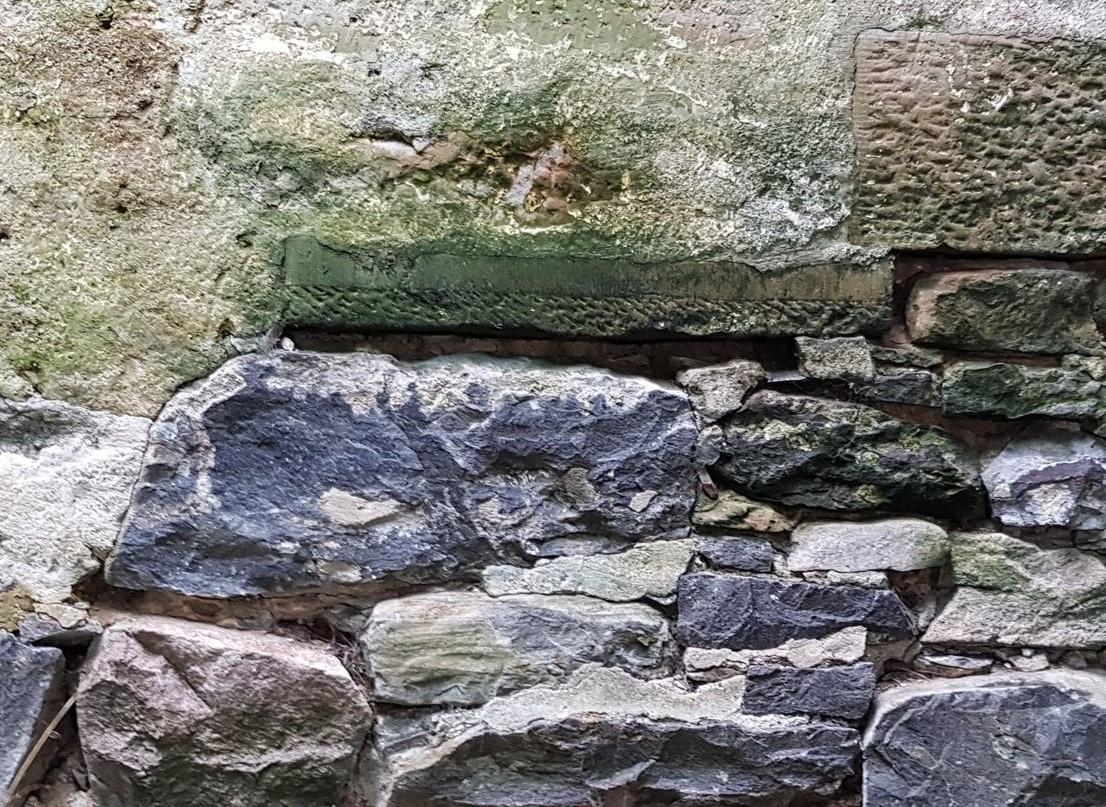
The stone is mostly granite in boulder form, but dressed at the corners. the frontage is mostly sandstone ashlar, with some serious but traditional architecture to it. what we think is the oldest part has some enormous boulders as the base layer. We are currently doing serious repairs that don't involve regulations, to keep the worst of the water out, as that has caused some local failures to stone and timber. the exposed base will be buried when the courtyard is built up for domestic use. meantime I intend to bank stiff mortar under and onto the face to reinstate full bearing and divert water to ground. this face has been exposed for decades, other than having 18" of manure against it, so is not about to fail. the ground is pure sand, rather dense and amazingly single-sized, yet angular, so is strong and porous, yet very easy to handle. The downside would be supporting any trenching and avoiding undermining. I am a Chartered Civil Engineer but don't have experience of stone buildings or A frame roofs. Thanks to all of you. Enough for now, and I welcome any tips on such buildings. -
services trench Services under a stone building
saveasteading replied to saveasteading's topic in Barn Conversions
jfb So just long bits, as straight as possible, and a trowel on a long arm? TonyT Will try with bits first. I now see that extensions for core drills are readily available, so is an option. Nothing happening currently, but I wanted to know before deciding other construction methods and programme. Getting the pipe in precisely the right place will be a challenge, with existing stones dictating the position. Even on new build I tend to allow some swivel room by boxing out the slab. This is much harder than new-build or refurb. -
All above agreed, but also your friend is right but a little cautious for most situations. Some repetition: 1. Don't let anyone see it, so gone asap. Not because it is illegal, simply to avoid explanations and complexities 2. The longer it is out the longer the ground has to recover. As we have had a wet summer, the ground should not have shrunk too much. Then the winter is likely to be enough to get back to stability. But depends on tree size and variety, and ground type. Can you advise? Pine in sand is no problem. Oak in clay might be. 3. I would leave the roots where they are. The loosening of the earth from digging out will exceed the gaps left when the roots rot. By all means remove big surface roots, and the trunk under the surface. Is that what a 'root bowl' is?
-
Less interest on the deposit from Jan til work started.? That deposit was surely for buying the materials: Your materials not someone else's. Unless the steel was an addition or a change, or they specifically excluded the equipment, then the method is their choice, and their cost. ask why they took your deposit and didn't use it for your project. and that was a huge show of trust on your part argue that the delay has been a nuisance/problem/cost to you. agree that material prices have gone up 10% +£300 deduct 5% interest of £2,000. -£100 disagree the rest. In summary agree to pay £200. then have the argument and eventually agree £300.

