
saveasteading
-
Posts
10101 -
Joined
-
Last visited
-
Days Won
82
Everything posted by saveasteading
-
Gavin’s isoquick foundation on clay soil
saveasteading replied to gavztheouch's topic in Foundations
Yes I like to stay high for these reasons. -
Cement powder is anhydrous. Add water and it hydrates.but we don't call it hydrous. I think people throw in the word anhydrous to make it sound more interesting. If minimal water is added to cement, then a large proportion reacts chemically, and becomes fixed and isn't wet. Then there isn't much left to evaporate. Floor fitters make lots of money adding a waterproof seal on concrete floors, mostly unncessarily. I've even had them make me sign a paper that it's my responsibility if the floor lifts. Some are chancers, some don't understand.
-
Ahh Perthshire, not Perth. Very exclusive. Do they have extremely posh accents?
-
Gavin’s isoquick foundation on clay soil
saveasteading replied to gavztheouch's topic in Foundations
That's very neat. -
Agreed. I've watched them all happening. Sand and cement is slow because you'll likely have 1 on his knees laying and 1 barrowing it. 50m2/day? Pumped concrete needs a skilled and very strong gang, and one to stay up all night to polish it. Expensive kit too. 1,000m2 / day Cemfloor has one man holding the pipe and....that's it. Anyone else is there to fetch and carry and clear up. He hired the pump and I think borrowed the levelling tripods from cemfloor. 400m2/day
-
Should we go with kingspan or it pumped?
saveasteading replied to CalvinHobbes's topic in Floor Structures
Their web page says it achieves 0.18 for Perimeter /Area = 0.4. Intuitively that seems very unlikely as it is eps (half as good as PIR) with cement binder (much worse). -
It is crushed stone without the fines. Type 3 is a particular grading and uncommon. You could get a lorry load more easily than a bag. A builders' merchant will have single size stone in big bags, with more or less variety according to local fashions. It can be expensive though when it is made from attractive stone for paths etc. I bought some last week called Cotswold stone (It is white and will be exposed) for £78 / bag whereas the sharp sand or gravel on the same delivery was £42. If there is a local stone then this should be cheaper. As it happens, it is for laying inside gravel grid specifically to be free draining. The original went in about 15 years ago and has had a lot of use. We are cleaning the messy top off and releveling some areas. Because of erosion it is not open textured any longer and it puddles locally where it has dropped. But because it is on a slope, any that doesn't make it downwards will run off because of the slope. Then it is caught in a perimeter layer of gravel and french drain.. To summarise. Single size stone or gravel is SUDS in itself as long a it is deep enough, to hold the rainfall, and contained . A slope is up to you, but where would you then catch any runoff?
- 8 replies
-
- 1
-

-
- laying gravel
- laying clay pavers
- (and 3 more)
-
Anyone already done this
saveasteading replied to Gone West's topic in Landscaping, Decking & Patios
I think the way the polders were originally protected was by banging in sticks quite deep but sticking out, then plants roots can cling to them. So mh suggestion is hessian, pinned down with sticks from plang thinning, and then grass seed either over or under it. And/Or your bear berry inserted in slits. I hope you keep us informed of progress and success. -
Anyone already done this
saveasteading replied to Gone West's topic in Landscaping, Decking & Patios
If it rots. A lot are plastic and will be in the soil forever. -
Anyone already done this
saveasteading replied to Gone West's topic in Landscaping, Decking & Patios
It's a standard procedure for appropriate slopes. you can buy hessian impregnated with seeds. But you are going to need plants with roots that go deep so that it ties the ground together through the slip planes. I think these sheets are usually spiked quite deep for the same reason. It would be quite a risk to rely on this. What about small retaining walls to reduce the height and gradient of the slope? Slip circles are remarkable and can go deep. There is a radius point somewhere in the air and the failure circle really does rotate about it. Civil Engineering can be fun. Mohr than that I can't remember though.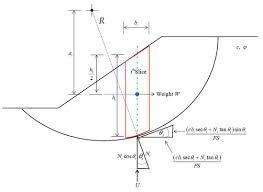
-
OK. A virtual pint is what the doctor prefers. Gravel in a gravel grid catches any oil drips over their large surface area and exposes them to bacteria. and the oil gets consumed. But what if you have a major spill? Most will stick to the gravel and the rest to the membrane beneath it, which wont allow oil through. In extremis it then washes down to the side where you collect it to a storage area. As long as your catchment is on the surface like a ditch or lagoon, and not connected to springs or soakaways, then it will rise to the top and you can skim it off if the plants don't consume it first. Phew. Or you could add a small weir / catchment between pipes and lagoon, so that water goes through a half height pipe and oil stays on top. £300 instead of thousands but that's still excessive. This is to be preferred to a hidden oil interceptor where oil gathers unseen until it washes through. This is all provable somewhere but I can't remember where. Anyway I've done it loads of times for schools and offices ( 40 spaces or so) , and has always been approved. and I know it works. You must state it all with utter confidence as a complete strategy. Block pavers with gaps for drainage also work, if you have open stone beneath. but the gaps clog quite quickly.
-
They shouldn't if well mixed and compacted. A road is a mix of stones not unlike MOT I , but stuck together by a glue of bitumen. If it is supplied as all big stones then it will have gaps and drain. If it is footpath material or surface dressing, then it is weak but solid. I think the best of it goes back into new road surfacing these days, and the rest is sold off. So its best to lay the base to a fall and try to keep the sharp sand depth consistent . And it will be easier to lay.
- 8 replies
-
- 1
-

-
- laying gravel
- laying clay pavers
- (and 3 more)
-
I knew that. Many a time I've thought it wasn't working when it was back to front. This especially happens with 2 female ends facing and a double male (?!) connector.
-
I've done it on a large scale, twice I think, and it was fine. Just a bit of a risk if there were any leaks (breaking out a structural slab) or of a concretor walking on pipes and damaging them. Structurally it isn't any issue at all. More important is whether you want the slab to be thick and act as a heat sink, or be thin and more responsive. My preference is the latter: a thin concrete screed covered in lots of insulation then a top screed as your finished surface. Says who, if not your SE?
-
Not a speckle finish option instead of black? Useful pics, thanks. That must be quite noisy fan to attract the air over there when it wants to rise.
-
Gavin’s isoquick foundation on clay soil
saveasteading replied to gavztheouch's topic in Foundations
pouring a slab in open conditions is a worry. wind as well as rain, then the dogs , cats and seagulls all descend to leave their marks overnight. -
for about 10 years it has not contained arsenic, but demo stuff will. It's still not nice though, as witness the bugs that try to eat it. A lot of treated timber recently, seems to just have a surface spray of some insect deterrent. Proper tanalising is a horrible messy business to get into all the pores from the exposed ends.
-
Gavin’s isoquick foundation on clay soil
saveasteading replied to gavztheouch's topic in Foundations
That can go wrong so it sounds a if they handled it well. I always dreaded puddles because the client thinks there is a problem. 5mm still makes a puddle. It's good for the concrete though. I'm surprised how approximate lasers are. They're no more accurate than 20 years ago. 0.5mm per m sounds little but over 20m it's, gulp, 10mm.* If a level is 'out', it is always the same way and doesn't average out.. And more concerning is that builders all think 1. they are expert, 2, the machines are accurate. * ask about equal back and fore sights. -
Don't worry that is not my plan. And also don't worry that I disagree with you. Biomass commercially is just silly, followed by transmission losses. Woodburners are usually for feelgood rather than efficiency or real need. Do you accept that remote houses should be allowed this backup and ancillary heating? That would also stop me going on about it. But so is the coppice re-growing and absorbing carbon.. If it supports dormice and other rare things, do we get a carbon credit?
-
hozelock. gardena. but can be silly prices at garden centres.
-
Open Book (cost +) vs Fixed Price
saveasteading replied to charlieroper's topic in Costing & Estimating
Meaning? you are watching and will say if its dragging? On cost plus where labour is by the hour, then an hour passing is progress for the builder. The project I mentioned many posts ago, was using a published book of rates (Spons) to which we added about 10% because they are already comfortable prices. If something wqas required that was not in the book then it had to become either a sub-quote, or based on time and purchases. -
If you build a wind turbine on a mountain, you have to count the steel fumes in china, and in shipping; the epoxy and fibreglass or carbon fibre or steel in the blades: the concrete in the ground, the cables, and the loss of peat habitat. Then disposal. I'm planning a small coppice on a 7 year rotation , using highly appropriate mixed species.so am even increasing wildlife habitat. And it would be for occasional use only, for when the electric supply is lacking, or the modestly sized ashp isn't quite coping. So the ashp size is reduced and it is always working at maximum efficiency. No bonfires, ever as that is sheer waste and pollution. Against that, the manufacture of the wbs of course, and the chain saw implications.
-
No this is crazy. They aren't paying attention that you are using a digester. It would send clean rain water through the digester and this messes up the digestion process plus sends extra water to the digester soakaway. Presumably this is to stop you pouring old sump or cooking oil into a rainwater hopper. But if you connect the dp direct into the drains, with no hopper, you are satisfying this.
-
Yes. Gravel parking will suffice. Details upon request. Anyway, modern cars don't drip oil. They must have shares in interceptors or simply not understand or care about good design.
-
"Submitted to and approved by the LA". So just do that. The more complete and scientific, the less chance they'll have a consultant look again it and demand that you need another consultant. Make a check list for their convenience and make sure you deal with them all.