saveasteading
-
Posts
10102 -
Joined
-
Last visited
-
Days Won
82
Everything posted by saveasteading
-
Steel column and pad in wrong place
saveasteading replied to vik2001's topic in RSJs, Lintels & Steelwork
Why is it in the wrong place? Who designed it? -
Do you mind telling us the cost? I hope you have it on a computer file of some sort. Preferably an interactive one that any future professional can work with.
-
SIP wall thickness vs u value
saveasteading replied to Bournbrook 's topic in Structural Insulated Panels (SIPs)
That's about it. The membrane is rainproof. Then outer cladding gets fixed. Nail holes through the membrane are on the inside of battens or cladding so they fill and cover the hole plus there shouldn't be any water there. -
That was one of my thoughts on a compromise . In theory they could still just scarper, but that must be your call.
-
SIP wall thickness vs u value
saveasteading replied to Bournbrook 's topic in Structural Insulated Panels (SIPs)
@G and J Even simpler: the inside barrier is just a sheet of plastic. the Outside one used to be the same but with tiny holes to let vapour out. Now it is more technical/ cleverer. if you look at a house being built you can see the outer sheet going on roofs and walls. It usually displays the maker's name. At that stage the rain is being kept out, and it will later be covered in tiles or cladding. -
In my experience we were forbidden, by our supplier, to use a torque wrench. But erectors would turn up with huge tools so that was their norm.
-
No. Unless you have a contract. He doesn't trust you, or runs off with the cash. You don't trust him. So he won't start the work. Some compromise perhaps. Tell us more. What is the nature of the work and the approx contract sum?
-
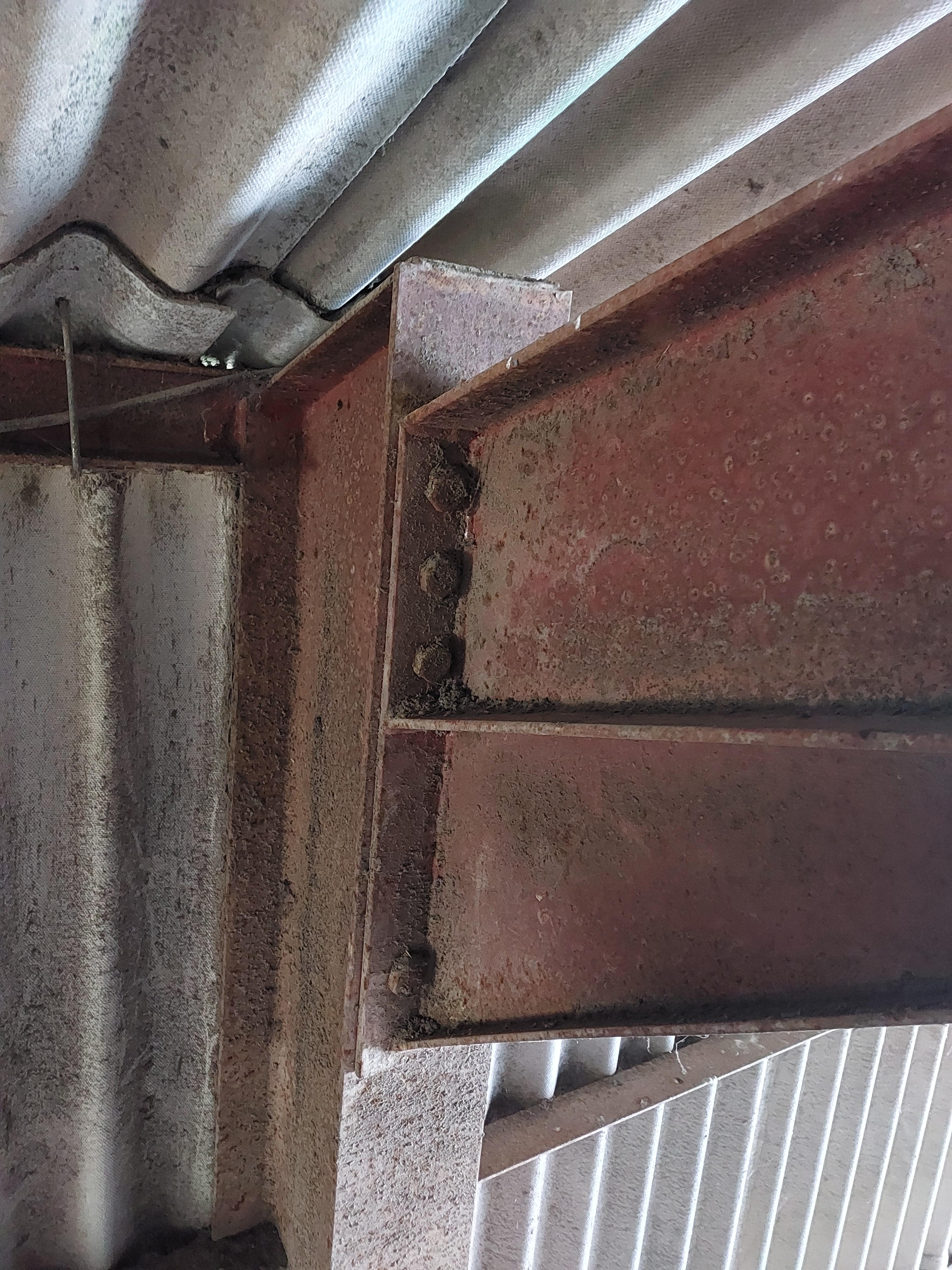
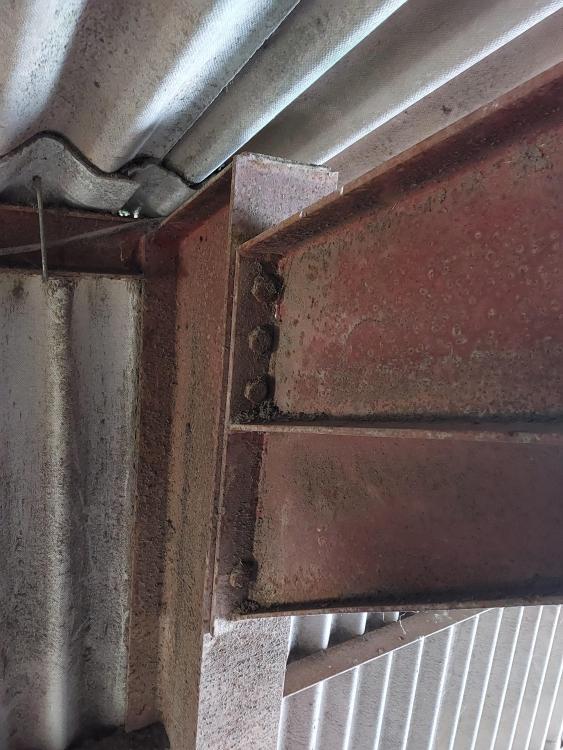
It gets hot. There should be 3 turns beyond the nut, Irs probably a tough cut Corrosion, as above. It possibly can't be turned off again. They come in multiple choices of length for choice and to not waste steel, and to not stick out too far. Buy the right length. And planes are pegged together? Certainly that seems to be how a glider wing is fixed. Here is something i was surveying last week. A steel portal frame. At this joint, if the wind lifts the roof, then the bottom bolts go into tension, and lots of it. With normal downward loading the rafter tries to rotate around the bottom of the haunch and the top bolts go into tension. With no nut it simply doesn't work Oops. I am on the wrong device....photo to follow..
-
Unlevel Foundation Solutions
saveasteading replied to nikki's topic in House Extensions & Conservatories
No slopes. Cover the whole area with the thickest board that the floor allows. Then add another layer on top, in one or two thicknesses. There will be steps but the screed takes care of that. -
So correctly torqued sounds like good idea. I was taught ' turn of the nut' on structures. This meant finger tight then half a turn with a normal spanner. Cutting the ends off is to be avoided. Find a shorter bolt. I was also taught to fit the bolt from below. It means you can easily see when one is missing.
-
Thinnest and strongest blocks for partition walls?
saveasteading replied to MariaD's topic in Brick & Block
I've seen such a wall in a London council flat. Hanging a kitchen unit on it was a bit scary, and you can't even use a long screw. The kitchen strengthened it. We aren't getting responses from the the OP @MariaD so it's all academic. -
You try to do the right thing and then…
saveasteading replied to Alan Ambrose's topic in Environmental Building Politics
They're saying that clouds of pollution create shadow and protect us? But they will also keep the heat in, between earth and cloud. I'll settle for the cleaner air. -
Welcome. Do we get to see photos of these?
-
Bonus read, just because I found it interesting
saveasteading replied to SteamyTea's topic in Boffin's Corner
And they manage until developers come along and argue that small ponds are unimportant and can be destroyed and not replaced. On Gardeners' World this week, a guy is sinking any handleless mugs into his garden as micro ponds: I've no idea how helpful that is, but he said they are soon occupied -
Do a sketch then. It does not have to be skilled or smart. And / or photo.
-
Balcony leading to flat roof....does it need fall protection?
saveasteading replied to Thorfun's topic in Flat Roofs
A thought. vertical post bolted to the outside end walls. Stainless tension cables linking the two. The posts can readily be made to suit, and colour coated, and not very costly. The posts can be made with whatever offset is needed to get past coping stones, and may be quite long to withstand the tension, but will otherwise be neat yet do the job. -
Agreed (mostly) . I'm in a 100 year old bungalow made of timber stud on 300mm footings (at most, and not all concrete) on clay. It moves seasonally but only enough to make the front door door stick, and a few plaster pops. There are several tiled floors, some big, and there has never been any cracking. ie the timber twists here and there but the floor stays put. If a building settles it will be by 2 or 3mm and in the first few months, probably during construction. I've built about 300 buildings and have had no suggestion of settlement in any. That's because we work out the maximum load, and spread it over the required area of ground according to its strength , and allow a safety factor. It should not budge. I'd think the only reason for settlement would be that the builder had over-dug or roughed up the footing and bodged it back in. (I have seen that). yes. and with indistiguishable overpainting.
-
Balcony leading to flat roof....does it need fall protection?
saveasteading replied to Thorfun's topic in Flat Roofs
Balustrade (???) fixed to the 2 ends only with a couple of rails linking them to form the long edge? Easy enough but the spars are getting a little bit chunky for attractiveness and it might be a special, with nice paint costing as much as the metal. I'd expect there to be a proprietary solution out there somewhere though. What about the balustrade posts sitting in concrete blocks that sit on the lower roof? It would work, but might be considered too temporary and removable. -
I worded it badly. as far as I know these are a supplier contractor, working for an end user.. not a developer or being built to sell. I'm not saying anything about whether these are good or bad value because we all see it different ways, and have different skills and priorities. I tried very hard to make eps wall shuttering work on several jobs but couldn't get it near to competing with other methods. But I can see it works for newcomers. Never tried a kit for floors. I didn't even know it existed until I came on BH, probably because they weren't targeting my sort of business by direct contact or exhibitions. It just amazes me that I could specify a 175 slab with one layer of medium grade mesh, on which to run 10 ton forklifts and racking up to 8m high, but these houses have 200mm with 4 layers.
-
I'd hazard that the strength of a kit is certainty, especially for first timers to self build. I'm not aware of any professional constructors using these systems. extra cost v risk reduction. Structurally, I don't really get the principle of a very strong slab bearing on polystyrene on top of thick strong sub-base. The slab would span several m of open space and would be heavy construction even for a big warehouse. But I suspect that the design has developed over many years to overcome any issues encountered, regardless of the site conditions. Certainty.
-
It is a standard thing in the building regulations. If nobody is dealing with this for you, your builder doesn't know , and you don't know, then I'm a bit concerned about quality.
-
because it is very cheap compared to the options. the obvious solutions are ventilation and shade. vent as much as possible. if security is an issue then build a chimney/funnel. shade is best though. White or reflective wrapping so that the sun gets caught or reflected away. a wettened floor works but the damp air then needs to be ejected.
-
And there is spare stuff sitting at the local BM. You can phase deliveries to minimise clutter and aid cash flow. But there's a better price available for taking one big delivery.
-
EPCs are complete bo**ocks
saveasteading replied to pulhamdown's topic in Energy Efficient & Sustainable Design Concepts
I've been required to do air tests on commercial buildings where I know that loading doors will be left open all day. In such a case we, and the client simply want a pass to sign off the building. I've met and questioned some of the people from BRE who set this stuff up, and will not comment further. -
How likely is an auction item to work at all / well?
saveasteading replied to saveasteading's topic in Barn Conversions
We're they in working condition?