


ProDave
-
Posts
30862 -
Joined
-
Last visited
-
Days Won
427
Everything posted by ProDave
-
And even if you get the pipe shrouds to work, how are you going to connect the waste pop up mechanism without it looking naff? you should have bought a floor mounting bath filler if that is what you wanted? EDIT: Even more confused. the instructions posted are for a different tap to the picture of part of a tap posted.
-
^^ If that is the tundish that is dripping then you have TWO faults. That is the tundish for the hot water, and it means either the over pressure valve (with the blue knob) or the over temperature valve (with the red knob) is letting water out. So that is a fault that needs fixing, potentially it is unsafe at the moment with an unknown fault. BUT that will not be the cause of the heat pump tripping on low pressure. There will be aoother set of valves and another tundish somewhere, quite likely near the inside half of the ASHP. You have a second fault causing the heating circuit to lose water. I don't presently have much confidence in your installers.......
-
Whoever you paid money to to install it. Did you pay Vailant to supply and install it, or did you pay your builder or a plumber to install it?
-
A tundish should NOT normally drip. It is there as a warning so you can see if it is dripping in which case you know something is wrong. So if it is dripping then something IS wrong and it is up to the installers to come and fix it. Don't let them fob you off with any notion that it is normal for it to drip.
-
You might be on to something if you are seeing water leaking from an outside vent pipe. This could be your hot water from the hot water tank, but it could equally well be the water that is going missing from the heating circuit. They are two completely separate things. Taking the heating system first, this is a sealed system that is charged to a set pressure then the water is turned off. There is an expansion vessel that will absorb normal rise and fall of pressure as the water heats up and cools down. As a safety feature this has a pressure and temperature relief valve that will let water out if the pressure gets too high. This is the one that will cause the low pressure error if it loses water for some reason as it does not automatically get topped up. Now the hot water cylinder. That is constantly topped up with cold mains water in, via a pressure relief valve to limit it to a safe pressure. That too has an expansion vessel (a larger one) to absorb changes in volume as the water heats up. This will have over temperature and over pressure relief valves that will discharge water if it gets too hot or the pressure gets too high. You need to follow the dripping discharge pipe into the house and find where it goes and which one is discharging. Both will discharge via a tundish that looks like this The open bit in the middle is so you can see if it is discharging water. It might not be discharging all the time, so this is where you want to insert a bit of tissue paper into both of them, and check regularly to see if the paper is getting wet. If you find one of the tundishes is discharging water, get your installers back and show them which one and get them to check it and fix the problem.
-
There is nothing intrinsically wrong with an ASHP that will make it leak and lose pressure. So it must be a leak in the pipework. You cannot blame Vailant for that, and why should the ASHP manufacturer keep sending someone to fix a fault that is not theirs? It is whoever you paid to install the system that should be coming out to fix the problem. It should not lose pressure and it should not need topping up. Mine has been running for over 2 years now without losing pressure. The only time it does, is if I have to deliberately let the pressure off if I want to make alterations, but it's at least 2 years since I have done that and no need to top up.
-
Yes they are one and the same. In this case it is an air to air heat pump. It takes heat out of the outside air, and blows that as warm air into the building. What we generically know as an "air source heat pump" is usually an Air to Water heat pump. they take heat out of the outside air and put that heat into water for use with under floor heating or radiators. In most cases both will do heating or cooling.
-
No I maintain it is not a "fault" with the ASHP. If it is all new pipes and all new rads then there is still a leak somewhere, so the installer should come and find and fix that leak. But you would have had exactly the same issue if it had been a gas boiler.
-
I doubt you can. We have the same with an inward opening Rationel door facing the prevailing wind in the Highlands. When it's blowing a gale, a small amount of water gets under the bottom seal, The wind is strong enough to blow the water dripping off the external drip bead back under the bead so it is then 100% relying on the seal to keep the water out, and some gets in, not very much. I think it might not actually be getting past the seal, but because water has been blown under, it sits on the seal, waiting to get in as you open the door. We have learned when it's windy, have a cloth handy when you open that door to mop up the few drips that come in,. Compare that to the old doors with no seals that were standard in most old houses it would have leaked like a sieve in that exposed position.
-
 I would be interested in the practicalities of doing that. How would you do that as a self builder, self designing and building a one off build? I suspect you can't I would imagine you have to be a builder, signed up to some competent persons type body to allow you to self certify that the design meets BS3632 and claim the VAT back through your VAT registered company. Is there any mechanism that would allow a self builder to DIY build one and reclaim the VAT?
- 19 replies
-
- 1
-

-
- vat refund
- vat exempt
- (and 2 more)
-
The loss of pressure is probably a leak in your plumbing. There should be a pressure gauge and you should be able to see that slowly dropping day by day until it gets too low and flags an error. As I believe you are using all the old existing radiators this is probably an existing leak in the existing plumbing somewhere. Hardly the fault of the installers if some old existing plumbing has a leak? Someone needs to find it. If YOU can find it then it will make the job for the plumber to fix it quicker and cheaper. As you are not seeing water dripping anywhere it is probably under the floor somewhere. P.S. An oil or gas boiler connected to the same set of radiators with the same leak would give exactly the same low pressure fault. this is NOT an "issue" with the ASHP.
-
So what does "giving local people more powers to get good projects done faster” actually mean? If it means give people more say, it will just give existing residents more chance to object to new housing near them? It is just typical of this government, a wooly, fluffy meaningless sound bite to make it sound like they are doing something, but with no substance about what or how they are actually changing anything for the better.
-
A Timber framed house with external wall insulation
ProDave replied to ProDave's topic in Timber Frame
I have not rendered the blockwork below DPC, i chose just to paint it with grey masonry paint. That part is below the joists and not covered by the EWI so the air bricks just go straight through to ventilate under the joists. -
Another option is the Puraflow filter system https://tricel.co.uk/sewage-treatment/packaged-filter-systems/ When I looked at that, the installation would have been excavate some of the top soil an place an area of large stones. the puraflow crates would sit on that and the effluent would slowly filter through the crates and into the ground through the stones.
-
That's the point. For an in ground system you typically dig a hole about a metre deep, then dig your 300mm cube hole in the bottom of that and do the percolation test. Here at this time of year it would fill with water and stay full. But for an above ground filter mound, you literally dig a 300mm cube hole right at the ground level and do a percolation test in that. If that passes you are good to go with a filter mound system.
-
That sounds like an extremely optimistic build time, particularly given shortages of building materials at the moment etc. Best of luck and I hope I am proved wrong. If you are only looking to rent accommodation over the winter have you looked at getting a long lease on what is normally a holiday rental? plenty of those on Skye.
-
You could try for an above ground filter mound. Basically a pile of expensive graded sand (I costed it at about £1000 for the sand) and the effluent is pumped to a drainage field on top of that and it percolates down through the sand into the ground below. To prove that is viable you have to do a percolation test, but instead of digging a deep hole, you do the percolation test in a shallow hole at ground level. All you need to know and how to do the calculations is in this book https://www.brebookshop.com/details.jsp?id=148788 However I objected to paying £50 for a book containing just a few actual useful pages so I went to our local library who got it on an inter library loan for me at a cost of just over £1 for the postage.
-
When we bought a bare plot, any stamp duty was calculated on the bare plot value and was under the threshold to pay any. I would look at separating the land purchase contract and the build contract.
-
Floor to ceiling 2440, rise 204mm so stair 1 okay at headroom 2236mm Stair 2 is marginal at 2032mm but just okay. It's stair 3 onwards that is the issue. What is the width of the stair opening? Is that measurement D 859mm? How about make the stair only 800mm which is still okay with building regs so stairs 3 onwards are under the open space so okay. So it's only the "slope" from stair 2 to 3 that may be an issue? but my ensuring stair 3 onwards is entirely under the open area I think it will be okay.
-
Cold water manifold, how big is toooo big
ProDave replied to Russell griffiths's topic in General Plumbing
I did a halfway house. Kitchen and utility each have their own feeds with local isolators. Where I used a "manifold" was for the 2 adjacent bathrooms. This gives me isolation for each in one place. And to keep pipework runs short, particularly hot water, the manifold is placed under the floor of the main bathroom accessed through a small trap door in the ceiling of the utility room. to save cost I "made my own"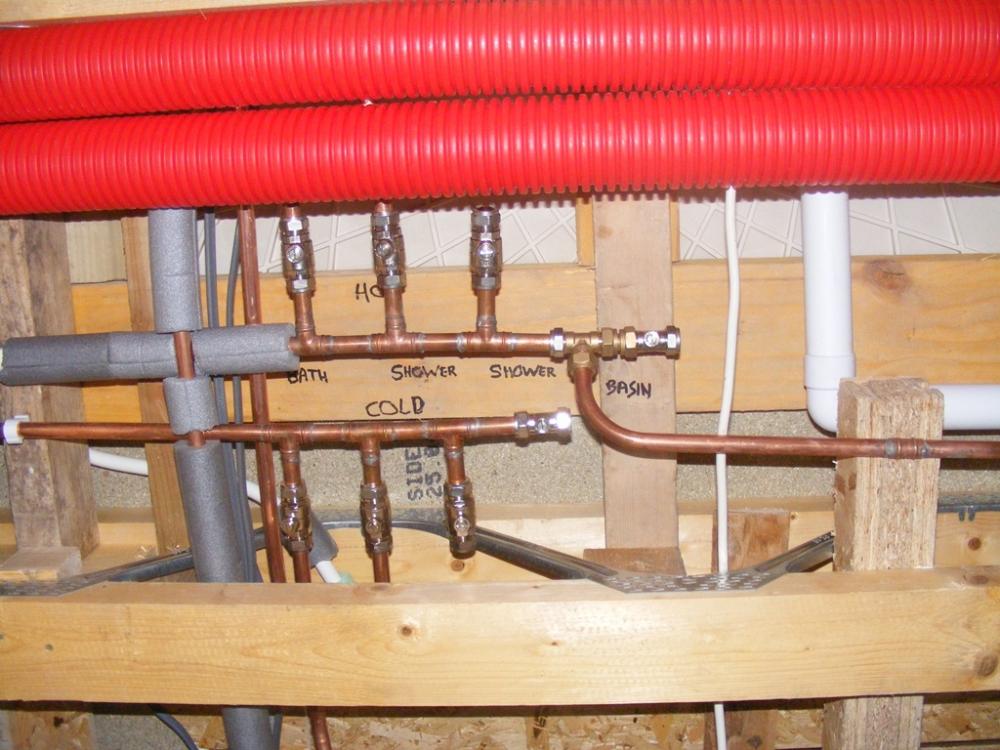
-
All I can say is DO NOT go for the cheap ones that Screwfix sell. they seem designed to last no longer than the pump, thus making them completely pointless.
-
New radiators not warming up
ProDave replied to interested bystander's topic in Central Heating (Radiators)
Sorry I had my under floor heating manifold thinking cap on. For the flow manifold to get hot, there must be some flow, otherwise that would remain cold. So as @Nickfromwales says check the radiator valves are on. Try also turning all the downstairs radiators off, that might encourage a bit more flow upstairs to get it started if it is an air lock. If all else fails, turn all radiators off then upstairs rads just one at a time. -
Try turning off ALL the other pumps, so you only have the manifold circulating pump running and see if that makes a difference (thinking if flow and return TO the manifold is piped backwards, or a pump is connected backwards, it will be fighting the manifold pump)
-
Does the ASHP pipe need insulation *inside* an external wall
ProDave replied to joth's topic in Air Source Heat Pumps (ASHP)
Seal PIPE to a snug fitting hole in the OSB layer. Insulate pipe inside and outside tight up to the OSB and seal around that as well. How are you going to use it for cooling? when I get around to implementing a cooling function it will be by way of a fan coil unit or 2. For this it will branch off from the flow and return in the plant room which is above the garage. This means cold water will never flow through the insulated pipes above the living room ceiling, they are only for hot water to the tank and UFH. -
New radiators not warming up
ProDave replied to interested bystander's topic in Central Heating (Radiators)
Can you post some pictures of your manifolds etc and any controls like motorised valves? Do you have individual controls for upstairs i.e. on a separate timer channel to downstairs? Can you hear the manifold pump running on the upstairs manifold?

