ProDave
-
Posts
30861 -
Joined
-
Last visited
-
Days Won
427
Everything posted by ProDave
-
The points you raise about developer houses being "wrong" for a number of reasons, is why most of us here have self built our own.
-
Pool ASHP's are not a good choice for UFH. I think few have inverter drive (they are built to heat what is in affect a very big buffer tank) and many won't work at Scottish winter temperatures.
- 17 comments
-
- 1
-

-
- the windy roost
- camping cabins
- (and 1 more)
-
Working correctly
ProDave replied to Pocster's topic in Mechanical Ventilation with Heat Recovery (MVHR)
Has it been balanced with an anemometer? -
You have the manifold already? I would not go to an UFH supplier, I would just buy another roll of pipe once you have worked out the lengths needed and just lay it.
-
Garage electric roller door installation, plumb level issues
ProDave replied to owen83's topic in Introduce Yourself
Don't get fixated on being plumb. As already stated it is vital the roll is dead horizontal, and it is vital the guides remain a constant distance apart and 90 degrees to the roll, so nice and plumb in that plane, but the plane you are looking at with your level does not really matter. -
First thing, when you go to bed, make sure the output control is set to it's lowest setting, fully anti clockwise. Then only turn the output control up later in the day when you sense they are starting to cool down. If the heat output is constant across the whole with of the output grill then it is likely all elements are okay. If it is cooler in the middle or at one end, one of the elements may have failed. They are easy to replace but you need to let the core cool down before you can dismantle it and take the front row of bricks out to get at the elements. I have had SH's in 2 previous houses, both poorly insulated and they were pretty rubbish because a poorly insulated house needs heat all the time you are using it, and if it runs out of heat the rooms quickly go cold. If the house has enough insulation to stay work for a few hours when the heat runs out they would probably work a lot better. All the sides of the heater are insulated. Most of the heat output is by convection by allowing cold air into the bottom into the hollow middle of the core (where the elements are) and out of the top of the core exiting through the grill. The output control opens a flap to allow easier convection as the core cools down. Some have a crude thermostat in the form of a bi metalic strip that is supposed to automatically open the output flat as the core cools down. One side effect of most of the heat exiting at the top of the heater, is my 1930's house with no floor insulation always had a pool of cold air at floor level that the SH just could not warm up.
-
Help ... can anybody recommend a good joinery company?
ProDave replied to hendriQ's topic in General Joinery
I think the lesson is don't give 50% deposits to traders you hardly know let alone trust. By FAR the best way to choose a tradesman is by personal recommendation by someone they have previously done work for. I know about 4 local joiners, but only one was good enough to be allowed to to my Oak kitchen worktop and hang a load of Oak doors for me. -
Garage electric roller door installation, plumb level issues
ProDave replied to owen83's topic in Introduce Yourself
They don't need to be truly plumb, I would fit as best match to the brickwork as you can without bending the track to the point it kinks. -
Don't lower it when the stove is lit.
-
Re thinking this, if a planning application is refused they have to state what planning policy it fails. In this case it did not appear to fail any planning policy, the case officer had approved it, but then some random councillor voted it out at committee So the reason for refusal was in fact "a councillor, not trained in and familiar with current planning rules refused it for no good reason other than he did not like it"
-
The middle 2 flow meters are black with crud. I doubt you can read a flow rate from them, let alone trust it. I would swap the 2 black middle flow meters for the 2 spare unused ones on the right. Then you will be able to see what the flow rate is. I suspect your system needs a good flush to get all the crud out and replacing with clean water and inhibitor mixed in.
-
I thought I had a problem with size. That tells me I need 86"
-
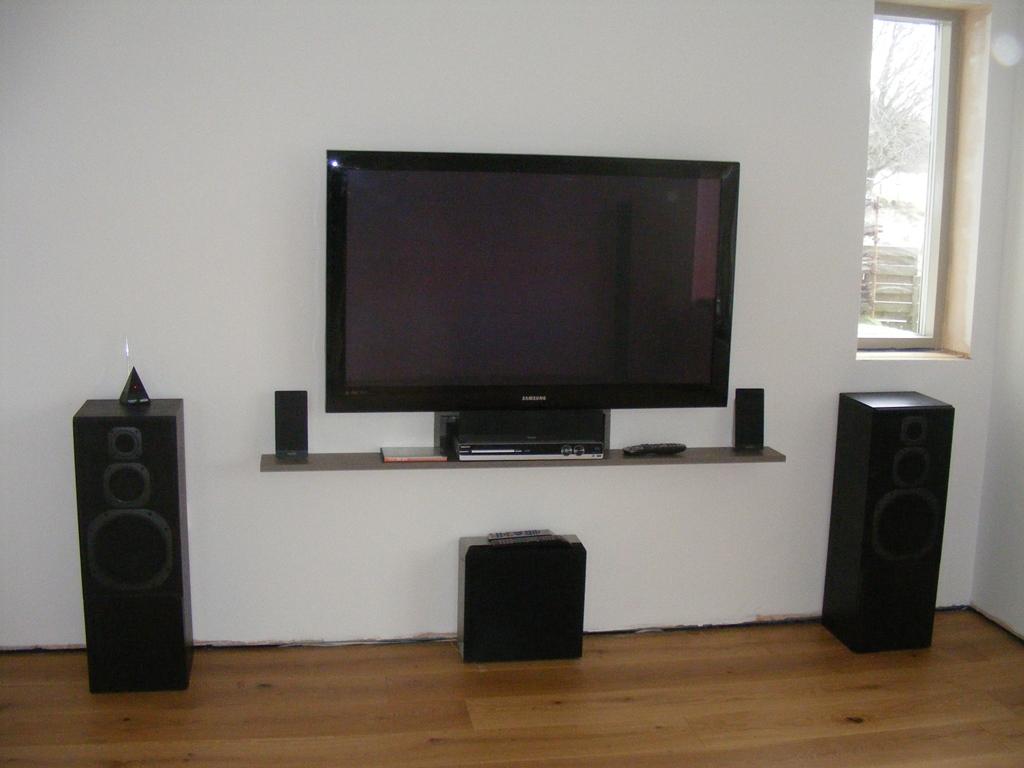
I dislike a television that high up the wall. It's a personal thing. Mine is at eye height. We have a clock above the tv now and I would hate to sit for hours looking up at the height of the clock. All the wiring hidden for various feeds (from the AV cupboard under the stairs) and for the surround sound speakers. Thats the surround sound amp in a pocket built into the wall under the tv. That's a 50" plasma. Takes 2 to lift it.
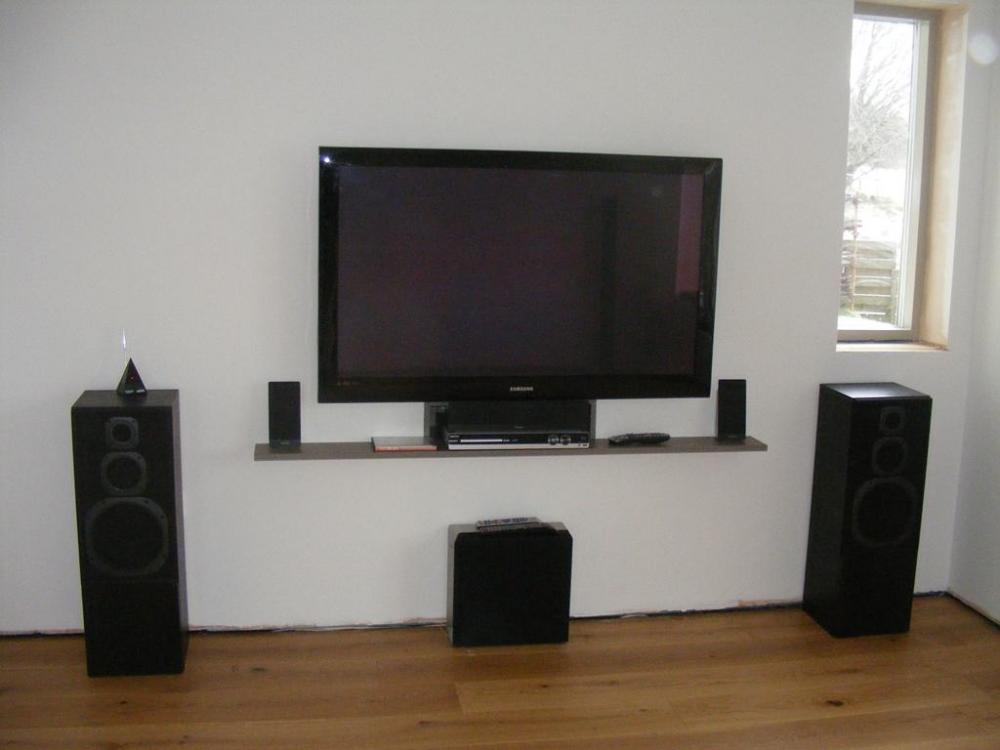
-
Choose your tv mount then plan the wiring. As a minimum fit a DOUBLE socket with two USB outlets so you can power other devices, e.g. a firestick. 3 hdmi cables to "somewhere" you might want to locate set top boxes, game consoles etc. A spare conduit and draw cord for whatever supersedes hdmi (if you were doing this 20 years ago you would have installed a load of scart cables....) And some coax for a good old fashioned television aerial seems a pretty good idea. Sockets are best just above the tv bracket, there tends to be a little more space, as long as they are not so high they show above the tv. Are you happy with the generally lousy sound from most inbuilt speakers in tv's or would you like a nice surround sound system?
-
Why are you wanting to replace all the old pipe? It looks okay to me?
-
It's all about confidence if you are going to invest in such a project, and when some of the claims are a little bit suspicious, the confidence drops. I am more inclined to spend that £3000 on some more PV and some batteries (I have still to work the numbers on that so that is not a given yet) but it would be more tangible assets than a bit of paper saying I own a small share in a wind farm, and immediate start to payback as soon as I connect it.
-
Like I say, I am uncovering "creative statements" So if 4600 investors is about right, then the claim the windfarm can "power 20000 houses" is somewhat ambitious is it not?
-
Contractor wants shooting. He has taken an inadequate, not fir for outside feed to a light, fitted a crappy non waterproof box, without even trying to waterproof the conduit entries and joined his SWA gate feed to it. It is full or water, witness the rusted SWA gland. you have found the solution to your tripping. Rip it ALL out and start from scratch with SWA from the house.
-
Fire alarm system: Nest Protects with heat sensor in kitchen
ProDave replied to bmj1's topic in Electrics - Other
And the rest of us just go and buy AICO alarms who will do a nice heat sensor without any butchering to integrate with all their other various types of smoke and CO alarms. Yhey even do a combined heat and CO sensor which was perfect for our kitchen / diner with a wood burning stove in it. -
There is at best some "creative spin" going on here. From Ripple's website: "Made up of 8 turbines in windy west Scotland, Kirk Hill has the potential to power over 20,000 households and businesses with the cheapest and greenest electricity" So this 8 turbine wind farm can power 20,000 households. So you would expect there to be 20,000 shareholders? This page https://renews.biz/75861/ripple-opens-membership-for-kirk-hill-wind-farm/ suggests there are 4600 co owners? And says it expect to start production in "March this year" (that article was dated February 2022) Ripple's own timeline for starting production is Project timeline: At a glance May 2022 Share offer closes May 2022 Pre-construction preparation October 2022 Track works start December 2022 Crane hardstandings construction January 2023 Turbine Foundations works start February 2023 Grid connection works March 2023 Control building construction July 2023 Turbine deliveries begin November 2023 Turbines start So production (and payback) not likely to start until the end of this year. I am not out to rubbish Ripple, I am doing due diligence before deciding to invest or not, and am uncomfortable with the conflicting evidence I am finding.
-
80 by 38 studs is a bit skinny and only 51mm (read that as 2 inch) polystyrene insulation in the frame. It's certainly not the best but at least something. That's Taping and filling, usual method in Scotland, you just fill then sand the joints on a dry lined wall. If you want to upgrade it, I would suggest over boarding with insulated plasterboard if you can stand a slight reduction in room sizes. Contrast that with our 2003 timber frame with 150mm studs and 150mm rockwool insulation filling the frame.
-
What a fight, glad you did not give up. So what has been approved by the appeal? your original plan, or one of the modified plans in your attempt to get approval? I think the lesson here is in a situation like this, don't mess about trying to please the unpleasable, let them fail it and go to appeal much sooner.
-
Not looking very hard? This would make a good tower, you might want some more boards if you want an intermediate platform, and a set of wheels if you want it to be mobile. A lot more sturdy than some of those DIY towers discussed and for less money. https://www.ebay.co.uk/itm/113283387488?hash=item1a60375060:g:C04AAOSwxCxT91~0&amdata=enc%3AAQAHAAAAoI0EPLXtRA09x%2BqzQLCYg9guHwi4YYGZijbYpv84s5aRZBj2UHM95anc4GScfGRf24nXBr%2FnolHF2H3MX6afHzE9U6CRfETyM4UbFYOJynTF66ivk1m0lf%2FdBqCxLjCnw2dasDGmsv2wNIX6ZLqmbi9RUOTnHOTyxw3d4QVfexSRZ%2B2TowdW6Z1AVDpz5fJPtH4g6zgm9Olj9CHcEvYHXNk%3D|tkp%3ABk9SR4Cl2s2vYQ I bought a load more than that, and as I could not find any local to me I hired a 7.5t flat bed and went and collected it from England.
-
For the price of those towers, you could get a load of second hand KwikStage and use that. That's what I used.
-
I would personally plasterboard the lot and then skim it. anything else is asking for a crack to appear where the upper plasterboard meets the lower plastered brick.