George
-
Posts
699 -
Joined
-
Last visited
-
Days Won
1
Everything posted by George
-
Even less of a concern for an Approved Inspector.
-
Why not just raise the ground level - there will be plenty of spoil looking for a home during the build. Then you keep access right up to their fence.
-
That brickwork hasn't been touched since construction so I doubt there's a lintel there. It'll be arching over and the upvc carrying some load - does the door stick at all? Now is the time to do it. Would take a builder half a day to sort out.
-
A good plot with a modern 4 bedroom house on top will likely be worth £500k so no-one is going to give you the land for cheap.
-
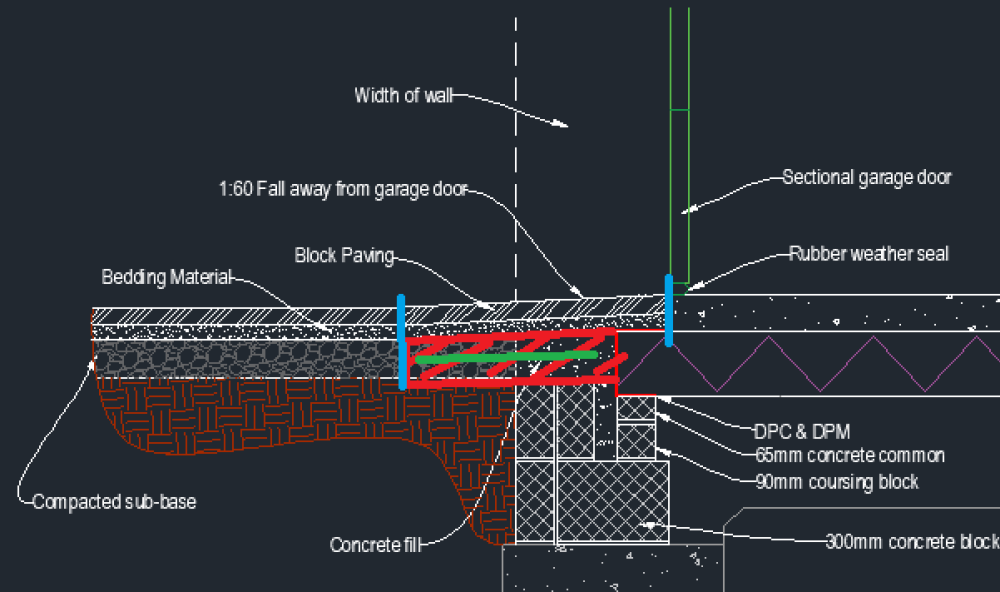
Concrete run-on slab and a movement joint in the block paving. Basically what you'd normally do but set 100mm lower so you can block pave over the top of it. Red = concrete Green = steel mesh Blue = movement joints I agree with running the foundation and blockwork through, too.
-
Proper surveying level is best but if you do just want to check a few spot levels, then a water level is way better than any phone app: https://www.wikihow.com/Use-a-Water-Level
-
replace floor/ceiling joists -am I insane?
George replied to Crowbar hero's topic in General Structural Issues
You would ideally prop/jack up the joist and plywood combination until the glue and fixings are in place. Else you're adding dead weight without getting the section strengthened. -
The limit is the size of the oven to toughen the glass. It'll be a job for a commercial scale glazier - I'd have thought there's an oven big enough in the UK but phone someone like Pilkington and ask them. If UK facilities are limited there'll be somewhere in Europe that could do it. As it is likely in the middle of a large roof then a glass lifter may be unsuitable and you'll need a crane (with suction pad attachment).
-
Whereabouts in the country are you? I would start on the passiv-haus register then go from there. Very few small architectural practises can survive only on £1 million+ jobs.
-
Although it's not a close up, it looks like trowel marks in the infill, which would suggest it's mortar. A 3:! mix can be nearly as strong as stone! I'd get a masonry hammer (wear safety glasses) to chip away rather than an SDS.
-
I had a wired one for a long time. Then partnered it with a ryobi battery one - have been pleasantly surprised how good it is. Chews through batteries but that's to be expected.
-
A shallow arch like that is unlikely to be the main load bearing element - as in the SE's email, much more likely to be a relieving arch. That is, a shallow arch working in combination with a beam below. The beam can be made smaller thanks to the arch distributing the load away from the centre of the beam. The infill appears to be mortar. I would chip a bit away and see if there is a beam still there. The mortar may have led to timber rot, or some other remediation work was done in the past already. Crack stitching I agree with - on jobs I default to 'manufacturer's recommendations' but I have had some success on my own buildings with bedding the stainless steel rods in lime mortar. I figure it doesn't create such a hard spot and is more akin to new-build bed joint reinforcement rather than using the 100% rigidity of the resin. However... this would be 'at risk' and I hope one day helifix will do research on this approach. You should definitely put up external wall insulation as part of the re-render.
-
It does mean that, but it is all about proportionality. Enough decorators fall down stairs and break necks when really they should have had a proper access plan and consideration of COSHH substances. Not using dodgy ladders and so on. That is all pretty sensible and proportionate when you consider a decorating company sending employees out to work. They should be considering these things and recording them appropiately. Where CDM does fall down a bit is when it's a one-man band. Whereas Management of HS regulations has a clause meaning that organisations with fewer than 5 employees don't need to write anything down (although they still need to prove they considered and fulfilled reasonably practicable steps), there is no similar exemption for CDM. So, while as a client you would want significant construction work to be written down regardless of number of employees, that isn't the case a decoration job.
-
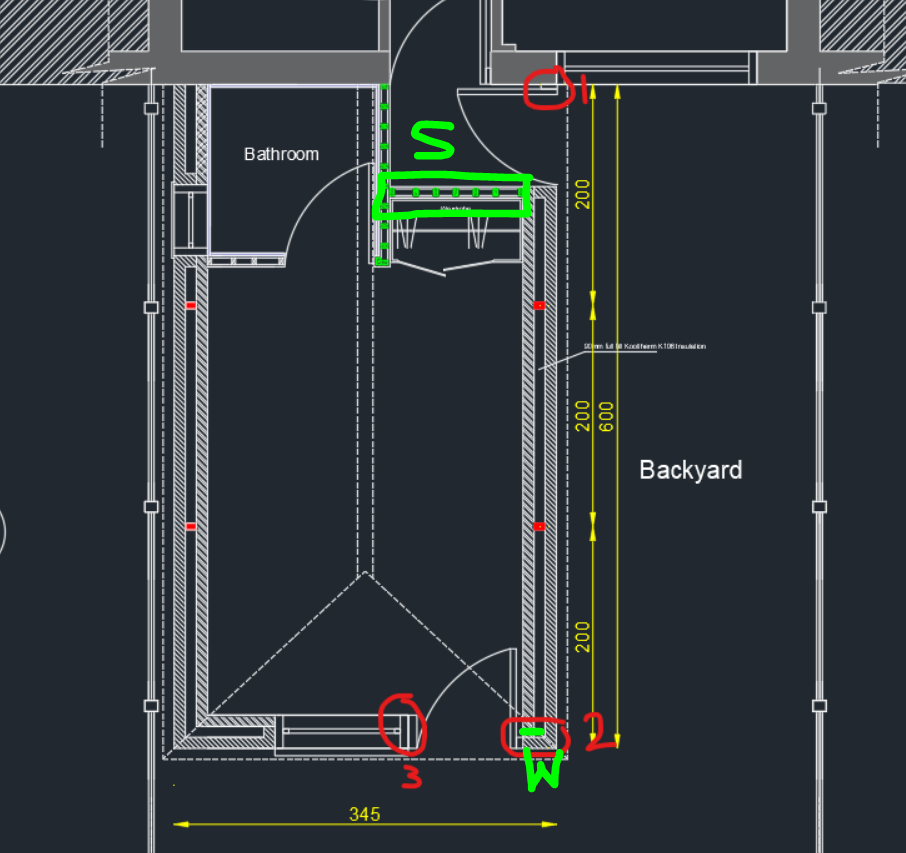
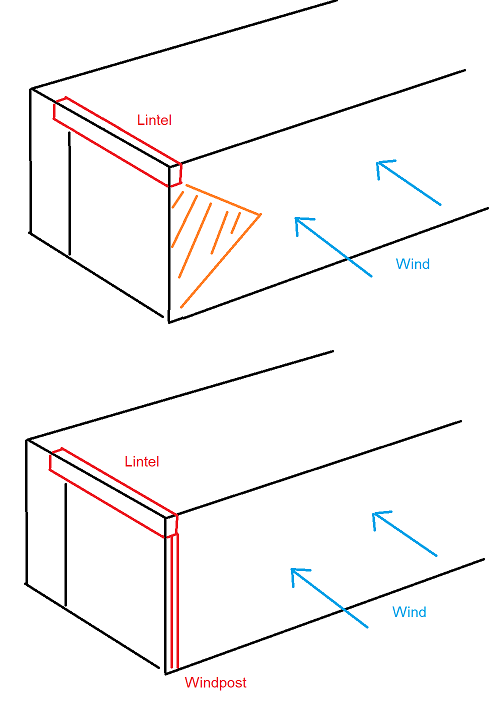
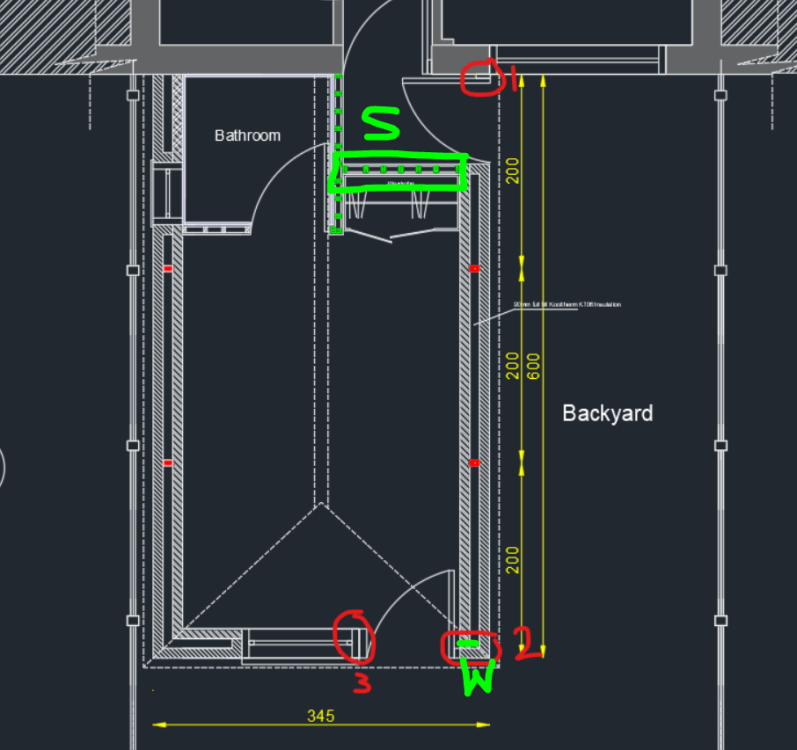
Maximum wall length covered by Part A rules is 12m. Although usually you start to break the rules (due to multiple openings etc) when you go over around 6m. No a lintel won't provide lateral stability. Walls are panel structures and panels need linear supports else they will span in two directions. For masonry this rarely works. A lintel will only support it at a 'point' (in the top corner). The difference looks a bit like this: Orange zone being at risk. I'm afraid we're into the realm of 'step 1: attend university and do a civil engineering degree' but fundamentally, the layout proposed does need a windpost. Best person to speak to next is an engineer who can specify what you need. Potentially a windpost manufacturer would do the calculation for you as well. What I would do is put a windpost at point 'W' and make the studwork wall a shear wall a point 'S' (this would be an extra layer of OSB and some additional strapping to the wall and the floor). Edit - actually what are the red blobs? Are they the proposed windposts or something else?
-
Any wall panel which complies with Part A rules is fine and won't need additional windpost/justification. Anything that doesn't comply will need a structural engineer's input to satisfy BC. I've rarely ever made a (non-Part A compliant) wall panel work without putting in a windpost or reinforcement. Windposts are a bit pricey but fundamentally are just a steel section with a bolt top and bottom. Left hand side appears fine to me. Only 6m long and at the bottom corner the two walls buttress each other. House construction is all about building boxes!
-
The 345cm end wall isn't a buttressing wall - doors and windows are not structural components. It sometimes is possible to deign a masonry wall to span top to bottom, but this has much less lateral capacity and requires a lot of fiddly detailing. much more robust is to use a windpost. The building regulations are a bit out of date on minimum return length. A wall with a cavity o 75mm needs 665mm. But many walls now have cavities of 100mm+ - this really needs a return of 780mm. That's fine until the beast from the east MkII rolls through, blowing over the fences. Structural design for domestic houses needs to consider a 50 - 60 year time span. In summary: Am I thinking in the right direction? Yes Do you think windposts will be required if the minimum returns and P2 are not met? Yes Is there a rule of thumb to when windposts are required? Masonry panels require support to be able to resist lateral loads. Most common is buttress wall in accordance with Part A. Designed solutions almost always require a windpost. Does the 3.45m wall works as a buttressing wall for the other two side walls? No What are the calcs needed to justify not using windposts? (e.g. Masonry wall panel design to EN1996?) EN1996 would suffice but it is unlikely to work without a windpost anyway.
-
British Gas reckon what they'd actually be charging (without the price cap) for electricity is 62p/kWh.
-
ASHP environmental yield- seems low?
George replied to daunker's topic in Air Source Heat Pumps (ASHP)
Would you think this is common? I've got a Samsung Gen6 and this could be a reason for the odd numbers (although there's something not quite right as on the weekly figures it'd be a SCOP of around 500!) I have noticed SCOP dropping since I lowered all thermostats. But overall it's saving money so it's a bit of a tough call sometimes. Ultimate answer would be to install a smaller heat pump. -
IWI Wood fibre alternative build up using OSB or Woodwool
George replied to George's topic in Heat Insulation
It is a downstairs shower. Yes I will stick with wood fibre and lime. Will add timber battens for the fixings. -
Octopus Cosy - new tariff for ASHP owners
George replied to George's topic in Air Source Heat Pumps (ASHP)
Interestingly my taps are too hot to put my hand under but shower is fine. Presumably loss of heat being in spray form. Run at tank at 45C, unvented so shouldn't be issues with differential pressure. -
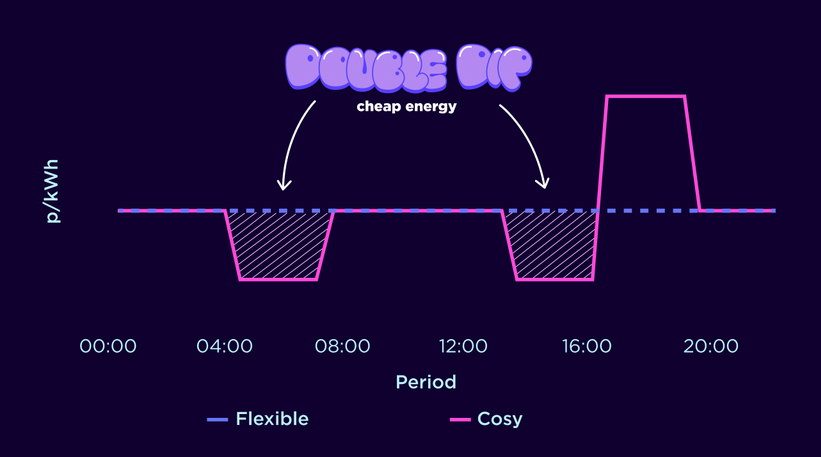
Bit of PSA, while it's probably cost neutral for me at the moment, if combined with a battery it'd be a decent cost saving. Although I don't have a smart meter so can't get it Two low/off-peak times and one peak time in the evening: On the website said ~20p off, 50p peak and 33p in-between. https://octopus.energy/cosy/ EV Man's youtube video on it: https://www.youtube.com/watch?v=2XkWWdJ2ga4
-
IWI Wood fibre alternative build up using OSB or Woodwool
George replied to George's topic in Heat Insulation
Yeah I did the (slightly older) Warmshell build up using mechanical fixings, mesh and lime plaster. 60mm on the south, west & east walls and 40mm on the north face (to allow more heat to keep frost damage reduced). No vapour control layers or anything - as per Lime Green specs (as was). Now they recommend an adhesive to fix the boards I think. Much of the original lime plaster was sound with only wallpaper on it, so I just scraped that off and fixed the wood fibre in place. One or two rooms need gypsum knocking off - there I did wherever was damp and/or the lower 500-1000mm and plastered in Duro or Ultra if it was an external wall. In a very damp porch/boot room all of the gypsum was taken off. Did a lot of airtightness with loft hatches, new external doors and checked the UPVC windows were sealed and working well. Completed in March 2021 and has performed very well. On pure u-value calculations it has exceeded them based on energy consumption. (This does require quite a few assumptions but actual ASHP energy use is ~3500kWh, floor area 176m^2. Assuming SCOP between 2.7 to 4.2, gives a energy demand 55 to 85kWh/m^2. i mean, there's a LOT of things missing - occasional log burner, effect of the MVHR, heat from domestic activity, people, cooking etc etc but in terms of order of magnitude it's made the house comparable to a non-passiv new build, circa 2005) The only locations I've had salts coming through is where I'd left gypsum in place on internal walls. I think what has happened is the masonry behind was saturated and so with cyclical interstitial condensation, is taking a very long time to dry out (which would be at most 1mm a day / ~ a year at best). Not worried though - I'll just vacuum off the salts and I'll repaint when its settled down. Certainly not related to either lime or the wood fibre. Extension I redid the floor. I did use glaspor, but with a concrete slab. Thinking being that the old walls would beenfit form there being a capillary break below the slab. With a lime plastered wall I'm not sure I'd be too concerned using modern insulation on floors as breathability is less of an issue with the floor. Rooms with existing concrete slabs I just left them and put in a thick carpet underlay. Central heating system was new and large rooms so having big radiators was OK. In any case, heat loss through floors isn't massive. Rooms with earth floors with original terracotta pavers I (of course) left - indeed, I exposed them and cleaned them up. Put a few rugs down but they're warmer than concrete. Extra insualtion in the loft. If I were doing it again I would do a better job on the inter-floor insulation, that is, around the outside, between the wood fibre boards. What I did was use wool insulation to pack the floor void. It works well (as evidenced by frost marks on the outside of the house) and I was concerned about the timbers getting too cold and causing condensation. But thinking back, continuous wood fibre insulation would have been better. I was working alone with a young child and it was Covid so I'm not too hard on myself...! While I'm here I'd actually also completely change the heating system if I were doing it again. Wha tI have is a single 16kW ASHP to do upstairs and downstairs UFH + radiators and DHW. What I would rather is if I'd used a much smaller ASHP to do hot water and the UFH/downstairs radiators. Then upstairs I'd have air to air multi-split to do heating and cooling for the bedrooms. The (vast) amount of money saved I'd put into a new Eco-design wood burner to give both systems a boost when very cold. -
I could have told you this would happen some day....
George replied to ProDave's topic in General Alternative Energy Issues
The free fuel for renewables clearly makes up for it. Either way, we need to move away from fossil fuels. -
I could have told you this would happen some day....
George replied to ProDave's topic in General Alternative Energy Issues
I'm no expert on electricity grids but I'm pretty sure that's how they've always operated. You need capacity for peak demand so power stations were brought on and off line as required. Now, they are brought on and offline as renewable generation changes and demand changes. -
I think this video has a section on setting a DHW timer: https://www.youtube.com/watch?v=byN0aPh_7NU