George
-
Posts
699 -
Joined
-
Last visited
-
Days Won
1
Everything posted by George
-
Yikes... I have a 16kW Gen6 as well. ASHP (and any well designed low-flow temperature system) radiators are not meant to be hot. So long as the air temperature in the room is right, then the radiator should be lukewarm. The Low in the first image refers to the weather compensation. Low = low external temperature = highest target flow temp to compensate. High = high external temperature = lowest flow rate as energy losses will be lower. EDIT - actually I'm wrong. This is reversed in the two settings. I'm going to reread the manual and check my own settings... You should be tweaking three things: the flow rate temperature and the high/low limits for when they reach their extremes. The difference won't be enormous, but for comparison I used ~39kWh when it was -8C for a slight smaller sized 4-bedroom (albeit built in 1880s) house. Nearly half the amount.
-
I think it was on Heat Geeks where they said you should point the fins downwards when heating .... don't quote me on that though.
-
IWI Wood fibre alternative build up using OSB or Woodwool
George replied to George's topic in Heat Insulation
Yeah solid wall. As I understand it, gypsum plaster is vapour permeable - it just doesn't react well to water. But being on the inner face of an insulated build up should prevent condensation within the plasterboard. -
Has anyone tried this construction: - solid wall masonry - levelling lime plaster ~15mm - wood fibre, say 60mm - 100mm board - 11mm osb - 9.5mm plasterboard + skim Or substitute the 11mm OSB and plasterboard for a woodwool board and lime skim. The reason I ask is that I've done most of the house with wood fibre + lime plaster with fibreglass mesh. But I've one room left which is a small shower room. Because this will need various fixings to be drilled into the wall, a 'structural' board covering the wood fibre would be very beneficial. I did something similar in one very small part in another bathroom - covered the wood fibre with OSB then had a service void gap, then tile backer board.
-
I could have told you this would happen some day....
George replied to ProDave's topic in General Alternative Energy Issues
Wind is currently supplying 42% of the UK's electricity demand. Was briefly over 50%. That's from 0% 20 years ago. Sure... on average it's about 1/3 but all the gas and coal not burnt today will still be available for tomorrow/when the wind doesn't blow. -
Thanks all. The bracket finder was a good link - after some searching I can't seem to find anything with enough reach and rotation. I think what i'll do is attach a thick bit of plywood to the outside wall, or a few battens, (painted appropriately) then attach the bracket to that. Trying to get lots of thermal break stand off fixings at close enough centres for a bracket would not be feasible, but plywood/battens will give me much wider tolerance.
-
Should I go with an MVHR?
George replied to anonymous's topic in Mechanical Ventilation with Heat Recovery (MVHR)
I did do internal wall insulation so main leakiness is top floor ceilings. Most doors and windows got some sort of attention with the internal insulation. -
Should I go with an MVHR?
George replied to anonymous's topic in Mechanical Ventilation with Heat Recovery (MVHR)
I put one into my 1880s home. I figured air will take the path of least resistance so giving it a route in/out of vent ducts should still achieve most of what a MVHR system should. -
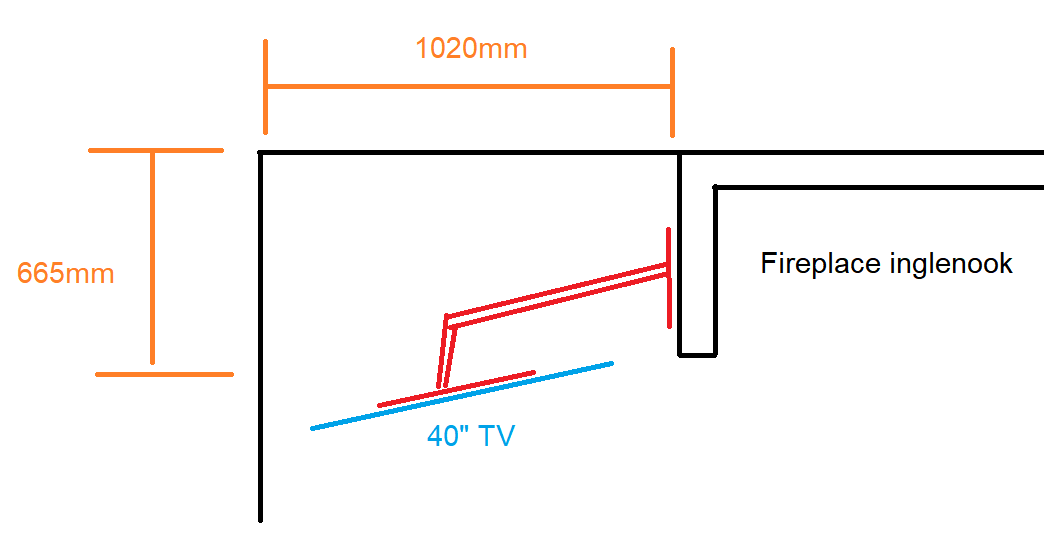
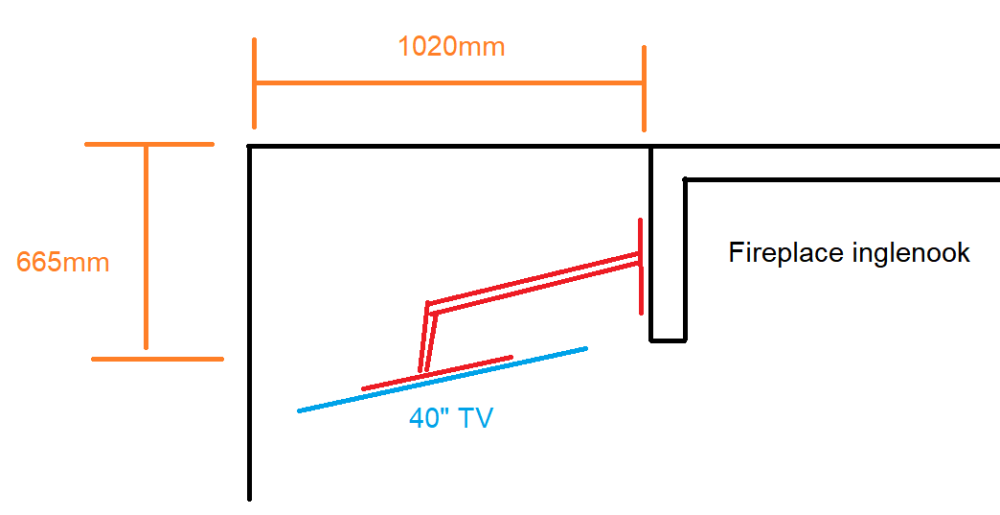
Hello, Due to having small children and wanting to tidy up the corner of my living room I'd like to put the TV onto an arm bracket. The plan view is like this: The outer walls (those dimensioned) have internal wall insulation and while I do have the through fixings, it'd be simpler to just hook onto the brick inglenook wall. But I can't work out which swinging arm TV mounts allow rotation beyond 90 degrees. Does anyone know of any which would do this? If not I'll just have to attach to the insulated walls. Thanks.
-
I could have told you this would happen some day....
George replied to ProDave's topic in General Alternative Energy Issues
That the wind doesn't always blow and sun doesn't always shine isn't a surprise to anyone - it's always been part of the calculation. You can't predict exactly when (except for night time), but you do know it will happen. -
Well... Only 'appropriately' supervised. An experienced worker doing a relatively straightforward task wouldn't need any direct supervising (assuming SKE, time and materials needed to do the work safely). But yeah, certainly more straightforward to stay firmly as the client and get others to direct work.
-
Part 4 of the regulations are the actual how to run a safe project (stable structures, shore excavations etc). So long as that is adhered to then the administrative parts are less of a concern for domestic scale work. Unlikely to be notifiable and any work you do as DIY wouldn't count towards that total. Beware when directing work as you can stray from being a Client into being a Contractor. Especially if overriding a contractor's measures to control health and safety risks. Seek advice if unsure as a bit of money on competent engineering or H&S input could save a larger sum later on.
-
Even with 1m strips, you'll need to put in trench sheets to support the excavation. Never rely on soil self supporting - just search YouTube for 'trench collapse' for why not (although be aware YouTube doesn't always vet videos very well so go for ones with a lot of views to avoid unpleasantness).
-
Notching Wood joists to parallels flange Channel
George replied to Warrentdo's topic in RSJs, Lintels & Steelwork
That's a very short bearing length - minimum of 90mm for an end bearing. (With SE calculation it could be shown to be OK but if there was a knot or something you risk the timber failing anyway.) It's usually easier to go for a bolted timber between the flanges of the PFC, with joist hangers attached to that. With direct bearing the joists you'd still need to put in noggins so you don't save any timber. -
What sort of charger? So long as the cable is big enough from the twin inverters back to the consumer unit it shouldn't make any difference. That is where the power gets 'used' by other devices on different circuits.
-
I could have told you this would happen some day....
George replied to ProDave's topic in General Alternative Energy Issues
Oh yes, add another 3 zeros. Doesn't really change my fundamental reasoning. Just change the 'G's to 'T's. Why so very pessimistic? Just on the vehicle side, there are 300 billion vehicle miles. If an EV can do, say, 3 miles to the kWh, then that means we'd need 100 billion kWh extra, or an additional 100 TWh needed to be produced. Well, that's how much we've reduced consumption from 2005 to 2021. As you say 2021 probably isn't the best year. But 2019 was 269 TWh. A reduction of nearly 100 TWhs. It's not as though we're aiming to switch to electric overnight. We've got time to do the upgrades. So like I say, I'm not too worried. (Think I've justified why) -
I could have told you this would happen some day....
George replied to ProDave's topic in General Alternative Energy Issues
Yes I was looking at the energy use rather than power capacity since as you say it is not very relevant, especially with low capacity renewables skewing the number significantly. -
I could have told you this would happen some day....
George replied to ProDave's topic in General Alternative Energy Issues
Historical electricity use https://www.gov.uk/government/statistical-data-sets/historical-electricity-data Peaked in 2005 at 362GWh. 2021 use was 255GWh. Much of this reduction I assume is from energy efficiency and less industry. Same data set, we've gone 270GWh in 1980, 302GWh in 1990, 342 GWh in 2000 and 347GWh in 2010. Local grid capacity is a factor but our grid is constantly being repaired and upgraded and we'll just have to address these capacity issues as EVs and heat pumps become more prevalent. What is also really interesting on that chart is column AH where the impact of renewables is shooting up the 'implied efficiency'. Edit - change the 'G's to 'T's. 362 000 GWh = 362 TWh -
I could have told you this would happen some day....
George replied to ProDave's topic in General Alternative Energy Issues
I'm not too worried. On the short term, electricity consumption has been falling in recent years so there's headroom in the system before even talking about load shifting. Then on a longer term over the last few decades we've managed to massively increase electricity generation, I see no reason we can't continue to do so. -
I went with Warmshell from LimeGreen. Found two or three plasterers in the area that were happy to use it.
-
Having seen a few cases where this has gone wrong (relying on vertical cuts to self-support), if you haven't got room to batter back then contiguous piling is probably your best bet. If vibrations are a concern then sheet piling is not going to be any better than a auger pile rig. Things like soil nailing and more elaborate temporary works is possible, but you'd need expressed permission (else trespass) and it'll be slower and overall may not save you much. Although it's money to just get out of the ground, I wouldn't try and skimp.
-
Reinforce or replace ceiling joists?
George replied to retrophit's topic in Lofts, Dormers & Loft Conversions
I don't think they're rated for use in shear. Have just been digging around for a declaration of performance and only tensile strength and pull out strength is listed. Can use screws to hold things in place but I'd always rather a proper bolt and toothed timber connector. -
It may be a matter of semantics - all I can speak to is my years working in multi-disciplinary practise. The Architects lead the visual and spatial design and the Architectural Technologists led the technical design. The Architectural Technicians do the drafting/modelling work. You could not run any project without all three working together with mutual respect. In my experience working on major projects, the Architectural Technologists are absolutely as vital as the Architects for a successful outcome. Neither could get anything done without the Technicians. Your experience as an Architect may differ. However, in the context of this thread, for a straight forward domestic job - for example, an extension, I'd trust any of them to do a decent job.
-
An Architectural Technician will be someone who mainly does drafting work - nothing wrong with that and technicians can be the person spot on for a small extension job. An Architectural Technologist is someone who gets a building to meet building regulations, design details and worries about thermal bridges way, waaay too much. They are on a par with an Architect in importance but are concerned with making the building function from a technical point of view rather than from a space and design point of view. At domestic scale an architect or an architectural technologist is equally 'good'. (For large commercial buildings you'd expect to have at least one of each, plus the civil, structural, mechanical and electrical engineers.)
-
Just say your house insurance company has asked for it. I occasionally get asked about my insurance (as a structural engineer) and I include details of my Professional Indemnity insurance in my T&Cs. I'm not offended - I'm designing something that affects what is most people's most valuable asset. Competence is via referrals, reviews, seeing examples of their work and so on.