

Stones
-
Posts
3761 -
Joined
-
Last visited
-
Days Won
23
Everything posted by Stones
-

How to value overgrown, unused, "garden" land.
Stones replied to K78's topic in Landscaping, Decking & Patios
I agree with Ian, go and speak to them and ask if you can lay your pipe over the land in question. I'd frame it in terms that you have the alternative route but would rather spend the £2K doing something useful and of benefit, like putting up a new fence on the site boundary to save your neighbours the hassle of constantly having to tidy up after fly tippers. Offer to pick up their legal fees so it's a zero cost / upside only proposal for them. -
Fair point, although for me the installation would have been done by the plumber regardless. When I factored in the additional costs I would have had (separate provision for kitchen and utility DHW and an ASHP) on top of the Sunamp premium, plus the restrictions of an E7 tariff in relation to our lifestyle, I felt it wasn't the right solution for us. Out of interest, is your ASHP a coastal model?
-
I'm going to make a shed out of pallets.....
Stones replied to ProDave's topic in General Self Build & DIY Discussion
'Marge, I'm going to build you a spice rack' http://i255.photobucket.com/albums/hh143/werdnayarg/webstuf/Homer Spice Rack/homer1.png Can't think why that quote came to mind... -
It's like being called into the headmaster's office! http://www.plumbingforless.co.uk/bathrooms/toilets/concealed-cisterns-and-accessories/grohe-eau2-concealed-cistern-63-ltr-sideback-inlet-cw-dual-air-button-38691-000 Toilet pan is a back to wall, floor mounted. Neither of us are that keen on having a large flush plate and prefer the look of the smaller flush button. The bulkhead we are building will be tiled all over, and has been framed such that the tiles on the top of the bulkhead will be whole tiles. All I was planning to do, as I did in my last house, was to fix the tile that would sit over the top of the cistern in such a way that we could remove it fairly easily. The method we chose in our last house was to bed it on small dots of silicone and grout with silicone rather than tile adhesive / tile grout. Worked fine in our last house.
-
I've bought Grohe cisterns. The've not been fitted yet but seem good enogh from a laymans perspective. I've not bought flush plates (yet), I had planned to use the push flush button supplied, creating a point of access to the cistern via a removable tile on the bulkhead that will conceal the cistern.
-
How about a storage container? Buy then sell on when finished or keep it and clad with timber as a permanent store?
-
I was looking at exactly this set up as well, but eventually decided against as it was just going to cost too much compared to alternatives. All of the feedback does seem very good (in terms of both performance and build quality) and Andrew and his team are more than willing to discuss things and develop non standard solutions as above (I can actually take a little bit of credit in persuading Andrew into 'developing' the solution above). I previously looked at the Sunamp Stack as a solution for DHW and heating, but again concluded it wasn't for me. I think if your DHW and heating demand are low enough, then a Sunamp product could be the ideal solution, assuming your happy with E7 or E10 electricity supply.
-
Health risks associated with passive houses
Stones replied to K78's topic in Energy Efficient & Sustainable Design Concepts
The analogy to cars is an interesting one. 30 years ago, reliability (and in many cases build quality) of cars was very poor. Automation and strict quality control have improved cars, and consequently owner experience and satisfaction many times over.. Is the building industry in the same position? Is a far higher degree of factory prefabrication the answer (pre insulated panels / cassettes, modular house)? We embarked on our first self build after going to see two 'starter' homes newly built by a large developer. I remember going into the first and asking where the lounge was (staircase running up one wall). I remember stretching my arms and being able to span the width of the room! The next house up was several thousand more, and was a bit better proportioned, but not enough to make me buy. In the end, I built a 3 bedroom bungalow which had 50% more floor space than the larger of the two houses we had looked at, for the same price as we would have paid for the larger developer house. Having built our own, and seen what we could do with our limited resources, we didn't consider a developer built house until much later in life, when we bought a house from a small developer (building 6 houses). I bitterly regret that purchase as although the house itself worked reasonably well in terms of space, it was poorly put together and poorly finished. It was the lack of quality control (over the build process) that made me decide that we would only ever self build in the future. -
Expanding Foam - an effective weather seal?
Stones replied to Stones's topic in General Construction Issues
Matches my own observations of our own ICF build. Very much the way in which my builder uses it externally - filling gaps in the ICF blockwork / EWI which aree then rendered over, or in the case of windows, as the scaffold onto which silicon sealant is then applied. -
On site today, I was doing a bit of tidying up, picking up the odd bits of expanding foam that had been buffed off the surface of our EWI prior to rendering. Some of those bits had ended up in a small puddle and were merrily floating around. Had me wondering just how effective a weathertight seal expanding foam would be a). exposed to the elements or b). protected from the elements Expanding foam impregnated tapes (e.g. Compriband) are routinely used for windows and doors, so presumably expanding foam would provide some benefit?
-
Health risks associated with passive houses
Stones replied to K78's topic in Energy Efficient & Sustainable Design Concepts
Very interesting. My perception has always been the reverse, generally influenced as it has been by the experiences of friends who have bought or lived in large developer built houses, but that is perhaps more to do with the issues highlighted by Steamy. When you say house types are a lot more thoroughly designed and developed, in what context do you mean? I'm guessing from your previous comments about developer build costs that the focus of all that technical design work is to be able to build these standard units at the lowest possible cost (far lower than a self builder could achieve). -
It really brings home how expensive it is to build a modest small house If you had paid someone the national average wage (£26500) and they had taken a year start to finish, you would be up at £1600 or so per m2. Highlights the really quite significant impact servicing a site can have.
-
Our initial spec was 195mm full fill PIR between rafters and 25mm across rafters. In the end I changed this to 180mm frametherm 35 between rafters and 50mm PIR across rafters. Three reasons, first was cost (cheaper using the frametherm and at that level of insulation the payback was something like 50 years for the extra), secondly, I thought it would give me a better balance of insulation properties (i.e. decrement delay) so a more comfortable house, and thirdly, I thought the frametherm would be far more forgiving in terms of installation - my concern was that a couple of badly cuts pieces of board insulation between rafters and the performance would suffer.
-
I'm going to make a shed out of pallets.....
Stones replied to ProDave's topic in General Self Build & DIY Discussion
I've likewise got a stack of pallets sitting on site. I'll be getting rid of them all except for the three that my windows and doors came on (Rationel do seem to supply very good pallets). At my last house, I built a series of large storage boxes for all of the various garden clutter I didn't want in the shed. I used the wooden crates the roof slates had come in, one turned upside down on top of the other, strengthened them using offcuts of 2"x2", then clad them with sarking board offcuts. I covered the roof with DPM which was going spare. The only cost was buying some nails. It really was very satisfying making something useful from stuff that would otherwise have been disposed of. -
Upgrading ex council house- what to go for?
Stones replied to Crofter's topic in Central Heating (Radiators)
There are still conditions as per 6.19 As I understand it, the biggest 'hurdle' is satisfying the noise requirements which I think in theory means the installer doing a test to confirm the noise emitted doesn't exceed whatever the limit is. -
Stage 1 Is Very Nearly Complete :)
Stones replied to Construction Channel's topic in General Self Build & DIY Discussion
Not bad at all... -
Health risks associated with passive houses
Stones replied to K78's topic in Energy Efficient & Sustainable Design Concepts
Just to pick up on this point, isn't the fact that it isn't commercially viable for developers to individually model each plot (for arguements sake lets say on a 500 home site) as responsible for some the problems being reported / encountered as the higher standards of insulation and airtightness themselves? A large development may only have a handful of designs, which are then placed at completely different orientations around the site. While one design may be perfect / optimum in one location, the converse may be true for another location and significant problems (solar gain being the obvious one) ensue. -
Upgrading ex council house- what to go for?
Stones replied to Crofter's topic in Central Heating (Radiators)
The rules on this have changed (amendment to general permitted development rights) - http://www.gov.scot/Publications/2016/06/2685/8 -
Health risks associated with passive houses
Stones replied to K78's topic in Energy Efficient & Sustainable Design Concepts
I just had a quick scan through the Page 1 results searching 'passive house health risks'. Two things stood out, the first was the use of earth pipes to preheat incoming air for MVHR, and yes absolutely, there are documented problems with that particular 'technology'. From what I remember from previously discussing this, to make it work you needed very expensive pipe which had some sort of (silver?) lining to kill of the harmful bacteria that could accumulate in the pipe. I do remember a rep at one of the building shows giving me a ballpark figure for the pipe, and me falling about laughing until he said he was deadly serious. The second thing that stood out was the many references to insufficient ventilation, caused by either poor design (incorrect ACH specified) or end user mismanagement (not servicing filters, closing vents, reducing airflow to reduce noise). To me the answer to many of these supposed health risks would be to increase the rate of ventilation (ACH). I really can't get my head around why this is such an issue. Noise I can perhaps accept, if a unit was constantly on a boost / its highest setting, but that to me at any rate would indicate an undersized or incorrectly specified MVHR unit. Otherwise, what's wrong with increasing the rate of ventilation? Okay, you maybe then do not fall within the passive house parameters because you have marginally exceeded the threshold heating requirement, but so what? It strikes me that the thing that really needs to change in terms of building regs are the ventilation rates. Do they take into account the realities of modern day living - drying large amounts of laundry inside, lots of showers etc? Both of these things are relatively recent additions to the way we live and probably some of the biggest contributors to the amount of moisture in a house. Skip back 30 years and showers were starting to make serious inroads into our ablutions, but prior to that we relied on baths, which may have been daily, but equally could have been weekly. The amount of laundry we now generate is undoubtedly linked to the ease with which things can now be washed by machine. Again skip back 30 years and twin tubs and washing days were still common. -
I'm quite sure it could all have been troweled on (that's how they put the initial bits of base coat on for the bellcast). I can only guess that the spray system makes it easier and more cost effective for them to do, especially for the top coat. They used a wheeled scaffold tower to do the plaster boarding, setting the platform height according to which run of board they were doing.
-
Yes, we will have a gravel bed around the perimeter of the house 300mm wide, slab path then french drain along the back of the house. They used 10 tubs of render, so approx 10 m2 per tub.
-
Health risks associated with passive houses
Stones replied to K78's topic in Energy Efficient & Sustainable Design Concepts
Of the 6 plots we have bought over the years, 4 have been purchased privately, 2 on the open market. Of those 2, I was able to negotiate the price down on one, but went to a closing date with the other. TBH, it's not difficult to find a site privately, it's just a case of doing a bit of detective work, identifying potential sites, finding out who the owner is and approaching them. -
Health risks associated with passive houses
Stones replied to K78's topic in Energy Efficient & Sustainable Design Concepts
I would certainly agree that the premis of house occupants not controlling their environment / fine tuning to their specific requirements will lead to problems, be they poor air quality, mould or whatever. But to change attitudes, you have to start somewhere. Are the problems / potential problems that have been raised a good enough reason to halt progressive improvements to building standards? As we've already discussed, problems exist in existing stock for the same reason - occupants are either unwilling or unable to manage their home to its optimum level of performance. How would you define the 'fanatics'? Reading through this topic, I don't think any of us here are paid up members of the passive house fan club, but we have chosen to take what we individually see as the best elements of passive principles ( insulation, air tightness) and incorporate them in our own builds. Is there a particular body or group that you feel has unduly influenced policy making? -
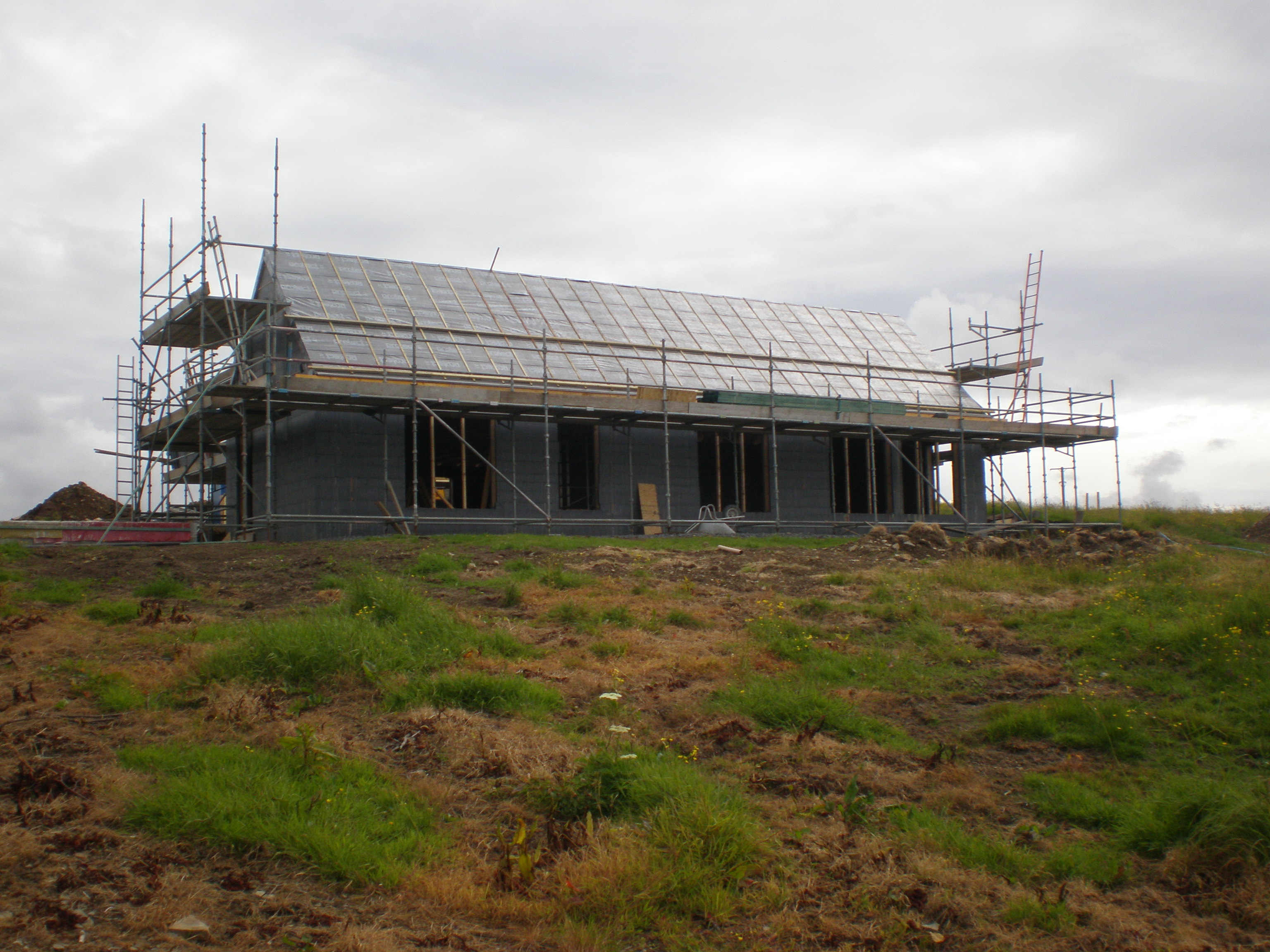
A busy couple of weeks on site has seen the majority of the timber cladding finished, the rendering completed, and first fix / plaster boarding progress inside. The render system used by my builder is made by Mapei. Having prepared the area to be rendered (as described in the previous blog entry) a base coat : was sprayed onto the EWI, then floated by hand to a 6 / 7mm depth finish. Fibre mesh (which you can see at the bottom of the picture) was then pressed in the base coat to provide long term strength. The base coat was left for a few days to dry before it was skimmed over by hand to take out any imperfections / ensure the fibre mesh was fully covered. A primer was then applied (using a paint roller) to the base coated surface ready for the final coat: Due to some unfortunate weather, some of the primer got washed off in heavy wind driven rain. Reapplied where required, the house was then ready for the top coat. The silicone based top coat : came premixed in 20kg tubs, and looks very similar to Artex! At around £100 a tub, quite expensive as well! The top coat was sprayed on, and floated / polished by hand. Let's keep any comments about the sprayer clean! With an aggregate size of 1.2mm, the final finish is fine textured rather than smooth. Having completed the top coat, the guys returned the following day to touch up anywhere that needed it - very easy to do when your render system can be applied (like Artex) with a paintbrush - and to remove all of the protective film from the windows and gutters. They also took the opportunity to apply base coat beneath the bellcast ready for painting in due course. With the protective film removed, and the render complete, you really do get a feel of what the finished article will look like. It certainly (to me anyway) looks very neat and crisp. The only niggle really is the roof tiles, which although nominally the same colour, we clearly have tiles from two dfferent batches on the roof, which shows when the sun shines. Redland (Monier tiles) will apparently supply a tub of the acrylic coating used to finish the tiles to paint on, but local experience suggests that after a winter of weathering the difference will disappear. Drainage works and final landscaping are due to start next week, so all being well, by the end of the month we will have everything done outside. Inside, work is continuing, with Electrical first fix complete, Plumbing first fix nearly completed and plaster boarding nearly finished. The decorator is due in a fortnight, so we have a bit of time in hand to get everything finished off ready inside.
-
Very similar to what we did in our last house. Standard insulated loft hatch with large block of sheet insulation bonded to the back of the hatch, then more pulled over opening.
- 23 replies
-
- 1
-

-
- insulated
- loft ladder
- (and 1 more)