LnP
-
Posts
386 -
Joined
-
Last visited
-
Days Won
1
Everything posted by LnP
-
1 m planning requirement to be scrapped?
LnP replied to sharpener's topic in Air Source Heat Pumps (ASHP)
The Telegraph article is behind a paywall. I've attached the Autumn Statement. On page 61: "The government is also creating more certainty for investors in low-carbon infrastructure by extending the critical national priority designation for nationally significant low-carbon energy projects. Alongside this, the government will look to remove unnecessary planning constraints by accelerating the expansion of electric vehicle (EV) charging infrastructure and will consult on amending the National Planning Policy Framework to ensure the planning system prioritises the rollout of EV chargepoints, including EV charging hubs. It will also consult on introducing new permitted development rights to end the blanket restriction on heat pumps one metre from a property boundary in England. Together these measures will reduce delays and capitalise on the UK’s world-leading approach to decarbonising the economy." Also interesting on the same page: "Substantive action is required to address the lengthy wait to connect to the electricity grid. These delays limit investment in the transition to low-carbon power generation, which is critical to the UK’s energy security. The government is therefore announcing reform of the grid connection process to cut waiting times, including freeing up over 100GW of capacity so that projects can connect sooner. This will help to enable the significant majority of projects to get their requested connection date with no wait and, for viable projects, reduce overall connection delays from five years to no more than six months." E02982473_Autumn_Statement_Nov_23_Accessible_v3.pdf -
If you were putting in a gas boiler, I guess it would have to go on an outside wall. But if you're putting in an ASHP with UFH, is it perhaps better to put the plant room in the centre of the floor plan - shorter runs for DHW, pipes to UFH manifold, MVHR ducts? Is there a maximum distance how far the plant room should be from the outside ASHP unit?
-
Noise requirements and planning consent
LnP replied to JamesPa's topic in Air Source Heat Pumps (ASHP)
I discussed this with a friend who is an acoustics consultant and spends his time investigating noise complaints from heat pumps as well as commercial fridge units, railway lines, aeroplanes etc. He made a couple of comments. Even if you meet the criteria required for the installation to be allowed under PD or have planning permission, a neighbour who finds the noise problematic can complain to Environmental Health who will investigate whether it's a nuisance. Their decision will be guided by BS 4142, but it is somewhat subjective - not just a question of measuring sound levels. In his experience 42 dB, can be quite a noticeable noise. Even if you meet PD criteria or have planning permission, you might find yourself having to mitigate the noise. If the government want to facilitate the installation of heat pumps, they'll have to deal with this, and we'll all have to get used to the noise. -
All good points. We'll see. I can put decking on top of it if I have these kinds of problems. I designed it with that in mind, e.g. set the handrail on the balustrade higher than the 1100 mm required by building regs to allow for the height of the decking.
-
It's an 11 m x 4 m roof terrace, which means we walk on it. It has a parapet around it so the GRP goes up and over the top of the parapet under the masonry copings. Two layers of 450g fibreglass mat, two pack polyurethane resin and top coat. Including flashing, trim, rollers, acetone, parapet rain outlets etc the materials came to about £1300. I got a builder to install it and it took him about 4 days with a labourer, so about £1,000 labour. I decided not to use non slip top coat because I was concerned about keeping it clean. It's only been in a few months and so far don't see the need for non-slip. If I change my mind I'll just put a coat of non-slip top coat on it.
-
+1 for GRP. I've just done a flat roof in GRP and am pleased with the result. Definitely better than felt.
-
Depending on where you bought the kit from, have you thought about discussing this with the supplier? I installed some electric gates and bought the motors and controls from The Electric Gate Shop. I called them a few time with questions and they were very helpful. I have no affiliation btw.
-
Do these devices jeopardise the leak tightness of the structure of the house? Or is the condenser/evaporator in a sealed chamber inside the unit? I'm not thinking so much about sealing around the ducts which go through the wall, which I guess is a given, but how the internals of the device are designed.
-
@ProDave I'll be starting my self build soon, self managed but not DIY, and would appreciate some advice on how I should specify the lighting wiring when getting quotes. I'm not planning smart lighting initially, but would like the option to install it later. Am I right in understanding from this that I need to specify I want neutrals in the switch boxes - loop at switch? Is this required by codes or is it a choice the electrician can make? Thanks
-
Impressive. But it might have taken them a bit longer if work at height risks had been properly managed. Plenty of guys wearing harnesses but not clipped onto anything.
-
I experience something similar with some external LED lights which are in a 3-way switched circuit. The two outside light switches have small red "locator' lights so you can find them in the dark. I'm wondering if the reason the LEDs glow when the switches are open, is because the the sparkie wired the circuit with no neutral in the switch boxes, and the locator lights in parallel with the switch contacts. So the locator lights would get their supply from the live in the box and the small current powering the locator light would find its way back to neutral via the LED fitting, causing the LED to glow. Would that make sense?
-
This is a good question and I'm also interested. My wife's view is that the bedroom is too warm if you can't see your breath!
-
How much technical detail should a construction drawing show?
LnP replied to Adsibob's topic in Damp & DPCs
@Adsibob I understand why you feel sh!t about this. I've found dealing with problems like this causes me sleepless nights. Get the builder back and talk it through with him. It sounds like you have a good relationship and I'm sure he'll want to work with you to fix it. You'll feel a lot better after you've had that conversation. I mentioned in your earlier post on this, that I'd had a similar problem (no cavity trays and other things) which was associated with water getting in via copings on a parapet wall. It required some dismantling and rebuilding to rectify. My sleepless nights were because I thought it was a big deal, but the builder just said, yeah it's a couple of days work, I'll get it sorted. He said he'd pay for it, but I'm a softy and insisted on making a financial contribution. The project was based on time and materials rather than fixed price, which was cheaper for me but meant the builder had no contingency or profit margin for screw ups. These things happen and I thought we should share the pain. -
I've just moved the gas and electricity meters out of the old house into nearby freestanding cabinets in preparation for demolishing the old house. We will live in an on site outbuilding during the self build so need the utilities to continue. The network operators (Cadent for gas and SPEN for electricity) we pretty good to deal with, but energy supplier Eon Next were hopeless. I needed to coordinate installation of the new relocated meters with the new supply connections so we wouldn't be left without supply. I gave up on Eon Next and switched to Octopus because of their reputation for good service and indeed they were much more helpful. For both gas and electricity, their technicians turned up on the day as planned.
-
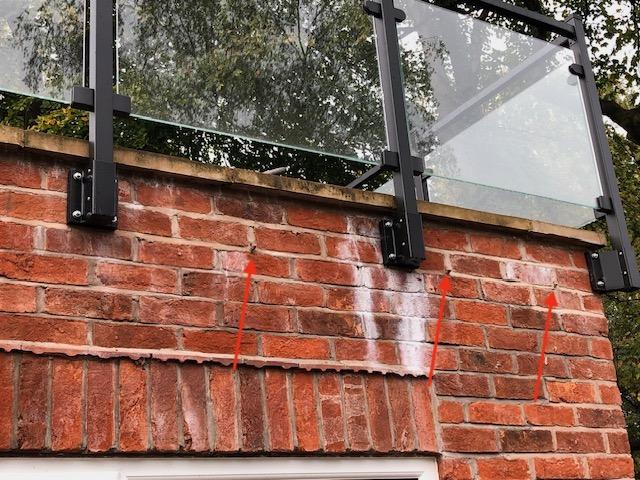
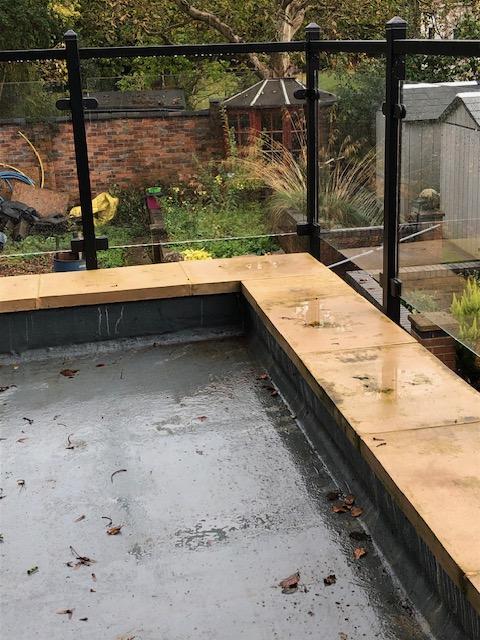
The cavity tray in our case was just a strip of polyethylene DPC which was wide enough to be in the mortar beds 1 course down in the inner leaf and 2 courses down in the outer leaf, so that it sloped to the outside. Weep holes marked with red arrows in the attached photo. Rather annoyingly, the plastic weep holes were shorter than a brick width and I had to keep asking the bricky to clear the perp end mortar away from the inlet to the holes. The GRP across the top of the wall is supported on cement board to stop it from sagging into the cavity. I would have preferred copings with sloping tops ("weathered"), but the parapet wall is varying widths and the builder wasn't keen on mitring the corners. If I had my time over, I'd try and avoid the parapet wall altogether. As well as introducing the need for copings, it made the balustrade more complicated.
-
I got a quote from Fleming last year and the (structure only) terms were 10% on acceptance of the quotation and the balance 14 days before delivery. But: "The Company reserves the right to revise the Price in respect of any factors which affect the Project, including, without limitation i) local authority delays, ii) Purchaser delays in providing instructions or details , iii) increases in the cost of labour or materials, or iv) any action of the United Kingdom or Scottish Government." They quoted for erection as well but didn't specifically mention different payment terms, so I'm not sure how the erection costs would have been handled.
-
@ToughButterCup posted this advice on supplier due diligence, which is very good, but I think there's probably more to be said regarding timber frame kit suppliers ....
-
I had a lot of water coming in from a newly built parapet wall around a flat roof. After a lot of head scratching and reading up (see attached from Handisyde "Everyday Details" Architectural Press mid '70s) we concluded there were 2 things wrong: 1. The roof was GRP covered and although the builder had brought the GRP up the wall and across the top of the parapet under the copings, he hadn't brought it all the way across. 2. He hadn't installed a cavity tray. So the copings had to come off, two courses of brick removed from the outer leaf so that a cavity tray could be installed (with drain holes), and the GRP carried all the way across the top of the wall to act as the DPC. It doesn't leak any more. Handisyde. Parapets.P.99.pdf Handisyde. Parapets.P.100.pdf Handisyde.Parapets.P.101.pdf
-
Help with my calculations, please. How deep should the foundation be ?
LnP replied to ToughButterCup's topic in Foundations
This website gives a different version of the equation, which does check out OK by dimensional analysis, so perhaps your equation is wrong. Caveat again, I know nothing about foundations!
-
Help with my calculations, please. How deep should the foundation be ?
LnP replied to ToughButterCup's topic in Foundations
I don't know anything about foundations, but I was curious ... as I recall, one way to answer this question is to do dimensional analysis on the equation. Working through the dimensions on the RHS should give a dimension of L (depth of the foundation), but it doesn't so I'm wondering if there's something wrong with the equation .. here is the dimensional analysis: p has dimensions force per unit area, and force=mass*acceleration, so p has dimensions M LT-2L-2 w is density which has dimensions ML-3 The expression in the bracket is dimensionless. So the RHS has dimensions (M LT-2L-2)/(ML-3). If you cancel that through, you end up with dimensions for the RHS of L2T-2, but it should have dimensions just L for the depth. So we need to get LT-2 out of the RHS. LT-2 are the dimensions of acceleration, so the dimensions would come out right if p was in kg/m2 rather than N/m2. So I would say that if you put in a number for p in kg/m2, your answer will be in m. Willing to have my maths homework corrected if I got this wrong 🙂 -
@HughF sorry I'm a bit late to this discussion .... This is interesting. A couple of questions: Are you recommending multi head mini split heat pumps just to provide air-conditioning or also for space heating? For cooling, how would this compare with running an ASHP in cooling mode through fan coil units as well as through the UFH? Say UFH on the ground floor and fan coils in a few specific rooms. I believe Daikin ASHPs can deliver water at 7 deg.
-
If it takes them more than 6 months to determine the application, they have to refund your application fee. You have to request it though. We waited till the permission had been granted until we made the request, but we did get our money back.
-
Gas boiler lobby obstructing heatpumps
LnP replied to Beelbeebub's topic in Air Source Heat Pumps (ASHP)
Powering boilers with renewable hydrogen uses six times more renewable energy than the renewable energy used for heat pumps. You can't beat the second law of thermodynamics. To get heat from renewable hydrogen, you have to generate electricity from solar or wind, convert it from AC to DC, electrolyse water to produce the hydrogen, compress and transmit it and then burn it in a boiler. Each of those steps has unavoidable losses. To get heat directly from renewable electricity, you cut out all of those losses apart from transmission, but then multiply it up by the SCOP in your heat pump. It makes no sense at all to burn hydrogen in a boiler and moreover, because of the inefficiencies, hydrogen will unavoidably be much more expensive than electricity running a heat pump. To heat our homes with renewable hydrogen, our off shore wind generating capacity will have to be 40 times larger than it currently is. To heat our homes with renewable electricity and heat pumps, it only needs to be 6.5 times larger. Hydrogen will play a key role in decarbonisation, but we should prioritise its use for applications where there is no alternative. For heating and transportation, the alternative is electricity. But there are no alternatives to industrial uses such as producing ammonia (used e.g. to make fertilisers) and producing methanol (used e.g. to make paints and adhesives). At the moment those processes get their hydrogen from natural gas and release CO2. One thing I can agree with the politicians about, is that the UK has a large energy resource in North Sea off shore wind. This is a great opportunity but we should use it wisely - to heat our homes, power our cars and yes, produce hydrogen, but to bring back some of the well paid chemical industry manufacturing jobs which have been lost over the last 50 years. Government support for hydrogen in domestic heating will just increase the cost of getting to net zero and is a distraction which will cause delays. They need to think more about how to make it financially attractive for people to install heat pumps. Decoupling the price of electricity and gas would be a good start - as long at electricity is three times the price of gas, there's no incentive to incur the extra costs of a heat pump. -
I agree the risk is probably low and what's done is done, so no point in worrying. Nevertheless, for the record, I'd like to point out that while some types of asbestos are less hazardous than others, all are dangerous. Many years ago, the guidance differentiated between the different types, but these days, no differentiation is made regarding how to deal with it in a safe way. Blue (crocidolite) and brown (amosite) asbestos were banned in 1985. By 1999, the manufacture and supply of all types of asbestos had been banned. But there is a lot of it about, and if you're involved in building work, you need to know how to keep yourself safe. The HSE have an excellent web site on the topic - link below. The guidance deals specifically with textured coatings. You shouldn't just set to it with a scraper. I've attached the two relevant guidance notes. Best not to disturb the textured coating and as mentioned above, just skim over it. a28.pdf. a0.pdf Asbestos Essentials
-
Maybe the advice is to find an ecologist you trust. We got our planning consultant to recommend one he'd worked with before and who he trusted. Also, but I'm not 100% sure about this, I think they're looking not only for evidence bats have been there, but also that there might be places which sleepy bats might find attractive to roost in - gaps, nooks and crannies. We have two buildings which needed to be surveyed, a 1960s dormer bungalow and a dilapidated Victorian coach house. The plot backs onto a canal which raises the risk that bats will be around. I was sure we didn't have bats present but wanted to make sure there were no spots which bats might find attractive, so before the survey, I filled gaps and put chicken wire over holes. The ecologist crawled all over the place but gave us a clean bill of health, no need for emergence surveys.